Author: lucifermeanslightbringer
A Burning Brandon
Hey there fellow mythical astronomers and members of the starry host! We are back with another weirwood compendium episode after taking detours into the Great Empire of the Dawn and green zombie land. If you are listening to these podcasts (or reading the matching essays at lucifermeanslightbringer.com) in the order they are released, then you will have heard Weirwood Compendium 1, the Grey King and the Sea Dragon, followed by our collaboration with History of Westeros on the Great Empire of the Dawn and then the Sacred Order of Green Zombies 1, 2, and 3.The reason why it came out like that is two-fold. First off, the Great Empire of the Dawn episode has been in the works for many, many months, and just happened to be finished when it did. I’ve very glad to finally have that out, because now I can freely refer to the idea of ancient people from the east, some of whom were dragonlords (I had been sidestepping it previously, waiting for this episode). .
The second reason I interrupted the Weirwood Compendium after only one episode is that when I finished the Great Empire episode and set to working on Weirwood Compendium 2 , I started side-tracking into Jon’s resurrection and the idea of undead skinchangers. It was turing into too big of an idea to wedge in, so I figured I’d just write a quick stand-along episode about zombies, maybe like 45 minutes or something right? *chuckles to self* …and of course it turned out to be a three part series. Everyone seems to have liked it a lot, so things worked out pretty well in the end.
Some of what we will be doing today is synthesizing some of the ideas the first Weirwood episode and the green zombie series, with an occasional mention of the ancient mariners from the east, and then proceeding forward today’s topics, which will center on young Brandon Stark. I wrote the green zombie series so that anyone could read or listen to it without having been exposed to any of my other writings, so now that we are safely back inside the friendly confines of Mythical Astronomy riddles and esoterica, we’ll have some further conclusions to draw about undead skinchangers are related topics.
And by the way, if you feel like you need to go back and re-listen or re-read the Grey King and the Sea Dragon episode or any other, don’t hesitate and don’t feel bad. I go over this material many, many times to get familiar enough with it to be able to present a coherent finished product, so I don’t really expect anyone to listen through one time and catch everything I’m talking about. This episode also builds on the Mountain vs. the Viper and the Hammer of the Waters episode, so that’s another one to listen to if you want to get everything fresh in your mind.
We are actually going to do a quick summarization of some of the main ideas in the Grey King and the Sea Dragon episode today, having thrown so much new information at you in the Grey King podcast and then interrupted it with yet more new information, so we won’t throw you straight to the wolves or anything.
One thing about going into the weeds on each component of a larger idea, such as we do on the podcast, is that it is easy to lose track of the bigger picture. In Weirwood Compendium 1, we talked about slaying dragons to release floods, weirwood ships as sea dragons, hammers and flaming swords which strike the Iron Islands, burning brands and drowned fire, weirwood thrones and crowns, and fiery sorcerers that emerge from burning wood… and I want to make sure all of those ideas aren’t a big jumble in your head. Since we took the time to work through all the textual evidence behind the various concepts already, we can now go quickly back through them and paint a more clear picture of how these ideas relate to one another. All of that will of course only be setup for new ideas, because, you know… onward and upward. Winter is coming.
King Bran
✧ Greenseer Kings of Ancient Westeros
✧ Return of the Summer King
✧ The God-on-Earth
End of Ice and Fire
✧ Burn Them All
✧ The Sword in the Tree
✧ The Cold God’s Eye
✧ The Battle of Winterfell
Bloodstone Compendium
✧ Astronomy Explains the Legends of I&F
✧ The Bloodstone Emperor Azor Ahai
✧ Waves of Night & Moon Blood
✧ The Mountain vs. the Viper & the Hammer of the Waters
✧ Tyrion Targaryen
✧ Lucifer means Lightbringer
Sacred Order of Green Zombies A
✧ The Last Hero & the King of Corn
✧ King of Winter, Lord of Death
✧ The Long Night’s Watch
Great Empire of the Dawn
✧ History and Lore of House Dayne
✧ Asshai-by-the-Shadow
✧ The Great Empire of the Dawn
✧ Flight of the Bones
Moons of Ice and Fire
✧ Shadow Heart Mother
✧ Dawn of the Others
✧ Visenya Draconis
✧ The Long Night Was His to Rule
✧ R+L=J, A Recipe for Ice Dragons
The Blood of the Other
✧ Prelude to a Chill
✧ A Baelful Bard & a Promised Prince
✧ The Stark that Brings the Dawn
✧ Eldric Shadowchaser
✧ Prose Eddard
✧ Ice Moon Apocalypse
Weirwood Compendium A
✧ The Grey King & the Sea Dragon
✧ A Burning Brandon
✧ Garth of the Gallows
✧ In a Grove of Ash
Weirwood Goddess
✧ Venus of the Woods
✧ It’s an Arya Thing
✧ The Cat Woman Nissa Nissa
Weirwood Compendium B
✧ To Ride the Green Dragon
✧ The Devil and the Deep Green Sea
✧ Daenerys the Sea Dreamer
✧ A Silver Seahorse
Signs and Portals
✧ Veil of Frozen Tears
✧ Sansa Locked in Ice
Sacred Order of Green Zombies B
✧ The Zodiac Children of Garth the Green
✧ The Great Old Ones
✧ The Horned Lords
✧ Cold Gods and Old Bones
We Should Start Back
✧ AGOT Prologue
Click to open in iTunes
Let’s start by recalling one of the central outlandish claim I made in Weirwood Compendium 1: that the Grey King and Azor Ahai might be the same dude in some sense. While it’s perhaps too much of an oversimplification to just say “they were the same person,” there does seem to be a common story and figure behind both myths. As we discussed in our Great Empire of the Dawn podcast, there is good reason to conclude that the dragonlords from Asshai and the Far East came to Westeros before the Long Night, specifically to Oldtown and the Iron Islands. Thus, there is a plausible way for the legend of Azor Ahai and the Grey King to have a common origin. The two legends would have evolved differently according to the different cultures that nurtured them, but beneath it all we seem to have this figure of a sorcerer who challenges the gods and steals their fire by slaying the moon, and I have begun to lay out the evidence indicating that this figure was a greenseer, or perhaps a group of greenseers.
That’s actually several claims:
- Azor Ahai and the Grey King were the same person or were from the same group of people
- Azor Ahai and the Grey were moon-breakers
- Azor Ahai and the Grey King were greenseers
- Azor Ahai and the Grey King possessed and utilized Lightbringer meteors
To that I would add that they were both transformed by their possession of the fire of the gods, and both in all likelihood were undead or resurrected.
We are well familiar with the idea that Azor Ahai had something to do with breaking the moon – that one is right there in the fable after all: Nissa Nissa’s death cry left a crack across the face of the moon when Azor Ahai stabbed her with Lightbringer. Similarly, the meteor-worshipping Bloodstone Emperor, whom I believe is another name for Azor Ahai, is held responsible for bringing on the Long Night through his use of blood magic and his usurpation and murder of the Amethyst Empress. A primary aspect of my original theory is that Azor Ahai possessed the fire of the gods that was the black moon meteorite and made from it the sword known as Lightbringer.
We believe the Grey King to be a moon-breaker because he is remembered as having taunted the Storm God into striking the tree with his divine thunderbolt, which we take for an account of a moon meteor impact, and because he is remembered as having slain the island-drowning sea dragon, which we take for an account of a meteor impact near the ocean or in the ocean that triggers tsunamis. The Grey King is said to have possessed the fire of the gods which the thunderbolt carried down to earth and to have possessed the living fire of the sea dragon, implying his harvesting of the meteorite and its fiery power in some way, whether it be making weapons from it as the tales of the ancient Ironborn possessing soul-drinking black weapons suggest, or something more magical. The Seastone Chair may well be a meteorite.
Most importantly, the Grey King is an active participant in the acquisition process – he tricks the Storm God into striking with his thunderbolt and he slays the sea dragon. This is paralleled in the Azor Ahai and the Bloodstone Emperor myths, both of which depict them as actors who trigger a chain of cataclysmic events through the use of blood magic.
That covers moon-breaking and possessing the fire of the gods in terms of possessing meteorites. But we have also seen that the fire of the gods can refer to a greenseer accessing the weirwoodnet. That claim is based on two things: the red weirwood leaves that are more often called bloody hands are also called “a blaze of flame,” implying the presence of blood and fire in the canopy of the weirwood; and more importantly, because the fire of the gods has always been a metaphor for the knowledge and powers of the gods, and nothing epitomizes the knowledge and power of the gods in ASOIAF like the powers bestowed upon the greenseer by the weirwood.
The fire of the gods can be lightbringer the meteor or access to the weirwoodnet – dragonfire or weirwood fire, if you will – and the two Grey Kings myths express this perfectly. The thunderbolt of the Storm King is a moon meteor symbol, but the burning tree is a weirwood symbol, due to the “blaze of flame” description of the weirwood canopy. Possessing fire through the burning tree makes the Grey King a greenseer. Then we have the horrifically violent, island-drowning sea dragon event, which seems to be talking about a meteor impact in one sense, but the “ribcage” now known as “Nagga’s Bones” on Old Wyk is almost certainly made of petrified weirwood. This implies that the Grey King’s throne and crown were made of weirwood, once again identifying him as some sort of greenseer.
The idea of Azor Ahai as a greenseer was first broached in Weirwood Compendium One, when we saw that in most of the major Lightbringer forging metaphor scenes, fiery sorcerers and dancers would emerge from the pyre of burning wood, usually wood with heavy symbolism attached to it. We developed the idea further in the green zombie series when we saw that the fiery undead Azor Ahai archetype seems to overlap strongly with the King of Winter, who is himself symbolic of a burning green man or wicker man. We saw that many characters like Stannis, Renly, Beric, Bloodraven, Jon, and Robb show us three lines of symbolism simultaneously – undead symbolism, burning man symbolism, and greenseer symbolism. Beric in particular strongly suggests the idea of Azor Ahai the greenseer, due to his combination of Azor Ahai and Bloodraven / greenseer symbolism.
So there you have it: the Grey King and Azor Ahai, fire-stealing moon breakers, and quite possibly the same fire-stealing moon-breaker. We will talk more about the transformation process of possessing the various kinds of divine fire – dragonfire and weirwood fire – as we go.
Before we dive into the main section, I want to briefly add a couple of observations about the Grey King in light of what we have learned during the Sacred Order of Green Zombies series. We saw that some versions of the green man fertility god have antlers or horns, while others have tree branches on their head in place of antlers. In this way, we can see that the weirwood crown of the Grey King and the later driftwood crown of the Ironborn both play into a type of green man symbolism. You can really see it in the TV show when Euron dons the driftwood crown – he looks like a horned Pan. But in keeping with the petrified weirwoods and death symbolism of the Grey King, it would be a dead green man / dead greenseer symbolism, much as we see in the northern mythical figures like the King of Winter, Barrow King, and Night’s King.
If the Grey King is a greenseer with death symbolism, is there a chance he could have been an undead greenseer? If he was Azor Ahai or one of his companions, then he may well have been, right? Well, we are told the Grey King lived for a thousand years and seven, during which time his skin grew to be as grey as his eyes and beard. That sounds more than a little bit corpse-like, and being a functionally immortal skinchanger zombie like Coldhands could potentially explain his supposed thousand year reign.
Grey King does seem to fit very will into the burning man / undead Lord of Death archetype that the Barrow King and King of Winter play into, and there is extensive grim reaper symbolism to be found on the Iron Islands. The Lord of Pyke is styled “the Lord Reaper,” and of course the words of House Greyjoy are “we do not sew,” a kind of opposite to the idea of Garth the Green and fertility gods (shoutout to my Westeros forum friend Crowfood’s Daughter!). On the Island of Harlaw, we find the scythe-based sigils of the Harlaws and their offshoot houses, again suggesting reaping. This is very consistent cycle of the seasons stuff: the men from the green lands plant and celebrate summer and fertility, the men from the Iron Islands do not sew, they reap – and plunder, and kill. According to TWOIAF, the Grey King’s “hair and beard and eyes were as grey as a winter sea,” so there’s even a winter association built in to his description.
We are going to be delving into a lot of Odin and Yggdrasil ideas in the Weirwood Compendium going forward, because Odin and Yggdrasil are a huge influence on Martin’s ideas about greenseers and weirwoods, and on all the one-eyed folks in the story in particular. I’ll go ahead an pop the cork on that one now and mention that one of Odin’s many, many names is Harbard, which means ‘hoary beard’ or ‘grey beard.’ Hoary is kind of an antiquated word, so for anyone who does not know what it means, it means “ancient, grey, white, silvery, or snowy looking.” Thus Grey King’s beard being as grey as a winter sea may well be an Odin reference, which is exactly what we should see if the Grey King is a greenseer. And now we think back to the oft-repeated phrase “green boys and grey-beards” which is frequently applied to the Night’s Watch, and we can see that both of these terms relate to greenseers, with grey beards implying old, undead greenseers as a counterpoint to green men or children of the forest. Odin is also a type of death / resurrection god, and three of his other names are “Father of the Slain,” “The Slain God,” and “Chooser of the Slain.”
There’s also a bit of zombie symbolism floating around on the Iron Islands, (pun intended). House Drumm has an association with necromancy, having a skeletal-hand-on-red sigil and a legendary hero called Dagon Drumm the Necromancer. The Lord of House Drumm is called “The Bone Hand” and “The Lord of Old Wyk,” giving him a direct association with the Grey King, who ruled from Old Wyk in a longhall made of Nagga’s “bones.” The Drumms possess a Valyrian steel sword, Red Rain, and like all nearly-black, dragon-forged Valyrian swords, Red Rain is a symbol of a black moon meteor, with the name “Red Rain” alluding to the meteors as a rain of bleeding stars. The current Lord Drumm, Dunstan, comes to the Kingsmoot on a ship called “the Thunderer,” giving us another Grey King association as well as a possible reference to Odin, because among Odin’s many, many names is “Thunderer.” Essentially, House Drumm shows us a necromancer lord from Old Wyk who wields black swords, bleeding stars, and thunder as a weapon.
There’s also an Ironborn hero named Balon Blackskin, so-called for his hard black skin which weapons supposedly could not penetrate. Could this refer to the hard black hands of a wighted person, or even a fire-tranformed person like supernatural red priest Moqorro, whose “burnt” black skin seems like it might be more than just dark skin pigment? Most of all, we have the words which are sacred to all Ironborn – what is dead may never die, yet rises harder and stronger. Many have noticed that this sounds like a perfect description of the wighting process, which raises very hard and strong walking corpses who will essentially never die until they are burned or have had their bones broken. The famous “drowning” ritual of the Ironborn mimics a death and rebirth process, and that is of course when they say the famous and slightly phallic words about rising harder and stronger. You can see what’s going on here – this is all about death and resurrection. And dicks – it’s a little bit about dicks. Lightbringer stuff always is.
Now the first Drowned Prophet was Galon Whitestaff, so-called for his tall staff of weirwood. Even though today’s Ironborn hate the trees and the Old Gods, it may be that this was not always the case if the Grey King himself was a greenseer. Thus Galon Whitestaff’s weirwood staff might be more than a cool staff carved from weirwood just for the heck of it – it could be a clue that he was a greenseer, perhaps raising drowned men from the dead in the true version of the water magic resurrection, something akin to what happened to Patchface. It’s highly speculative to link Patchface’s resurrection and water resurrections to greenseer magic, but we do have the first “drowned priest” walking around with a weirwood staff, so there maybe a connection of some kind. Returning to the idea of weirwood and driftwood crowns being similar to having antlers, we can see that Patchface the drowned stag man is actually a very good likeness of the Grey King, an undead greenseer who came from the sea and wore a wooden crown.
Then we have the Drowned God to consider – he is by definition a dead god, but one who is still active and powerful. It’s an undead god, in other words, just the sort of thing we are looking for. When a slightly kooky Ironborn king tried to assimilate the Drowned God into the Faith of the Seven, he eventually identified him with the Stranger, seeing the Drowned God as a death god, just as we do. The Drowned God is said by Damphair to have first emerged from the sea with a burning brand, beginning the long association between the Ironborn and the idea of drowned fire and showing us the Drowned God as a resurrected figure in possession of fire. Again this fits the mold we are finding elsewhere in the North, and with the Grey King and Azor Ahai – a resurrected death god figure who possess fire.
To cap off this introduction, let’s return to the logical angle on the hypothesis that Azor Ahai and the Grey King were the same person in some sense.. Although I prefer to spend the most of out time on symbolic analysis, we do of course have to line up any symbolic interpretations with the facts and logistical evidence that we have to consider. First of all, I notice that the Grey King is recorded in Ironborn mythology to sound very much like a Quetzalcoatl type figure who comes from a foreign land and teaches the primitive natives advanced knowledge of science, astronomy, and the like. Many cultures all around have some version of this myth, which is one of the reasons why Atlantis-type theories are so popular (that and the fact that they’re so much fun!) Besides the more famous stealing of fire from the Storm God…
The Grey King also taught men to weave nets and sails and carved the first longships from the hard pale wood of Ygg, a demon tree who fed on human flesh.
Perhaps the Grey King was some sort of Albert Einstein of the Ironborn, inventing every aspect of their sea-craft himself, or perhaps this is simply the exaggeration of myth and fable. This makes more sense, however, if the Grey King was a foreigner from an advanced civilization who simply brought already-developed knowledge and technology to the Iron Islands. In TWOIAF, much discussion is made over the mystery of the Ironborn’s seafaring skill, which is completely unique among all the First Men in Westeros. It is held up as one of the pieces of evidence that the Ironborn do not descend from First Men, along with mysterious, inexplicable origins of the Castle Pyke and the Seastone Chair. I would agree, and the fact that the Grey King is said to have taught the Ironborn how to build boats and fish really jibes well with this idea, and so to does the idea that he founded bloodlines which rule the Iron Islands to this day. He was said to “come from the sea,” but that could just mean coming from the sea as in coming from a distant land in boats.
The ancient Ironborn are remembered by some of the green lands as having black weapons which drank the souls of those they slew, which I have suggested matches well with the idea of Lightbringer swords made from black meteors, and this technology would have had to come from the east. Since the sea dragon is in one sense a reference to a moon meteor landing in the sea, possessing the fire of the sea dragon could be interpreted as making weapons from sea dragon meteorite, and all of this lines up with Azor Ahai or his kin coming to the Iron Islands with their ancient sword making technology and habit of making them from meteoric iron. This could be a satisfying answer to the question of why the Ironborn maintained a huge advantage in iron-smithing over the rest of Westeros until the Andals came. It’s the same answer as the question of their advanced nautical skill: they are in part descended from an advanced civilization which had contact with ancient Westeros.
Finally, in terms of logistical evidence, I will again highlight the fact that the Seastone Chair is made of oily black stone, a material only found for sure on the Isle of Toads, the city of Yeen on Sothoryos, and of course at Asshai, where the entire city is made of oily black stone. Moat Cailin may or may not be made of oily stone, as we have discussed, but the point is – this material seems like a probable link to Asshai. It was supposedly found on the beach of Old Wyk by the first First Men to come to the Islands, and even the Ironborn who claim a non-First Men descent do not know how the Seastone Chair came to the Iron Islands.
Likewise, the Castle Pyke, with its anachronistic round tower design that First Men were supposedly not capable of, was found as-is by the first people remembered as having come to the islands of Pyke. In fact, not only was Pyke supposedly built before anyone we know of came there, it also seems to have partially collapsed before being rediscovered as well. I believe this fits with the evidence at Moat Cailin, a structure which is far beyond the building capabilities of the First Men as we know them and which seems to have suffered a violent trauma thousands of years in the past. This trauma would likely be one of the meteor impacts and / or the earthquakes and floods they would have triggered, events which occurred at the time of the Long Night. That would explain why nobody remembers who built these structures – the Long Night was a huge cultural reset button during which time much knowledge and technology would be lost. Places like Castle Pyke, Moat Cailin, and the Wall that cannot be explained by the First Men’s capabilities and whose origins are basically unknown are best explained by the possibility that they were built before the Long Night with knowledge that was lost during the Long Night. That certainly seems to be the case at Castle Pyke and the Iron Islands, where abundant evidence points towards the idea of ancient mariners from a far away land contributing to the gene pool and culture of the Ironborn.
And now back to some mind-bending symbolism!
Ride the Lightning
This section is dedicated to our two newest avatars of one of the twelve houses of heaven, BlueRaven of the lightning peck, earthly avatar of Heavenly House Gemini, whose words are “the way must be tried”, and Ser Brian the Returned, Knight of the Last House, Wielder of the Valyrian Steel blade Red Song, and earthly avatar of Heavenly House Ophiuchus the Serpent-Bearer.
Just as we are going to be talking more and more about Yggdrasil and Odin in our quest to understand the mysteries of the weirwoods, we are also going to begin talking about Bran in earnest. If a greenseer hooked up to the knowledge and power of the weirwoodnet represents man’s possession of the fire of the gods, then Bran, our only main character who is a bona-fide greenseer, and who already seems to be the most powerful greenseer alive, should surely manifest the symbolism of one who is in possession of that godly fire. Sure enough, that’s exactly what we find. So let’s begin Weirwood Compendium 2 by taking a look at young Brandon Stark.
Thankfully, we are not starting from scratch. We’ve already broached the topic of Bran’s symbolism in our Tyrion Targaryen episode where we took a look at Bran’s dream of falling from the tower amongst animated, fiery gargoyles that appear outlined against the moon. We identified Bran as a moon child, primarily due to the conspicuous fact that he is pushed out of the tower by a golden lion man, Jamie Lannister, who seems like a straightforward symbol of the sun at this point in the story. Bran wanders too close to Jamie’s sun fire, and is cast out of the heavens and broken. But just as those moon meteors which drank the fire of the sun represent the rebirth of Azor Ahai, so too does broken Bran represent Azor Ahai reborn as a reborn moon character, just as Daenerys does.
In other words, Bran is a dynamic character who represents both the moon and what the moon turns into, and this is true of most of our main characters, who all show a transformation process along these lines, from either sun or moon or comet to falling meteor or reborn comet or darkened sun.
It’s widely known that Bran means crow or raven in Welsh, and obviously Bran is lined up to take over for the three-eyed crow, Bloodraven, so that makes a lot of sense. We’ve seen that crows and ravens make excellent black meteor symbols, with the ravens being dark messengers and and the crows of the Night’s Watch being the black-clad swords in the darkness who fight with fire. Therefore Bran’s status as a kind of crow or raven also implies Bran as a moon meteor. Jojen refers to dreaming of Bran as a winged wolf, and of course his coma dream is mostly about trying to fly, which he eventually does on “wings unseen.” If Bran ever skinchanges a dragon – you’ll recall him straddling the gargoyles atop the keep right before falling – then he will have achieved peak meteor symbolism status. The fiery gargoyles made very good moon meteor symbols, having woken from stone with fire in their eyes, and because gargoyle mythology has its origins in dragon lore, and in fact, Bran’s fall from the First Keep is also equated with the gargoyles which later fell from the First Keep and landed in the same place Bran did, broken like Bran was.
One of Bran’s most important symbolic identities comes from a story Old Nan tells him to scare him out of climbing the walls and towers of Winterfell, which Bran recalls to himself as he climbs toward his fateful encounter with Jamie:
Old Nan told him a story about a bad little boy who climbed too high and was struck down by lightning , and how afterward the crows came to peck out his eyes. Bran was not impressed. There were crows’ nests atop the broken tower, where no one ever went but him, and sometimes he filled his pockets with corn before he climbed up there and the crows ate it right out of his hand. None of them had ever shown the slightest bit of interest in pecking out his eyes.
This is an central aspect of Bran’s symbolic identity, because it connects the idea of challenging the heavens and stealing the fire of the gods – a bad little boy who climbs too high – with being struck by lightning. Just as the fire of the gods was possessed for mankind by the Grey King when a thunderbolt set fire to a tree, Bran’s climbing too high and being struck down from the tower is what triggers the opening of his third eye. Later in this episode, we’ll take a look at a couple of complementary Bran scenes which show an association between lightning and Bran using his greenseer abilities, such as the scene at Queenscrown with Hodor and the lightning.

As for the crows pecking out the eyes of the bad little boy after he was struck down by the lightning, we see that the opening of Bran’s third eye is accomplished by the crows pecking his eye – his third eye – at the end of his coma dream, just before he wakes:
“I’m flying!” He cried in delight.
I’ve noticed, said the three-eyed crow. It took to the air, flapping its wings in his face, slowing him, blinding him. He faltered in the air as its pinions beat against his cheeks. Its beak stabbed at him fiercely, and Bran felt a sudden blinding pain in the middle of his forehead, between his eyes.
So, Bran was cast down after climbing too high, and the crows did peck his eyes. In addition to the crow pecking in between Bran’s eyes here, we also notice that the word “blinding” is used twice. However, it turns out that all that eye pecking and being struck by lightning is merely a euphemism for gaining access to the weirwoodnet. Check out this absolutely frightening passage from ACOK, a dream Bran has early on in the book before he has really come to terms with being a warg:
That night Bran prayed to his father’s gods for dreamless sleep. If the gods heard, they mocked his hopes, for the nightmare they sent was worse than any wolf dream. “Fly or die!” cried the three-eyed crow as it pecked at him. He wept and pleaded but the crow had no pity. It put out his left eye and then his right, and when he was blind in the dark it pecked at his brow, driving its terrible sharp beak deep into his skull. He screamed until he was certain his lungs must burst. The pain was an axe splitting his head apart, but when the crow wrenched out its beak all slimy with bits of bone and brain, Bran could see again.
What Bran sees terrifies him – he’s climbing the tower, and reliving the moment Jamie pushed him from the window. He had been blocking out this traumatic memory until this point, and the crow pecking open his third eye allows Bran to fully come to grips with these events so he can move on and continue to develop his greenseer power. The idea of Bran losing sight in his physical eyes and gaining sight in his third eye is another Odin idea, one which we will dive into fully in the next section when we got back to the Nightfort.
Now just as Bran is both the moon and the reborn moon, he is also the lightning bolt which struck the tree – a falling moon meteor – and the tree which was set on fire by the Storm God’s thunderbolt. The falling fire of the gods becomes a part of the burning tree in other words, and Bran the falling moon is reborn as a burning tree, as a greenseer. Here is where Bran’s wicker man / burning man symbolism comes in – surprise surprise, Bran the Prince of Winterfell also plays into the King of Winter burning wicker man symbolism that Jon and Robb and Eddard manifest.
I’d like to pause a moment for a tip of the hat to my good friends and research buddies on the Westeros.org forums Ravenous Reader, Wizz-the-Smith, and Blue Tiger, who contributed greatly to this next bit. Blue Tiger also runs a Polish ASOIAF website and fan forum called OGIEŃ I LÓD, where he has actually posted polish translations of my first two essays. These folks are three of the biggest and most frequent contributors to Mythical Astronomy, so all praises and thanks to them. So, Bran as a wicker man. Let’s pull the quote from AGOT when Jon goes to visit comatose Bran before heading to the Wall and the Night’s Watch, where he is greeted by an unfriendly Lady Catelyn:
She was holding one of his hands. It looked like a claw. This was not the Bran he remembered. The flesh had all gone from him. His skin stretched tight over bones like sticks. Under the blanket, his legs bent in ways that made Jon sick. His eyes were sunken deep into black pits: open, but they saw nothing. The fall had shrunken him somehow. He looked half a leaf, as if the first strong wind would carry him off to his grave.
Bones like sticks, aye? Looks like a leaf, you say? When Bran wakes from his coma dream to Summer’s bright golden eyes, it says that “he reached out to pet him, his hand trembling like a leaf.” He’s also being described like a bird: he has a claw here, and a moment later when Jon holds his hand, Bran has “fingers like the bones of birds.” Elsehwere, Bran “perches” atop Winterfell’s towers, as just another one of the birds which are his only company, and even falls asleep high in a tree on time. Bran is a raven and a crow, so that makes sense, but when you combine the stick bones and leaf hands with the bird symbolism, you get a scarecrow – but a scarecrow who is also a crow, just as the Night’s Watch scarecrows are also crows as all Black Brothers are. The scarecrows ultimately burn in Jon’s Azor Ahai dream, just as the Wicker Man / King of Winter is fated to burn in the spring, and so I give you the mother of all Bran wicker man quotes, courtesy of Blue Tiger:
A series of chisel-cut handholds made a ladder in the granite of the tower’s inner wall. Hodor hummed tunelessly as he went down hand under hand, Bran bouncing against his back in the wicker seat that Maester Luwin had fashioned for him. Luwin had gotten the idea from the baskets the women used to carry firewood on their backs; after that it had been a simple matter of cutting legholes and attaching some new straps to spread Bran’s weight more evenly.
This wicker basket may seem innocuous, but it’s actually loaded with symbolism, even before Bran climbs inside it. It’s made of wicker of course, and since it used to be a basket for carrying firewood, we can see that the idea of burning wicker is implied. More specifically, it implies that Bran is firewood, which makes sense because Bran is the wicker man here. You’ll recall Julius Caesar’s claim that the druids would place sacrificial victims inside person-shaped wicker cage before burning him alive – that seems to be what martin is calling out to here with Bran climbing into a wicker basket of the type used for carrying firewood. Bran as a burning wicker man completes the picture began with the ‘boy who struck down by lightning’ monicker – Bran is a burning tree figure, in possession of the fire of the gods.
The King of Winter Wicker man burns in the spring, which I have correlated to the last hero working to bring the spring through sacrifice and transformation. I linked this to Jon, as a King of Winter / new last hero figure, and I have also noted that Bran is the other person who looks most like a new last hero figure, so… you can see how this all fits together. Bran and Jon both have last hero and King of Winter / burning wicker man symbolism, and both will be sacrificing themselves in some respect and transforming in order to bring the end of the new Long Night which seems about the fall.
Bran’s bird symbolism is also continued by the wicker basket, as wicker was often used to make small bird cages in times past. The thing is, it’s a cage which also allows freedom – and this correlates to Bran’s ultimate wooden cage, the weirwood throne, a cage which also sets Bran free. A similar paradox is going on with Hodor, who at first carries Bran’s wicker cage on his back, and then later becomes Bran’s new cage when Bran begins to skinchange Hodor’s body. Hodor is Bran’s cage, but Hodor is also put in a cage when Bran takes over – he refers to Hodor stirring “down in his pit” when this happens.
There’s a really great quote about Bran and cages in the scene where Jon’s visit’s his sleeping body:
Yet under the frail cage of those shattered ribs, his chest rose and fell with each shallow breath.
This cage of ribs that belongs to a broken moon character has to remind us of Nagga’s ribs, the supposed rib cage of the sea dragon. That’s a really nice way of lining things up – if Bran plays the role of a tree person struck by lightning, he might as well show some sea dragon symbolism. The weirwood ribcage of Nagga’s ribs correlates quite well with the weirwood cage Bran will ultimately end up in, since they both contain greenseers and are both made of weirwood, and this is yet another link between the Grey King and greenseers. Now, inside a person’s ribcage, we find the heart, and thus the greenseer in the weirwood cage may be intended to play the role of the heart of the heart tree.
A couple other good Bran as a wicker man quotes, both from AGOT:
Hodor lifted Bran as easy as if he were a bale of hay, and cradled him against his massive chest.
And a similar quote when Robb carries Bran to his bedchamber:
His brother was strong for his age, and Bran was as light as a bundle of rags, but the stairs were steep and dark, and Robb was breathing hard by the time they reached the top.
So far Bran is made of sticks, hay, rags, and firewood. There’s also a roundabout straw man symbol hung on Bran: at Winterfell, he fights Tommen with wooden swords, where Bran is “Bran was so heavily padded he looked as though he had belted on a featherbed,” and then in ACOK, Tommen rides against a padded quintain stuffed with straw. Beds are generally stuffed with either straw or feathers, and feather mattress Bran and the straw man quintain are both Tommen’s opponents, so it seems that the straw man might be functioning as a parallel to Bran. Here’s the quote:
The master of revels bowed, but Prince Tommen was not so obedient. “I’m supposed to ride against the straw man.”
“Not today.”
…
They set up the quintain at the far end of the lists while the prince’s pony was being saddled. Tommen’s opponent was a child-sized leather warrior stuffed with straw and mounted on a pivot, with a shield in one hand and a padded mace in the other. Someone had fastened a pair of antlers to the knight’s head. Joffrey’s father King Robert had worn antlers on his helm, Sansa remembered . . . but so did his uncle Lord Renly, Robert’s brother, who had turned traitor and crowned himself king.
Tommen’s opponent is a straw man with antlers on his head… That’s pretty easy symbolism to recognize. The straw knight is a leather warrior, which also calls to mind the idea of wearing skins and skinchanging as well as Bloodraven’s leather like skin, and the “child sized” description suggests children of the forest and Bran the child greenseer. The fact that Tommen is also supposed to be thought of as part Baratheon, and is yet fighting an antlered opponent, gives us a horned lord / brother against brother thing going on here, and this is emphasized by the reference to Renly as a stag man who turned traitor.
Alright, so Bran’s wicker man symbolism is well in order, and the implication of Bran as firewood gives us burning wood. There is other fire symbolism around Bran, beginning with the fact that he has that kissed by fire hair that Robb and Sansa and the Tullys have. Not exactly earth-shattering, but worth noting. Let’s take a look at some hard evidence though, and this first one comes from the beginning of AGOT, courtesy of Westeros.org forum user TyrionTLannister:
Robb grinned and looked up from the bundle in his arms. “She can’t hurt you,” he said. “She’s dead, Jory.”
Bran was afire with curiosity by then. He would have spurred the pony faster, but his father made them dismount beside the bridge and approach on foot. Bran jumped off and ran.
By then Jon, Jory, and Theon Greyjoy had all dismounted as well. “What in the seven hells is it?” Greyjoy was saying.
Bran is afire with curiosity to see their new hellhound direwolves, with Theon’s “what in the seven hells is it” line implying the hellish origin of the direwolves’ symbolism. And then there is of course the famous scene in the crypts, also from AGOT, where Shaggy and Rickon are hiding in Ned’s tomb:
The darkness sprang at him, snarling.
Bran saw eyes like green fire, a flash of teeth, fur as black as the pit around them. Maester Luwin yelled and threw up his hands. The torch went flying from his fingers, caromed off the stone face of Brandon Stark, and tumbled to the statue’s feet, the flames licking up his legs.
Not only is this a possible foreshadowing of Bran catching fire in some sense, it also neatly equates the sacrifice of Bran’s legs with his possession of the fire of the gods. It’s a particularly apt metaphor. Also noteworthy is Shaggydog playing the perfect hellhound, guarding the entrance to the grave with eyes of fire.
Turning once again to the name of young Brandon Stark, it would seem that it goes deeper that the fact that Bran means raven is Welsh. For example, Bran is also a food: bran, or miller’s bran, is the hard outer portion of a cereal grain. Because of it’s high oil content, it is subject to rancidification, and is therefore usually separated and heat-treated to keep it from spoiling and rotting. In other words, it’s another implication of Bran being burned – again, in some sense. We haven’t looked at enough Bran scenes to begin to speculate about exactly what this means for him, how exactly it will play out. For know, I am primarily concerned with highlighting his corn king / wicker man King of Winter symbolism, and perhaps at some point we can deduce how symbolic or literal this idea of burning Bran might be.
And speaking of corn kings, miller’s bran is a cereal grain, like corn, which means that Bran is indeed a corn king, a hero made of vegetable material. That’s pretty funny since he loves to feed corn to the crows… actually, what we are being shown here seems to be Bran feeding himself to the crows. That’s kind of what the corn king does, sacrifice his body to feed the people, and that’s the main symbolism of the communion ritual practiced by Christians the world round – bread and wine are eaten to symbolize that Jesus’s body and blood are given to nourish and sustain mankind. We see this kind of relationship with Bloodraven and his weirwood – it’s a symbiotic relationship where the tree is sort of absorbing or eating Bloodraven, even as he wears the tree’s skin. Bran feeding himself to the crows would therefore seem to suggest Bran will be a corn-king style sacrifice.
When Theon and the Ironborn take over Winterfell, Black Loren carries Bran down to the high seat of the Starks in the great hall and it says that “the black-bearded man dumped Bran onto the stone as if he were a sack of oats.” Oat-bran, I guess it would be in this instance. Somebody needs to drown Bran in bowl of milk already and be done with it! Who’s hungry for cereal?
Now the english word bran goes all the way back to Proto-Indo-European, often abbreviated PIE, which seems to be the oldest traceable common language ancestor of most European and west Asian languages. It’s original meaning seems to be rotten, stinky, or rancid. That’s why the bran part of the grain got that name – it’s the part that goes rancid if you don’t roast it a bit. Similarly, bran means raven or crow in welsh because ravens and crows are carrion eaters – they eat spoiled meat.
That’s all really interesting, especially the corn king connections, but the reference to fire is only implied in a round-about way. However, the etymology of Bran is not nearly done giving up the goods. The name Brandon contains the word brand – hence my burning Brandon joke. But if it’s a joke, it’s likely to be an intentional one, because the burning brand is an important symbol of the moon meteor fire of the gods falling to earth, and we know that that’s the role Bran plays when he falls from the tower. The burning brand is a great meteor symbol for Bran because it shows the light-bringing aspect of a torch, and because a burning brand is burning wood, it suggests the burning tree, a symbol of the weirwoods.
In Old French, bran is the alternate form of the word branc, and branc means ‘firebrand, flaming sword, or torch.’ It comes from a Proto-Germanic word brandaz, which has the same meanings – flaming sword, torch, firebrand – and there is an older PIE word behind that. This is where the modern English word brand comes from, and the Norse equivalent is brandr, and again it means flaming sword or torch. So yeah – that burning Brandon thing is no joke after all! It’s easy to see now why George chose the burning brand as one of the symbols for lightbringer – because bran can literally mean “flaming sword,” and it’s a great way to signify Bran as a Lightbringer child, one who has possessed the fire of the gods for mankind… for better or worse.
With this flaming sword symbolism in mind, consider all the broken sword symbolism associated with Lightbringer: the first two unsuccessful attempts to temper Lightbringer, the last hero’s broken sword, Beric’s broken sword, the broken sword sigil of the Second Sons, the broken sword point of land at castle Pyke which thrust like a longsword into the bowels of the sea, and the splitting of Ned’s Ice. Even the magic meteor sword Dawn has breaking in pied in its name, due the habit of describing dawn as “breaking” in the sky when the sun rises. In his darker moments, Bran thinks of himself as “Bran the Broken,’ and in his better moments, defiantly thinks “I’m not broken!” It seems well possible that Bran’s broken man symbolism correlates to this broken sword aspect of Lightbringer, and there’s a clue about this in the prologue:
Royce’s body lay facedown in the snow, one arm outflung. The thick sable cloak had been slashed in a dozen places. Lying dead like that, you saw how young he was. A boy.
He found what was left of the sword a few feet away, the end splintered and twisted like a tree struck by lightning. Will knelt, looked around warily, and snatched it up. The broken sword would be his proof.
Ser Waymar is something of a last hero figure, being a First Man who journeys into the cold dead lands and crosses swords with the Others, and perhaps Waymar’s dozen wounds stand for the last hero’s twelve companions. But the important link to the last hero is the broken sword, snapped by the cold of the Others just as the stories of the last hero suggest. That broken sword is like a tree struck by lightning – another fabulous connection between lightbringer and the burning tree struck by the Storm God’s thunderbolt. And here we can see how Bran’s symbolism lines up – he is the stick boy struck by lightning, but also a broken (yet fiery) sword. The Burning Brandon.
What’s more, the place where Bran goes to feed the crows is called the Broken Tower. Even though he falls from the First Keep, he was in fact on his way to the broken tower when he overheard Jamie and Cersei. And how did the Broken Tower become broken? From AGOT:
His favorite haunt was the broken tower. Once it had been a watchtower, the tallest in Winterfell. A long time ago, a hundred years before even his father was born, a lightning strike had set it afire.
Inside the broken remnants are charred and rotten beams, giving us the suggestion of burnt wood and rotten wood, both of which are appropriate if the broken tower is serving as an analog to Bran, since Bran means rotten and burning wood equates to burning trees. This is the place where Bran goes to feed corn to the crows, symbolic of Bran sacrificing himself to obtain the fire of the gods.
I simply cannot wrap this up without mentioning another mythical tree of Norse mythology, that of barnstokkr or branstokkr., whose tale comes to use from the Volsung Saga. This tree grows in the center of the palace of mighty King Volsung, it’s arms and branches growing through the roof and windows. The story goes that at the wedding of his daughter Signy and King Siggeir, Odin enters the feast disguised as a one-eyed old man, grey with age and wearing a mottled hood and cape, and bearing a special sword called Gram. Odin buries it hilt-deep in the barnstokkr tree and decrees that he who can pull it forth from the tree will receive it as a gift and will never have a better sword than it. Siggeir and all the other guests try and fail, but Sigmund, son of King Volsung and sister to Signy, succeeds and possesses Gram, much to the dismay and jealousy of King Siggeir. Siggeir eventually kills Volsung and imprisons Sigmund and his eight brothers. The brothers are killed, Sigmund escapes, and Signy secretly gives Gram back to Sigmund. They conceive an incest baby together, and Sigmund and his son grow rich as outlaws and actually become werewolves. Eventually Sigmund kills Siggeir with Gram.
Still with me? The important thing here is that Gram is very much a parallel to Lightbringer. Sigmund eventually comes against Odin himself in battle, though Odin is disguised, and Odin breaks Gram in half. The two halves are kept by Sigmund’s wife – not his sister Signy, but a different woman – and she fathers Sigmund’s son Sigurd, eventually giving him the two pieces of the broken sword. One day Sigmund hears of the dragon Fafnir, and needs a sword capable of slaying it, so a Dwarven smith named Regin makes three attempts to forge such a sword. The first two attempts end up with inferior swords which are broken, but on the third attempt, Regin reforges the two halves of Gram and bingo, we have a dragon-slayer sword which Sigurd does eventually use to slay Fafnir. Reforged Gram is “all decked with gold and gleaming bright,” and seems to have a dragon emblazoned on it, depending on how the text is translated.
Recall that brandr is the Norse word for flaming sword and torch or burning brand. Jesse Byck, a professor of Old Norse and Medieval Scandinavian Studies at UCLA who also serves as the director of the Old Norse Studies Program and who has written several books on Norse mythology, is of the opinion that the original name of barnstokkr was branstokkr or brandstokkr, as brandr is also synonymous with “hearth,” and Volsung’s mighty hall was notable for being lined with blazing hearts on either side, much like the kitchen at the Nightfort or Harrnehall’s Hall of the Hundred Hearths. Additionally, Gram the gleaming dragon sword comes from Branstokkr, so it makes sense that the root word of Branstokkr or Brandstokker would be brandr, a word for a flaming sword. Obviously, the myth of a tree named Bran which is tied to a lightbringer-like sword works tremendously well as a part of Bran’s mythological influences. Bran is both a flaming sword and a burning tree, the two forms of the fire of the gods in ASOIAF. This is the same meteor fire / weirwood fire dichotomy we found with the Grey King’s possession of the fire of the gods, and that is not an accident of course.
Professor Byck also suggests that Branstokkr is simply another form of Yggdrasil, being a magical tree growing in the center of a sacred courtyard, among other reasons, further tying this myth to weirwoods, greenseers, and Bran.
We’ just about finished, but I wanted to say one more thing about Bran having some of the King of Winter symbolism so strongly exemplified by Jon. Jon is born during the winter, and given the name Snow, and there’s really not much summer to him at all, it would seem. He’s the quintessential black sword in the darkness. But Bran is different – he was born after the last winter ended, and therefore begins the story being labelled “summer child” over and over, most memorably as Old Nan lectures him about fear being for the Long Night when the Others comes and all the rest. His wolf is named Summer, and has glowing golden eyes. In other words, Bran seems to be the type of corn king figure who transform between summer and winter king, as opposed to being the winter king in a pair of opposites. That’s my initial take, anyway, and I reserve the right to refine this analysis as we go along. The symbolism of Summer the wolf going underground with Bran suggests the season of summer going into hibernation, so we’ll have to explore that line of symbolism another time.
Bran has other lines of symbolism – namely, that of Bran the Blessed and the Fisher King, as well as an apparent symbolic tie to bridges and a few other things – but we will get into those in due time. For now, we’ve rounded out the introduction to Bran’s symbolism, and we can rip into one of the best chapters in the series: Bran’s chapter at the Nightfort. Yes, I know – we just went to the Nightfort in the last episode, talking about the seventy nine sentinels and the army of dead leaves and Coldhands. This is, as much fun as we had there already, we actually haven’t even made it to the best symbolism in the chapter: the weirwood, the well, and the moon.
The Weirwood and the Well
This section is brought to you by the Patreon support of Shiera Luin Elen, the Blue Star of Heaven, resident linguist of the podcast and acolyte of the Church of Starry Wisdom
We spent a fair amount of time at the Nightfort in the Green Zombie series, showing that everything in the entire chapter seems to be about undead skinchangers, leading up to Sam’s account of Coldhands which prompts Bran to ask if he is a green man with antlers on his head. We talked about how Sam coming back through the Black Gate and up the well symbolizes a return from the grave, which is a match for the undead horned figure / Herne the Hunter symbolism of House Tarly. We showed how the dead, rattling leaves which marched around like a dead army reinforced this dead greenseer Night’s Watchmen symbolism throughout the scene. We mentioned that Bran tells the story of the seventy nine sentinels, which are terrific symbols of undead green men Night’s Watch brothers. But the best parts are yet to come. We needed to go over all that stuff about horned lords and undead greenseers first, but having done so, we can now return to this awesome chapter from ASOS and ponder the mystery of the twisted weirwood that wants to attack the sun and moon. It’s one of the best pieces of evidence that the greenseers brought down the moon, which in turn supports the ideas that the Hammer of the Waters was a moon meteor and that Azor Ahai was a greenseer.
We’ll begin with the weirwood tree:
The yards were small forests where spindly trees rubbed their bare branches together and dead leaves scuttled like roaches across patches of old snow. There were trees growing where the stables had been, and a twisted white weirwood pushing up through the gaping hole in the roof of the domed kitchen.
Any time you see the word dome, you should check to see if we might be talking metaphorically about the dome of the sky – Martin actually uses that phrase, “the dome of the sky,” in a line we are going to quote later on. This particular dome in the Nightfort kitchen is likely to represent the sky because we have a weirwood growing in the middle of the room. The weirwoods draw their primary influence from Yggdrasil, the world tree of Norse myth, and as we mentioned a moment ago, Yggdrasil grows up in center of the courtyard of Vahalla in a similar fashion to this weirwood at the Nightfort. The important thing to understand is that mythical world trees such as Yggdrasil serve as something of a model of the framework of the universe, with their trunks depicting the idea of a celestial axis on which our planet and the canopy of stars seems to turn, and this is called the axis mundi. Yggdrasil connects the nine realms of the Norse universe to one another, with upper realms in the branches generally correlating to what we would think of as the heavens and the roots representing the underworld or underworlds.
In other words, the presence of a cosmic axis tree in the middle of the room makes it likely that this dome is indeed meant to be the dome of the sky. And wouldn’t you know it – there’s a gaping hole in the dome, which the “twisted” weirwood is “pushing up through,” almost as if the weirwood itself had torn a hole in the sky. I probably don’t have to tell you that I believe this is a metaphor depicting the greenseers bringing down the moon and causing the Long Night. It’s very like the scene from the Wayward Bride chapter which we looked at in the Grey King and the Sea Dragon, a scene which introduced us to the idea of human-like trees standing in as symbols of greenseers:
Tall soldier pines and gnarled old oaks closed in around them. Deepwood was aptly named. The trees were huge and dark, somehow threatening. Their limbs wove through one another and creaked with every breath of wind, and their higher branches scratched at the face of the moon.
We also got the line, “The trees hid the moon and stars from them, and the forest floor beneath their feet was black and treacherous,” as well as one about “the trees were whispering in some language that she could not understand.” There was also that one about the greenseer turning the trees into warriors, as well as the warriors of the Mountain Clans dressing up like trees, and lots of moon drowning and sea dragon references. You remember all of that, right?
Anyway, the idea of a trees symbolizing a greenseers is pretty easy to grasp, especially when they are doing human-like things of symbolic import, such as scratching at the face of the moon, shutting out the moon and stars, turning into warriors, and the like. In the Nightfort scene, it’s not just any old tree, but a “twisted” weirwood, and it’s pushing up against the cracks in the dome of the sky – and there’s more of this to come. Calling the weirwood twisted seems apt, because the greenseers that brought down the moon and caused the Long Night would be the ones I have nicknamed “naughty greenseers.”
A bit later in this chapter, the party returns to these kitchens again:
The Reeds decided that they would sleep in the kitchens, a stone octagon with a broken dome. It looked to offer better shelter than most of the other buildings, even though a crooked weirwood had burst up through the slate floor beside the huge central well, stretching slantwise toward the hole in the roof, its bone- white branches reaching for the sun. It was a queer kind of tree, skinnier than any other weirwood that Bran had ever seen and faceless as well, but it made him feel as if the old gods were with him here, at least.
Now the weirwood is bursting through the slate floor as well as pushing through the gaping hole in the domed ceiling. Such a violent, disruptive tree! Earlier it was called “twisted,” now it is called “crooked” as well, adding to the naughty greenseer vibe. The “faceless” description could be a reference to the Faceless Men and the God of Death, Him of Many Faces, although the Old Gods are also referred to as “the old ones, the nameless, faceless gods of the greenwood” way back in the beginning of AGOT. There are actually many symbolic parallels between the Faceless Men and skinchangers, so more exploration will have to be done here to suss out the meaning of this connection.
Alright, our twisted and crooked weirwood bursts through the floor and… it reaches for the sun with bone white branches. That’s a line which really gives the image of the skeletal hand of a dark greenseer reaching up to blot out the sun. We mentioned the skeletal-hand-on-red sigil of the House Drum and Dagon Drumm the Necromancer, and when we consider that the weirwoods are often described as bone white, it seems possible that the common symbolism here may be intentional, and that the bone white branches reaching for the sun are meant to suggest an undead greenseer who dabbles and necromancy and wields thunder. That is of course right in line with the themes of this chapter, which pertain to undead greenseers, and right in line with my theory about the Grey King and Azor Ahai legends referring to a greenseer or group of greenseer who brought down the moon and became undead. Whether the correlation to House Drumm is intended or not, the crooked and twisted tree is now reaching for the sun as well as pushing through the gaping hole in the dome, and it is not finished yet, so you can more or less see what is happening here.
The Nightfort weirwood is growing next to the well, and since there is an underground living weirwood face known as the black gate in a side tunnel off of the well, it seems likely that this weirwood is a growth generated from the root network which the weirwood gate is a part of. As we saw with Coldhands the pyschopomp escorting Sam back from the other side, the Black Gate represents a threshold, a place symbolic of the crossing over to the underworld or the afterlife. This means that the crooked Nightfort weirwood is literally growing up from the realm of the dead and bursting through the floor into the realm of the living. It’s a vivid depiction of a greenseer coming back from the dead – to crack a hole in the sky. As we noted previously, the weirwood face that is the black gate is described as looking dead or like a man who lived for a thousand years, descriptions which could also apply to the Grey King, and we will see more associations between this tree and the Grey King later in the chapter.
The coupling of the weirwood and the well is a very clear reference to Yggdrasil, which happens to have a couple of very important wells beneath it. We’ll come back to this idea in a moment , but for now consider that the weirwood, in its capacity as a cosmic world tree, represents the celestial axis – and here, the tree grows slantwise towards the hole in the roof, which is apparently not directly overhead of the weirwood. The implies a tilted cosmic axis, which could be seen in one of two ways. The axis of the earth is indeed slanted, which is a very good thing for life on earth, so a slanted tree-axis might not be anything bad at all. Even the twisted description of the tree could simply refer to the spin of the axis. Alternatively, you could take the crooked and slantwise descriptions and infer a cosmic axis which is in some sense askew, and this would be copacetic with the idea of the Long Night as an upheaval of the heavens and the cycles of nature. Fun to muse on, but not crucial to the action, so let’s keep going.
The wierwood is hardly done grasping at the heavens, and here’s the best line in the chapter. As Bran tries to go to sleep, listening to the army of dead leaves scuttle about and thinking of the seventy nine sentinels, we read that:
Pale moonlight slanted down through the hole in the dome, painting the branches of the weirwood as they strained up toward the roof. It looked as if the tree was trying to catch the moon and drag it down into the well. Old gods, Bran prayed, if you hear me, don’t send a dream tonight. Or if you do, make it a good dream. The gods made no answer.
lt looked as if the tree were trying to catch the moon and drag it down into the well. Well, you don’t say. The weirwood tree is the old gods, as Bran says, and the Old Gods are really the greenseers – and now we can see that the greenseers apparently like to bring down the sun and the moon, to reach up from the underworld and break a hole in the dome of the sky.
The greenseer who broke the moon, the person or group of people behind the legends of Azor Ahai and the Grey King, did so in part to obtain the fire of the gods of course – and here we see that the weirwood is painted in the light of the moon, even as it reaches up for the moon to pull it down. It’s a two way connection, with the moonlight representing the light or moon-fire of the gods coming down the greenseer. It’s like Michelangelo’s “The Creation of Adam” on the ceiling of the Sistine Chapel… but it’s also something like Adam and Eve eating from the forbidden tree of the knowledge of good and evil, with greenseers reaching up to steal the fire of the gods and breaking the heavens to do so. Chew on that for a second!
Most importantly, this is pretty much as obvious a clue as George can give us that the greenseers pulled down the moon. This is how they caused the hammer of the waters, but it wasn’t done to stop the immigration of the First Men. It seems to be about possessing the fire of the gods, of course, and I’ve also said many times that I suspect the primary blame should be placed on human greenseers (or perhaps green men greenseers, if they are a different species of humanoid) rather than the children of the forest.
Bran lays eyes on this scene with the weirwood and the moon and asks the Old Gods not to send him a dream, or failing that, to send him a pleasant dream. The thing is, Bran IS the boy who climbed too high, and he very much plays into this archetype of the naughty greenseer who possesses the fire of the gods, so unfortunately bad dreams are the kind he’s likely to get. Bran’s foreboding at the sight of the twisted, grasping weirwood, and his subsequent desire for the Old Gods not to send him a dream may be a subtle hint that it was naughty greenseers dreaming (i.e. using their greenseer powers) which caused this whole moon disaster. The tree is like a reminder: here’s what can happen with the power of dreaming. This chapter is filled with ominous foreboding, even though nothing bad actually happens here at all – quite the opposite. The chapter opens with Bran thinking to himself “no, it is the Nightfort, and it is the end of the world.” A bit later, Bran thinks to himself that Old Nan had always said that the Wall was the end of the world. That’s the idea – when the greenseers pull down the moon, it’s the end of the world as we know it, and nobody feels fine.
As for the idea of pulling the moon down into the well.. well, two things. This is an expression of the sea dragon idea – the drowning of the moon in the ocean – and it’s also a reference to Mimir’s well that lies beneath Yggdrasil. We’ll start by talking about Mimir’s well and then come back to the sea dragon, since we basically know what the sea dragon is about already. This Yggdrasil stuff is really important, and we are going to be getting into more and more of it as the Weirwood Compendium goes along, so listen up everyone.
I Was Up Above it (Now I’m Going Down In It)
This section is brought to you by the Patreon support of the Venus of Astghik, starry lady of the dragon stones and Priestess of the Church of Starry Wisdom
Mimir’s well is first and foremost a terrific source of knowledge and magical power – the things Odin is always craving – and this leads Odin to sacrifice one of his eyes to gain permission from the giant Mimir to drink from his well of knowledge. The idea is that Odin is sacrificing one of his physical eyes to open his third eye, and this is often a theme of Odin stories – the idea of personal pain and sacrifice to gain magic and knowledge. It’s easy to see how this translates to ASOIAF – greenseers must sacrifice their physical bodies for access to the weirwoodnet and all that it brings. Bran loses his legs and Bloodraven loses an eye, in an obvious parallel to Odin, and you’ll recall that Bran dreamed of specifically having his physical eyes pecked out so that his third eye could see – that’s basically taken right from the pages of Norse mythology. Call it the Odin makeover. Here’s a quote from AGOT where Bran sees Bloodraven in his dream as the three-eyed crow:
Bran looked at the crow on his shoulder, and the crow looked back. It had three eyes, and the third eye was full of a terrible knowledge.
That terrible knowledge is the knowledge of the gods which mankind may not always be prepared to deal with, if you know what I mean. That’s why it’s called the fire of the gods – it’s powerful, but dangerous and costly. It’s playing with fire!
Now the important part of the Mimir’s well story in regards to correlating it to the Nightfort scene is the way Odin gives up his eye as a sacrifice – Odin actually throws his eyeball into the well, just as the weirwood is trying to pull the moon down into the well. The well in the Nightfort already works well as a symbol of Mimir’s well simply because it is under the weirwood, as Mimir’s well is in a sense ‘under’ Yggdrasil. The idea of a ‘source of divine knowledge’ being found inside Mimir’s well is represented at the Nightfort by the living weirwood face inside the well, because the weirwoodnet is the ultimate source of divine knowledge in ASOIAF.
The moon works as a symbol of the eye of Odin, not only because a grasping weirwood wants to pull it into a well, but because Odin sacrificed his eye to gain divine knowledge, just as Azor Ahai seems to have sacrificed the moon to gain access to the fire of the gods. Even better, the moon is many times equated with an eye or described as “peering” or “peeking” in ASOIAF, and although we will go through many of those examples when we get to our God’s Eye episode, right now I will pull a moon-eye quote which involves Bloodraven, since he is basically a fairly straightforward adaptation of Odin. It comes from the Dunk and Egg novella “The Mystery Knight.” There’s an awesome scene where Bloodraven’s eye is equated with the moon… and it too takes place by a well:
Dunk whirled. Through the rain, all he could make out was a hooded shape and a single pale white eye. It was only when the man came forward that his shadowed face beneath the cowl took on the familiar feature of Ser Maynard Plumm, the pale eye no more than the moonstone brooch that pinned his cloak at the shoulder.
Ser Maynard Plumm is of course Bloodraven in disguise, and this bit about his moonstone brooch appearing as a pale white eye is a big clue to readers that Maynard Plumm is in fact Bloodraven. This is an Odin trick, actually – he appears in disguises of all sorts, even animals, but always with one eye. Most importantly, equating the pale eye of a greenseer to a moonstone gives us the crucial reinforcement of the scene at the Nightfort, where the moon seems to be playing the role of the eye of Odin as it falls into the well beneath the sacred tree. The Dunk and Egg scene shows us that a greenseer’s eye is like the moon, and the Nightfort scene shows us the moon going into the well in an imitation of Odin’s eye. The weirwood pulling the moon down into the well is a great clue about greenseers bringing down the moon as it is, and connecting this to the eye of Odin and Mimir’s well reinforces the ideas that greenseers were involved and that the moon was pulled down to gain magical power and knowledge. Finally, Bloodraven’s correlations to the Nightfort scene also suggests the idea of a greenseer pulling down the moon who is also the blood of the dragon, and that is of course the big idea here about Azor Ahai and the Grey King.
Maynard Plummraven’s pale eye is actually a moonstone, and the idea of the moon becoming a stone when it falls into the well is reinforced in both scenes. When Dunk sees this illusion with Bloodraven’s brooch, he is standing in front of a well down which he has just thrown Alyn Cockshaw. Cockshaw meant to throw Dunk down the well – to dunk Dunk, if you will? – but instead Dunk “fed him” a stone, breaking his teeth, and then turned the tables by sending Alyn down the well. Cockshaw’s sigil is a night black field with red, white, and gold feathers, so perhaps you could interpret that as a fiery bird that ate a stone and fell down the well, but the stone is the main thing. If you prefer, you could also interpret falling Lord Cockshaw as a flaming penis (which his what Lightbringer is, more or less).
Dunk himself was almost thrown down the well, and his symbolism is too splendid to even get into right now as an aside, but consider his sigil with the falling star and the elm tree. A tree, and a falling star. And isn’t his horse named Thunder? He’s also thick as a castle wall making him a stone, and the name “Dunk” even suggests that he be thrown in a body of water. Anyway…
Now right before Dunk throws Alyn down the well, he begins to threaten the Fighting Cockshaw by saying “if you’ve thrown Egg down the well…” Naturally, a dragon child named “Egg” works quite well as a moon symbol, since the moon cracked like an egg to birth dragon meteors, as everyone knows. In fact, at the end of this affair, Bloodraven interprets John the Fiddler’s dragon dream of a dragon waking at Whitewalls to have been referring to Egg coming into his own as Aegon Targaryen, so Egg is indeed the egg which gave birth to a dragon at Whitewalls and thus an A1 prime example of the second moon. It’s also yet another example of how a character can play the role of moon and dragon-child-of-the-moon, transforming from one to the other.
The pattern of pulling moon symbols down into wells continues with the real dragon’s egg at Whitewalls, which was smuggled out of Lord Butterwell’s solar by Bloodraven’s dwarves, who snuck it down the privy shaft. A privy shaft is basically a shitty kind of well, so I think you’ll agree it serves the purpose in terms of symbolism. The fact that it is the privy shaft of Lord Butterwell also enhances the well symbolism. It’s the same idea once again: a greenseer stealing a dragon’s egg / moon symbol and pulling it down into the depths of the well.
The egg being in Butterwell’s solar is a nice callout out to the second moon which wandered too close to the fire of the sun before giving birth to dragons, because this egg was literally in the solar. The dwarves who helped Bloodraven probably parallel the children of the forest who may have assisted the naughty human greenseers who pulled down the moon. Given what we seen of sinister dwarves in dream visions in ASOIAF, might the dwarves symbolize some rebel faction of naughty children of the forest? Just thought I would throw that idea out there.
Jumping back to the Nightfort, you will probably remember Hodor dropping the stone into the well in a nod to the scene in the Lord of the Rings where Pipin foolishly drops the stone down the well in the Mines of Moria and awakens the orcs and the balrog. Here is the passage from the Nightfort chapter, after Hodor has been hodoring into the well, and picks up a piece of slate to throw down into it:
“Hodor, don’t!” said Bran, but too late. Hodor tossed the slate over the edge. “You shouldn’t have done that. You don’t know what’s down there. You might have hurt something, or woken something up.”
Hodor looked at him innocently. “Hodor?”
Far, far, far below, they heard the sound as the stone found water. It wasn’t a splash, not truly. It was more a gulp, as if whatever was below had opened a quivering gelid mouth to swallow Hodor’s stone. Faint echoes traveled up the well, and for a moment Bran thought he heard something moving, thrashing about in the water.
Essentially, each one of these little tidbits about the well and the weirwood and the moon are telling a piece of the story. The twisted weirwood comes up from the underworld and pushes through the sky, reaches for the sun, and pulls the moon down into the depths of the well. Now the stone Hodor drops takes over, showing the moon falling into the well like a stone – a moon stone. It’s worth noting that the piece of slate came from the roof – in other words, if fell down from the hole in the dome… and now it’s going into the well. A moment earlier, Bran speculated that the well might not have a bottom, but here we see that there is water down there, not to mention a strong implication of some sort of sea monster, thrashing about in the water and opening its quivering gelid, squisher mouth. Disgusting, but still better than a privy shaft.
Now as I mentioned, the moon drowning in a body of water is easily recognizable to us as a sea dragon symbol – and so it makes a ton of sense to see the implication of a sea monster down in the well after the moon falls into it. Of course, the story doesn’t end there – the sea dragon rises from the depths after all, and Azor Ahai is a hero prophesied to be reborn from the sea. Something has woken up down there.
That was only a story, though. He was just scaring himself. There was no thing that comes in the night, Maester Luwin had said so. If there had ever been such a thing, it was gone from the world now, like giants and dragons. It’s nothing, Bran thought.
But the sounds were louder now.
It’s coming from the well, he realized. That made him even more afraid. Something was coming up from under the ground, coming up out of the dark. Hodor woke it up. He woke it up with that stupid piece of slate, and now it’s coming. It was hard to hear over Hodor’s snores and the thumping of his own heart.
As we saw when we looked at this scene in the Green Zombie series, the scuffling sounds Bran begins to hear a moment earlier are compared to a variety of things: the rattling and rustling of the dead leaves, the seventy nine sentinels, various other ghosts of the Nightfort like Mad Axe or the thing that came in the night. These were all ideas which implied undead greenseers – the thing that came in the night, by the way, leads the dead ‘prentice boys behind him in imitation of something called the “Wild Hunt” which is strongly associated with the horned nature god figure, a subject we will expand upon another time. In any case, now we can see that these rustling sounds are tied to the mysterious sea monster in the depths of the well, awakened by Hodor’s dropped stone…
…and of course the terrible sea monster of the abyss turns out to be Sam. Samwell Tarly, whose face is compared to a moon no less than four times in the series, far outpacing anyone else. Sam IS the man in the moon, the man with the moon face, and that makes him the perfect person to represent whatever the moon turned into after it fell into the well. And although Sam has that undead stag man symbolism of Herne the Hunter which lines up with the other undead skinchanger symbols here, he also has sea monster symbolism, courtesy of Lazy Leo Tyrell, who calls Sam a “black-clad whale” and a “leviathan” in AFFC… and again I will point out that the term ‘leviathan’ can be a general term fro any large sea creature like a whale or it can refer to the specific leviathan of mythology, a multi-headed dragon that lives in the sea. To make Sam’s fishy symbolism clear, Martin hangs a couple of fishy metaphors on him as soon as he comes out of the well. This quote begins with Bran having just skinchanged into Hodor, stood up, and drawn his sword… and then:
From the well came a wail, a piercing creech that went through him like a knife. A huge black shape heaved itself up into the darkness and lurched toward the moonlight, and the fear rose up in Bran so thick that before he could even think of drawing Hodor’s sword the way he’d meant to, he found himself back on the floor again with Hodor roaring “Hodor hodor HODOR,” the way he had in the lake tower whenever the lightning flashed. But the thing that came in the night was screaming too, and thrashing wildly in the folds of Meera’s net. Bran saw her spear dart out of the darkness to snap at it, and the thing staggered and fell, struggling with the net. The wailing was still coming from the well, even louder now. On the floor the black thing flopped and fought, screeching, “No, no, don’t, please, DON’T …”
Meera stood over him, the moonlight shining silver off the prongs of her frog spear. “Who are you?” she demanded.
“I’m SAM,” the black thing sobbed. “Sam, Sam, I’m Sam, let me out, you stabbed me …” He rolled through the puddle of moonlight, flailing and flopping in the tangles of Meera’s net. Hodor was still shouting, “Hodor hodor hodor.”
There’s a lot going on here, but the first thing to notice is the flailing and flopping language as Sam “rolled through the puddle of moonlight.” The puddle of moonlight is itself a moon blood / moon flood symbol, which should come along with the island-drowning sea dragon, here played by Sam the black leviathan. The other big clue about Sam being a sea monster is that he is quite comedically caught in Meera’s net like a fish.
I even wonder if Martin isn’t intending a double meaning with the line “from the well came a wail” – although ‘wail’ spelled to refer to a wailing sound, Sam is a whale coming from the well. “From the well came a whale,” lol. Widow’s Wail becomes Widow’s Whale, a sea dragon sword that brings waves of night and blood. The Ibbenese whalers, hunting whales with Lightbringer since 8,000 BC…. well maybe not. The wailing sound is also a piercing creech that went through Bran like a knife, and it turns out that creech is an Anglo-Saxon word which refers to a sharply pointed hill. We know that moons and mountains have a strong symbolic connection, so a sharply pointed, piercing hill that turns into a knife sounds a lot like a falling moon mountain, the type we see with the symbolism of Gregor Clegane, the Moon Mountain that Rides. And later in the paragraph, Samwell the creech is screeching, another clue to associate the piercing creech with Sam. the wailing whale. That’s a lot of wordplay! It makes sense though, as a piercing moon mountain and an island drowning sea dragon are really the same thing, and we will actually see Sam depicted as a slumbering mountain that wakes when horns blow in another scene later on.
The other thing that probably jumped out to you was the reference to lightning right in the middle of the action. This is an immensely clever way of bringing the thunderbolt symbol into a metaphor where it otherwise wouldn’t exist. He can’t actually make lightning strike every time he wants to make a Storm God’s thunderbolt reference, so in this scene the memory of a previous lightning bolt suffices. The reason to do so is obvious – George is giving us both Grey King symbols at the same time; the thunderbolt and the sea dragon. In other words, the moon is pulled down into the well by a crooked greenseer, then the sea dragon and thunderbolt appear simultaneously. Also at this moment, we see the bad little boy who was struck by lightning open his third eye and skinchange a giant.
To add to Sam’s sea dragon symbolism in this scene, his breathing is referred to as being “as loud as a blacksmith’s bellows” as he comes out of the well, a huge black shape, and then a moment later it says “the fat man was still breathing like a bellows.” As I said many times in the Grey King and the Sea Dragon, the sea dragon fable is partly about moon meteorite material and making swords from moon meteorite ore, and on a symbolic level, the entire thing can be seen as a meteor dragon sword being tempered in the cold sea and coming out frozen fire, black steel, etc. You will recall all the suggestions of the Ironborn bringing fire out of the ocean – that’s what I am referring to here.
Thus, Sam is the moon-turned-black-leviathan rising from the depths of the sea, and he breathes like a bellows to remind us that we are supposed to forge swords from sea dragon material. Of course the black brothers vow to be a “sword in the darkness, the fire that burns against cold, and the light that brings the dawn” – flamings swords in the darkness, in other words. If the black brothers, who dress in black from head to heel, are to be thought of as swords, they must be black swords, just as the white-clad Kingsguard are called “the white swords.” Therefore, it’s all pretty consistent – Sam is a black leviathan and a huge black shape who immediately presents us with the symbolism of a black sword and a bellows after he rises from the depths, accompanied by a reference to lightning (or perhaps we might poetically call it “a memory of lightning,” R.I.P. Robert Jordan).
I also neglected to mention last time that the Tarlys, in addition to their flagrant Herne the Hunter symbolism, also possess a conspicuous Valyrian steel sword, Heartsbane. When you think about Nissa Nissa being stabbed in the heart by Lightbringer, you can see that Heartsbane makes a terrific parallel to Lightbringer. Sam is actually named after an ancestor of his, ‘Savage’ Sam Tarly – boy that’s a good wrestler name, isn’t it? – who fought the Vulture King in the Red Mountains of Dorne when Aenys Targaryen was king. Heartsbane was said to have been red from hilt to point with the blood of Dornishmen, just to drive the point home for us about it being an entirely red sword, turned red with blood just as Lightbringer was. And heck – the idea of it being Dornish blood which colored the sword red could line up with the idea of the Daynes being descended from the Amethyst Empress, who may also be Nissa Nissa.
Thus we can see that Heartsbane compliments the undead stag man symbolism of House Tarly, and now makes them a terrific match for the symbolism of Stannis – undead stag man with a Lightbringer sword. That’s the exact same symbolism shown to us in House Drumm, the necromancer Lords of Old Wyck who wield Red Rain. Sam is mockingly called “the Slayer,” and though he’s no Savage Sam Tarly, he does nevertheless carry this House Tarly symbolism with him into his scenes, particularly when he’s joining the brotherhood of the black swords, breathing like a bellows, representing a piece of fallen moon, rising from the depths like the sea dragon, and being the thirteenth Night’s Watch brother to make it back from the great ranging. And don’t forget, Sam is the only person we’ve seen kill an Other.
Alright, so that’s all pretty sweet, but you might be wondering how many different kinds of symbolism Sam can have. He has a moon face, he’s a sea dragon / leviathan, AND he’s an undead horned green man? Well, yes, and this isn’t such a train-wreck of symbolism as it appears, because the sea dragon is not only the black meteor that landed in the sea and drowned islands, it’s also a reference to weirwood, vis-a-vis the bones of the sea dragon on Old Wyk which are really petrified weirwood. So in actuality, both of Sam’s prominent line of symbolism suggest an undead greenseer. Herne the Hunter IS an undead horned green man figure, and one aspect of the riddle that is the sea dragon involves the Grey King sitting on a weirwood throne and living for a thousand years with grey flesh.
In other words, Sam’s flopping fish, whale, and leviathan symbolism is just that – symbolic references to the sea dragon, which is really talking about greenseers and moon meteors. So no, these are not clues about the last hero being a merling. I don’t want to give the wrong idea.
Now the idea of the moon being down in the well is not only expressed by Samwell of the moon face coming out of it, but also by the weirwood door itself. Here is the quote about the door, known as the Black Gate:
It was white weirwood, and there was a face on it. A glow came from the wood, like milk and moonlight, so faint it scarcely seemed to touch anything beyond the door itself, not even Sam standing right before it. The face was old and pale, wrinkled and shrunken. It looks dead. Its mouth was closed, and its eyes; its cheeks were sunken, its brow withered, its chin sagging. If a man could live for a thousand years and never die but just grow older, his face might come to look like that. The door opened its eyes. They were white too, and blind.
Just like the weirwood door in the Eyrie known as the moon door, and just like the half-weirwood moon-faced door on the House of Black and White, this weirwood door is moon-associated, glowing with milk and moonlight. It is blind, emphasizing the ‘moon as an eye which as been torn out’ symbolism of Odin and Mimir’s well, and the white eye description matches that of Bloodraven’s illusory moonstone brooch pale eye. It’s almost as if the weirwood upstairs is the before and the one down in the well is the after. The one above is a young and faceless weirwood, reaching for the moon – but down in the well, we have the only weirwood with a moving face, and it glows with moonlight, as if it has now pulled down the moon and possessed its light, becoming an animated tree-person. This is exactly our interpretation of the thunderbolt setting fire to a tree Grey King fable – that it produced a tree-man in possession of the fire of the gods, the Grey King – and of course we’ve mentioned that the wrinkled thousand-years aged, dead-looking weirwood face sounds very like the description of the Grey King. I’m not saying that the Grey King literally became the weirwood door, but rather that the door’s symbolism depicts a corpse-like yet animated weirwood person who dragged the moon down into the underworld and possessed its light.
Finally, consider that Bran, a symbol of a falling moon carrying the fire of the gods, will now descend the well himself, just as the weirwood was trying to pull the moon down into the well. And who is pulling Bran down the well and down into Bloodraven’s cave? Bloodraven, of course, who is a dragon-blooded greenseer. Now in the Odin story, the eye plucked out belonged to the sorcerer himself, so in some sense the moon should be the eye of the weirwood tree. We saw the moon associated with Bloodraven’s eye, which qualifies, and the blind white eyes of the weirwood door look exactly like the pale moonstone eye which was really his brooch, and both of these things work to suggest the moon as the eye of the weirwood. But consider Bran. He represents the moon when he falls from the tower or goes down the well shaft, but he also represents the naughty tree sorcerer who pulled it down and was struck by lightning when he climbs too high and later awakens from his coma with his third eye open. Thus, in a roundabout way, the greenseer represented by the weirwood tree at the Nightfort is putting out his own eye when he pulls down the moon, and clearly the overall theme of the greenseers paying a heavy price to possess the fire of the gods is implied throughout these myths.
In fact, it seems that this weirwood might be meant to represent Bran – it really should, since Bran is playing the role of the bad little greenseer boy who climbed too high. You’ll recall that it’s called a young and skinny wierwood, and of course twisted and crooked. Now compare that to the scene with Jon saying farewell to comatose Bran, a stick-thin young boy with legs that bent at angles that made Jon sick. Consider the fact that Bran is so young that he does not fully understand the moral component of skinchanging into Hodor’s body, and seems to be breaking many of the taboos set out for skinchangers, usually motivated by his very understandable desire for mobility and wholeness.
Nevertheless, he is very much set up to be the bad little boy who climbed too high, and he’s still climbing and reaching for the lightning of the gods… and it’s an open question as to how that will turn out for everyone. It could be that Bran will break a taboo, such as attempting to raise the dead, that absolutely has to be broken in order to save the day, and Bran will be left to pay the price for his necessary, but “wrong” action, much in the way that Jon had to break many of his Night’s Watch vows to go undercover with the Wildlings and ultimately work for the good of the Watch, or like when Ned decided to lie and say he tried to usurp Robert in order to save his children’s lives.
So there you have it – in a chapter saturated with undead greenseer ideas, we also get a vivid depiction of the greenseers bringing down the moon and tearing a hole in the heavens to gain some new level of magical power and knowledge, and we also get a direct callout to the two most important Grey King myths. Both the weirwood face down in the well and undead horned lord and sea dragon Sam Tarly coming out of the well depict the Grey King in the role of the drowned and resurrected moon. That is simply one manifestation of Azor Ahai reborn, although more technically, a reborn moon character could also be considered “Nissa Nissa reborn. However you want to slice it, the point is that Azor Ahai is both a reborn sun and a reborn moon character. You’ll recall that tasty line from Damphair about making a godly king when the moon drowns and comes again – that’s our man, Azor Ahai reborn from the sea.
Would You Believe They Put a Sam on the Moon?
This section is brought to you by the Patreon support of Esdue dei Liberi, called Islandsbane and The Silent Blade, acolyte of the Church of Starry Wisdom
Now, as I was saying, you might not think of Sam the Slayer as a powerful undead greenseer figure or an Azor Ahai reborn type of person, but hey! When was the last time you killed an Other with dragonglass? Thats’s a distinctly Azor Ahai / last hero type of thing to do. He also has the power to cast lightning, something like the WIzard Tim from Monty Python’s Holy Grail movie, as we see in AFFC:
Wordless, Sam staggered up onto the deck to retch, but there was nothing in his belly to bring up. Night had come upon them, a strange still night such as they had not seen for many days. The sea was black as glass. At the oars, the rowers rested. One or two were sleeping where they sat. The wind was in the sails, and to the north Sam could even see a scattering of stars, and the red wanderer the free folk called the Thief. That ought to be my star, Sam thought miserably. I helped to make Jon Lord Commander, and I brought him Gilly and the babe. There are no happy endings .
“Slayer.” Dareon appeared beside him, oblivious to Sam’s pain. “A sweet night, for once. Look, the stars are coming out. We might even get a bit of moon. Might be the worst is done.”
“No.” Sam wiped his nose, and pointed south with a fat finger, toward the gathering darkness. “There,” he said. No sooner had he spoken than lightning flashed, sudden and silent and blinding bright. The distant clouds glowed for half a heartbeat, mountains heaped on mountains, purple and red and yellow, taller than the world. “The worst isn’t done. The worst is just beginning, and there are no happy endings.”
Alright, so first Sam identifies with the red wanderer (meaning Mars), known as the Thief, just as Jon has – and this further identifies Sam the Slayer as an Azor Ahai reborn figure, which is what the sea dragon greenseer figure represents. The idea of this red star being a thief and a wanderer works especially well for the idea of the Grey King as an Azor Ahai figure, since the Ironborn take pride in stealing, and because the Grey King would have been a wanderer from very far off places – namely, Asshai.
Then comes Daeron the singer with some vivid mythical astronomy: the stars are ‘coming out,’ as in coming out of the sky, and who knows! Maybe we’ll get a bit of moon – as in a falling bit of moon, a star coming out of the sky after the moon is impregnated by the comet, also a type of red wanderer. That’s precisely when Sam does his wizard impression and seems to reach out with his stormy finger and strike the cloud mountains with lightning. Of course, I believe the lightning bolt is a symbol for falling stars and falling bits of moon, which is why we get a lightning bolt right after the lines about the stars coming out and getting a bit of moon.
As we were just discussing at the end of the last section, Azor Ahai is a reborn moon character as well as a reborn sun character, and Sam is of course one of these reborn moon figures. When he comes out of the well a the Nightfort, he was like a drowned moon reborn as a sea dragon rising from the depths, and here in this scene on the ship, Sam is like the Grey King, possessing the fire of the Storm God and using it himself to throw thunderbolts, a power which he gains after the stars come out and a bit of moon falls to the earth. This equates Sam with the burning tree, just as the Grey King is equated with the burning tree once he possess the fire of the Storm God. Sam’s Herne the Hunter symbolism makes him an undead horned lord symbol, and this is reinforced in this scene on the ship by the line “Sam staggered up onto the deck,” a stag-man play on words we’ve seen elsewhere. This scene on the ship would therefore seem to be be showing us an undead horned greenseer figure casting the lightning bolts. That’s exactly who we think the Grey King was, an undead greenseer / horned lord. We are also going to follow up on this idea when we get into the Storm Kings of Durrandon, horned lords with clear associations to Thor’s lightning hammer, Mjolnir.
In a scene in ASOS, the prologue from Chett’s point of view, Chett stops to watch Sam’s woeful attempts at archery, and Sam is playing the role of a fiery red moon which is shooting arrows at tree. Sam is labelled as the moon when Chett sees him:
He watched from the trees as the fat boy wrestled with a longbow as tall as he was, his red moon face screwed up with concentration. Three arrows stood in the ground before him. Tarly nocked and drew, held the draw a long moment as he tried to aim, and let fly. The shaft vanished into the greenery. Chett laughed loudly, a snort of sweet disgust.
Sam is a red moon, so imagine his arrows as the meteors being shot at the planet. He’s trying to hit a tree, so that would be the Storm God’s thunderbolt which set fire to the tree. Although the arrows here are not lit on fire, the Night’s Watch does of course use fire arrows against the wights. After Sam misses with his second moon arrow, Edd offers up some of his trademark sarcasm:
“I believe you knocked a leaf off that tree,” said Dolorous Edd. “Fall is falling fast enough, there’s no need to help it.” He sighed. “And we all know what follows fall. Gods, but I am cold. Shoot the last arrow, Samwell, I believe my tongue is freezing to the roof of my mouth.”
Knocking things out of the canopy of a tree is a good symbol for knocking a meteor out of the celestial tree, and of course weirwood leaves can be symbolic of the blood and fire hand of god which flings the moon meteors, or which is the explosion of the moon meteors, however you want to say it. After the leaf falls, Ed gives his line about helping fall fall faster, and thus bringing the arrival of winter, and that is exactly what the moon meteors did, bring the winter. Inother words, Sam is playing the role of a horned fertility god, helping to turn the seasons with moon meteor arrows. If only he could hit that tree!
Ser Piggy lowered the bow, and Chett thought he was going to start bawling. “It’s too hard.”
“Notch, draw, and loose,” said Grenn. “Go on.”
Dutifully, the fat boy plucked his final arrow from the earth, notched it to his longbow, drew, and released. He did it quickly, without squinting along the shaft painstakingly as he had the first two times. The arrow struck the charcoal outline low in the chest and hung quivering. “I hit him.” Ser Piggy sounded shocked. “Grenn, did you see? Edd, look, I hit him!”
“Put it between his ribs, I’d say,” said Grenn.
Sam hit the charcoal outline of a person, hanging on a tree – this implies the tree as a person, and the charcoal implies a tree person that is ready to get on fire.
“Did I kill him?” the fat boy wanted to know.
Tollett shrugged. “Might have punctured a lung, if he had a lung. Most trees don’t, as a rule.” He took the bow from Sam’s hand. “I’ve seen worse shots, though. Aye, and made a few.”
Ser Piggy was beaming. To look at him you’d think he’d actually done something. But when he saw Chett and the dogs, his smile curled up and died squeaking. “You hit a tree,” Chett said. “Let’s see how you shoot when it’s Mance Rayder’s lads. They won’t stand there with their arms out and their leaves rustling, oh no. They’ll come right at you, screaming in your face, and I bet you’ll piss those breeches. One o’ them will plant his axe right between those little pig eyes. The last thing you’ll hear will be the thunk it makes when it bites into your skull.”
As you can see, there is a lot language here which turns trees into people, from the idea of trees with lungs to Chett’s sarcastic description of soldiers standing still like trees with their arms out and leaves rustling. Instead he says the soldiers will plant an axe in his skull and describes the thunk of the axe biting into his skull – but if we imagine a tree-soldier planting a weapon in a moon face, we can think of a greenseer like Bloodraven, whose face is pierced by weirwood roots. And if we think about a tree-person’s weapon biting a moon face, that sounds like Azor Ahai the greenseer (a tree person) biting the moon with a comet dragon. ‘Right between the eyes’ is also where Bran felt the crow pecking his third eye open, so planting an axe right between the eyes of a moon face gives a pretty clear implication of moon death leading to the awakening of a greenseer, as we have seen elsewhere.
It’s also important to remember that comets are sometimes called “star seed,” and that’s what’s being implied here – the comet is like a seed, planted in the moon, just as Chett speaks of an axe being planted in his red moon face. What grows from the destroyed moon is our fiery greenseer, Azor Ahai reborn, who is synonymous with a burning tree, the weirwoodnet inhabited by a greenseer. We’ll follow up on this idea in the future, have no fear.
Sam’s moon symbolism continues – after his shot, he is “beaming,” like a moon shooting moon beams. A smile on a moon face like Sam’s represents a crescent moon (think of the smiling “cheshire cat” moon), and here we see Sam’s smile curling up and dying, so more lunar death symbolism. A bit later in the chapter, right before the horn sounds to warn of the wight attack which falls on the brothers here at the Fist, Chett comes upon a sleeping Sam, planning to kill him, and Sam is described as a moon mountain, and there is more death symbolism:
Tarly was buried beneath a mound of black wool blankets and shaggy furs. The snow was drifting in to cover him. He looked like some kind of soft round mountain.
There is an allusion here to the Barrow Kings – Sam is buried under a mound. That makes perfect sense, since Sam has the undead horned god symbolism – it corroborates our identification of the Barrow King as being of the line of Garth (or Garth himself), but transformed into a deathly version of the fertility god, the opposite of the summer king / Oak King that Garth represents. What George is doing here is showing us that the horned lord that awakens from the moon mountain is a death god figure, a Barrow King type.
As for Sam the moon mountain, this symbolism is similar to Gregor’s symbolism of a moon mountain which turns into stone fists, a moon mountain that rides (flies, falls to earth). Gregor the Mountain is symbolically linked to the huge mountain the dominates the Eyrie, called the Giant’s Lance, which is covered in snow like Sam the moon mountain is here. Now it’s really quite interesting what awakens the slumbering moon mountain… Chett is sneaking up to kill Sam, edging quietly past the ravens, and here is the description:
He edged past them placing each foot carefully. He would clap his left hand down over the fat boy’s mouth to muffle his cries, and then…
Uuuuuuuhooooooooo.
He stopped midstep, swallowing his curse as the sound of the horn shuddered through camp, faint and far, yet unmistakable.
So the shuddering sound of the horn comes right as the moon is to be killed, and right as the moon mountain is about to wake. This is the horn that wakes the sleepers, waking the barrow king king / dead horned man that slumbers in the moon mountain, and it is also the shuddering cry of anguish and ecstasy which cracks open the moon to birth dragons, also known as “the sound that cracked the moon.” As Sam the moon man awakens from the horn blast, he sees Chett and says:
“Was it two?” he asked. “I dreamed I heard two blasts…“
“No dream,” said Chett. “Two blasts to call the Watch to arms. Two blasts for foes approaching. There’s an axe out there with Piggy writ on it, fat boy. Two blasts means wildlings.” The fear on that big moon face made him want to laugh.
The second appearance of the moon face description in one chapter really emphasizes that we are supposed to think of him as a moon character here. Not only was the “man in the moon” slumbering, he was dreaming of horn blasts – and here we are perhaps being given a link to green-dreaming and horn-blowing. And of course, there’s never just two of anything, so just like there is three arrows fired earlier from Sam the red moon, we get the fateful third blast a moment later which announces the presence of the Others, whereupon Chett wets himself, ha ha. The more important thing that happens is that the Night’s Watch proceeds to fight the Others and their undead cold servants with fire – fire arrows to be specific, showing us some kind of War for the Dawn type of battle and reinforcing the idea of Sam’s moon arrows being associated with fire.
Just to make sure I am being clear, when I talk about a dead horned lord figure slumbering inside the moon mountain and being awakening when it explodes, what I am really talking about is the potential to make an undead greenseer, a burning tree. It’s just like saying dragons are sleeping in the moon and are awoken when it cracks open – the dragons aren’t really created until the comet brings the sun’s fire into the mix and the moon explodes to create meteor dragons. The undead horned lord figure is not created until the meteor strikes the tree and sets it on fire, so Sam carries both the symbolism of a moon and the resurrected horned god and sea dragon figures that arise when the moon meteors land. It’s very similar to Bran, who symbolizes both the falling moon thunderbolt and the boy / tree struck by lightning, or Dany who is a moon maiden and also the dragon it becomes.
Ok, just one more Sam scene, we’ll make it quick. It’s from a Jon chapter of ACOK which also takes place in the Fist of the First Men, but before the attack and before Jon splits off with Quorin Halfhand. The chapter opens with a horn blast:
The call came drifting through the black of the night. Jon pushed himself onto an elbow, his hand reaching for Longclaw by force of habit as the camp began to stir. The horn that wakes the sleepers, Jon thought.
This horn actually announces the arrival of the Halfhand and his Shadow Tower men, and a page or two later, Jon goes to bring Lord Commander Mormont’s orders to the other brothers:
He found Dolorous Edd at the fire, complaining about how difficult it was for him to sleep when people insisted in blowing horns in the woods. Jon gave him something new to complain about. Together they woke Hake, who received the Lord Commander’s orders with a stream of curses, but got up all the same and soon had a dozen brothers cutting roots for a soup.
Sam came puffing up as Jon crossed the camp. Under the black hood his face was as pale and round as the moon. “I heard the horn. Has your uncle come back?”
“It’s only the men from the Shadow Tower.”
A dozen and one brothers cutting roots for a soup has to remind us the idea of making wierwood paste, which comes in a weirwood bowl with twelve faces on it. That’s another important last hero math symbol I didn’t mention last time – the weirwood bowl Bran drinks from does indeed have twelve weirwood faces on it, and this is highly suggestive of the twelve companions of the last hero being greenseers and tree people. Thus twelve plus one Night’s Watch brothers making food from plant material after the horn that wakes the sleepers blows strikes me as a correlation to the weirwood bowl and weirwood paste. The line here from Dolorous Edd complaining about people blowing horns in the woods again suggests a link between greenseers and the magical horns in the story, an idea we’ve seen a few times now.
This horn that Jon associated with waking the sleepers instead brought Shadow Tower men, and that’s really tremendous symbolism. Black brothers are already black meteor symbols, and the shadow tower symbolism suggests a place where man can go up to the heavens and obtain powers of darkness. It’s a symbol of the destroyed second moon, from whence the black shadow meteors come. As for Qhorin Halfhand himself, he is “tall and straight as a spear,” his braid is touched with hoarfrost, and his blacks have faded to greys. Best of all, when he took the blow to his hand that gave him his nickname, “he stuck his maimed gist into the face of the axeman so the blood spurted into his eyes, and slew him while he was blind.” That’s a great bloody hand symbol, coupled with a figure who is blinded and slain.
And of course, we find Sam with a moon face once more, and he’s puffing again like the bellows he symbolized in the Nightfort. He’s come puffing along because he heard the horn that wakes the sleepers, naturally.
There are more good symbolism scenes with Sam, but I don’t want to let Ser Piggy hog the entire episode, and we have other topics to cover. I bet you didn’t think he would have such exciting symbolism, but there you have it. Sam is a total badass!
The Warg Prince and the Dark Tower
This section is brought to you by the Patreon support of Black-Eyed Lily, the dark phoenix, acolyte of the Church of Starry Wisdom
Right before Bran and company arrive at the Nightfort, they wait out a storm in the tower house at Queenscrown, which is on an island in the middle of a lake. The scene is especially memorable because it overlaps with the following Jon chapter, with Bran and Jon’s POV’s combining to give us the story inside and outside of the tower. This scene seems to be written in parallel to the Nightfort scene, and we’ve referred to it once already with the quote about Bran remembering the lightning which struck the tower at Queenscrown during the middle of the action at the Nightfort. Like the Nightfort scene, the events at Queenscrown also draws parallels to Bran’s fateful fall from the tower in AGOT…. so let’s take a look! The parallels begin with the ruined inn:
No one had lived in the village for long years, Bran could see. All the houses were falling down. Even the inn. It had never been much of an inn, to look at it, but now all that remained was a stone chimney and two cracked walls, set amongst a dozen apple trees. One was growing up through the common room, where a layer of wet brown leaves and rotting apples carpeted the floor.
Alright, so we have a common room with no roof to compare to the kitchens at the Nightfort which have a gaping hole in the roof, and the obvious similarity is that they both have trees growing through the floor – the apple tree here and the weirwood at the Nightfort. The apple tree as a symbol evokes the tree of the knowledge of good and evil in the Garden of Eden, which is usually depicted as an apple tree. Needless to say, this Biblical tree is very much in the tradition of the cosmic world tree that Yggdrasil comes from, and the apple itself expands mankind’s consciousness and makes them “like gods,” very like the weirwood paste or the water of Mimir’s well. In other words, while an apple tree isn’t a weirwood, it’s still pretty apt in terms of symbolism and very much ties into the idea of man stealing the fire of the gods to become god like himself.
The profusion of wormy apples on the ground hint at a poisoned or corrupted gift, and there’s also a celestial metaphor going on with the apples. Anything in the upper canopy of a world tree represents the heavens and heavenly bodies – we’ve seen that with the ravens and bloody / burning hand weirwood leaves, both excellent meteors symbols which appear in the canopy of the weirwoods. That’s why the Adam and Eve myth slides so nicely into George’s Azor Ahai the moon-stealer mythos, because the apple simply becomes the moon, and plucking it from the celestial canopy to gain the the knowledge and consciousness of the gods is akin to plucking the moon from the sky to gain access to the fire and power of Lightbringer. This act of original sin in the Garden of Eden triggered mankind’s fall, just as the moon-stealing did, and the angel who guards the entrance to Eden ever after even carries a flaming sword, so really, the myth is a great match for what Martin has going on.
You can also see the similarities to the Odin myth, and this is basically what Martin does – if he wants to create a story about a cosmic tree and stealing the fire of the gods, he will pull from many relevant mythologies form the real world and mix them in however it makes the most sense to him for his story. That’s how we get this expertly-woven synthesis of the Garden of Eden and Yggdrasil ideas underlying the mythology of Azor Ahai, the greenseers, and Hammer of the Waters.
So getting back to the wormy apples, if the apple is a moon, a worm in the apple could symbolize a dragon inside a moon, waiting to break out. There is some good apple symbolism along these lines in the prologue of AFFC where Alleras the Sphinx is shooting apples at Oldtown which we don’t have time to get into, and the really great clue about wormy apples comes in this line from Princess Arianne Martell in AFFC as she ponders the mystery of who betrayed her plot to crown Myrcella:
But it made no sense for Dayne to be the traitor. If Ser Gerold had been the worm in the apple, why would he have turned his sword upon Myrcella?
We’ve looked at Darkstar’s symbolism before: he’s a black hole, the result of the sun and moon coming together to cast the world in darkness, the black meteor stars which are ironically named Lightbringer. These dark stars bleed waves of night and black moon blood, and they are analogous to the black shadowbaby assassins and Drogon the Winged Shadow. They are the worms that came from the moon apple, and Darkstar Dayne himself is thoroughly rotten, just the apples that cover the ground of the inn at Queenscrown.
There’s no well in the common room, but Martin sneaks a well reference in in Jon’s chapter, as he stares into the eyes of the old man whom the Magnar has commanded Jon to kill:
The man kept staring at him, with eyes as big and black as wells. I will fall into those eyes and drown.
We saw the moon go down the well at the Nightfort, which I interpreted as a version of Odin’s eye going into Mimir’s well, and here we again have the suggestion of eyes down in the well as the Old Man’s eyes themselves look like wells. I just love how Martin does this. If he had put a real well in the common room by the apple tree, it would be too obviously similar to the Nightfort, so instead the man’s eyes are wells which Jon could fall into and drown. It’s similar to when memory of the lightning at Queenscrown sufficed to insert the lighting symbol into the scene at the Nightfort. Now Jon Snow, as an Azor Ahai reborn / Lightbringer character with black sword and black ice symbolism, is a fine representation of a moon meteor. Thus his falling into the black wells is very similar to the idea of Bran going down the well at the Nightfort. Finally, Jon imagines he will drown in the wells of the old man’s eyes, giving us a drowning moon meteor / sea dragon meteor symbol. Elsewhere in the chapter, Jon notes that he is a very good swimmer, for what it’s worth.
The other main feature of Queenscrown is of course the tower on the island in the lake. Lakes with islands in the middle of them make us think of The God’s Eye lake and the Isle of Faces, especially since there is greenseer activity on the island once Bran gets there. There is actually a mention of the green men on the Isle of Faces in the Jon chapter as Grigg the Goat – a wildling with clear horned symbolism – tells Jon he hopes to one day visit the green men on their sacred isle. It’s also interesting to note that people north of the Wall have heard of the green men and the Isle of Faces, and even aspire to go there.
Just as Jon thinks of drowning, Bran thinks of drowning in the lake as they cross the hidden causeway, and look out for the sly reference to drowning in a well:
The hidden stones were slimy and slippery too; twice Hodor almost lost his footing and shouted “ HODOR! ” in alarm before regaining his balance. The second time scared Bran badly. If Hodor fell into the lake with him in his basket, he could well drown, especially if the huge stableboy panicked and forgot that Bran was there, the way he did sometimes. Maybe we should have stayed at the inn, under the apple tree, he thought, but by then it was too late.
He could well drown – did you catch that? Well drown? Martin is a sneaky bastard, I hope you all appreciate that by now. Now anytime I see things happen “under the tree” or “under the trees,” I take a look to see if we are talking about greenseers, who live under trees. In this case, since we are talking about Bran staying under a tree, I think this is likely an intended allusion to Bran living under the weirwood trees in Bloodraven’s cave. It also works to associate the apple tree with weirwoods as trees people can live under.
As for Bran falling into the lake, it’s notable that lightning also strikes the lake, and this is from the Jon chapter as he is telling Ygritte about the hidden causeway:
She pulled back and gave him a look. “Walk on water? What southron sorcery is that?” “No sorc—” he began, as a huge bolt of lightning stabbed down from the sky and touched the surface of the lake. For half a heartbeat the world was noonday bright. The clap of thunder was so loud that Ygritte gasped and covered her ears.
This is a sly job of implying that the lightning bolts come from sorcery, very like when Sam the Magic Man casts thunderbolts with his finger, or, if you’ll hearken all the way back the Mountain the Viper episode, you’ll recall Gendry clasping his hammer in hand – end sentence – and then ‘lightning flashed’ to begin the next sentence, a direct allusion to Thor’s hammer which throws bolts of lightning. In any case, lightning hitting the lake is symbolically the same thing as falling Bran hitting the lake and drowning, because falling Bran is like a lightning bolt.
Let’s move to the tower proper. Inside, it bears a resemblance to the well shaft:
Steps built into the inner wall of the tower curved away upward to their left, downward to their right, behind iron grates.
Spiral stairs in both directions, just like the well shaft… very cool. At the top, there’s also a privy shaft the drops straight to the lake to suggest the well, just as the privy shaft at Whitewalls did. Nothing goes down the shaft here at Queenscrown that we hear of, but it is there.
On the outside, the Queenscrown tower is a fairly ordinary watchtower with gold-painted crenelations… at least during the day. It gets more grim-sounding descriptions at night however, such as when the text refers to Bran and company huddling in the “dark tower” during the storms (think of the Shadow Tower symbolism), or like this passage from the Jon chapter:
“Some o’ the Thenns are saying they heard noises out there. Shouting, they say.”
“Thunder.”
“They say shouting. Might be it’s ghosts.” The holdfast did have a grim haunted look, standing there black against the storm on its rocky island with the rain lashing at the lake all around it.
They’re talking about Hodor’s shouting, so what they’ve just done is equate Hodor’s yelling with thunder and Hodor with a ghost. There’s another clue about the towers in this general area earlier in the Jon chapter as he refers to there being “a few scattered roundtowers poking the sky like stone fingers,” giving us very similar language to the trees reaching for the sun and scratching at the moon, as well as the tower at Hammerhorn Keep on the island of Great Wyk which claws at the moon.
The point of all of this tower stuff is that the tower, like the pinnacle of a mountain or pyramid, represents the place where man can commune with the gods. In the case of ASOIAF, it’s the place where our naughty greenseers reached up into the heavens. We are basically spoon-fed this idea in AGOT:
And the tall, slender Children’s Tower, where legend said the children of the forest had once called upon their nameless gods to send the hammer of the waters, had lost half its crown. It looked as if some great beast had taken a bite out of the crenelations along the tower top, and spit the rubble across the bog.
Now that we suspect the hammer of the waters event as being a moon meteor, this story starts to sound like it’s talking about greenseers sitting in a dark tower using sorcery to break the moon and steal the fire of the gods. When Theon return to Moat Cailin in ADWD, we get another clue along these lines:
The Children’s Tower thrust into the sky as straight as a spear, but its shattered top was open to the rain.
These two quotes depict the two-way street that is communication with the heavens. The tower thrusts into the sky like a spear, but then a beast came down and savaged it. It’s written to sound like a dragon attacking the top of the tower, which is simply giving us the dragon version of the Lightbringer meteors instead of the lightning bolt version.
In fact, the broken Children’s Tower compares very well the ‘broken tower’ of Winterfell which was struck by lightning. The lightning bolt which broke the broken tower is the same thing as the hammer that fell on the Neck and broke Moat Cailin – a moon meteor – and Bran’s climbing too high and being cast down from the tower is analogous to the greenseers climbing the Children’s tower at Moat Cailin and breaking the moon, thereby calling down the hammer of the waters.
The link between lightning and greenseeing is suggested yet again back at the Queenscrown scene when lightning strikes the tower itself while Bran is inside it, skinchanging into Summer to attack the wildlings and help his brother Jon:
The Magnar said something in the Old Tongue. He might have been telling the Thenns to kill Jon where he stood, but he would never know the truth of that. Lightning crashed down from the sky, a searing blue-white bolt that touched the top of the tower in the lake. They could smell the fury of it, and when the thunder came it seemed to shake the night.
George sure does have some awesome ways to describe lightning! This is kind of the point of the correlations between this chapter and the Nightfort scene and Bran’s fall from the tower: the thunderbolt of the storm god. Bran climbed the tower as the bad little boy who got struck by lightning, and here he is atop the tower when lightning strikes – using his greenseer abilities. He’s doing the same the when the thunderbolt and sea dragon symbols show up at the Nightfort, skinchanging into Hodor. His original fall from the tower spurred on the opening of his third eye. All of this is telling us that the thunderbolt striking the tree myth does indeed have to with creating or empowering greenseers.
The tower itself is sort of obliquely compared with a tall tree earlier in the Bran chapter when they reach the top and take in the view:
Meera spun in a circle. “I feel almost a giant, standing high above the world.”
“There are trees in the Neck that stand twice as tall as this,” her brother reminded her.
“Aye, but they have other trees around them just as high,” said Meera.
So, climbing the tower is kind of like climbing a tree, or kind of like being a giant. Bran is repeatedly becoming a giant at the moment of truth in these scenes, so perhaps there is a link between giants and weirwoods. This is from ACOK:
He remembered their godswood; the tall sentinels armored in their grey-green needles, the great oaks, the hawthorn and ash and soldier pines, and at the center the heart tree standing like some pale giant frozen in time.
Recall, if you will, that a fish garth or fishing weir is a wooden trap design to catch fish on a river, and that this might be an implication that Garth people – horned lords – are some how stuck inside the weirwoodnet, being perhaps the first greenseers to go into the trees or carve faces in the trees. They would be the giants frozen in time, perhaps. Thus it makes sense to think of Bran skinchanging a giant (Hodor) as a prelude to skinchanging the frozen giant of a weirwood tree. Climbing the tower and skinchanging the tree seem to be the same thing, and the tree does indeed allow Bran to fly and soar above the world. This is an important topic which we will discuss in our next Weirwood Compendium episode, actually, so I will leave it at that for now. We also haven’t really gotten into Hodor’s symbolism, a fun and exciting romp will well undertake another day.
Now go back to the quote about the lightning bolt that struck the tower at Queenscrown, the one whose fury could be smelled by Jon and the others. It came right after Jon refused to kill the old man, and right after Ygritte did it for him, flinging the knife at Jon’s feat. After the searing white bolt of lightning crashed down from the sky, shaking the night, the next line is:
And death leapt down amongst them.
The lightning flash left Jon night-blind, but he glimpsed the hurtling shadow half a heartbeat before he heard the shriek. The first Thenn died as the old man had, blood gushing from his torn throat. Then the light was gone and the shape was spinning away, snarling, and another man went down in the dark. There were curses, shouts, howls of pain. Jon saw Big Boil stumble backward and knock down three men behind him. Ghost, he thought for one mad instant. Ghost leapt the Wall. Then the lightning turned the night to day, and he saw the wolf standing on Del’s chest, blood running black from his jaws. Grey. He’s grey. Darkness descended with the thunderclap.
Try to picture what is going on here. Bran is sitting in the dark tower as it is struck by lightning, thereby signifying that Bran possesses the fire of the gods. He’s controlling a direwolf outside the tower, leading an attack on the wildlings. When we read about the Warg King of the ancient past going to war with his beasts and greenseers, this is the kind of thing you should imagine, but on an order of magnitude greater. TWOIAF also tells us about the Andal King Erreg the Kinslayer who surrounded the High Heart whilst warring upon the children of the forest, whereupon the greenseers among the children called down “clouds of ravens and armies of wolves,” though their efforts were in vein. We also hear of “the night in the White Wood, where supposedly the children of the forest emerged from beneath a hollow hill to send hundreds of wolves against an Andal camp, tearing hundreds of men apart beneath the light of a crescent moon.” The crescent moon is a nice touch there, and you more or less get the idea. Bran is showing us a glimpse of the awesome power of greenseers in combat.
In terms of symbolism, Summer leaping down among the wildlings as death incarnate in unison with the terrifying thunderbolt strike is basically the expression of the wolf as a meteor. The direwolves play the fiery hellhound role in general, and here Summer literally leaps down in the momentary flash of light from the lightning, a grey shadow with black blood dripping from his fangs. Stepping back to examine the combined mythical astronomy of the greenseers that we have seen so far, we can see that the ravens and wolves seem to be meteor symbols which can be sent by the greenseers, just as the greenseers broke the moon and sent down the moon meteors.
Summer’s leap through the lightning flash is actually paralleled at the Nightfort scene, though the symbolism is a bit different. This quote comes from near the end of the chapter, after Samwell has explained all about Coldhands.
A shadow detached itself from the broken dome above and leapt down through the moonlight. Even with his injured leg, the wolf landed as light and quiet as a snowfall. The girl Gilly made a frightened sound and clutched her babe so hard against her that it began to cry again. “He won’t hurt you,” Bran said. “That’s Summer.”
Given what we’ve seen of this hole in the dome, this scene is pretty stunning. Summer leaps through the moonlight, showing us that Summer is indeed a type of moon meteor – but this time, the landing is as light and quiet as a snowfall. To me, that could indicate one of two things, besides some sort of joke about summer snows: a meteor impact from the past, or possibly a foreshadowing of a future impact. If this could be a depiction of one of the meteors that landed in the ancient past, the “snowfall” language could be meant to signify a meteor impact up here in the north, where it would have landed in snow covered lands or even on a glacier. Or perhaps it’s simply done to signify that the fiery hellhound meteors in the end did trigger the snowfall and winter of the Long Night.
Alternately, if this a foreshadowing of the meteor impact, it could be signifying that this time the meteors will be “ice dragons”in some sense, perhaps from the remaining moon which I theorize to be associated with ice and ice magic, as opposed to the one which gave birth to dragons in the ancient past which seems clearly associated with fire. There are other scenes which I do believe are foreshadowing a meteor impact yet to come, and I would expect this new wave of meteor impacts to trigger the fall of the new Long Night which we all expect is coming, and we will get around to talking about those one day – definitely before TWOW is released, because I have a feeling the meteors might fall near the end of the book.
Setting aside prophecies of doom – my own prophecies this time – this is a really nice parallel between Summer leaping down through the lightning flash at Queenscrown and through the moonlight and the hole in the dome at the Nightfort. Remember how I said Martin uses the expression “dome of the sky” to refer to the canopy of stars? That actually comes as Jon is fleeing Queenscrown:
Lightning shivered through the black dome of sky, and thunder rolled across the plains.
And then a moment later, the last line of the chapter:
He rode till dawn, while the stars stared down like eyes.
Just to, you know, drive the point home. It’s one more link between eyes and stars or falling stars, and one final link between this Queenscrown chapter and the one at the Nightfort.
King of the Long Night
This section brought to you by Starry Wisdom acolyte Macias the Dreamer, spotter of comets, master of hindsight, and loyal bannerman to whoever wins the Game of Thrones
What about Night’s King, you might be asking. I’ve linked Coldhands to all of this undead greenseer business because Sam comes out of the well talking about Coldhands having sent him, whereupon Bran famously asks if Coldhands is an antler-headed green man. I’ve also linked all this naughty greenseer symbolism to Bran, the bad little greenseer boy struck down by lightning, for all the reason outlined in this podcast so far. But this all takes place at the Nightfort, so shouldn’t this be telling us something about the Night’s King? To be more specific, Bran’s recounting of the Night’s King story is immediately followed by the description of the weirwood growing slant-wise towards the hole in the dome and reaching for the sun, and this makes it tempting to draw a connection between Night’s King and the portrait created of this twisted greenseer pulling down the moon and sun.
Well, I’ve mentioned a couple of times now that Stannis seems to combine the ‘burning stag man wielding Lightbringer’ symbolism of Azor Ahai with that of Night’s King. As my friend from the Westeros.org forums Durran Durrandon wrote in his essay “One God Two Gods, Red God, Blue God: Melisandre and the Night’s Queen,” Stannis’s relationship with Melisandre is a fiery version of the Night’s King and his icy, moon-pale Corpse Queen. Mel taking Stannis’s seed and soul to birth black shadows serves a alternative-temperature parallel to the Night’s King giving his seed and soul to the Corpse Queen and sacrificed to the Others, which probably means giving their children to the Others to enable the creation of new Others, who are called white shadows. Fiery moon queen, black shadows, icy moon queen, white shadows – see? Stannis really clinches it by taking the Nightfort as his seat – that’s pretty unambiguous. So what is a burning stag-man, half-corpse, lightbringer-wielding Azor Ahai person like Stannis doing impersonating Night’s King?
The logical answer is that Azor Ahai became Night’s King, perhaps at the end of his life, and this too I have suggested before. Again we must give caveats – we do not know how many people are behind the myth of Azor Ahai, just as we are told that it could be many Brandons building structures in ancient Westeros who contributed to the now-combined myth of one magical boy named Brandon the Builder. It seems a bit much for one person to be Azor Ahai and the Night’s King and the Grey King – I mean dude really gets around, doesn’t he? Dany is the best example of a character who, centuries from now, might be mythicized in the local folklore of many places across a broad span of the globe, so this isn’t impossible. The legends of her told in Qarth or Meereen will be different from those told of her in Westeros, centuries and eons from now. But just as several people seem to be playing the role of Azor Ahai reborn – Dany and Jon at the least, and I’d argue many others too – it seems more likely Azor Ahai refers to a group of people or clan or family line or type of sorcerer.
That’s how I think about it anyway, and I don’t get too hung up on trying to figure out the specifics of the events of ten thousand years ago. Following the symbolism, what we see is repeated depictions of this character or type of character who is a fiery undead greenseer, and this is the type of person or group of people who broke the moon. Azor Ahai is at the center of all of that of course, and the Grey King is wrapped up in this too, as is the King of Winter… and I do believe that Night’s King belongs in this category. After all, Night’s King was supposedly thrown down by Joramun the King Beyond the Wall and Brandon the Breaker, King of Winter and possible brother of Night’s King, implying that Night’s King was a Stark, as Old Nan says. If the Kings of Winter have an origin tied up in these fiery undead “descendants of Garth,” if you will, then Night’s King would have that same origin.
Let’s consider the figure remembered as Night’s King. He was said to be “only a man by light of day,” according to Old Nan, “but the night was his to rule.” Now, it doesn’t take a huge leap of intuition to wonder if the night he was ruling was the Long Night. He’s the Night’s King, after all, shouldn’t he be king during the Long Night? We’ve seen that a large part of the Azor Ahai reborn archetype is that of the dark solar figure, the Lion of Night or the black shadow dragon, that sort of thing, and the Night’s King works very well as another manifestation of that symbolism. As the Bloodstone Emperor, Azor Ahai was remembered as being an emperor during the Long Night – the King of the Long Night, and perhaps the Night’s King.
But for that to be so, Night’s King has to live at the time of the Long Night, which brings up the issue of chronology, the first obstacle to the idea that Night’s King was in some sense the same person as Azor Ahai.
The accepted chronology has the Night’s Watch forming at the time of the War for the Dawn, and Night’s King is said to be the 13th Lord Commander, which would place his life about 200 years or so after the Long Night. That’s by no means set in stone however, for several reasons. First, we are talking events from 8,000 years ago or more, and even we with our modern science don’t know a terrible lot about specific human history from that far back. Second, thirteen commanders could have died fighting the others during the War for the Dawn, which could have lasted… well we have no idea. Could have been several years. The chain of command can transfer several times on a battlefield during a ferocious battle if the leaders are leading from the front, as the Lord Commanders of the first Night’s Watch surely would have been, so the War against the others needn’t have even been that long.
The third reason that being the 13th Lord Commander doesn’t necessarily mean that Night’s King lived long after the Long Night is that some in the fandom have quite reasonably suggested that the last hero might have named himself the 13th Lord Commander after the War for the Dawn was over in honor of the twelve fallen companions. This notion has sentimental appeal, and I think it makes a certain amount of sense as well. It also leads to the conclusion that the last hero became Night’s King, and because Azor Ahai and the last hero seem to have a lot in common, being heroes who are said to have fought the Long Night with magic swords, saying the last hero might have been the same person and Night’s King isn’t much different from my suggestion that Azor Ahai and Night’s King may be the same person. It’s easy to see how that sort of part hero / part villain type of character fits with everything we have seen of Azor Ahai and George’s self-professed love of grey characters with conflicted hearts. And heck, if Azor Ahai is primarily a villain as I originally claimed, why not the Night’s King as an under-appreciated hero? It’s certainly on the table.
The idea here is that the various deeds performed by one man might have eventually led to the creation of two different tales – one about a hero, and one about a villain. Or perhaps a group of similar sorcerers – the Azor Ahai people, for lack of a better word – split into two factions, or simply two rival magicians, one the last hero and the other Night’s King. I’ve also suggested many times that the relationship between the last hero and Azor Ahai could be a father – son one, so it could be that Azor Ahai senior eventually becomes the Night’s King, and his son plays the last hero, cleaning up dad’s mess. We’ve seen fathers cleaning up after their sons too, though, so it could be the other way around.
There are many variations of these scenarios which could have played out, but as always I am content to highlight a range of possibilities and let you lovely people decide what makes the most sense. I can’t help but notice the thirteen year reign of Night’s King and think that that might be a good number for the duration of the Long Night. It was said to last “a generation,” which is pretty vague, but any longer than a dozen years and it’s hard to imagine how anyone would have survived the extreme famine.
I hope I have convinced you that the Night’s King living during the long Night is at least a possibility worth considering. So what else do we know about him that could indicate that he is an Azor Ahai type? I’ll actually quote a bit from the Night’s King story as relayed to us in Bran’s inner monologue during this Nightfort chapter:
He had been the thirteenth man to lead the Night’s Watch, she said; a warrior who knew no fear. “And that was the fault in him,” she would add, “for all men must know fear.” A woman was his downfall; a woman glimpsed from atop the Wall, with skin as white as the moon and eyes like blue stars. Fearing nothing, he chased her and caught her and loved her, though her skin was cold as ice, and when he gave his seed to her he gave his soul as well.
Alright, Night’s King was a warrior who knew no fear – that fits in with the idea of Azor Ahai as a man who challenged the heaven and grasped for the cup of immortality, the fire of the gods; as well as with Bran’s identity as the bad little boy who climbed to high and got struck by lightning. And look! He has a thing for moon women. Certainly not the fiery, mother of dragon type of moon woman – she’s icy cold to the touch and she’s got a case of the cold blue star eyes. But still, we’ve been talking about Azor Ahai and Nissa Nissa as a sun – moon relationship from day one, and here we find Night’s King having a thing for lunar women. The Night’s King fell under the sway of sorcery after taking his moon woman to wife, much as Azor Ahai was transformed by the forging of Lightbringer and the pulling down of the moon.
I would call this an expression of my theory about there having been a fire moon and and ice moon, with the fire moon having been the “second moon” of the Qarthine legend that cracked open to birth dragons in the ancient past and the ice moon being the moon we still have in the sky. Fiery moon women like Daenerys, the mother of dragons, and Melisandre, who has eyes like red stars and skin warm to the touch, would be depictions of the fire moon which gave birth to dragons, and icy moon women like the Corpse Queen or Lyanna of the blue winter rose would symbolize the ice moon which we still have in the sky. We’ll talk more about that when I start my Moons of Ice and Fire series in the near future, but for now we can simply say that Night’s King’s loving of a moon woman is a good comparison to Azor Ahai. If Azor Ahai ended his life as Night’s King, then perhaps Nissa Nissa would have been his first “fire moon” bride, with the icy, moon-pale Corpse Queen as his second, ice moon bride. The sun and moon and husband and wife, so, two moons, two wives, and that’s a pattern we see quite often in the book.
If we are thinking about this more conventionally in terms of cultural dispersion, as one folktale which has travelled and adapted to the local culture, it could simply be that in the north, the moon woman is cold, while in the eastern version, her blood is fiery. In the east, the meteors are associated with the local monsters – flying, fire-breathing dragons, and in the north, they are associated with the hordes of ice demons with eyes that burn like blue stars.
So Night’s King is a warrior without fear who takes a moon woman to wife – that checks out for Azor Ahai so far. We also know that he bound his brothers to his will with dark sorcery, and although there’s not really anything about ensorcelling brothers or kin in the Azor Ahai or Bloodstone Emperor story, Azor Ahai was practicing blood magic when he harnessed the power of Nissa Nissa’s sacrifice and lifeblood to create Lightbringer, so he’s no stranger to dark sorcery. If my hypothesis that Azor Ahai and the Bloodstone Emperor are the same person is true, then we have more dark sorcery, because the Bloodstone Emperor’s story is full of dark magic and even places an act of human sacrifice, the Blood Betrayal, as the cause of the Long Night. “Binding” the brothers to the Night’s King will could also refer to shadowbinding, especially if we are talking about undead brothers.
Finally, it is said (by Old Nan at least) that Brandon the Breaker, the King of Winter who combined with Joramun to throw down Night’s King, was a brother to Night’s King, as I mentioned. If Night’s King ruled during the Long Night as I suggest, then Brandon the Breaker may very well be the last hero. The clues about the last hero basically point in two directions, in terms of Westerosi bloodlines – the Starks, and the Daynes. The Starks for obvious reasons – they are the main protagonists of the story, the home team, among other things. As for the Daynes, their Sword of the Morning symbolism is more or less synonymous with the idea of the last hero and the Night’s Watch, being the light that brings the dawn and the sword in the darkness and so on, with the exception of the black sword / white sword and color contrast between the two. The sword of the Morning and the black sword brothers who wear black mourning clothes, you remember that right? A Dayne gone bad is a Darkstar or a Sword of the Evening like Vorian Dayne, and that’s closer to Night’s King in terms of symbolism. Anyway, the idea of the Starks and Daynes sharing some ancient blood connection to the last hero and Azor Ahai is generally in line with my notion that the last hero represents some kind of mingling of the bloodlines of dragonpeople from the east and native Westerosi greenseers. Night’s King is most likely wrapped up in this as well.
Once again I will refrain from trying to get too specific, but I have been sniffing at the general idea that the lineage of the Starks and Daynes goes back to this intermingling of the blood of dragon people from the east and greenseers from Westeros for a long time now. Just about as long as my good friend from the Westeros.org forums “Lord Martin,” whose essay “The Starks Are Not First Men” came out in March of 2015 when I was releasing my first mythical astronomy essay, a few months after TWOIAF had come out and we in the fandom had begun obsessing over the stranger details about eastern Essos. Lord Martin hit on some of the same things I did in my early essays, and in fact I’ll quote the first paragraph so you can see what I am talking about, and since he did such a nice job writinga short summary of the theory:
My theory, after several reads of the World Book, is that the most ancient roots of House Stark do not lie with the First Men. Rather, the earliest humans in Westeros crossed the Sunset Sea during the Dawn Age stopping in the Iron Islands before settling in the North. These people were related to the ancestors of the Valyrians were as terrible and supernatural as their counterparts back in Essos. It was these ancestors who created the Others and caused the Long Night and their blood line lives on in House Stark as the blood of Valyria lives on in the Targaryens.
Pretty great, right? Lord Martin speculates an “east-from-Asshai” route over the Sunset Sea, which I think it possible but probably not as likely as the route used today through the Summer Sea, though really that’s an unimportant detail. More generally, I think Lord Martin has the key points here. The important thing is the idea of a race of dragonlords who predate Valyria coming to ancient Westeros, and this being the link between Azor Ahai and Westeros. Thus, the appearance of Azor Ahai / undead greenseer symbolism with Night’s King and the King of Winter makes sense to me and can still live in harmony with the idea of the Night’s King and last hero being a Stark.
It’s probably a bit of an overstatement to say the Starks are not First Men, because their house would have been founded by dragon-people intermarrying into the native Westerosi population, and then marrying into the other First Men houses in the North for thousands of years. They are for all intents and purposes First Men, but they very well might have this bit of ancient dragon ancestry, and of course that lineage would be partially magical in nature and therefore possibly still present. This gets to the heart of the potential connection between greenseer and skinchanger magic on one hand and the dragonbond and the idea of people who are the “blood of the dragon” on the other, but that is a topic we aren’t quite ready to get to the bottom of just yet.
We also need to figure out how we should think of people and houses descended from Garth the Green. Is he to be thought of as the father of the First Men, or should we consider Garth and his horned folk to be foreigners, of a bloodline apart from the main body of First Men? It’s hard to separate him from the First Men, because so many southern Houses, and even the Starks and Lannisters too, perhaps, claim to descend from Garth the Green. He is supposedly the first man in Westeros, so I think his origin story has to be wrapped up with the origins of the First Men, but we also have to consider that Garth is a green man, and that green men are some sort of elvish race apart from humans. They could have contributed their genes to the great houses in the Reach and elsewhere, just as we suspect the children of the forest must have done to account for the presence of skinchanger and greenseer abilities amongst the First Men.
I do want to re-emphasize that Stannis is a burning stag man playing the role of Night’s King. We’ve been focusing on the implication that Night’s King was Azor Ahai, but Stannis also implies that Night’s King was a greenseer, an antler-headed stag man. The picture painted here suggests a fiery greenseer type creating Others by planting his dragon seen inside the cold womb of the Corpse Queen. This might explain why the Others seem to posses a cold internal fire, almost as if the hot fire of stars and dragons was turned cold in the creation of the Others. That’s how I think about them, and I am definitely looking forward to explaining why in the Moons of Ice and Fire series.
Let’s finish by returning to the question we opened this section with, in respect to all the undead greenseer symbolism at the Nightfort: what about the Night’s King? Well, I would say the answer is yes. Yes, the weirwood reaching for the sun and moon and pushing up through the dome of the sky does apply to Night’s King. In my estimation, he is either another name for Azor Ahai or the last hero, or he descended from them and their magical legacy.
You can kind of see how these ideas all come together in the North – Azor Ahai and the magic sword to fight the Long Night, Night’s King and the Starks, the Others and the last hero… and the center of it all, or perhaps behind it all, are the greenseers, both of mankind and of those who sing the song of earth. At the center of it all is the fire of the gods come down to earth, and all the ‘trouble’ it caused once in the hands of mankind. Bran is the bad little boy who climbed too high and was struck down by lightning, but he now possesses the fire of the gods. It’s quite possible the only way to fix the trouble started by the fire of the gods WITH the fire of the gods – you have to fight fire with fire, so to speak. Our beloved Burning Brandon may be just the man to do something no one else can…
So tune in next time for Weirwood Compendium three, where we will get caught up in the tangled limbs of Yggdrasil for real and begin to talk about just how it is that greenseers can bring down a moon.
The Long Night’s Watch
Hello there friends and fellow mythical astronomers, it’s your starry host, lucifer means lightbringer, and we are hear to put his whole zombie business to rest for once and for all. Or at least until nighttime… those zombies are hard to keep down. I think I have made my general points in the first two episodes with enough repetition that we don’t need to waste any time recapping; if you’re with reading to this, then you liked the first two green zombies episodes and you more or less got the idea about undead skinchangers and the resurrected, undead fertility god.At the beginning of part two, I mentioned that in the course of looking for clues to tie green men or horned people to the north, we had talked a lot about the last hero, but that we still needed to examine northern culture and the Night’s Watch. Well, we can’t claim to have done a comprehensive examination of all northern folklore, but we did tackle the King of Winter and the Barrow King, the two which seem to have fairly strong ties to Garth the Green or horned folk in general. I left off last time talking about the undead skinchanger zombie last hero needing some help, so now it’s time to talk about the last hero’s companions and the original Night’s Watch.
A great big thank you goes to all of our Patreon supporters, and we’ve had several people sign up after the first green zombie episode, so we appreciate that. If you’d like to become a Patreon supporter and help keep the show going and improving, then head on over to lucifermeanslightbringer.com. Thanks to the one and only George R. R. Martin, may his pen of creativity flow freely.
Thirteen Zombies
This section is sponsored by Patreon supporter The Orange Man, whom we welcome into the priesthood of the Church of Starry Wisdom
I might as well just tell you – I think the last hero’s twelve dead companions were actually twelve undead companions. Said another way, the original thirteen members of the Night’s Watch may have all been undead skinchangers and greenseers. They may have even originally been green men or descendants of humans and green men (if indeed green men are some kind of race apart from regular humans). Naturally, I think there is abundant evidence in support of these ideas, or else it wouldn’t be the topic of a podcast and essay, so as we go, we will be sort of simultaneously examining potential evidence for Night’s Watch brothers as the walking dead or as green men or horned folk.
Now we are told that the last hero’s companions all died, and I don’t disagree – I just don’t think that was the end of the story. Rather, I think that they rose from the dead somehow and carried out their mission alongside an undead last hero. I’ve observed that Martin always likes to sneak as much truth in his fables as possible, so the idea of the last hero’s twelve ‘dead’ companions being twelve undead companions fits the mold of myths which are more true than they appear, but in surprising ways, and it strikes me as the kind of thing George would find amusing.
Consider this. We are told in the main last hero myth that his twelve companions died before the children gave him whatever help they gave him, and before he acquired dragonsteel, and before he defeated the Others. That would leave the last hero confronting the Others essentially by himself, unless the children literally fought with him against Others in hand to hand combat, which I suppose isn’t impossible. However, there is actually one other source of potential information about the last hero to be found, and it gives us reason to believe that the last hero did not confront the Others by himself. It comes from AGOT, and this is from a Bran chapter in Winterfell where the assembled northern hosts are drinking and getting all fired up to go to war with Robb:
Much later, after all the sweets had been served and washed down with gallons of summerwine, the food was cleared and the tables shoved back against the walls to make room for the dancing. The music grew wilder, the drummers joined in, and Hother Umber brought forth a huge curved warhorn banded in silver. When the singer reached the part in “The Night That Ended” where the Night’s Watch rode forth to meet the Others in the Battle for the Dawn, he blew a blast that set all the dogs to barking.
King Bran
✧ Greenseer Kings of Ancient Westeros
✧ Return of the Summer King
✧ The God-on-Earth
End of Ice and Fire
✧ Burn Them All
✧ The Sword in the Tree
✧ The Cold God’s Eye
✧ The Battle of Winterfell
Bloodstone Compendium
✧ Astronomy Explains the Legends of I&F
✧ The Bloodstone Emperor Azor Ahai
✧ Waves of Night & Moon Blood
✧ The Mountain vs. the Viper & the Hammer of the Waters
✧ Tyrion Targaryen
✧ Lucifer means Lightbringer
Sacred Order of Green Zombies A
✧ The Last Hero & the King of Corn
✧ King of Winter, Lord of Death
✧ The Long Night’s Watch
Great Empire of the Dawn
✧ History and Lore of House Dayne
✧ Asshai-by-the-Shadow
✧ The Great Empire of the Dawn
✧ Flight of the Bones
Moons of Ice and Fire
✧ Shadow Heart Mother
✧ Dawn of the Others
✧ Visenya Draconis
✧ The Long Night Was His to Rule
✧ R+L=J, A Recipe for Ice Dragons
The Blood of the Other
✧ Prelude to a Chill
✧ A Baelful Bard & a Promised Prince
✧ The Stark that Brings the Dawn
✧ Eldric Shadowchaser
✧ Prose Eddard
✧ Ice Moon Apocalypse
Weirwood Compendium A
✧ The Grey King & the Sea Dragon
✧ A Burning Brandon
✧ Garth of the Gallows
✧ In a Grove of Ash
Weirwood Goddess
✧ Venus of the Woods
✧ It’s an Arya Thing
✧ The Cat Woman Nissa Nissa
Weirwood Compendium B
✧ To Ride the Green Dragon
✧ The Devil and the Deep Green Sea
✧ Daenerys the Sea Dreamer
✧ A Silver Seahorse
Signs and Portals
✧ Veil of Frozen Tears
✧ Sansa Locked in Ice
Sacred Order of Green Zombies B
✧ The Zodiac Children of Garth the Green
✧ The Great Old Ones
✧ The Horned Lords
✧ Cold Gods and Old Bones
We Should Start Back
✧ AGOT Prologue
Click to open in iTunes
That doesn’t sound like the last hero wandering alone in the wilderness, and it doesn’t even sound like the Last Hero setting out with twelve companion to seek out the children of the forest for advice. It sounds like the badass Night’s Watch, armed and ready, courageously riding out to face the Others! We know that the Last Hero is the one credited with defeating the Others, and his deeds are recorded in the annals of the Night’s Watch, so it is overwhelmingly likely that this tale of the Night’s Watch riding out to fight the War for the Dawn is a story about the Last Hero leading the first Night’s Watch. But how is this possible if his companion died? Are these new companions? Or just the same old companions, risen from the dead?
Similarly, Stannis tells Jon that “even Azor Ahai did not win his war alone.” We are not told who it was that fought with Azor Ahai, but there’s a terrific hint about Azor Ahai reborn leading an army of zombies in a familiar passage from ADWD. That is the one where Haldon Half-Maetser and Tyrion overhear Benerro, the High Priest of R’hllor, prophesying about Daenerys Targaryen being the fulfillment of the Azor Ahai reborn prophecy. He says something about smoke and salt, a summer that never ends, and then he says “death itself will bend its knee, and all those who die fighting in her cause shall be reborn.” (thanks to Redactor Gangreen424 for reminding about this passage). We are being told two things here. The first is that Azor Ahai is someone who triumphs over death, who resists and defeats death – this certainly sounds like a resurrected character to me, in a literal sense, and from a thematic standpoint, it lines up with the idea of the last hero’s journey into the cold dead lands to defeat the Others as a symbol of journeying into the realm of the dead to defeat the grave itself. The second thing we are told is that those who die fighting in his cause will be reborn. Sound like a typical promise of a heavenly afterlife for being one of God’s ‘chosen’ warriors, but it might mean something more literal, an actual rebirth as a zombie warrior to fight at Azor Ahai’s side.
Although we don’t know if Azor Ahai and the last hero are the same person or related to one another, the chances are good that they are connected somehow, and at the very least, they are parallel figures of myth who supposedly fought the Long Night with a magical sword associated with dragons – and they did not win their war by themselves. Who went to battle with them against the Others? It has to be the Night’s Watch, right?
I think that this would actually be the last hero’s group of thirteen freshly minted skinchanger zombies, beings capable of confronting the Others. Think of twelve people like Coldhands or like improved, skinchanger versions of Beric, with a resurrected Azor Ahai-type leading them with dragonsteel – that’s the idea. I am more concerned with what Coldhands is than who, but if I had to make a bet on exactly who Coldhands is, my guess would be that he was one of the last hero’s party. Whether he is or not, I think he serves as a good example of what they would have been like according to my theory – functionally immortal skinchanger zombies.
I have already explained why it would make sense for the last hero to be a skinchanger zombie – because zombies don’t feel cold or hunger or fatigue, and because skinchangers theoretically make for the best zombies – and the same logic applies to the last hero’s companions, the original Night’s Watch brothers. If they were undead skinchangers, they would be really be prepared to take on the Others – by day or by night. For this to be true, we need to find clues that the original Night’s Watch were both skinchangers and zombies, and that is precisely what we will be doing today. I briefly considered separating these two ideas into separate sections, but the clues for both seem to come together in the same scenes, so you will have to put up with a bit of wandering back and forth between the idea of the Night’s Watch rangers being skinchangers and their being undead people.
The Graveyard Shift
This section is sponsored by Patreon supporter Ser Therion Black, The Justiciar, bearer of the Valyrian steel sword Altarage and acolyte of Starry Wisdom Church
I believe there is a lot to suggest the concept of the undead Night’s Watch. To begin with, the Night’s Watch is already something of a death sentence as it is. Many people join the Watch to avoid a death sentence, and an instant death sentence hangs over the head of all the Brothers, activated as soon as they try to leave the Wall without express permission. Mormont tells the Night’ Watch pledges that their “old life has ended,” which I am suggesting used to be literally true. Everything about the Watch is bare, bleak, cold, and devoid of life. That is why Bran’s vision of Jon “growing pale and hard as all memory of warmth fled him” works equally well as a description of the wighting process or as a description of regular life at Castle Black. One of the first quotes from a Jon chapter at Castle Black in AGOT is:
The chill was always with him here. In a few years he would forget what it was like to be warm.
This is a perfect companion to Bran’s vision, and similarly, it works equally well as foreshadowing or as a simple description. The next lines continue the idea:
He sat on a bench, his fingers fumbling with the fastenings on his cloak. So cold, he thought, remembering the warm halls of Winterfell, where the hot waters ran through the walls like blood through a man’s body. There was scant warmth to be found here in Castle Black; the walls were cold here, and the people colder.
Cold, like corpses, wights, and Coldhands. And notice that the series of analogies here which help create the image of cold people: Winterfell’s warm water is equated with blood, then Jon calls Castle Black’s walls cold, implying cold blooded walls; then he says that the people are colder than the walls – thereby implying the people with cold blood. This calls to mind the cold-flowing blue blood of the Others or the wights’ dry and frozen black blood.
And it’s not only warmth that is forgotten – the black brothers swear off the joys of sex, fine cuisine, and freedom, and the only fellowship they have is with other condemned criminals. Thematically, they are already half-dead. If the original black brothers were undead, it would kind of make sense.
When we examined the idea of an undead King of Winter, we saw how winter corresponds to the death phase of the corn king and seasonal cycle, and it’s the same for nighttime. It ain’t called working the graveyard shift for nothin! The Night’s Watch is defined by their nocturnal activity, and they operate in a land which constantly in the grips of snow and winter, their castle literally embedded in a Wall of ice. People who work in darkness and in the worst of winter – this is the place to look for zombies and undead green men.
Just in terms of general symbolism, black is the color of death. It’s what you wear to a funeral, you know? Damned if it doesn’t make you look half a corpse when you wear it, for that matter, as we hear in AFFC:
“Your lord father would want you to look a proper king at his wake. We cannot appear at the great sept wet and bedraggled.” Bad enough I must wear mourning again. Black had never been a happy color on her. With her fair skin, it made her look half a corpse herself.

Ser Arthur Dayne by Mike Hallstein
What makes me think that Martin might be working a pun here and not just making an off-hand remark about Cersei’s complexion is the idea of wearing black as wearing mourning. The black brothers are the light that brings the dawn, a.k.a. the morning, and also the sword in the darkness, but they paradoxically always wear black, from head to heel. This seems odd because we are given a prominent figure called the Sword of the Morning who has a white sword named Dawn, wears white, and lives in a white tower named after a white sword (where it’s the ‘Palestone Sword’ tower at Stafall or the ‘White Sword tower’ in which Arthur Dayne lived as a KG). The color of the sword of the morning is white, right? But on the Wall, we have black brothers with black dragonglass weapons playing the role of the sword which shines in the darkness and brings the dawn – and now it makes sense. They are wearing mourning! They are black swords of mourning, I guess you could say. I am suggesting they were zombies, and here we learn from Cersei that indeed, wearing black mourning clothes makes you look half a corpse.
Now, the potential double meaning in the quote above could easily be coincidence and not be meant to have a double meaning at all, but it’s far from the only thing suggesting the undead Night’s Watch. Mostly, I found that last one a bit amusing. But let’s get down to business and consult one of the more underrated oracles of ASOIAF, Dolorous Edd. He’s creeping up on Old Nan and Septon Barth as a font of wisdom, and he has a couple of clues for us about the undead Night’s Watch. This is from ASOS, when Edd is talking to Samwell at Craster’s after they burn the body of one of the black brothers, Bannen:
“We ride at first light, did you hear? Sun or snow, the Old Bear tells.”
Sam glanced up anxiously at the sky. “Snow?” he squeaked. “We … ride? All of us?”
“Well, no, some will need to walk.” He shook himself. “Dywen now, he says we need to learn to ride dead horses, like the Others do. He claims it would save on feed. How much could a dead horse eat?” Edd laced himself back up. “Can’t say I fancy the notion. Once they figure a way to work a dead horse, we’ll be next. Likely I’ll be the first too. ‘Edd,’ they’ll say, ‘dying’s no excuse for lying down no more, so get on up and take this spear, you’ve got the watch tonight.’ Well, I shouldn’t be so gloomy. Might be I’ll die before they work it out.”
Might be we’ll all die, and sooner than we’d like, Sam thought, as he climbed awkwardly to his feet.
This is a great one, pretty much a dead give-away if my theory is right – dead Night’s Watch brothers, manning the Wall. I mean, it’s right there. Ed said it, so don’t forget it (#dolorouswisdom). It’s actually right in the Night’s Watch vows, too – “I shall live and die at my post.” But dying at your post is no excuse, so get back up there and stand the watch, dead man! Notice also that the brothers will be riding out at first light – at dawn – further emphasizing the role of the black brothers who wear mourning as the ones come with the dawn. They’ll be riding six dead horses when they come, yee haw!
We also find that there is idle of talk of dead things manning the various Night’s Watch fortresses, and this is from that Jon chapter in AGOT where he is just coming to realize what the Night’s Watch is like. Jon names the three manned castles out of the nineteen on the Wall, and the thinks to himself that:
The other keeps, long deserted, were lonely, haunted places, where cold winds whistled through black windows and the spirits of the dead manned the parapets.
This could easily just be an innocuous quote to build up the abandoned, deathly atmosphere of the Night’s Watch, but when you consider that it comes in the first Castle Black chapter, which sets the tone for his arc there – an arc which ends with his death and hopefully resurrection – it seems more ominous and literal. Jon himself will become a ghostly spirit manning the parapets, after all. Similarly, this is the same chapter that we find Jon thinking that “In a few years he would forget what it was like to be warm,” a callout to Bran’s vision of Jon seemingly turning into a corpse, so I tend to look at a line like this one about the haunted spirits manning the parapets as fitting in with the other clues in this chapter which are all about Jon becoming an undead Night’s Watchman.
In fact, there are dead Night’s Watch brothers manning their post on the Wall in death, for all eternity – the seventy nine sentinels. And not coincidentally, we get their story in the chapter where Bran and company meet Samwell at the Nightfort, hear about Coldhands, and confuse him for a green man.
“There are ghosts here,” Bran said. Hodor had heard all the stories before, but Jojen might not have. “Old ghosts, from before the Old King, even before Aegon the Dragon, seventy- nine deserters who went south to be outlaws. One was Lord Ryswell’s youngest son, so when they reached the barrowlands they sought shelter at his castle, but Lord Ryswell took them captive and returned them to the Nightfort. The Lord Commander had holes hewn in the top of the Wall and he put the deserters in them and sealed them up alive in the ice. They have spears and horns and they all face north. The seventy- nine sentinels, they’re called. They left their posts in life, so in death their watch goes on forever. Years later, when Lord Ryswell was old and dying, he had himself carried to the Nightfort so he could take the black and stand beside his son. He’d sent him back to the Wall for honor’s sake, but he loved him still, so he came to share his watch.”
Very touching, very touching. But it’s also just another way of depicting the same idea – dead and frozen Night’s Watch brothers, manning the Wall against the forces of the north for all time. Additionally, calling them “sentinels” gives them the symbolism of trees – sentinel trees, which Martin uses to imply double meanings about tree warriors in many places, in my opinion. These sentinel tree soldiers are even planted in the wall just like a seed – a hole is dug, they are put in alive, then covered over. The point of equating them with trees, of course, is to imply them as greenseers, as tree-people. Their spears also work to suggest trees, being long vertical wooden poles, and finally… they all have “horns.” Horns, like the green men Bran talks about in this same scene. Because don’t forget – warhorns are made from animal horns.
And yes, the green men have antlers, not horns – but they are essentially the same thing, as we see when Robert is called ‘a horned god’ while wearing the antlered helm. Additionally, I should point out that many depictions of the green man in the real world use branches on his head in place of antlers – you’ll notice that antlers and tree branches simply look very similar, and the stag-man is the guardian of the forest, so there’s a certain unity of symbol here. That is why Garth’s crown of vines and flowers and even the driftwood crown of the Ironborn (and especially the hypothetical weirwood crown of the Grey King) play into the horned man symbolism. Thus, tree people and horned people are very similar, and they are probably the same thing in ASOIAF in that the green men – the horned stag people – are also greenseers – tree people. The Seventy-Nine Sentinels are a good example, having pretty thorough tree symbolism – I really love them being planted in little holes like saplings, that’s hilarious – but then also having the ghostly horns.

The Seventy-Nine Sentinels, by Amok
This is also probably a good time to pass along a really cool bit of etymology which was shown to me by Westeros.org forum users Isobel Harper and Giant Spyder, as well as my friend Voice of the First Men form the Last Hearth forum (nice work, everyone!) Ok, so the “weir” in weirwood.” A weir is one of two things: 1.) a fence or enclosure set in a waterway for taking fish, or 2.) a dam in a stream or river to raise the water level or divert its flow. The origins of the word go back to Middle English and has equivalents in Old Norse (ver, meaning ‘fishing place’) and Old High German (werien, which means ‘to defend’). There are several interesting implications of this having to do with time being like a rivers flow which the weirwoods are outside of, or of the weirwood as a kind of gate or regulation tot growth of mankind… but he interesting thing for our purposes here is that another name for a fishing weir, a trap to catch fish, is a ‘fishgarth.’
That’s right.. a weir is a garth, and a weirwood tree is a Garth tree. This may be the singular reason George chose to name his greenman / horned god fellow Garth, quite frankly, so he could make this exceedingly clever joke. Martin simply has a habit of reinforcing an idea in as many ways as he can – we’ve found a ton of clues tying Garth and horned folk to weirwoods already, so this is simply a very amusing log to go on the pile. And yes, that was a firewood joke.

photo of a fishing weir from Quamichan Village on the Cowichan River, Vancouver Island, ca 1866 by Frederick Dally
To be honest, that Bran chapter at the Nightfort is pretty much all about the undead Night’s Watch. We’ve just pulled the story the Seventy-Nine Sentinels from there, a vivid depiction of undead greenseer Night’s Watchmen, and of course this is where Bran learns of Coldhands the undead Night’s Watchmen… and to build on to this, there’s also a really outstanding running metaphor with the leaves in that scene. Yes, that’s right, the leaves. The important thing to remember about rustling leaves is that rustling leaves are the communication of the greenseers through the weirwood, as we have seen many times, so with that said, here’s Bran starting to get the heebie-jeebies at the Nightfort:
Bran forced himself to look around. The morning was cold but bright, the sun shining down from a hard blue sky, but he did not like the noises. The wind made a nervous whistling sound as it shivered through the broken towers, the keeps groaned and settled, and he could hear rats scrabbling under the floor of the great hall. The Rat Cook’s children running from their father. The yards were small forests where spindly trees rubbed their bare branches together and dead leaves scuttled like roaches across patches of old snow. There were trees growing where the stables had been, and a twisted white weirwood pushing up through the gaping hole in the roof of the domed kitchen. Even Summer was not at ease here. Bran slipped inside his skin, just for an instant, to get the smell of the place. He did not like that either.
Rustling of the leaves in the branches of the weirwood is standard greenseer communication, but here we have a dead version of this – spindly trees rubbing bare branches together. Where did their leaves go? Well, they’re still rusting, but they are dead and on the ground, “scuttling” like roaches. Best of all, there is an actual weirwood here to anchor the symbolism – meaning, the wierwood is like a sign saying “this is what we are talking about here.” In similar fashion, the paragraph ends with a bit of actual skinchanging.
Then a bit later, Bran says that “There are ghosts here,” and proceeds to tell the story of the seventy nine Night’s Watch brothers who once broke their vows and now keep eternal watch in the ice, which we quoted already. That is another very large sign to tell us what we are really talking about in this chapter – undead Night’s Watch brothers who are like trees and who have horns. And then…
As the sun began to set the shadows of the towers lengthened and the wind blew harder, sending gusts of dry dead leaves rattling through the yards. The gathering gloom put Bran in mind of another of Old Nan’s stories, the tale of Night’s King. He had been the thirteenth man to lead the Night’s Watch, she said; a warrior who knew no fear.
And then we get the entire Night’s King story. The Night’s King is supposedly a magic-using, oath-breaking Lord Commander who gave his seed and soul to the Corpse Queen in a similar fashion as Stannis does to Melisandre. Thus it’s possible that the Night’s King became a “half-a-corpse” in some sense, like Stannis. Many have connected the Night’s King to the last hero in some way – that number thirteen thing kind of jumps out at you – and I am open to that possibility. I don’t want to dwell on the Night’s King but he sort of fits in with the rest of the ghost stories Bran tells in this chapter, and as we mentioned last time, his Corpse Queen is believed by some to be a daughter of a Barrow King, whose legend is connected to that of Garth the Green, so that may be an additional implication of dead green men to go with the others in this chapter.
That main thing I want to draw attention to are the leaves, which are now rattling gusts of dry dead leaves. Rattling and rustling leaves are greenseer talk, so once again dead leaves imply dead greenseers, and the word rattle implies a deathly sort of whisper (think death rattles, Coldhands’s rattling voice, and Robert’s rattling laughter in the crypts). As everyone settles into sleep for the night, Bran cannot sleep, and the truth of the leaves is revealed, so to speak:
Bran wriggled closer to the fire. The warmth felt good, and the soft crackling of flames soothed him, but sleep would not come. Outside the wind was sending armies of dead leaves marching across the courtyards to scratch faintly at the doors and windows. The sounds made him think of Old Nan’s stories. He could almost hear the ghostly sentinels calling to each other atop the Wall and winding their ghostly warhorns.
Now the dead leaves which were already depicting dead greenseer activity have become a marching army. Even better, they are immediately compared to the seventy-nine sentinels, who are the undead Night’s Watch. Like the army of dead leaves, those sentinels are an undead army who are named after trees, and of course they have those horns to remind us of green men. The wind is what sends the army of dead leaves marching, and wind is what powers the ghostly warhorns – note the phrase “winding their ghostly warhorns.” And then a moment later, Bran begins to hear the sounds of Sam and Gilly coming up the well:
Then he heard the noise. His eyes opened. What was that? He held his breath. Did I dream it? Was I having a stupid nightmare? He didn’t want to wake Meera and Jojen for a bad dream, but … there … a soft scuffling sound, far off … Leaves, it’s leaves rattling off the walls outside and rustling together … or the wind, it could be the wind … The sound wasn’t coming from outside, though. Bran felt the hairs on his arm start to rise. The sound’s inside, it’s in here with us, and it’s getting louder. He pushed himself up onto an elbow, listening. There was wind, and blowing leaves as well, but this was something else. Footsteps. Someone was coming this way. Something was coming this way.
It wasn’t the sentinels, he knew. The sentinels never left the Wall. But there might be other ghosts in the Nightfort, ones even more terrible.
Here again the rattling and rustling leaves are mixed up with the idea of ghosts that inhabit the Nightfort and the Seventy-Nine Sentinels – is the scary sound the army of leaves, or is it the Seventy-Nine Sentinels? They are both the same answer, really – undead green man Night’s Watch brothers. Of course the noise turns out to be Sam, a black brother, tying the idea of the Nightfort ghosts to Night’s Watch brothers, just as the story for the seventy nine sentinels does. And Sam, of course, is no common Night’s Watch brother – you’ll recall the Herne the Hunter symbolism of his ancestors, Harlon the Hunter and Herndon of the Horn, twin children of Garth the Green who married a woods-witch and built the castle on Horn Hill. Herne the Hunter is a ghost version of the horned nature god, so Sam is indeed completely the metaphor in spectacular fashion – just like the army of whispering dead leaves and the Seventy-Nine Sentinels, he is very much depicting undead green man as Night’ Watch brothers. In a chapter where Coldhands is compared to a green men by Bran.
Even better, Sam later recalls to himself that Coldhands had required him to swear to never reveal Bran’s existence, saying “swear it for the life you owe me.” Coldhands is playing the horned god role of psychopomp here – that’s the term used to a deity who causes souls to transition from life to death and sometimes, back again. Mithras is a psychopomp, and so is Jesus and Osiris. Coldhands is implying that he gave Sam his life back, and symbolically, coming up out of the well is indeed like coming back from the underworld, the realm of dead. That’s what a psychopomp does, and this little tidbit here reinforces the idea of both Sam as resurrected and Coldhands as a horned god – pretty sweet huh? You’ll recall that the horned god is called “the Lord of Death and Resurrection,” and this is why, because he aids the death and resurrection process. (A hearty tip of the hat to Patreon supporter Lord Brandon Brewer of Castle Blackrune, one of our twelve earthly avatars of the Houses of Heaven, himself being the Lord of House Sagittarius. He pointed out this quote with Sam owing his life to Coldhands.)
I should probably clarify this, actually: how can a god associated with death be a nature god? Well, a certain aspect of the horned god represents the component death plays in the cycle of life. He’s the defender of the woods, and he can kill, as nature can. But death always feeds the life cycle, and that is why he is a lord of resurrection. Some versions specifically identify the green man with sort of safeguarding the essence of the green, of life, through the winter months so it can be reborn in spring – Jack in the Green is a great example of this.
Throughout all of these quotes, what we see is the dead leaves personified as scuttling creatures, a ghostly army, and finally Night’s Watch brothers. They rattle and whisper like the communication of living wierwood leaves, but they are dead. The stars of this chapter are the ghost stories, the talk of Coldhands, and the weirwood gate, but the running imagery with the leaves make a nice compliment and reinforces the idea of undead skinchanger Night’s Watch brothers.
And speaking of the weirwood gate – recall the definition of weir which places on emphasis on being a gate which regulates flow. Here, we have a weirwood gate which literally regulates the flow of people through the Wall- this is the kind of thing that says to us, “yes, Martin understands the various meanings and implications of the words he’s using.” I would also add that the weirwood gate not just any gate, it is essentially symbolizing the gates of the afterlife, of the transition between life and death. It is the point through which Coldhands cannot pass, because he is quite literally dead. Sam’s return through the Black Gate, however, symbolizes someone who has returned from the “the other side,” if you will.
And what’s with naming a white weirwood gate “the Black Gate?” Just as the brothers who shine in the darkness and bring the dawn are somewhat counterintuitively dressed in black, the “black gate” is a white weirwood face. If it was the case that the Last Hero’s “dragonsteel” was a black, dragon-forged sword, the true sword that brings the morning, or if it turns out that Jon will be fighting the new War for the Dawn with a black Valyrian steel sword, think of the word play around mourning clothes being black and the black gate being white and just remember that Martin likes to twist these things around a bit. It’s tempting to think he’s just messing with us, but of course there is a lot more intention in his writing than that. He might be messing with us, but he has a plan in mind, have no doubt.
Corpse Lord Commander
This section is sponsored by Patreon supporter and Starry Wisdom acolyte Silas the Red Beard, Chief of the Redsmiths
Dolorous Edd has one other really good tip hidden in his sarcastic banter, and it comes right after Mormont contemplates the skull in the weirwood’s mouth at Whitetree and wishes it could speak. The line there was “The children of the forest could speak to the dead, but I can’t.” Ed has something to say about that, and this will send us on an exploration of the Lord Commander of the Night’s Watch as an archetype in light of our theory.
Two men went through each house, to make certain nothing was missed. Jon was paired with dour Eddison Tollett, a squire grey of hair and thin as a pike, whom the other brothers called Dolorous Edd. “Bad enough when the dead come walking,” he said to Jon as they crossed the village, “now the Old Bear wants them talking as well? No good will come of that, I’ll warrant. And who’s to say the bones wouldn’t lie? Why should death make a man truthful, or even clever? The dead are likely dull fellows, full of tedious complaints— the ground’s too cold, my gravestone should be larger, why does he get more worms than I do …”
As we said last time, the simplest explanation for the idea of talking to the dead is the ability of greenseers to hear the voices of the dead from the past, but that it could also hint with a more direct contact with the dead. So what do we make of the Lord Commander wanting to be able to speak with the dead? Is this a hint about the Lord Commander being a greenseer or a necromancer?
Consider the Lord Commander as an archetype, a classic role with a prototypical mold set out in the ancient past. The first Lord Commander of the Night’s Watch would have been the last hero – if he led the fight against Others in the War for the Dawn, it’s hard to see how he wouldn’t be thought of as the commander of the Night’s Watch. As we have seen, there is abundant evidence pointing towards the idea of the last hero being a skinchanger or green man, and a resurrected one at that, so speaking to the dead would have been well within his purview. Heck, he could just have a conversation with himself and be speaking with the dead.
We don’t even have to comb through the text for symbolic evidence about the last hero being a skinchanger to show that the Lord Commander is supposed to be a skinchanger – the idea of the Lord Commander as a skinchanger is directly implied by the raven we always see on his shoulder. Think about it – usually, we only see maesters or greenseers with ravens on their shoulders. All of the maesters, and all the greenseers we’ve seen so far… and the Lord Commanders of the Night’s Watch, both Geor Mormont and Jon Snow. Why the Lord Commanders?

Lord Commander Mormont byAJ Manzanedo
The maesters have ravens on their shoulders because they tend to and train the ravens, but Lord Commanders do not do this. Bran, Bloodraven, and theoretically Coldhands have ravens perching on them because they are greenseers or skinchangers who occasionally inhabit ravens and are friendly with ravens. So why does Martin give us this very memorable picture of the Lord Commander of the Night’s Watch again and again, the king crow dressed in black fur and wool with a black raven perched in his shoulder? I say it is done because the classic role of the Lord Commander of the Nights Watch was that of a skinchanger or greenseer. Thus, talking to the dead might have been something he could do. Again, this could mean simply accessing the weirwoodnet, or it could imply some kind of divination or even necromancy.
One has to think of the Night’s King, a Lord Commander who dabbled in dark magic and sacrificed to the Others… was he a skinchanger or greenseer to begin with? Could he raise wights from the dead, or did he have something to do with creating the Others who could? As I mentioned before, there are ample clues that greenseer magic was involved in creating the Others, so any kind of skinchanger or greenseer ability in the Night’s King might explain it.
Mormont himself, though not a skinchanger, does really believe in the Old Gods, and his house is rumored to be a house of skinchangers – we hear the humorous story of Mormont women turing into bears to mate with real bears, no doubt a legend based on an original truth of skinchanger magic.
Here’s a very important point to make which is overlooked by most, and it suggests a direct connection between the origin of the Night’s Watch and greenseers. We already know that in ancient days, the Night’s Watch used to regularly trade with the children of the forest to receive dragonglass weapons, presumably so they could fight the Others if need be. We also know that every other black brother who still worships the Old Gods takes their Night’s Watch vows before the heart trees. But consider this: before the Andals came to Westeros with their faith, every single person who joined the Night’s Watch would have been an Old Gods-worshipping First Man, and would have sworn their sacred Night’s Watch vows to a weirwood tree – and thus, to the greenseers. Let that sink in for a minute: the original members of the Night’s Watch all gave their oathes to the greenseers, a tradition kept up for thousands of years. This is a stunning fact which has been sitting right in plain sight since book one.

Jon Snow and Samwell Tarly take their vows before a heart tree, from HBO’s Game of Thrones
This connection between the greenseers and the Night’s Watch is further corroborated when Sam opens the weirwood face known as the Black Gate under the Nightfort by reciting a stripped down version of his Night’s Watch vows, as if they were some sort of magic spell.
If you think about it, there are heavy implications here – the Night’s Watch oath seems to represent some sort of agreement between the Night’s Watch and the weirwoodnet, which is the greenseer godhood. It probably means that the greenseers had a large part to play in founding the Night’s Watch to begin with. And when we also take into consideration that the Last Hero’s story involves both the children of the forest and the Night’s Watch and that the children provided dragonglass to the ancient Night’s Watch, we can see that the founding of the Night’s Watch pretty much has to be intertwined with the children of the forest and with the greenseer magic of the weirwoods.
There’s also a conclusion to be drawn from examine that stripped down version of the oath, which I believe we can take for being the original version, since that is the one accepted by the eight thousand year weirwood face. All the restrictions about holding no land and fathering no children are gone, and the bit about my watch not ending until my death is also not present here. Sam only says six things – he is the sword in the darkness, the watcher on the walls, the fire that burns against cold, the light that brings the dawn, the horn that wakes the sleepers, the shield that guards the realms of men. Basically, all the parts of the oath which have to do with fighting the Others. This agreement is the charter of the Night’s Watch, the oath they swore to the greenseers, so we can conclude that the greenseers were somehow demanding of the Watch that they always dedicate their lives to fighting the Others – that is what the greenseers wanted out of this agreement.
What did they offer in return? What could have compelled such an oath from the Night’s Watch brothers? Presumably it had something to do with providing assistance necessary to defeat the Others – that is the great motivating factor to force the children and the greenseers as well as mankind to do difficult things and make difficult choices. Of course I would suggest that assistance might involve their resurrection.
This may have been the actual truth behind the legend of “The Pact” between the children and the First Men, whereupon they agreed to a truce and the First Men stopped cutting down the weirwoods, eventually taking up the religion of the children (meaning they became greenseers and skinchangers). I’ve long argued that the children saving mankind’s bacon during the Long Night is the most likely explanation for the First Men taking up a new religion en masse, that of their former enemy. The pact was supposedly signed on the Isle of Faces thousands of years before the long Night, but the supposed timeline of event before the Long Night isn’t worth the paper it’s not printed on, in my opinion, so this really isn’t a problem. Additionally, the idea of the Isle of Faces being involved simply drags the green men back into it. The first Night’s Watchmen may have been freshly resurrected green men, giving their oaths to the greenseer who raised the from the dead.
Recall also that there is a separate rumor of massive blood sacrifice being done on the Isle of Faces to call down the Hammer of the Waters… its possible the legends could be mixed up and the idea of blood magic on the Isle of Faces actually refers to raising the dead, or even intentionally sacrificing green men just so they could be raised from the dead. This event could have been the founding of the Night’s Watch as well as the the signing of the real Pact between humans and children, or perhaps a second Pact if indeed there had already been one in the ancient past.
However this played out in the specifics, it is safe to say that the origins of the Night’s Watch are rooted in this pact with the greenseers which their oath represents. I believe all of this fits well with the idea of the classic role of the Lord Commander being a skinchanger, and thus the raven on Mormont and Jon’s shoulder… makes a lot of sense. The raven would have potentially been a way for the Lord Commander – or the last hero – to keep in contact with the greenseers hooked up to weirwoodnet, just as Coldhands likely does with his ravens.
That very thing may be going on already – many think Bloodraven is skinchanging Mormont’s raven, with the big giveaway being that the raven shouts “burn” to Jon when the wights attack Mormont in his chambers in AGOT. It’s pretty clearly a suggestion from the raven to burn the wights, which is exactly what Jon needs to do, and does – and there was nobody in the room was saying ‘burn’ for the raven to have copied. Thus the idea of Bloodraven skinchanging the Lord commander’s raven and giving him advice is directly suggested here, way back in book one, and therefore any unusual or poignant speech from Mormont’s raven is likely to be Bloodraven talking.
A great example is Jon’s choosing, which was heavily influenced when Mormont’s raven flew out of the kettle, landed on Jon’s shoulder, and then said “kettle,” calling for the vote which of course went for Jon in a landslide of arrowhead tokens. This is most likely Bloodraven taking a hand in the section of the next Lord Commander, something Bloodraven would indeed be highly motivated to ensure went to Jon. In symbolic terms, it’s another sign of the greenseers having influence over the Night’s Watch. Perhaps that’s how it was done in the old days – the choosing was guided by the the favor of the Old Gods, as shown by ravens or other animals inhabited by greenseers.
So, the ancient men of the Night’s Watch swore their vows to the greenseers, and I believe the older Lord Commanders were skinchangers who stayed in touch with the weirwoodnet. The last hero would have been the first such. That is why I believe Martin create such an iconic figure out of Mormont as a raven-perch, and why he continued the tradition over to Jon Snow in such memorable fashion, so that we would always strongly associate the idea of the Lord Commander with having a raven. Eventually we would figure out that apart from maesters, people who have ravens are usually skinchangers.
Naturally – or perhaps unnaturally – we should expect that there would be clues about the Lord Commander being dead to be found. First, there is the fact that both Jon and Mormont are treacherously killed by their own men, and there’s also this nice joke in ACOK:
“I know the penalty for desertion my lord, I’m not afraid to die.”
“Die!” the raven cried.
“Nor live, I hope,” Mormont said, cutting his ham with a dagger and feeding a bite to the bird. “You have not deserted— yet. Here you stand. If we beheaded every boy who rode to Mole’s Town in the night, only ghosts would guard the Wall. Yet maybe you mean to flee again on the morrow, or a fortnight from now. Is that it? Is that your hope, boy?” Jon kept silent. “I thought so.” Mormont peeled the shell off a boiled egg. “Your father is dead, lad. Do you think you can bring him back?”
“No,” he answered, sullen.
“Good,” Mormont said. “We’ve seen the dead come back, you and me, and it’s not something I care to see again.”
We’ve seen the dead come back, you and me – because of the wording, you could read this to say that Mormont and Jon are the dead coming back – and of course, Jon is dead and will be coming back. Mormont doesn’t want to see that again, because being a zombie is no fun, as we discussed. The Old Bear saw a wighted bear a the Fist of the First Men, and that was no fun either. Also notable is the line, “only ghosts would guard the Wall,” building on the other instances of dead Night’s Watch brothers, and of course a little casual talk of resurrecting Ned, the very first incarnation of the King of Winter that we see. Bran talks of raising Ned, of course, and there is one more “undead Ned” scene we will quote from at the end of this episode.
Continuing with the comparison of the Lord Commanders to the last hero, let’s consider the idea of leading a ranging into the cold dead lands. Mormont’s decision to lead the Great Ranging into the frozen lands to see what exactly the fuck is going on with wighted corpses and wildlings and maybe the Others might be a sort of echo of the last hero leading the original ‘ranging’ in to the frozen dead lands. If there is to be one more “ranging” into the north, I think resurrected skinchanger Jon Snow is the man to lead it. With apologies to Patchface, who offers to lead the ranging to Hardhomme.
Actually… we haven’t talked about Patchface, but he is probably another undead person, though seemingly resurrected by means of some very mysterious water magic. The relevant thing here is Patchface wears the antler helm, suggesting green men again, and he is probably undead… and he offers to lead a ranging into the north. Patchface’s skin is tattooed with red and green motley, the two colors of the eyes of greenseers, and it’s said that before he died, he was a child who could sing in many languages and perform magic. He’s a child, like the children of the forest, he’s a singer like those who sing the song of earth, i.e. the children of the forest, and he can do magic, which yes, applies to a lot of people, but a singing child who does magic is a child of the forest, and that is what is being suggested here. Taken with the antlers and the red and green motley, it all seems pretty consistent. Patchface is like a drowned and resurrected green man, a topic which is slightly outside the purview of this essay, but again, the idea of an undead horned fellow leading the ranging in to the North is entirely in keeping with the larger pattern established by everything we have seen so far having to do with the last hero and the Lord Commander being an undead skinchanger or horned person.

Shireen/Patchface by ~tyusiu
One other note on Patchface: he’s something of a strange take on Santa Claus, who of course derives from certain horned god / wild man of the woods mythologies. I mentioned in Part 1 that Santa and Satan are both variants of the Holly King, the winter-specific personification of the horned god, though obviously taken in different directions. Santa’s trademark “ho ho ho” actually originated as something called “the devil’s bluster,” which is the way the devil character would enter the stage in German and European plays in the middle ages. The figure of the wild man of the woods, a specific version of the green man mythology, was very popular in those days, and the church had to incorporate him in to their mythology (the church was responsible for putting on plays at that time, which if course were used to issue propaganda). The eventual creation of St. Nicholas, the kind old Santa Claus we know and love, represents the church attempting to take this forest man figure whom they could not repress, and instead baptize him. Indeed, the German name for the wild man of the woods was “old Claus” or “furry Claus,” and the Germans to this day call the devil “Old Nick.” The church fathers split off the nastier, more carnal elements of the wild man in the goat-horned image of Satan, and sanctified Saint Nicholas as their acceptable version of this mythology.

Wild men support coats of arms in the side panels of a portrait by Albrecht Dürer, 1499 (Alte Pinakothek, Munich)
So when Patchface, a fairly creepy and disturbed horned figure with jingling bells and red and green motley says “oh oh oh,” we ought to hear “ho ho ho,”but recognize it as the “devil’s bluster.” And next time you look at that creepy photo your parents made you take with the drunken old grifter dressed as Santa at the Mall 30 years ago (children of the 80’s will know what I mean here), try to be glad it wasn’t Patchface. Essentially, Patchface belongs to a darker tradition behind jolly old St. Nick which includes such figures as Krampus, the wild man of the woods or “woodwose,” and even the Norse / Germanic god Odin or Woden. (Hat-tip to Paterson supporter Lady Jane of House Celtigar, the Emerald of the Evening and captain of the dread ship Eclipse Wind, earthly avatar of Heavenly House Cancer, as well as Westeros.org forum user Ravenous Reader, one of the preeminent minds of the forums.) If you are curious to read more about this, check out Phyllis Siefker’s Santa Claus: Last of the Wild Men: the Origins and Evolution of Saint Nicholas Spanning 50,000 years. The Santa mythology is really interesting, and he’s a part of the King of Winter side of the Horned God, and since it is Christmas-time and all, I figured you’d enjoy that little deviation.
So Patchface the deranged Santa is probably not leading a ranging into the frozen dead lands, but Jon might. Mormont leads a ranging, and so too did another very famous Lord Commander – Ser Brynden Rivers, known as Bloodraven – that’s actually the ranging he was lost on, when he disappeared from history and became the three-eyed crow, the ‘last greenseer’ as he is called. As a contributor to the body of symbolism that makes up the Lord Commander archetype, Bloodraven hits all the marks – he is a dragon-blooded greenseer who became the Lord Commander of the Night’s Watch, and he eventually became half a corpse. Some think he might have brought Dark Sister with him to the Wall and even to that cave, which could serve as a stand-in for the last hero’s dragonsteel and complete the symbolic parallel. Bloodraven, like all the other Azor Ahai and last hero parallels, seems to be occupied with fighting the Others. Even his House, Blackwood, reinforces Bloodraven’s dead greenseer symbolism – the great weirwood tree at Raventree Hall is dying, and eventually it will turn into a stone tree.
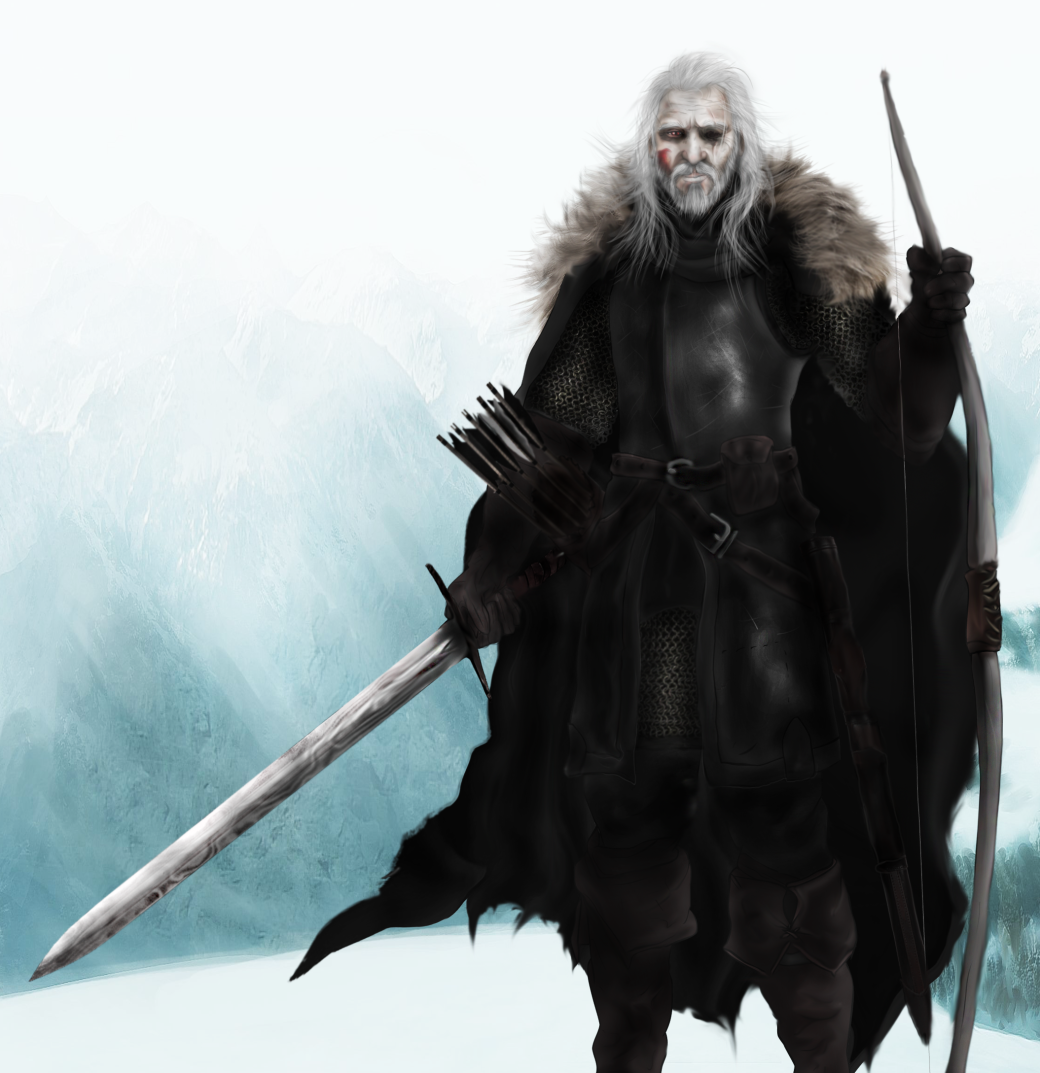
Lord Commander Brynden Rivers of the Night’s Watch – by Mike Hallstein
As adjunct to this idea of the Lord Commander as a skinchanger with a raven who may be a zombie, let’s talk about the wighted corpse of Small Paul. Paul is no Lord Commander, but he is many times linked to Mormont’s raven, culminating in the scene when Sam is attacked by Paul’s wighted corpse, who has a raven on his shoulder at the time. The raven is eating Small Paul, presumably in an attempt to aid Sam and Gilly, but the portrait remains of Paul as a zombie skinchanger Night’s Watch brother with a raven on his shoulder.
Now as I said, before Small Paul dies, quite a bit is made about him wanting to claim Mormont’s raven after the mutineers, of which Paul is a part, kill Mormont. He says he’s always wanted a talking bird and asks Chett if he can keep Mormont’s raven, to which Chett says yes. Then Lark the Sisterman teases Paul by saying maybe they can eat bird if they get hungry, to which Paul becomes angry and threatening. And later when Paul is trudging away from the fist with Sam, he is still muttering about how he was supposed to get Mormont’s raven. So when he appears dramatically in undead form with the raven on his shoulder… it seems significant. He’s been linked to that raven multiple times, and in the scene where he finally gets it to sit on his shoulder like a raven bonded to a skinchanger, he’s a corpse. This would appear to be a symbolic clue about undead skinchangers as Night’s Watch brothers, and in that same scene, we find several other clues to this effect. Sam defeats Small Paul by shoving a hot coal in his mouth, only to discover more wights outside their tent:
She stood with her back against the weirwood, the boy in her arms. The wights were all around her. There were a dozen of them, a score, more … some had been wildlings once, and still wore skins and hides … but more had been his brothers. Sam saw Lark the Sisterman, Softfoot, Ryles. The wen on Chett’s neck was black, his boils covered with a thin film of ice. And that one looked like Hake, though it was hard to know for certain with half his head missing. They had torn the poor garron apart, and were pulling out her entrails with dripping red hands. Pale steam rose from her belly.
The first clue is in the description of the wights: some ‘wore skins and hides,’ a possible allusion to skinchanging. Many of them are brothers, suggesting zombie Night’s Watch. Put them together, and you get zombie skinchanger Night’s Watch brothers. You’ll notice the word ‘dozen’ is used, perhaps to suggest the last hero’s twelve, although that could just as easily be coincidence. But the best clue comes at the end with the description of the wights as having dripping red hands, bloody from the horse they killed. Of course, the five-pointed red leaves of the weirwood are described as looking like bloody hands on more than one occasion, and the red leaves of the weirwood are mentioned one paragraph after this quote to remind us of them. So what we have here is a group of wights with hands like weirwood leaves, implying the idea of greenseer wights – some of whom are black brothers and some of whom wear skins.
And don’t forget, this scene is right when Coldhands appears, an undead Black Brother who is, according to me, an undead skinchanger. Just as with the Nightfort scene, we can observe that scenes that feature Coldhands or talk of Coldhands is where we find clues about undead skinchanger Night’s Watchmen.
The Green Rangers
This section is sponsored by Lord Leobold the Victorious, the Firelion of Lancasterly Rock and Earthly Avatar of the Celestial House Leo
I’ve noticed that a suspiciously high number of the Night’s Watch brothers can be traced back to the Reach or to horned god or greenseer symbolism, so in this section, we are going to run through all of those examples of green rangers and see what there is to find. Of course we have talked about Jon the corn king and Samwell Tarly’s Herne the Hunter Symbolism and House Tarly’s descent from Garth, but there are many, many more.
For a start, there are no less than three Garth’s in the Night’s Watch – Garth of Oldtown, Garth Greyfeather, and Garth Greenaway. I’ve actually spent time tracing out the action of these three to see if there is a correlation to the three Baratheon brothers, who impersonate Garth with their stag-man imagery, and there are signs that this is the case, but this series is running long as it is, so I will just mention a couple of tidbits.
First the names: “green-away” is suggestive of a green man dying or losing his green, “grey-feather” could imply death, as grey is the color of corpses, with the feather supplying the nature association, and Garth “of Oldtown” might be a reference to the reach in general or to the notion of horned lords at Oldtown, which could have something to do with the Great Empire of the Dawn and the ancient fortress they built there. Whether or not those interpretations hold water, the fact that there are three Garths in the Watch is highly suggestive of horned people joining the watch, and the three Garths do do some interesting things. All three go on the Great Ranging, and all three survive the Fist of the First Men – which is statistically unlikely, since more than two-thirds of the brothers on the ranging died at the Fist. That’s notable for a different reason, though – the Great Ranging seems like a parallel to the last hero’s journey, and we can see that Martin wants us to notice the three Garths, as all escape the Fist.
After the Fist, it turns out that Garth of Greenaway was a mutineer, and he even specifically helped kill Mormont – he and Ollo Lophand confronted Mormont together with bared steel, and Ollo was the one to stab him. Given that Mormont, as Lord Commander, is a type of dead green man figure, this probably speaks of the cycle of green men killing one another. During the madness of the mutiny, Garth Greenaway kills Garth of Oldtown, and that definitely speaks of the cycle of horned gods killing one another – it’s explicit Garth-on-Garth violence, and I believe it is placed alongside Mormont’s murder to help us associate his death with the corn king / garth mythology. It’s very similar to when we saw Argilac Durrandon, that last storm king, slain alongside Dickon Morrigan at the battle known as The Last Storm. The members of House Moriggen of the black crow on storm green sigil were playing the role of green man last hero as a Night’s Watch brother, and so we saw the death of Argilac the horned lord placed alongside Dickon Morrigen’s death to reinforce House Morrigen’s green man status, just as placing Garth of Oldtown’s death alongside Mormont’s reinforces Mormont’s death as part of the green man cycle.
Just as Argiliac, the old Storm Lord, is killed by Orrys Baratheon, the new storm lord, Garth of Oldtown is killed by another Garth. Of course, the idea of one Garth killing another reminds us of Stannis killing Renly, one of the first things that jumped out to me as a parallel between the Garths and the Baratheons. (shout-out to Westeros.org forum user Equilibrium).
So what about Garth Greyfeather? Well, he turns up in a last hero metaphor. When Jon finally makes it back to Castle Black after escaping from the the group of Wildlings who he climbed over the Wall with, he learns about the mutiny at Craster’s and that only a dozen faithful brothers are initially thought to have survived and made it back to Castle Black, one of whom is… Garth Greyfeather. So that’s our dozen true brothers to symbolize the last hero’s twelve, coming back from this ranging which symbolizes the last hero’s journey, so where is the last hero, the plus-one to this dozen?
Why it’s Sam, who, at the time Jon learns of these dozen survivors, is thought to have died there – he was stuck weeping over the Lord Commander like a son weeping for his father, actually, and couldn’t be roused to flee with the dozen – although he does of course eventually make it back to the Wall. Not only does Sam make an excellent last hero because of his Herne the Hunter symbolism, his possessing a horn which may or may not be a magical horn of great significance, and his having been metaphorically escorted back from the underworld by Coldhands the psychopomp – I can’t help but notice that Sam has smuggled back a male baby who was supposed to become an Other, and a woman who gave birth to him.
If I were to look at this as a parallel, I would see a possible corroboration for the idea that the Starks have something icy about their bloodline – that the last hero might have brought back some icy Other genetics that became a part of House Stark. This theory has been proposed before, and more or less revolves around the idea that one of the icy children of the Night’s King and the Corpse Queen might have been smuggled south instead of being turned into an Other, thus instilling some measure of “ice blood” into House Stark, a kind of opposite to the blood of the dragon, if you will.
As I have said before, I think it is pretty clearly implied that the Night’s King and Corpse Queen were creating Others by giving their male babies to be made into Others, and I would further suggest that they might have been the first people to actually create the Others. In other words, the Night’s King story may have taken place during the Long Night, and not after, and it may be a story about how the Others were created. If this is the case, then the idea of the last hero or some ancient Stark connected to him returning to Winterfell with one of these cold babies would be plausible, and we might be seeing an echo of that event with Sam smuggling Gilly’s “monster” through the Wall. We are told the baby’s “brothers” (meaning the Others) will come for him, so I sometimes wonder if this will trigger an attack on Castle Black by the Others, or if perhaps bringing Gilly’s babe south of the Wall will break the warding spell of the Wall and allow the Others to pass, but that’s just a little speculation.
The so-called Corpse Queen was a moon-pale woman with cold skin and blue star eyes – I think about her as an ice priestess, a cold version of Melisandre. She gave birth to babies who became Others, so Gilly is a kind of parallel for her as a “mother of the Others.” But unlike Gilly, the Corpse Queen was already a magical being, transformed somehow through ice magic, so it may be that she was simply spitting out Others herself, or that she was capable of transforming her human children into Others in the way that the Others presumably do to Craster’s male children.
The fact that Sam, a last hero figure, has taken a Corpse Queen, mother-of-the-Others figure south of the Wall with him could be an echo of the last hero becoming the Night’s King as well. Some have speculated that the Night’s King used the Black Gate to smuggle his babies though the Wall and deliver them to the Others a la Craster, and Sam does the opposite, smuggling a male baby (appropriately nicknamed ‘Monster’) who was meant to be an Other through the Black Gate, but in the opposite direction.
Anyway, that’s enough about the Night’s King. The relevant thing is Sam the not-so-striding huntsman is playing the last hero, and one of his party is a Garth – Garth Greyfeather. We were already looking at the Great Ranging as parallel to the last hero’s journey, and finding this terrific last hero math here at the end of it really goes a long way to strengthen this theory. So now, think back to the fact that one Garth killed the other at Craster’s – seeing this fraternal Garthicide play out as a part of the ranging seems like a strong clue that killing the horned god is a major part of the last hero story.
There’s more to say on Garth Greyfeather, too. Much is made of Jon Snow the corn king using grey goose feathers for his arrows – that’s how he knows the arrow that killed Ygritte wasn’t his. Therefore, grey-eyed Jon Snow is a grey-feathered Garth, you might say. If the grey in Garth’s name is meant to connote death as in the grey of corpses, Jon might well qualify as a grey Garth.
Then In ADWD, Jon sends out three groups of three rangers each into the north, with one group being made up of Black Jack Bulwer, Garth Greyfeather, and Hairy Hall – that was the group that ended up a heads on poles with their eyes cut out by the Weeper. I’ve noted that the sacrificed “bull” here is a nod to Mithras’s slain bull, so now we can see that Martin is showing us two sacrificed deity mythologies at one time, both of which are a part of Jon’s makeup: the slain bull of Mithras and the slain horned nature figure. House Bulwar also descends from a child of Garth, which itself is another clue about Garth people joining the Watch. The third decapitated head from that scene was Hairy Hall, who sounds like a hairy wild man of the woods, reinforcing the idea of dead green men in the Watch.
Moving right along, we have a ranger named Tom Barleycorn, a clear allusion to John Barleycorn, an English folk character. He’s not a horned god, but he is a corn king – his story basically imitates the cycle of the barley plant, with his death and resurrection doing the standard thing of symbolizing the the cycle of the seasons. Appropriately, Tom Barleycorn is a scout, someone skilled with woodscraft. Jon smells him before he sees him emerge from the wood, perhaps that’s a fermenting barley / beer joke.
It’s also worth noting that when the blue-eyed corpses of Jafer Flowers and Othor were brought back to Castle Black, they were put in the ice cells – the same ice cells which are foreshadowed to hold Jon’s corpse.. and when safer and Other are put in there, it describes the ice cell as “a dark cold cell chiseled from the ice and used to keep meat and grain and sometimes ever beer.” Grain, as in corn grain and corn kings; beer, as in fermented barley and Tom Barleycorn; and meat, as in dead meat like those wights and Jon’s corpse. Jon will be representing all of them together, however, being the resurrected corn king figure. Also note that Jafer “Flowers” has a nature based name, and he also comes from the reach, home of Garth and houses founded by his children. Othor, meanwhile, is found with a hunting horn, evoking Herne the Hunter, a dead horned figure, just like poor Othor here. We’ll actually return to Othor’s corpse in minute for some more forensic examination.
There are certainly some horned fellows in the Watch: there’s a fellow named Jarman Buckwell, whose house sigil sports a rack of golden stag’s antlers. He has a distinctive horn which Mormont can recognize upon hearing – and ‘Jarman’ sounds a lot like Joramun, the OG horn-blower himself. That’s a great example of Martin showing us that we are to associate musical horns and stag antlers, as I claimed he did with the seventy nine sentinels and their horns. Next we have Gren, who is called “aurochs” because he is as big and shaggy as an aurochs – and an aurochs is a horned animal similar to a hairy bull or a bison. Grenn is also one of the twelve loyal brothers to survive Craster’s and make it back to castle Black. Winton Stout comes from House Stout, who actually live at Barrowton, evoking the dead Garth idea of the Barrow Kings. Ulmer, formerly of the Kingwood brotherhood, deserves a mention, because the Kingwood brotherhood are a Robin-Hood like group that lives in the woods and protects the people, and Robin Hood is very much a descendent of the green man / protector of the forest mythology. In the appendix of ACOK, George even hid an Elron in the Night’s Watch – like Elrond of Rivendell, the ruler of the Rivendell elves in Lord of the Rings. Very sneaky. Garrett Greenspear is suggestive of a green warrior, with Garrett being potentially derivative of Garth. The same may be true of Gared, the ranger spooked by the Others whom Eddard executed at the beginning of AGOT.
Kedge Whiteeye doesn’t have green man symbolism, but his one blind eye reminds us of Bloodraven, a greenseer. Similarly, Todder, known as Toad, reminds us of the frog-people that live in the Neck and frequently manifest the green gifts. Daeron is a “singer,” as in those who sing the song of earth, and he’s from the Reach. Toad likes to sing as well, though his voice isn’t quite as good as Daeron’s (‘like piss poured over a fart,‘ I believe the description was.) There was a Lord Commander called the Black Centaur, which is certainly suggestive of skinchanging in a symbolic sense since a centaur is a combination of man and animal.
There are several Night’s Watchmen associated with wood, like Dywen, who has wooden teeth and can smell the wights coming on the Fist. Leathers and Jax, two wildlings who join the Watch, are called “sons of the haunted forest” by Jon. The name Jax may be an allusion to Jack in the Green, a character related to Tom Barleycorn who keeps the green areas alive in the winter to be reborn in the spring, and a man called leathers who is from the Haunted Forest might remind us of Bloodraven, who’s only remaining skin is described as white leather. Leathers the wildling is also known for being ferocious and a little bit terrifying, evoking the scary wild man from the woods idea.
Then we have Wick Whittlestick, one of the a-holes that murdered Jon. ‘Whittelstick’ is wood symbolism, and the word ‘wick’ adds the idea of fire to the mix. Now we can also see that Jon Snow plays into the pattern of Azor Ahai / green man people being killed treacherously by other green man / Azor Ahai people – Wick Whittlestick is a burning tree person, which is essentially the same as a burning stag person. Another a-hole is Ser Alliser Thorne, a man named after a prickly plant. In the Nightfort chapter, it mentions that a huge thorn bush had taken over the training ground where brothers used to fight, a hilarious parallel to Alliser Thorne training the brothers in the training yard at Castle Black. This also equates the thorn bush to black brothers with swords, thereby implying the brothers as plants who fight, building on the symbolism of Ser Alliser and our other plant-people warriors. Ser Alliser adds a dragon element, because he came to the Wall as the price for being loyal to the Targaryens when Tywin sacked King’s Landing.
Big Liddle comes from the Liddles of the Mountain Clans of the North, and their sigil is a green and white tree line pattern with three pinecones – the pine tree is a distinctly winter-associated tree, it should be noted, because it is an evergreen (pine trees can be a symbol of immortality, actually, as they can live an extremely long time – up to 5,000 years at least). The mountain clans dress up as trees and bushes when they attack Deepwood Motte under the command of a fiery stag Azor Ahai person, Stannis Baratheon, giving us tree people connection to Azor Ahai and stag-men. And while we’re mentioning Stannis, Stannis does in fact come to the Wall and in a way take over the Night’s Watch, flying his fiery heart banner over Castle Black, leading the fight against the Watch’s enemies, and forcing the Brothers’ hand in many things. Stannis is also a tremendous Night’s king parallel, as we have discussed many times… and I even found a line the other day where Stannis jokes about taking the black.
Thoren Smallwood’s name evokes a wooden person, and may be a nod to Thoren the dwarf from Lord of the Rings. The Smallwoods come from Acorn Hall, which happens to be the location of heavy Arya-as-a-children-of-the-forest symbolism. Arya is dressed up in an green dress with acorns, to which she says “I look like an oak tree,” reminding us of tree-people in general and Garth the Green in particular, he who planted the Oakenseat and personifies the Oak King, ruler of summer and green things. Quite memorably, Arya is called ‘skinny squirrel’ by a fellow named Greenbeard. The children of the forest are called “squirrel peole” by the giants, and the the child known as Leaf is many times compared to Arya by Bran. There’s more to the Arya / children thing, but I digress.
There is also more squirrel – children symbolism in the Night’s Watch, as we find a ‘Geoff the Squirre’l hidden in the appendix of AFFC, and then there is Bedwyck, called “Giant,” and here I have to pull from ACOK:
Jon hear a rustling from the red leaves above. Two branches parted, and he glimpsed a little man moving from limb to limb as easily as a squirrel. Bedwyck stood no more than five feet tall, but the grey streak in his hair showed his age. The other rangers called him giant.
Bedwyck is a ranger who both old and child sized, just as the children of the forest are a very old race who are called children because of their small size; Bedwyck is a squirrel person, just as the children were called squirrel people, and he’s inhabiting weirwood tree, like a greenseer. He’s even making the leaves rustle like a greenseer(!) He’s climbing the tree in a quest to see better and gain knowledge, a symbolic match for the weirwood-greenseer bond.
Now w hen the brothers are sheltering from the rain outside of Craster’s in ACOK, Bedwyck the Giant “crams himself inside the hollow of a dead oak,” and ask Jon how he likes his castle. A dead Oak King is a dead Garth of a fashion, so Bedwyck is kind of skinchanging a dead Garth here. Living in a dead tree, at the very least, is evocative of a dead greenseer. Bedwyck’s name also intrigues; it unites the idea of fire via the word wyck and dreaming via the word bed. Thus he’s a fiery greenseer living in a dead Garth tree, something like that. It should also be noted that Bedwyck was one of the twelve faithful and true brothers who made it back to Castle Black after the mutiny.
Kill the Green Boy, Let the Green Man Be Born
This section is sponsored by Patreon supporter and Starry Wisdom acolyte Kathleen the Ruthless, Captain of the Ironborn ship Night Terror
To finish up on green men in the Night’s Watch, let’s talk about green boys in the Night’s Watch. “Green boy” is essentially a combination of “green man” and “child of the forest,” and I believe Martin is using “green boy” in metaphors to symbolize greenseers, green men, and children of the forest. Most often, this description is applied to Starks – Robb, Bran, and most of all, Jon. Sometimes it’s other Night’s Watch brothers, and when it’s not a Stark or a black brother, it’s generally being used in some kind of metaphor related to the same subject matter. I don’t want to get lost following every green boy pun out there, but let’s tackle one – the action around Jon taking his Night’s Watch vows in the grove of nine and finding the wighted corpses of Jafer Flowers and Othor on the way back, and then the following night where Jon battle the wighted corpse of Othor in Mormont’s solar, all of which stretches across two consecutive Jon chapters of AGOT.
First, Ser Alliser gives about the most backhanded promotion ever, telling Jon, Pip, and the rest that they “are as hopeless as any boys he’s ever met,” that their hands were made for manure shovels, and so on. He explains that despite their manifest unfitness to serve, new recruits are coming and so he has “decided to past pass eight of you on to the Lord Commander to do with as he pleases.” His final warning is a memorable one, and one which the TV show used because it’s simply awesome in its transcendent grumpiness:
Pep let fly a whoop and thrust his sword into the air. Ser Allliser fixed him with a reptile stare. “They will call you men of the Night’s Watch now, but you are bigger fool than Mummer’s Monkey here if you believe it. You are boys still, green and stinking of summer, and when the winter come you will die like flies.”
Ah, good old Ser Alliser. I think his translation of “How to Win friends and Influence People” might be off a bit. English-to-Westerosi common tongue translations are notoriously unreliable. Jokes aside though, he’s laying it out pretty starkly – you are green boys, you smell like summer, and in the winter, you will die. That’s what the green man does, what corn king does, what horned god does. Some those myths move the dates around a bit, but that is the general idea – a summer king or summer phase in the cycle, and a winter phase or winter king.
When Jon goes to say his vows, all of this becomes more apparent. He starts by recalling the last words Benjen Stark ever spoke to him before leaving on his fateful ranging;
You’re no ranger, Jon, only a green boy with the smell of summer on you.
This line is repeated twice: once when Benjen says it, and once here in Jon’s memory, which tends to make me think it’s an important line. As the ice alf Night’s Watch recruits as green boys is emphasized elsewhere by Ser Alliser and others, I think it’s safe to say it’s something we should pay attention to. Jon is a green boy – especially before he says his vows.
A page later, as Jon actually does go to say his vows, he goes through the icy tunnel under the Wall, and feeling the vast weight of the ice pressing down on him, he thinks to himself that “The air was colder than a tomb, and more still.” When they emerge from the “cold dark walls” of the tomb-like tunnel, the light is a “sudden glare” which causes Sam to blink – it’s the proverbial light at the end of the tunnel! This is pretty obvious death and rebirth symbolism, and reinforces the idea that only dead or undead brothers should really journey north of the Wall, which Jon thinks of as having “ridden past the end of the world.”
They reach the weirwood grove of nine, and “as the last light faded in the west and grey day became black night,” Jon and Sam say their vows. Then we have an important pronouncement:
The woods fell silent. “You knelt as boys,” Bowen Marsh intoned solemnly. “Rise now as men of the Night’s Watch.”
So now the green boys are… green man, right? Dead green men is more accurate – remember again that all the original Night’s Watch brothers would have journeyed through the icy tunnel-tomb and come beyond the end of the world to swear oaths to the greenseers in their weirwoods. Green boys go beyond the grave, and come back men of the Watch, symbolically reborn with their green sucked away.
Interestingly, and probably not by accident, the man who tells Sam and Jon to rise as men of the Watch – Bowen Marsh – is one of the four people who will betray and murder Jon. So, in a time-loop kind of way, Jon’s death is symbolized here as he rises from the snowy ground under the watchful eye of his killer, no longer a green boy. Bowen Marsh’s nickname is the Old Pomegranate, and pomegranates are of course a symbol of being abducted to the underworld, as in the Persephone myth, so even before we knew Marsh would kill Jon, his pomegranate nature lends an element of coming to and from the underworld to this scene. Again, I would not be surprised if this ends up being where Jon is resurrected.
As soon as they finish swearing their vows and make to leave, Ghost appears between two weirwoods holding a dead hand. This leads the brothers to the wighted corpses of Jafer Flowers and Othor, when Jon faces a reality check:
My uncle’s men, Jon thought numbly. He remembered how he’d pleaded to ride with them. Gods, I was such a green boy. If he had taken me, it might be me lying here..
When green boys go north of the wall, they end up as walking corpses, I believe that is again the message here. That’s what Jon just did, symbolically. As usual, Martin reinforces an important theme all throughout a chapter, and so we find that not even one page after Jon thinks of himself as a green by who could have become a wight, he recalls the nightmare he had the previous night:
It is only a wood , Jon told himself, and they’re only dead men. He had seen dead men before …
Last night he had dreamt the Winterfell dream again. He was wandering the empty castle, searching for his father, descending into the crypts. Only this time the dream had gone further than before. In the dark he’d heard the scrape of stone on stone. When he turned he saw that the vaults were opening, one after the other. As the dead kings came stumbling from their cold black graves, Jon had woken in pitch-dark, his heart hammering. Even when Ghost leapt up on the bed to nuzzle at his face, he could not shake his deep sense of terror. He dared not go back to sleep. Instead he had climbed the Wall an d walked, restless, until he saw the light of the dawn off to the east.
Don’t forget that Jon himself once played the role of a ghost waking from the crypts of the Kings of Winter when he played that prank on the younger Stark children by covering himself in flour and hiding in the crypts – this dream of the Kings of Winter waking is kind of like a companion to that scene. So, in this chapter, what we have is Jon imagining himself as a green boy-turned-corpse, followed immediately by a recounting of a dream of the Kings of Winter waking from the dead a dream which also foreshadows Jon’s resurrection as the new King of Winter.
The final line about Jon restlessly walking the Wall until he can see the light of dawn is a nice poetic touch that just sort of encapsulates Jon’s purpose in the story as the ultimate personification of a watcher on the walls. It’s also a nice bit of Venus / Morningstar action here. Venus is called the light-bringer, the dawn-bringer, and the son of the morning because it rises low in the sky in the pre-dawn hours and shines brightly, an usher and a herald to the coming dawn. Jon, who is a morningstar figure, replicates this by climbing to the top of the Wall, putting him low in the sky, and then awaiting the first rays of dawn, which Jon greets with relief.
This is probably a good time to point out a bit of last hero math that can be found in the crypts of Winterfell – on two occasions, actually. Put put a pause button on Jon – he’s standing in the haunted forest, looking at the wighted corpses of Jafer and Othor while remembering his dream of the kings of Winter waking from their crypts – we are going to bounce over to the crypts for a minute and then comeback to Jon in the woods here.
Alright, so in AGOT, Bran and maester Luwin and Osha and Hodor go down into the crypts after Bran had the dream of Ned’s ghosts in the crypts. They pass eight statues of Kings of Winter and Kings in the North and Stark Lords, then Rickard, Brandon, and Lyanna to make nine, ten and eleven, and then they come at last to Ned’s empty tomb, making dead Ned the twelfth member. Luwin takes his torch and “thrust his arm into the blackness inside the tomb, as into the mouth of some great beast,” almost as if to set Ned’s ghost on fire or something, and then out pops Rickon and Shaggydog as the last hero, “plus one” figure. Shaggy has “eyes like green fire” his fur “as black as the pit around them,” so he is giving us the associations of green magic mixed with fire, as well as shadow and darkness. He fights with his brother, a wolf named summer with golden eyes, so we can see even in the wolves a kind of fratricidal rivalry of light and darkness. We’ve seen the last hero and his group of twelve killed by an AA figure many times, so here it seems like Luwin’s torch and Summer the wolf would be playing that role, bringing fire against the last hero. The torch is dropped at the feet of Ned’s brother Brandon, giving us a fiery Brandon Stark, which I take as an allusion to a fiery King of Winter, and / or as an allusion to Bran losing the use of his legs to gain access to the “fire of the gods.”
The second last hero math starring the Kings of Winter comes in ACOK, just after Bran wakes from warging into Summer. Bran was in Summer, surveryingthe damage to Winterfell left by Ramsay’s burning and sacking. Interestingly, this is the scene where Summer and Bran see the infamous Winterfell dragon, the “great winged snake whose roar was a river of flame.” Bran also kills an elk while he is in Summer, so we have a horned figure dying and a dragon being born… and when Bran wakes, we get last hero math. Asha lights a torch, “filling the world with orange glare,” waking a sleeping Rickon, and then it says “when the shadows moved, it looked for an instant as if the dead were rising as well,” meaning the dead Kings of Winter were rising too, just like Rickon – who played the last hero in the last scene. The Bran proceeds to name off thirteen Stark Lords, ending with the line “this was where they came when the warmth had seeped out of their bodies; this was the dark hall of the dead, where the living feared to tread.” The last one listed is Cregan Stark, who fought Aemon the Dragonknight – there is our suggestion of the last hero fighting against a dragon / Azor Ahai character.
Ok, so now let’s go back to Jon in the haunted forest with Jafer and Othor. The two corpses of the brothers are taken back to Castle Black and put into one of the ice cells – along with the grain and beer and meat, as we noted a moment ago. This is another likely foreshadowing of Jon’s own corpse being put in the ice cells to go along with Jon seeing is own reflection in the wall of the ice cell in ADWD as Wick Whittlestick, the man who will kill Jon, opens the door so Jon can “slip inside.” When Jon gets back to Castle Black, he learns that King Robert is dead and that Ned has been thrown in a cell, yet another foreshadowing of Jon being thrown in the ice cell. After hearing this very bad news, he leaves Mormont’s solar, and…
Outside one of the guards looked at him and said, “Be strong boy. The gods are cruel.”
They know , Jon realized. “My father is no traitor,” he said hoarsely. Even the words stuck in his throat, as if to choke him. The wind was rising, and it seemed colder in the yard than it had when he’d gone in. Spirit summer was drawing to an end. The rest of the afternoon passed as if in a dream. Jon could not have said where he walked, what he did, who he spoke with. Ghost was with him, he knew that much. The silent presence of the direwolf gave him comfort.
Earlier in the chapter, we get a definition of spirit summer: it’s when the summer season is “giving up its ghosts at last.” Everything here is about the death of the green man, the summer king – Jon went out and did his death and rebirth ritual with his Night’s Watch vows only to come back and learn Robert the Horned God was dead – and right as summer is giving up its ghosts. This is yet another reminder that Robert is the summer king whose death heralds the onset of winter – and out in the yard, we have cold winds rising. This is when the king of Winter must be reborn, in the winter – and it’s even noted in this chapter that “Jon had been a babe” when the last winter began.
This appears to be some very specific foreshadowing of Jon’s death and sojourn in Ghost’s body here – Jon’s words, one of which is traitor, “stuck in his throat, as if to choke him,” very like the traitor’s knife which will kill him. After this symbolic death, the rest of the afternoon passes as if in a dream – Jon is now dead, and passed into he limbo realm. He doesn’t know here he is, who he is speaking with, what he is doing… because he’s in the limbo realm, which is basically the in-between place. But hey! All he knows is that Ghost is with him, and that gives him comfort. That’s about as good as foreshadowing gets, quite franky – when Jon is walking in limbo, the one thing he knows is that Ghost will be there with him.
Not only that, but there is more venus symbolism here as Jon descends from Mormont’s solar like Venus descending from the heavens as the Evenstar, choking on his words to simulate death, then walks around in a dream with Ghost, simulating the soul in limbo… but then at the end, he and Ghost ascend back up to Mormont’s solar, just like Venus rising as the Morningstar, whereupon Jon and Ghost play the hero and fight the wights with fire and sword, tooth and claw. You’ll notice that Jon is given a new Valyrian steel sword for this act, too, showing us the last hero acquiring his dragonsteel through some act of valor. In fact, Jon’s previous sword was taken from him only hours before, after Jon lost his tempter and attacked Alliser Thorne for insulting his father, showing us the last hero losing his sword before gaining dragonsteel. This idea is repeated when Jon pulls one of the swords from the dead guards to use against the wights, only to lose it in the fight. That dang old last hero, always losing his sword!
As for Longclaw, the dragonsteel Jon wins from this fight, was pulled from the fire of the Lord Commander’s “solar” – form the fire of the sun, in other words – just as Lightbringer is supposed to be. That doesn’t make Longclaw Lightbriger, but it does mean that it is symbolizing Lightbringer, or whatever we are supposed to call the last hero’s sword. The main point I want to drive home is that this chapter shows us, again and again, that Jon will die and be reborn to become the new last hero, the new King of Winter. It’s even emphasized when Jon is sort of placed in house arrest in his room right before waking to fight the wights – he wakes in darkness “shivering uncontrollably” and slowly pushes himself to his feet… as if rising from the dead. He rises as a frozen person, but is burned while playing the hero, perhaps indicating the process for Jon. Perhaps his body will first be cold-wighted, then cleansed with fire, as we suggested in part one. That seems to be a popular choice from the feedback I have received so far – ice first, then fire, with an assist from the greenseer magic of his bond with Ghost and possibly Bran.
Saving the best for last, there is one very clear example of the idea of undead Night’s Watch which I believe is the most important of all.
The Scarecrow Brotherhood
This section is sponsored by Patreon supporter Ser Dale the Winged Fist, the last scion of House Mudd, captain of the dread ship Black Squirrel, and member of the Sacred Order of the Black Hand
In ASOS, the Night’s Watch brothers of Castle Black are preparing for the wildling attack that is coming first from the south and then from north of the Wall, and they do an interesting thing. They make scarecrows.
Men in black cloaks were visible on other roofs and tower tops as well, though nine of every ten happened to be made of straw. “The scarecrow sentinels,” Donal Noye called them. Only we’re the crows, Jon mused, and most of us were scared enough.
Whatever you called them, the straw soldiers had been Maester Aemon’s notion. They had more breeches and jerkins and tunics in the storerooms than they’d had men to fill them, so why not stuff some with straw, drape a cloak around their shoulders, and set them to standing watches? Noye had placed them on every tower and in half the windows. Some were even clutching spears, or had crossbows cocked under their arms. The hope was that the Thenns would see them from afar and decide that Castle Black was too well defended to attack. Jon had six scarecrows sharing the roof of the King’s Tower with him, along with two actual breathing brothers.
There are a couple of things that make this relevant to our quest for knowledge and understanding. The first is that the scarecrows come to be associated with missing black brothers:
The brothers had even started wagering as to which of the straw sentinels would collect the most arrows before they were done. Dolorous Edd was leading with four, but Othell Yarwyck, Tumberjon, and Watt of Long Lake had three apiece. It was Pyp who’d started naming the scarecrows after their missing brothers, too. “It makes it seem as if there’s more of us,” he said. “More of us with arrows in our bellies,” Grenn complained, but the custom did seem to give his brothers heart, so Jon let the names stand and the wagering continue.
The scarecrows are already honorary black brothers, and here they associated with specific Night’s Watch brothers who are absent. Grenn adds the connotation of death, saying that the scarecrows only make it seem like there are more dead Night’s Watch brothers with arrows in their bellies. That’s the thing I want to hone in on here – the scarecrows represent dead brothers.
More specifically, they represent undead brothers.
Remember when I mentioned that Beric Dondarrion is called a scarecrow knight? It happens three times actually, and like the quotes about the scarecrow brothers, they are all in ASOS:
A scarecrow of a man, he wore a ragged black cloak speckled with stars and an iron breastplate dinted by a hundred battles.
Note the use of the word ‘ragged,’ it adds to the scarecrow symbolism because scarecrows were often stuffed with rags. The word ragged is also quite often used to describe the blacks of the Night’s Watch, probably to emphasize the link between scarecrows and the black crows of the Watch. .
“Any knight can make a knight,” said the scarecrow that was Beric Dondarrion, “and every man you see before you has felt a sword upon his shoulder. We are the forgotten fellowship.”
Not only is he a scarecrow, he’s a scarecrow who is a member of a brotherhood of knights.
“The king is dead,” the scarecrow knight admitted, “but we are the king’s men, though the royal banner we bore was lost at the Mummer’s Ford when your brother’s butchers fell upon us.” He touched his breast with a fist. “Robert is slain, but his realm remains. And we defend her.”
The ramifications of this are pretty obvious: Beric is a fire undead person in a black cloak, and he’s a scarecrow. Therefore, those scarecrow brothers the Night’s Watch make might be symbolizing undead Nights Watch – fire resurrected scarecrows, like Beric. And we get a big, giant, flaming clue that we are indeed supposed to associate the scarecrow brothers with fire undead people in Jon’s dream of wielding a burning red blade, one of the most important scenes in the series:
Burning shafts hissed upward, trailing tongues of fire. Scarecrow brothers tumbled down, black cloaks ablaze. “Snow,” an eagle cried, as foemen scuttled up the ice like spiders. Jon was armored in black ice, but his blade burned red in his fist. As the dead men reached the top of the Wall he sent them down to die again.
In other words, the only brothers Jon has in this scene are the scarecrow brothers, and they are on fire. Burning scarecrows, just like Beric, a scarecrow knight with a black cloak who is animated by fire magic. And we can take this as a clue about the original last hero and the original Night’s Watch because Jon is mimicking Azor Ahai and the last hero in this dream. He’s playing the role of Azor Ahai by wielding the burning red sword and slaying his love, Ygritte (as he does later in this dream), just as Azor Ahai slew his love, Nissa Nissa, with Lightbringer. He’s paralleling the Last Hero by defending the Wall by himself against the forces of the north who sound like ice spiders and wights. But again, he’s not completely alone, because he has the burning scarecrow brothers. A dozen Beric’s perhaps, instead of a dozen Coldhands.
I want to emphasize again that Lord Beric might be one of the most important characters in the book, purely in terms of symbolism. Beric combines the flaming sword and fire-resurrection symbolism of Azor Ahai reborn with a not-so-subtle Bloodraven impersonation – the one red eye, the wierwood throne in a cave full of weirwood roots, the Lord of Corpses title, and so on. In other words, Beric implies a Lightbringer-wielding, fire-undead scarecrow brother who is also greenseer, and that is a big fat bingo. Now we can see that his scarecrow associations are no accident – they are done specifically so that we might decode the meaning of the scarecrow brothers manning the Wall, particularly when you take Jon’s dream of wielding Lightbringer alongside burning scarecrows into account. And that meaning is clear now – the last hero’s companions in the War for the Dawn were undead Night’s Watch brothers, mostly likely fire undead ones. The scarecrow brotherhood, everyone.
You’ll recall that during Beric’s fight with the Hound, Beric’s sword breaks – just as the last hero’s sword was said to break from the cold. And twice in that fight, the Hound’s sword is referred to as cold – once it says “the flaming sword leapt up to meet the cold one,” and as the Hound is about to break Beric’s sword, it says “Lord Beric blocked the cut easily, but the burning sword napped in two, and the Hound’s cold steel plowed into Lord Beric’ flesh where his shoulder joined his neck and clove him down to the breastbone. The blood came rushing out in a hot black gush.” Thus we are given a pretty strong impression of our undead greenseer Azor Ahai person having his sword broken by a cold sword, just as the last hero’s sword snapped from the cold, and just as we saw Ser Waymar’s sword snapped by the Other’s crystalline ice swords.
You’ll also notice in of the passages we just read that Beric mentions being loyal to King Robert, who is dead, and Sandor even calls Robert the King of Worms while in Beric’s cave. In other words, Beric serves a dead horned god, and this of course goes along with all the other references to undead horned gods around the Night’s Watch and the last hero. That same idea pops up again in one of the quotes about the scarecrow brothers:
The west had gone the color of a blood bruise, but the sky above was cobalt blue, deepening to purple, and the stars were coming out. Jon sat between two merlons with only a scarecrow for company and watched the Stallion gallop up the sky. Or was it the Horned Lord?
The Horned Lord is a constellation named after a King Beyond the Wall called the Horned Lord who lead an attack on Westeros, as we mentioned last time. We don’t know if he was a horned green man or more likely a wildling chieftain playing into this power line of symbolism, but of course the point here is to continue to draw associations between the Night’s Watch and horned folk – specifically, to dead horned folk. Here we see Jon, who will probably end up as some sort of burning scarecrow himself, standing next to one of his scarecrow brothers, looking up at their horned lord together.
There’s a nice companion to this scene in ADWD when Bran wargs into Summer and sees the dead Night’s Watch brothers which Coldhands slaughtered with his ravens:
The direwolf’s pale yellow eyes drank in the scene around them. A nest of entrails coiled through a bush, entangled with the branches. Steam rising from an open belly, rich with the smells of blood and meat. A head staring sightlessly up at horned moon, cheeks ripped and torn to bloody bone, pits for eyes, neck ending in a ragged stump. A pool of frozen blood, glistening red and black.
A paragraph later, the ripped black clothing of the slain brothers are called “ragged cloaks.” We just saw Jon staring at the horned moon with his scarecrow brothers, and now we have dead brothers staring at the horned moon, so let’s consider these dead brothers as a symbol of Jon. They are ragged, and the one has a ragged stump for a neck – note the use of stump to imply tree people, people made of wood. The scarecrows brothers are stuffed with rags and straw, with straw being similar to wood (especially wicker), so we find these brothers implying rags and wood, specifically, dead brothers mad of rags and wood. That ties in nicely to both the scarecrow brother idea as well as the wicker King of Winter idea.
The fact that these dead brothers end up inside of a wolf – Summer and the other wolves are actually eating them in this scene – probably correlates to Jon going inside of his wolf when he dies. Hopefully his spirit will not be “eaten” by Ghost – it wouldn’t really make much sense of that to happen, so I assume it won’t. But it is a nice way to show the dead NW brothers who seem to parallel Jon being both dead and “inside a wolf.”
The dead brothers also manifest some snaky dragon symbolism – their steaming entrails coil through the bush, like a snake ensnared in a tree- like Bloodraven perhaps, a white dragon ensnared in the roots of the weirwood. The pool of red and black frozen blood is an interesting symbol – red and black are Targaryen colors, but here they are frozen, just as Jon is a cold version of a Targaryen. The brothers of the watch are euphemistically said to ‘bleed black blood,’ so the frozen black blood coming from the veins of black brothers creates a black ice symbol which is specifically tied to the Night’s Watch. It also reminds us of Melisandre’s death warning to Jon:
“Ice, I see, and daggers in the dark. Blood frozen red and hard, and naked steel. It was very cold.”
The black and red frozen blood also remind us of the current state of Ned’s black Ice sword – it now shows “waves of night and blood,” or another time, it’s “blood and black the ripples shone.” Black ice, turned the color of blood and darkness – that’s what we see in this puddle. Mel is implying it too – ice, she sees, and daggers in the darkness, frozen blood – but that’s really just a description of Ned’s sword. Read the line again – “Ice she’s sees” – it’s even a capital “I” Ice, because it’s the first word of the sentence. She sees Ice – a sword in the darkness, represented by frozen red and black blood. Waves of blood and night, seen in a sword formerly called Ice.
As I mentioned in part 2, the twin concepts of black ice and frozen fire basically symbolize Jon, who wields Lightbringer in his dream armored in black ice, and who arms his brothers with frozen fire. His hunger for Winterfell is once described as being as sharp as a dragonglass blade, and there’s also a line from ASOS where Stannis says to Jon “I have found you here, as you found the cache of dragonglass beneath the Fist, and I mean to make use of you. Even Azor Ahai did not win his war alone.” It’s direct comparison between Jon and his dragonglass, and it is implying Jon as a weapon in the hands of Azor Ahai – Jon himself is the weapon, the sword in the darkness – a sword of black ice, burning red. I know these symbolic merry-go-rounds get a bit confusing sometimes, so I want to be clear – Jon and Ned’s sword are both “black ice” and “frozen fire,” representing a certain kind of unity of ice and fire. The red and black frozen blood puddle and Mel’s vision of daggers int he dark and frozen blood are referring to the same thing – Jon Snow, a weapon of black ice who who is, in my opinion, destined to wield black Ice, now known as Oathkeeper. We just need to get it to the Wall, but we have two books. 🙂
So, this puddle of black ice blood and frozen red blood evokes Jon in several ways, and it’s coming from a dead tree-man brother wearing scarecrow rags who stares at the horned moon, like Jon did in his scene with a scarecrow brother. The horned moon ties these scenes together, and when we recall that the horned moon was used to foreshadow the death of another King of Winter, Robb, we can see that the horned moon in these scenes is also foreshadowing Jon’s death and transformation into a burning scarecrow, in emulation of the resurrected horned god and the King of Winter.
One final note on this grisly tableau as a symbol of Jon Snow’s death and resurrection, it’s worth noting that the entrails coiled through the bush reminds us of the First Men sacrificing people and stringing their entails up in the weirwood branches, which is something they used to do. I’m not sure if Coldhands did this intentionally, or if it’s merely a nod to the reader to think about weirwoods and human sacrifice in conjunction with these dead Night’s Watch brothers, but it’s worth pointing out.
Returning to the topic of scarecrows, we see that they are also tied to the seventy nine sentinels who wind their ghostly warhorns. Not only are they called “scarecrow sentinels“and “straw sentinels,” we also get this line as Jon and Donal Noye ascend the Wall in the winch cage after hearing two horn blasts from atop the Wall:
The wind was whipping at the black cloaks of the scarecrow sentinels who stood along the ramparts, spears in hand. “I hope it wasn’t one of them who blew the horn,” Jon said to Donal Noye when he limped up beside him.
The scarecrow sentinels stand with spears in hand, just like the seventy nine sentinels, and now they might be winding their horns too? If they are trying to wake the sleepers, they might be waking themselves. Kidding aside, this is a pretty clear association between the seventy nine sentinels with their ghostly warhorns and the scarecrow brothers with their newfound habit of blowing horns. This is makes sense, because both are giving us clues about undead green men Night’s Watch brothers. Interestingly, one group is frozen and the other is burning.
Now that we have examined the King of Winter ideas related to the wicker man, we can see that these burning scarecrows actually fit right into green man mythology. They are the spitting image of the King of Winter burning at the end of his reign, and these fiery scarecrow brothers are in service to Jon Snow, the probably future King of Winter. It makes sense that the King of Winter symbolism is extended to the Night’s Watch, because the Night’s Watch serves that same role of bringing the spring.
This is the kind of corroboration from multiple angles that we should find whenever we uncover a mythological influence behind ASOIAF. Martin always leaves multiply references for us to find – for example, we might see that Martin has chosen the title ‘King of Winter’ for his ruler of the North and wonder if he intends a reference to the wicker man King of Winter, but when we see the burning scarecrows serving the probable King of Winter Jon Snow, we can be sure that is what is going on. Then we look at the theme of the Night’s Watch – bringing the spring and ending the Long Night – we see that also lines up with the purpose of the wicker man perfectly.
There’s actually even one more line of corroboration of these ideas pertaining to the King of Winter as a burning wicker or straw man, and that can be found in two scenes where we see wights being set on fire.
A Burning Wreath for the King of Winter
This section is sponsored by Patreon supporter Luna of the Mayari, Blade of the Goddess
Fittingly, the first involves Coldhands. It’s the scene where Bran’s company is fighting its way up the hill to get to the safety of Bloodraven’s cave. Amazingly, this scene is actually a perfect parallel to the scene at the end of Game of Thrones where Mirri Maz Dur performed her blood magic on Drogo. We discussed that scene in the first zombie episode as a potential parallel to Jon’s resurrection, highlighting the fact that we saw dancing shapes silhouetted inside the tent, “the shadow of a great wolf and a man wreathed in flames.” Now listen to this scene from ADWD, which takes place as Bran has already skinchanged into Hodor’s body and killed a wight with Hodor’s sword:
Up above them, flaming figures were dancing in the snow. The wights, Bran realized. Someone set the wights on fire. Summer was snarling and snapping as he danced around the closest, a great ruin of a man wreathed in swirling flame. He shouldn’t get so close, what is he doing?
Then he saw himself, sprawled facedown in the snow. Summer was trying to drive the thing away from him. What will happen if it kills me? the boy wondered. Will I be Hodor for good or all? Will I go back into Summer’s skin? Or will I just be dead?
That’s pretty much the same language – ‘a man wreathed in swirling flame‘ versus ‘a man wreathed in flames.‘ Summer is the great wolf, and both the burning wights and Summer are specifically described as dancing, just like the dancing shadow figures in Mirri’s tent. That’s about as clear a sign as we are going to find that these two scenes are somehow meant to be linked to one another, so the important question to ask is why?
Well, I suggested that Drogo’s botched resurrection ceremony may be a parallel to Jon’s resurrection, so consider the subject matter of this scene with that in mind. Bran is talking about what happens when a skinchanger dies, where his soul goes. That is again what I like to call, ‘a big fat bingo.’ Also featured in this scene about one paragraph later: a skinchanger getting kicked out of a body he was inhabiting (Bran is kicked out of Hodor), and that too is a bingo. This is all stuff that relates to Jon’s resurrection, something which Bran himself may take part in.
The important things in this scene are the dancing great wolf and man wreathed in flame. The wolf clearly signifies Starks and skinchanging in this scene, as we claimed it did in the scene with Mirri Maz Dur and Drogo, since Summer is literally a wolf skinchanged by a Stark. So what about the burning man? In the tent scene with Mirri, we interpreted that as the fire side of Jon’s heritage, his Targaryen ancestry – the idea of a flaming person lines up with Dany calling herself fire made flesh when she wakes the dragons. But here in this scene with Bran and Coldhands, the man wreathed in flame is a burning wight. What does this mean?
Well, taken with all the previous information about burning scarecrows and the King of Winter, I’d say this still represents Jon’s fiery side, although this time it would be his future as a fiery undead person. There’s a clue about what kind of fiery undead person Jon will be in Bran’s scene a paragraph later, as Bran returns to his body lying in the snow and we read “The burning wight loomed over him, etched tall against the trees in their icy shrouds.” By superimposing the burning wight over a tree, Martin has created the image of the burning wight as having branches over his head, like a green man with branches in place of antlers.
He’s also created the image of a burning tree – and the flames of this wight cause the tree to lose its icy shroud, which it dumps on top of Bran. If we look at the tree itself as a greenseer symbol, we can see it transforming – it’s a frozen, white tree, but then it throws off it’s icy shroud – think funeral shroud – and turns into a burning tree, as if it were coming back to life. That’s also why George used the expression ‘”wreathed in flame” in both this scene and the one in Mirri’s tent of dancing shadows – a wreath is a green thing associated with Christmas and winter. A flaming wreath implies a fiery green winter-associated thing, which is what the King of Winter is exactly.
Those of you who read or listened “The Grey King and the Sea Dragon” will know that the red leaves of the weirwood which are usually described as bloody hands are once described as “a blaze of flame among the green,” and thus we have an analogy of the weirwood as a burning tree. There’s a lot more to it including the Grey King’s burning tree and the fire of the gods, so I recommend checking that out, but take my word for it that Martin is indeed using the buring tree as a symbol of the weirwoods – think of Moses and the burning bush, where the burning bush was the voice of God’s knowledge and wisdom, just as the weirwood, a burning tree in a manner of speaking, bestows the power of the old gods on the greenseer, and the knowledge and power of the gods is of course often described as “the fire of the gods.”
Thus, it is no accident that the dancing wight wreathed in flame in this scene is showing us a burning tree image. It’s merely another greenseer clue, but attached to a burning undead person. Essentially, there is a synergy between the King of Winter and the weirwood – they are both burning tree people.
Additionally, Bran is thinking about using Hodor as a potential new host body if he dies, putting slightly different take on the idea of a skinchanger being reborn – that’s more along the lines of theories about the Boltons being bodysnatching skinchangers. Interestingly, one paragraph after this quote, right before Bran is booted from Hodor by the sheer disorientation of the fight, “tears filled Hodor’s eyes and froze there.” If Hodor inhabited by Bran represents some kind of resurrected skinchanger, he now has ice eyes, which done to imply one of two things: the icy blue eyes of a cold wight or an Other, or the icy eyes of the Starks, such Brandon “Ice Eyes” Stark, a King of Winter, and all of the statues in the crypts, which are described as watching “with eyes of ice.” I’ll probably write something specifically about body-snatching at some point, but the idea of Hodor having icy eyes in that scene seems meaningful and I wanted to point it out. Also recall that Garland Tyrell wearing Renly’s armor showed us a kind of body snatching version of Azor Ahai reborn, so this might be a thing.
The second scene with burning wights reinforces the interpretations of the first scene, as well as showing us the burning wicker man as the King of Winter with amazing clarity. This is Jon, recalling the burning of the wight in Mormont’s chambers as he is being given Longclaw for saving the Old Bear’s life. Leading up to this quote, Jon thinks to himself that he sometimes dreamed of somehow earning his father’s sword Ice, through some act of valor, even saving Lord Eddard’s life. Now he saved the life of a kind of father figure, Lord Commander Mormont, and he is being given the sword meant for Mormont’s son. That is pretty cool because it conflates Eddard, a King of Winter symbol, with the Lord Commander of the Night’s Watch, and we’ve already seen they both overlap with the last hero to some extent. Keep that in mind, and check out this scene, which opens with Mormont speaking:
“I would not be sitting here were it not for you and that beast of yours. You fought bravely … and more to the point, you thought quickly. Fire! Yes, damn it. We ought to have known. We ought to have remembered . The Long Night has come before. Oh, eight thousand years is a good while, to be sure … yet if the Night’s Watch does not remember, who will?”
“Who will,” chimed the talkative raven. “Who will.” Truly, the gods had heard Jon’s prayer that night; the fire had caught in the dead man’s clothing and consumed him as if his flesh were candle wax and his bones old dry wood. Jon had only to close his eyes to see the thing staggering across the solar, crashing against the furniture and flailing at the flames. It was the face that haunted him most; surrounded by a nimbus of fire, hair blazing like straw, the dead flesh melting away and sloughing off its skull to reveal the gleam of bone beneath.
Breaking in again for a moment, so far we have Mormont remembering that the Night’s Watch is supposed to fight with fire, which lines up well with the idea of the last hero’s twelve being burning scarecrows, fiery undead. Even better is the description of the wight. His hair is like straw, just like a scarecrow, and his bones are like old dry wood, which make us think of a burning tree person again – just like the burning wight etched against the trees in the scene in front of Bloodraven’s cave, and just like the wights in the Coldhands scene with Sam and Gilly, where they had bloody red hands to symbolize the weirwood leaves, and of course, most of all, like the burning scarecrow brothers mounted on wooden poles. The corpse of Jafer had the same “hair like straw” description as well, strengthening the idea of the wights as straw men.
The corpse also “staggers” across the room – is that a playful double usage of the word stag to make us think of a burning stag man? I’d have to say probably so, because we already know the burning stag man and the burning scarecrow ideas go together. Don’t forget, this is Othor’s corpse, the guy with the hunting horn – he’s already showing us Herne the Hunter stag man symbolism, so why not have him stagger a bit?
A strong evocation of the wicker man actually comes in the description of the wight’s hair blazing like straw. By calling the wight old wood and straw, we are really being given the picture of a wicker man. If only this burning wicker man were somehow associated with the King of Winter in this scene. If only.
Ahh, Mr. Martin Lewis, if you would do the honors please?
Whatever demonic force moved Othor had been driven out by the flames; the twisted thing they had found in the ashes had been no more than cooked meat and charred bone. Yet in his nightmare he faced it again … and this time the burning corpse wore Lord Eddard’s features. It was his father’s skin that burst and blackened, his father’s eyes that ran liquid down his cheeks like jellied tears. Jon did not understand why that should be or what it might mean, but it frightened him more than he could say.
Oh holy hell. It’s the King of Winter as a burning corpse. This dream has never made any sense as anything other than Jon’s subconscious generating scary things for a nightmare, but now we can se it makes wonderful sense. Depicting Eddard as a flaming corpse, once which was just associated with being made of straw and old wood, is.. is… well, I’m out of superlatives, but it’s the King of Winter is what it is. His destiny is to becoming a burning corpse, likely for the good of all humanity – at least, everyone who likes it when winter eventually gives way to spring.
That’s why this dream terrifies Jon, on a deep level – he’s staring at his destiny as a fiery undead King of Winter, a skinchanger zombie corn king extraordinaire.
And just to top all that off, the original scene in which Jon and Ghost fought the wight in Mormont’s solar contains yet another echo of the dancing pair of the great wolf and the burning man, though it is not spelled out as clearly. It doesn’t have the tight, matching language, but it is nevertheless a scene with a great wolf and a burning wight fighting one another, a scene in which Jon symbolically comes back to life and becomes the hero, wining himself a new sword of dragonsteel… while burning himself in the process.
And that is what we call foreshadowing.
Bonus Round: Trees Bodysnatching People
This special bonus section sponsored by our most generous Patreon supporter, who wishes to remain silent but whose support speaks volumes. Thanks a lot ______.
So, I’ve mentioned the idea of undead greenseers a few times, but what exactly does that mean? How would that work? We’ve talked extensively about the idea of resurrected skinchangers and the process by which you make one: the human spirit is stored in the animal, the human body is resurrected by some means, and the either the human spirit or the merged human – animal spirit is somehow put back in the resurrected body. But what happens if you swap out the skinchanger in this process for a greenseer… and swap out an animal for a weirwood?
It would look like this. A greenseer who is wedded to the trees is somehow killed, and his spirit goes into his home weirwood, or perhaps just into the weirwoodnet as a whole. But before his spirit could completely dissolve into the green godhood, someone comes along and resurrects the greenseer’s corpse. Is there a way for the greenseer spirit lurking in weirwood to take possession of his old body again? Now consider the skinchanger example, where the skinchanger’s spirit merges with his animal and the combined spirits are put back into the resurrected corpse… and again swap in a weirwood tree for the animal. What if some part of the tree, some piece of the weirwoodnet intelligence, came along with the greenseer spirit when it was put back into the reanimated corpse?
This would be like trees bodysnatching people, in a sense. Pretty freaky, right? Instead of a wolfman zombie, it would be a treeman zombie. That would actually be a more perfect incarnation of the wicker man King of Winter. Best of all, because Ghost the direwolf has the same blood and bone coloring of the weirwoods, which Jon remarks upon multiple times, Jon’s resurrection process using Ghost’s body as a storage vessel basically symbolizes the weirwood process I am talking about. Jon won’t be a weirwood zombie, but he is symbolizing one, which makes us wonder about the original last hero or King of Winter… or maybe the Night’s King or Azor Ahai… I’d throw the Grey King and his weirwood throne in there too… And what about Bran? Could his boy’s flesh die, only to have his spirit go into the weirwoodnet… and then, I dunno, bodysnatch Hodor for good and all? Or Hodor’s corpse, if Hodor dies and George doesn’t want to make Bran quite such an evil bodysnatcher?
There are countless examples of trees being personified as human. Take a look at the prologue from AGOT for example, which is stuffed full of trees having clutching fingers or human emotions. It goes through every book – we have burning, drowned, and frozen trees, all acting like people, again and again. My favorite example of this comes when Asha is fighting the Moutain Clans, who dressed up in tree camouflage, at Deepwood Motte – she recalls to herself the stories she’s heard about the children fighting the First Men, and how they “turned trees into warriors.” I don’t think George is going to give us Tree Ents, like Lord of the Rings, but trees bodysnatching people might be his macabre version of it.
There’s a great clue about making soldiers form trees in ADWD, actually, and I will just read this one myself. Dany is speaking with Xaro Xhoan Daxos, discussing the evils of slavery, and she asks Xaro if he knows how unsullied are made. He says “Cruelly, I have no doubt. When a smith makes a sword, he thrusts the blade into the fire, beats on it with a hammer, then plunges it into iced water to temper the steel. If you would savor the sweet taste of the fruit, you must water the tree.” To which Dany says, “this tree has been watered with blood,” and Xaro replies, “how else, to grow a soldier?” There are obvious parallels between the Unsullied and zombies – they have had their personalities almost completely destroyed and erased and turned into basically mindless zombies who do whatever they are told by their master. Here we learn that to make soldiers like this, you must water trees with blood. That’s exactly what people did with heart trees in the distant past, and the occasionally not-so-distant past, and I have already suggested ways in which blood sacrifice to trees might create zombie soldiers. The meaning of this passage, therefore it may be that the idea of the children “turning the trees into warriors” might mean making undead greenseer tree-man zombies.
Or how about this – what if it’s not really the weirwood consciousness trying to bodysnatch people, what if there is some old greenseer stuck in the weirwoodnet, trying to get out? Is there some old green man in the weirwoodnet, like Job from the Lawnmower Man? (a great movie everyone should watch they haven’t already) The word weir refers to a wooden fish trap set up on a river or stream, remember, so are the weirwoods in some sense a trap? They do store consciousness, the souls of the deceased greenseers, so that lines up, but is the implication that someone is stuck in there against their will? Since a fishing weir is also a fishgarth, might the weirwood be some kind of trap for garth people?
Let’s set aside the idea of the weirwood trapping people against the will and just think about trap as in repository. We are told all of the trees on the Isle of Faces were gives faces to witness the Pact, and it is somewhat implied that blood sacrifice might be a part of “giving a heart tree a face” and “opening the tree’s eyes” so greenseers can look through them. My guess is that if human sacrifice is involved, it might be the greenseer who wants to enter the tree who is sacrificed. When we are told of the trees in the Isle of Faces being given faces – and separately told about blood magic sacrifice of either humans or children the forest, on the Isle of Faces, as I mentioned – what we might really be hearing about is the story of green men being sacrificed so they can enter the trees and give them faces and eyes. It might have been the initial entry on mankind (or green man kind) into the weirwoodnet, or even the creation of the weirwoodnet in the sense that we know it. It may also be that these sacrificed green men might have been made into tree-man zombies, using the process I just described.
There’s something unpleasant about the weirwoods – perhaps it’s the fact that are always screaming or angry looking, weeping blood, or maybe it’s the bloody mouth and leaves like bloody hands. These trees do not look happy – are they being tortured? Are they being skinchanged against their will? It’s a question I have always wondered about. I mean, do they like having bloody faces carved in them, and do they like humans and children of the forest and green man wearing their skins? Or are they perhaps performing some kind of awful sacrifice for the good of mankind, with their suffering etched on their faces to remind us? Did they trap evil garths, or did they allow their skins to be shared so that mankind might survive or achieve some important goal?
Is their face the face of Garth and his green men, making their garth-trees for real? That is my guess, as of right now. I’ve thrown out a lot of questions and speculation here at the end, so as to provide some food for thought. I like to confine my speculation to the things we have seen in the book, and the whitings which can be logically deduced from adapting what we have seen in the book. The skinchanger resurrection process is laid out pretty clearly, so swapping a tree for an animal is simply logical deduction. If a skinchanger’s animal can be used as a temporary storage vessel, then a tree should work too, perhaps even better. We’ve been shown all manner of tree-people and people trees – that’s what the wields are, on a most basic level, trees with hands and faces – and here, using the magic we have been shown in the books and a little logic, we can see a way in which a tree consciousness can inhabit a person, or an undead corpse… or maybe a golem body made of ice, who knows. The world is full of possibilities when people can bodysnatch animals, people, corpses, and trees. If the trees can bodysnatch back, well… that’s what I call dark fantasy. Part of me thinks that having created all the mechanisms needed for this to occur, George might be unable to resist. We’ll have to wait and see what kind of zombies we get. One thing is for sure – the Winds of Winter are sure to bring us plenty of walking corpses.
King of Winter, Lord of Death
Well it’s been three days, and here we are, back from the dead for more zombie talk. We’re pretty much going to pick up where we left off discussing the ways in which the horned god, green man, and corn king mythology is woven in ASOIAF in regards to the last hero, Azor Ahai, and ending the Long Night. I am going to confess to you right now that even though I said, “oh there will be one more short episode to follow up on this,” that turns out not to be the case. Yes, I unfortunately have to break the news to you that this episode isn’t all that short, and it isn’t the last green zombie episode. This one will focus on the King of Winter, and the third one, soon to follow, will be about the Night’s Watch.As we saw last time, the essence of the resurrected fertility god is the symbolic link between death and resurrection and the cycle of the seasons. These resurrected nature deities are simply a personification of the way the seasons turn, with their death coming in the fall and their rebirth in the spring – in fact, their rebirth usually brings the return of spring. The mission of the last hero and / or Azor Ahai was exactly this: to turn the seasons, after they had become stuck in the winter phase, and therefore, Azor Ahai and the last hero are very much a symbolic match to these resurrected fertility god mythologies. The Morningstar-related mythology of “lightbringer” or a “light which brings the dawn” overlaps very well with the nature god idea of bringing spring – particularly when the Long Night is defined a prolonged winter and a prolonged darkness. We need to bring the light and the spring, in other words, so the idea of a resurrected nature god figure wielding Lightbringer actually makes a great deal of sense.
Accordingly, we have found several characters who seem to conflate Azor Ahai and last hero symbolism with horned god, green man, and greenseer ideas, such as Stannis, Renly, Beric, Bloodraven, and Jon Snow. All of these characters, however, also show us very strong zombie and resurrection symbolism: Beric is literally resurrected and called the lord of corpses, Jon is soon to be resurrected, Renly was pretend resurrected at the Battle of the Blackwater, Stannis looks “half a corpse” because of his making shadow babies with Melisandre, and Bloodraven is called a “grisly talking corpse” and “the corpse lord.” My conclusion from this was that Martin has given us a resurrected corpse version of the fertility god instead of a freshly reborn one. This is apparently our hero – Jon Snow the corn king will soon be a resurrected skinchanger, and he will most likely be a kind of new last hero for the new Long Night. Similarly, I believe that the original last hero was likely to have been a resurrected skinchanger or greenseer as well.
The idea of a skinchanger zombie last hero also happens to make a lot of sense from a logistical and rational perspective, as they are the ideal candidates to journey into the cold dead lands and confront the Others, having no need for food, shelter, warmth, sleep. Hearkening back to the saying, “what is dead may never die” and considering Coldhands’s probable age, it seems that skinchanger zombies may even be functionally immortal, unlike the degraded zombies we see elsewhere. I don’t think it’s coincidence, in other words, that Jon is about to become a resurrected skinchanger – in fact, I am asserting that the reason George killed him and brought him back to life is precisely so that he can become a skinchanger zombie, the ideal candidate to face the Others.
We have seen that George is incorporating clear horned god and green man ideas in southern Westeros with Garth the Green, the Sacred Order of Green Men, and the Baratheon Storm Kings, but what we are interested in is evidence, literal or symbolic, which ties these ideas to the North, the Night’s Watch, and of course the last hero. We have talked a lot about the last hero already, but we’ve only touched in the Night’s Watch around the edges and we haven’t examined Northern culture at all. Today we will be doing just that: having a look at some of the old legends of the North, and next time we will talk about the Night’s Watch. As we do so, we will be looking for anything having to do with green men or zombies.
King Bran
✧ Greenseer Kings of Ancient Westeros
✧ Return of the Summer King
✧ The God-on-Earth
End of Ice and Fire
✧ Burn Them All
✧ The Sword in the Tree
✧ The Cold God’s Eye
✧ The Battle of Winterfell
Bloodstone Compendium
✧ Astronomy Explains the Legends of I&F
✧ The Bloodstone Emperor Azor Ahai
✧ Waves of Night & Moon Blood
✧ The Mountain vs. the Viper & the Hammer of the Waters
✧ Tyrion Targaryen
✧ Lucifer means Lightbringer
Sacred Order of Green Zombies A
✧ The Last Hero & the King of Corn
✧ King of Winter, Lord of Death
✧ The Long Night’s Watch
Great Empire of the Dawn
✧ History and Lore of House Dayne
✧ Asshai-by-the-Shadow
✧ The Great Empire of the Dawn
✧ Flight of the Bones
Moons of Ice and Fire
✧ Shadow Heart Mother
✧ Dawn of the Others
✧ Visenya Draconis
✧ The Long Night Was His to Rule
✧ R+L=J, A Recipe for Ice Dragons
The Blood of the Other
✧ Prelude to a Chill
✧ A Baelful Bard & a Promised Prince
✧ The Stark that Brings the Dawn
✧ Eldric Shadowchaser
✧ Prose Eddard
✧ Ice Moon Apocalypse
Weirwood Compendium A
✧ The Grey King & the Sea Dragon
✧ A Burning Brandon
✧ Garth of the Gallows
✧ In a Grove of Ash
Weirwood Goddess
✧ Venus of the Woods
✧ It’s an Arya Thing
✧ The Cat Woman Nissa Nissa
Weirwood Compendium B
✧ To Ride the Green Dragon
✧ The Devil and the Deep Green Sea
✧ Daenerys the Sea Dreamer
✧ A Silver Seahorse
Signs and Portals
✧ Veil of Frozen Tears
✧ Sansa Locked in Ice
Sacred Order of Green Zombies B
✧ The Zodiac Children of Garth the Green
✧ The Great Old Ones
✧ The Horned Lords
✧ Cold Gods and Old Bones
We Should Start Back
✧ AGOT Prologue
Click to open in iTunes
Now, we have already found a smattering of horned lord ideas north of the Wall in wildling culture, and I have also proposed a tenuous link between Coldhands and the green men – or at least, I stole the idea from Bran and attempted to provide supporting evidence. But we haven’t dealt with the real heavyweights of the North – the Starks – so let’s turn our focus northward, towards the bright blue star that is the eye of the Ice Dragon – or the eye of the rider, tales vary.
As always, we are fuel by the support of our Patreon supporters, and we thank you sincerely. Researching all of this takes quite a bit of time, as you might guess, and like most of you, I was not born the heir to a Lannister fortune, so it really is the support of you generous patrons who which enables me to spend the time it takes to make Mythical Astronomy happen. And here’s something you can do to help the podcast which doesn’t cost a dime – leave a little review on iTunes. It really helps increase the visibility of the podcast on all places where podcasts are listed, so if you have a couple minutes for that, I will be most grateful.
Thanks to Animals as Leaders for providing the music for our podcast, and thanks to Mr. Martin Lewis of the Echoes of Ice and Fire Facebook page for his excellent vocal performances. Last but definitely not least, I know I speak for everyone when I say thanks to a Mr. George R. R. Martin for writing these wonderful novels.
Garth’s Wheelbarrow
The section is brought to you by Patreon supporter and Priestess of the Church of Starry Wisdom Fire Wren, Pie Master of Pie Island
We’ll begin by examining two of the major mythical figures of the north which may relate to Garth and the horned folk: the King of Winter and the Barrow King. I know the King of Winter is the one you really want to hear about, so naturally we will start with the Barrow King, because that’s how these things are supposed to work. The Barrow Kings are cool too, however, so we got to got to give them their due.
It begins with a possible direct connection between Garth the Green and the northern legend of the “First King” and the subsequent Barrow Kings of House Dustin. In TWOIAF it says that Garth the Green was “High King of the First Men,” and that he might have been the first lord or chieftain to lead the First Men across the Arm of Dorne and into Westeros. His line of Gardener kings similarly claim to have been the high kings of the First Men thereafter. But up in the Barrowlands in the North, we hear of the Barrow Kings who rivaled the Starks in ancient days, and they “styled themselves Kings of the First Men and claimed supremacy over all First Men everywhere.” This claim was based on their supposed ancestry from someone called “the First King,” who is said to have “once ruled supreme over all the First Men.” Now, any number of First Men kings could have claimed to be the “king of all First Men everywhere” or even to have descended from the ‘first great king’ of some portion of Westeros, but there is a very strong indication that the First King and Garth legends are actually talking about the same fellow. It comes in ADWD, when Theon sees the Great Barrow at Barrowton:
Some claimed that it was the grave of the First King, who had led the First Men to Westeros. Others argued that it must be some King of the Giants who was buried there, to account for it’s size.
So there you go. It’s all ancient legend, but when they speak of the “First King” who lead the First Men across Westeros, they are talking about Garth the Green, or said another way, these appear to be two versions of the same myth, grown apart through time and circumstance. Or perhaps it’s a literal connection – maybe old Greenhands ended his life up north, and he’s actually buried in this barrow. Either way, the emphasis in the southern legend is on Garth’s life and fertility, while the emphasis in the northern myth is on Garth’s death and burial. This generally lines up with the cycle of the seasons and the cycle of the nature god – winter represents the death state, the stage after the fertility god’s death where he await resurrection, so it make sense on a basic level to see a myth about a dead nature god in a place that is defined by winter. Lots more of this to come!
As an aside, I must point out that the part of the Barrowton legend about the great barrow being the final resting place of a King of the Giants may have truth in it as well, if it does indeed refer to Garth, because there are a couple of clues about Garth being a larger than average dude. When Robert dons his antlered helm so he can look like a horned god, Ned says that “he became a veritable giant,” and Renly’s antlered helm is said to add a foot and a half to his height. Garth himself was said to sire John the Oak on a giantess, so maybe he was a larger than average dude to begin with, the kind a giantess would go for (and the kind who could survive the encounter, for that matter). There are scattered stories about taller than average people around the world in TWOIAF, so perhaps Garth and the green men are some sort of very tall humans or humanoids. The nice thing about theorizing about the green men is that we should find out the truth, because Howlands Reed has been to the Isle of Faces and potentially has told Jojen and Meera what he saw there, and Bran and Bloodraven can surely see what’s there though the weirwoodnet. Perhaps we will learn the truth of these green men. If they are tall stag-man humanoids, you heard it here first.
But getting back to the point, we have this possible link between Garth and the First King of the Barrow Kings via the shared claim of being the King of the First Men and the first to lead them across the Arm of Dorne. We might be able to corroborate this by taking a look at the theme of the Barrow King myth and seeing if it lines up with the greater corn king mythology that defines Garth the Green.
As I began to say a moment ago, winter is the death stage in the cycle of nature and resurrected nature gods. The idea of a Barrow King is precisely that of a King of Death, a King over Death, or a King of the Dead. Barrowton, the seat of the Barrow Kings, is built at the foot of a huge grave – that’s a symbol which isn’t exactly what you would call cryptic. Well, I mean, it’s about crypts, yes, but it’s not cryptic in that it’s not hard to understand… anyway. 😉 Building your fortress over someone else’s grave is unquestionably bad luck and certainly in poor taste, but building a fortress over the grave of your greatest ancestor is something altogether different – it signifies the use of death and the grave as a foundation, as a source of power and authority. If that ancestor is Garth, then the Barrow Kings are drawing authority and power from Garth’s death.
The descendants of the Barrow Kings and the First King are of House Dustin, and their sigil includes a rusted iron crown to pay tribute to the First King. Compare that the Garth’s line of Gardener Kings, who wore a crown of vines and flowers in peacetime and a crown of bronze and later iron thorns when at war – it’s almost like Garth put on his metal crown and went to war in the north, then died, and his crown rusted to reflect his death. But he’s still the king – the Barrow King, the Lord of Death, and so he still has a crown – but a rusted one to reflect his death state. The Barrow King, in other words, sounds a lot like undead, zombified Garth.
There are more zombie clues to be found lurking about the First King of the Barrow Kings. TWOIAF tells us that supposedly, there is a curse laid on the Great Barrow which
“would allow no living man to rival the First King. This curse made the pretenders to the title grow corpse-like in appearance as it sucked away their vitality and life.”
The idea of a curse this powerful seems a bit fanciful for Martin’s type of fantasy in my opinion, but the idea that the First King possessed magic that could turn people into walking corpses is an idea that has our attention. Martin is certainly simulating the degradation and evolution of myth and folklore in ASOIAF, so when we look at myths like these, we are really looking at the base elements of the myth. Here we have a dead Garth, reaching out from the grave to turn people corpse-like in a thematic inversion of Garth’s classic role as a bringer of fertility. Instead of a curse, might this be another clue about greenseers raising the dead? Green men or descendants of Garth who turned their magics in a darker direction?
In TWOIAF, the maesters suggest that the Barrow Kings who descend from the First King are themselves generally associated with corpses, saying that that is why it’s thought that the Corpse Queen of the Night’s King might have been a daughter of a Barrow King. That’s another suggestion of the Barrow Kings being a magical bloodline, as the Corpse Queen was certainly a magical being who may have been involved in making Others with the Night’s King. There are ample clues about greenseer magic being involved in the creation of the Others, so perhaps the Corpse Queen was using greenseer magic inherited from her green ancestors in her icy endeavors. Similarly, many have suggested that the raising of the cold wights is a mutated form of greenseer magic, something like skinchanging the dead., an idea which I think has a lot of merit.
So the story here at Barrowton, overall, is about Garth the stag man / fertility god coming up north and dying, but establishing a line of kings who are the opposite of Garth – they celebrate death, building their fortress at the Great Barrow, and they might have the capability of turning people corpselike somehow or making zombies. Whether or not Garth himself is in that barrow, his myth seems to have travelled, in all probability carried here by people who considered Garth their ancestor and who eventually came to believe he was buried in the Great Barrow. If Garth was a green man – and again, we don’t know what green men really are – then we have a possible account of green men coming north and becoming associated with death.
To sum up, the Barrow King is a Lord of Death figure who represents the the death / winter cycle of the corn king process. The corn king is killed in the fall and resurrected in the spring – but for a time, he’s the lord of the dead, like the Barrow Kings, and like the Corpse Queen and Night’s King for that matter. In the Holly King / Oak King, brother vs. brother version of this type of myth, consider that each god takes a turn being dead for six months, or you might say in hibernation for six months.
If we think about, this death / winter stage of the corn king cycle is very, very important for ASOIAF, because it is during the merciless winter of the Long Night that the hard work must be done to turn the seasons. That’s precisely when we need our heroes. That’s why it makes so much sense for the last hero to be a zombie – winter is the death stage of the corn king cycle. A corn king figure in winter kind of HAS to be dead in some sense – you’ll recall that Herne the Hunter, a horned god associated with the guarding the woods in wintertime, is a ghost.
The King is Dead
This section is brought to you by Patreon supporter and priest of the Church of Starry Wisdom Sir Cozmo of House Astor, whose House Words are ‘We Walk at Dawn’
The King of Winter may play into the idea of a dead corn king representing the winter stage of the cycle of the seasons as well, as I am sure you realize by now. The Kings of Winter are heavily associated with the crypts, where they all have their life-like statues whose eyes always seem to follow people who pass by. The crypts are essentially the heart of Winterfell, in fact, and Ned has many parallels to Hades, the Greek god of the underworld (and that makes three times I have to tell you to go read Mythological Weave of Ice and Fire, where sweetsunray has Ned as Hades on lockdown). Hades has Cerberus the hellhound, and the Starks have their direwolves, who are likened to hellhounds in symbolic fashion. Thus we can see that the Starks are very much lords of the dead, the keepers of the gates to the underworld – just as the name ‘King of Winter’ implies.
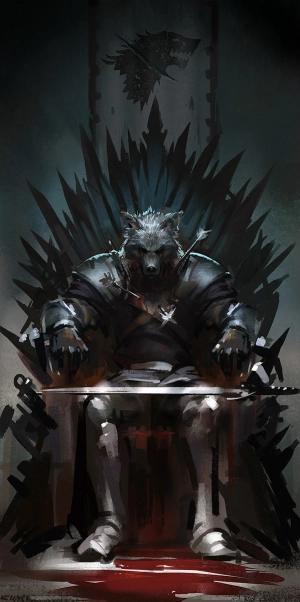
Young Wolf by Saejima (fan pop)
As we heard last time, the Starks may descend from Garth the Green via Brandon of the Bloody Blade who may have been an ancestor of Bran the Builder. That kind of goes together with the idea that the Barrow Kings descend from Garth, because if Garth and his descendants came north, it is very likely that traces of them could be seen in more than one House. I didn’t mention this before, but there is other evidence of Stark activity in the south in the time before the Long Night. Brandon the Builder is associated with building or designing two of the greatest castles in southern Westeros – the final version of the Hightower of Oldtown as well as great keep of Storm’s End. In other words, whomever or whatever was behind the northern myth of Bran the Builder travelled around quite a bit. Perhaps the myth itself originated in the south and travelled north with the descendants of Bran the Builder and Brandon of the Bloody Blade, or perhaps Bran or the group of people collectively remembered as ‘Bran the Builder’ made their first constructions in the south before migrating northward. Either way, it can be taken as strong evidence of Stark activity in the South in ancient day, and as possible corroboration for a southern origin for House Stark as well.
Those two locations where Bran was said to have helped a great lord build his mighty keep – Oldtown and Storm’s End – are of course noteworthy in their own right for their connection to horned folk. Oldtown is in the Reach and not far from Highgarden, home of Garth the Green, the horned green god, and the man whom Bran would have been helping to build the Hightower was Uthor of the Hightower, who was also said to have taken a daughter of Garth the Green to wife, Marris the Most Fair. At Storm’s End, Bran would have been giving architectural advice to Durran Godsgrief, and Durran is a horned lord in his own right as we have seen, founding a line of stag-men who wear antlered crowns and antlered helms.
In other words, Bran the Builder’s ties to these two southern places and their horned god legends lines up well with the idea of Brandon of the Bloody Blade being a son of Garth and an ancestor to House Stark. If that is the case, the story of their house is very similar to the Barrow Kings. Descendants of the First Green Man King, come to the north to become the lords of death and winter. It makes sense in terms of Westerosi cultural history, because both the Starks and the Barrow Kings might descend from Garth and therefore share a common origin for their myth, a green man story adapted to the more northern themes of winter and death. .
The idea of a green horned lord coming north to die and become the King of Winter is actually depicted at the very beginning of Game of Thrones, when Robert the Green Horned God King comes north to Winterfell and heads straight for the crypts! When Robert arrives, Ned in fact acknowledges Robert’s dominion over Winterfell with his very first words spoken to Robert, greeting him with “Your Grace. Winterfell is yours.” They head down into the crypts, and Robert wages a one-man contest to see how many times he can foreshadow his own death in one scene, including the not-very subtle example of Robert saying that sometimes he wishes he had lost at the Trident, or when King Bobby B speaks of drinking himself into an early grave. That’s pretty much asking for it, in retrospect. In particular, there’s something going on with Robert’s laughter I want to key in on:
Robert laughed, the sound rattling among the tombs and bouncing from the vaulted ceiling. His smile was a flash of white teeth in the thicket of the huge black beard.
The word rattle evokes a death rattle, especially when it echoes amongst the tombs. Martin pulls a similar trick in the scene where Bran and Jojen and Meera realize Coldhands is a corpse. Coldhands’ speech is described with the line “his voice rattled in his throat, as thin and gaunt and he was.” Coldhands voice is a death rattle, and here in the Winterfell crypts, Robert’s laughter is too. A bit later in the crypt scene with Ned, Robert tells the infamous ‘the king eats, the hand takes the shit’ joke and laughs:
He threw back his head and roared his laughter. The echoes rang through the darkness, and all around them the dead of Winterfell seemed to watch with cold and disapproving eyes.
Finally the laughter dwindled and stopped. Ned was still on one knee, his eyes upraised. “Damn it Ned,” the king complained. ” You might at least humor me with a smile.”
“They say it grows so cold up here in the winter that a man’s laughter freezes in his throat and chokes him to death,” Ned said evenly. “Perhaps that’s why the Starks have so little humor.”
And now we know how Coldhands died – one to many jokes on the Wall. Dolorous Edd better be careful, he could kill everyone. Kidding aside though, Ned is pretty clearly turning Robert’s rattling laughter around and warning him that it can cause death and freezing, and his message is punctuated by the cold, disapproving glare of the stone Kings of Winter around him. There’s even a match for this at Renly’s death, which Brienne describes in the immediate aftermath by saying “He was laughing one moment, and suddenly the blood was everywhere.”
Robert goes on to talk of how Ned and he should have been brothers by blood if he had married Lyanna, and that’s actually what is going on here, with Ned and Robert playing the ‘summer king / winter king as brothers who kill each other’ version of the corn king cycle. In truth, Robert and Ned love each other of course, but their actions cause each other’s death, as prophesied in the opening chapter of AGOT when they find the clear omen of the direwolf mother killed by a stag antler. Robert enters the crypts as the summer king, talking of the bounty and fertility of the south, and he names Ned the Winter King with his words of greeting, telling Ned how good it is to see “that frozen face of yours.” The entire chapter consists of a kind of tug of war, with Ned saying “you should really come see the Wall and the Night’s Watch, and try not to laugh so much because it can kill you,” and Robert is constantly trying to get Ned to laugh and talking of teaching him to laugh again by showing him the rich fruitfulness of the south, and then finally taking Ned south to help him rule.
So in terms of depicting the cycle of the seasons as a fraternal affair, Ned and Robert are separate people, one symbolizing the winter stage of the cycle and one the summer. But in many versions of the corn king mythology, all the stages of the cycle are represented by one deity, and in that context, the Winter King is actually a foreshadowing of the fate of the Summer King, and vise versa. Ned’s King of Winter role is simply the death and winter phase of the corn king cycle, as with the Barrow King, while Robert’s is the summer and vitality stage. That’s why it makes sense to depict Robert as the honorary lord of Winterfell while foreshadowing his death in Winterfell’s crypts – a dead horned god is analogous to the winter king, or this case, the King of Winter.
There’s even a line in the crypts where Robert is telling Ned that he wants him at his side again because he is surrounded by traitors and false flatterers, and then it says “Robert looked off into the darkness, for a moment as melancholy as a Stark.” In other words, when Robert gazes in the darkness of the tomb and stares at his own death, he look like a Stark.

An illustration of Julius Caesar’s claim of human sacrifice via wicker man
In fact… Martin may very well have taken the title “King of Winter” from a specific bit of green man folklore also known as “the wicker man.” A few of you might be familiar with a British cult horror movie from the 70’s of the same name, the plot of which RadioHead actually just recreated in their music video for “Burn the Witch” as a matter of fact… but the wicker man is originally a Celtic druid practice. According to Julius Caesar in his Commentary on the Gallic War, the druids built man-shaped wicker cages in which they burnt people alive. Historians doubt the human sacrifice aspect of this however, as there is really no other evidence to support it. What has survived of the wicker man tradition is the burning of wicker man effigies at various neb-pagan festivals. (This is actually where the idea of burning a large wooden man at the Burning Man festival in Nevada came from.)
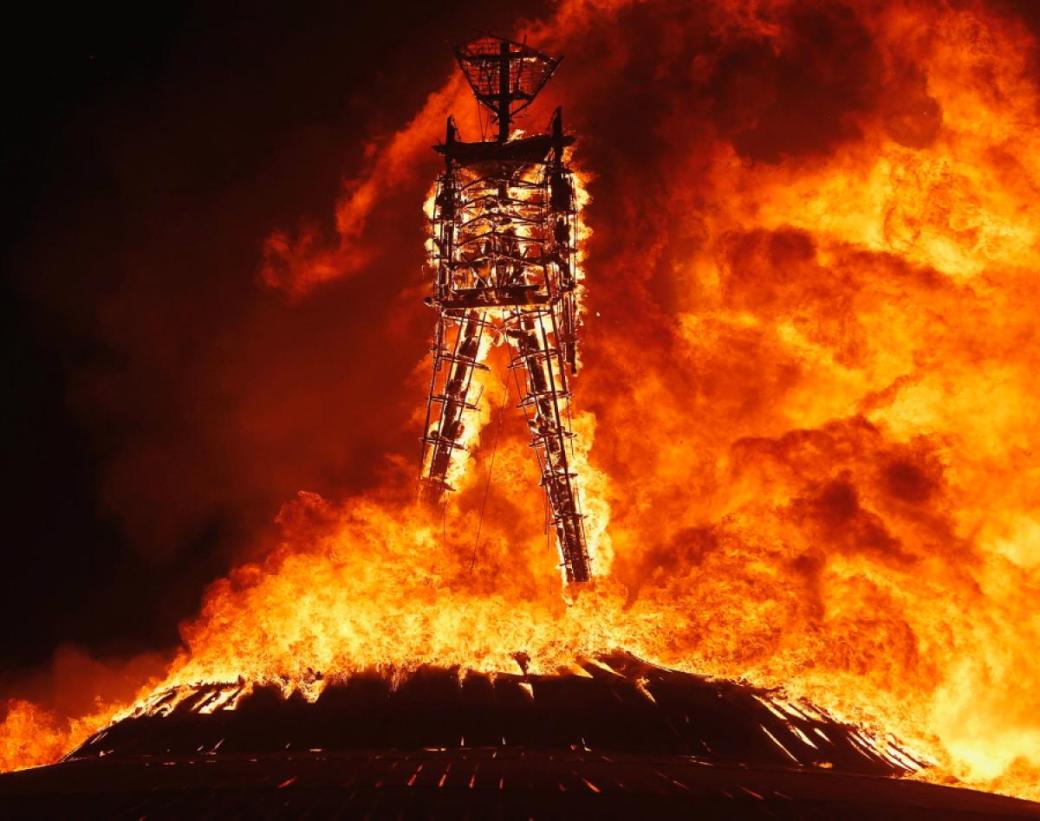
The Burning Man Festival, Blackrock City, Nevada
In particular, there is a practice of making a small green man with extra shoots and leaves from your garden in the fall. You are supposed to keep it through the winter as the greenery dries out and dies, and during this time the wicker man is called “the King of Winter.” It’s a green man, but it’s dead – and it’s the King of Winter. It’s more like a straw man, a wicker man, or a wooden man. In other word, when I tell you that the King of Winter was a formerly green man of some kind, it’s actually not the slightest bit tinfoily or far-feteched – indeed, it’s clearly suggested by the title “King of Winter.”
So you save your King of Winter all winter long, and then the spring comes, and with it, Beltane… what do you do with your dead green man, now that his winter reign is over? You burn him, of course.
That’s pretty interesting – burning a green man when spring arrives? Spring is usually when the corn king is resurrected, but we can quickly see that in ASOIAF, burning and resurrecting a corn king can be the same thing, particularly if Jon the dead corn king is resurrected by fire magic to help end the Long Night and bring the spring or if the same was true of the last hero. A burning, resurrected green man is also exactly what we see in our fiery undead stag men, resurrected Renly with the ghostly green armor and antlers of golden flame, and half-a-corpse Stannis of the fiery hart and the fiery heart.
Now because King Robb Stark made Jon his heir in a will which may or may not surface in TWOW, resurrected Jon may well become the actual King in the North, and King in the North is just the more modern version of the King of Winter title. Jon is already “Lord Snow,” which is just another way of saying King of Winter, if you think about it. So, if Jon is resurrected by fire and becomes the King of Winter and helps to bring the spring time… he’ll be a stunningly accurate incarnation of the King of Winter. Jon isn’t a green man or made from garden shoots, but he is a corn king and a skinchanger, and skinchanger magic is just a part of greenseer magic. Thus we can see Jon the undead skinchanger will make an excellent King of Winter, and at the same time, he’ll actually be becoming his own version of Azor Ahai reborn as a fiery undead King of Winter. As they say… “titles, titles.”
What’s this now? Azor Ahai reborn as the King of Winter? Well, look – we don’t know know how many different people contribute to the combined myth of the magic sword hero who defeats the Long Night, just as we don’t know how many ‘Bran’s are a part of the Bran the Builder legend or how many Durrans there were and which did what. But yes – the King of Winter is like a frozen, dead Azor Ahai, but one who also burns in the spring. It’s some kind of ice and fire duality – surprise surprise. Consider the first King in the North we see in the books, Robb Stark. He has the Tully looks – kissed by fire red hair, and striking blue eyes that could remind us of the Others, and of course there is a long history of associating the eyes of Starks with ice, including a Brandon Ice Eyes Stark, an ancient King in the North, and all of the stone kings of winter who are described as having “eyes of ice.” Stannis shows us similar imagery when Dany sees him in her House of the Undying vision as a “blue-eyed king with a red sword.” If we had more time we could also mention Jon Connington, the ‘Red Griffen Reborn’ who also has eyes of ice and kissed-by-fire red hair, and who wears a red wolf pelt to combine the symbolism of fire and the Starks… he’s also known for keeping the night watch while they are on the riverboat on the Rhoyne… but we don’t have time for that, so let’s talk about Robb, the actual King in the North / King of Winter that we see in the books.
Dark and Strong to Fight the Cold
This section is brought to you by Patreon supporter and priestess of the Church of Starry Wisdom Cinxia ,Queen of the Summer Snows and Burner of Winter’s Wick
Robb Stark is indeed meant to show the archetype of the King of Winter, have no doubt. All the kings of Winter in the Winterfell crypts are in the same distinctive pose – enthroned, with a wolf at his side and an iron longsword across his lap. The sword are supposedly to keep the vengeful Stark spirits in their grave, but they might also be a warning to trespassers. The latter is the modern accepted meaning of a Stark lord laying open steel across his lap – “everyone knew what that meant,” as Bran says when Robb does it to Tyrion in AGOT. It’s a denial of hospitality, the opposite of invoking guest right. The point is that Robb appears this way to us twice – once in AGOT, as I said, and more impressively in Catelyn’s first chapter of ACOK, the first time we see Robb crowned as the King in the North. It’s a longer quote, but worth considering. He is greeting us exactly the way a King in the North should. This is the opening of the chapter:
Her son’s crown was fresh from the forge, and it seemed to Catelyn Stark that the weight of it pressed heavy on Robb’s head. The ancient crown of the Kings of Winter had been lost three centuries ago, yielded up to Aegon the Conqueror when Torrhen Stark knelt in submission. What Aegon had done with it no man could say. Lord Hoster’s smith had done his work well, and Robb’s crown looked much as the other was said to have looked in the tales told of the Stark kings of old; an open circlet of hammered bronze incised with the runes of the First Men, surmounted by nine black iron spikes wrought in the shape of longswords. Of gold and silver and gemstones, it had none; bronze and iron were the metals of winter, dark and strong to fight against the cold.
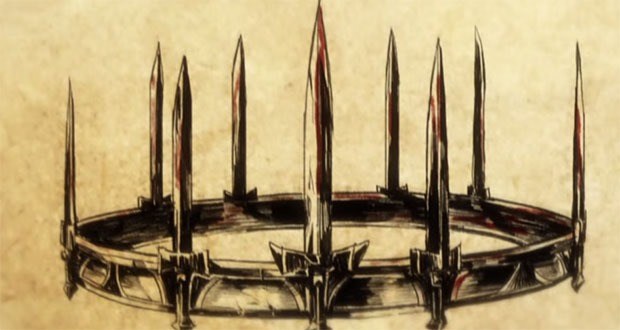
The King of Winter’s crown (artists unknown – please let me know if you know who created this!)
This is a big hint that the King of Winter is someone who fights against the cold. As I’ve pointed out elsewhere, such as in the Tyrion Targaryen episode, Winterfell is indeed an oasis of heat and warmth in the frozen north, a bulwark of heat against the cold. You could read “King of Winter” as implying a king who uses the forces of winter, like the original king of the Others or something, just as you could interpret “Winterfell” to mean the place from which Winter falls, the source of winter, and just as you could interpret “winter is coming” as a threat – the King of Winter is coming to kill you. But you can also interpret ‘the King of Winter’ as the king over winter, the king who defeated winter – and that’s what is implied here by his having dark and strong metals to fight the cold. You could likewise interpret Winterfell to mean “the place where winter was felled,” as in defeated, and “winter is coming” as a warning to prepare to fight the winter.
These two ideas are not even mutually exclusive, as often times a victorious warrior will take on the trappings of the one he defeated, such with Orrys Baratheon becoming the new storm lord after defeating the old one. The idea is that by defeating something powerful, you gain its power, and that is really what I think is up with the King of Winter. It ends up as an ice and fire duality, where the King of Winter is a chilly dude who uses various forms of fire to master the forces of winter. Recall Stannis as the blue-eyed king wielding a red sword, Robb as a blue-eyed king with kissed-by-fire red hair, and recall Jon dreaming of wielding a burning red sword while armored in “black ice.”

Ned Stark with Ice, by John Picacio
Ned is introduced to use with a sword called Ice which is named after the original sword of the King of Winter, and that makes us think of the King of Winter or the Lord of Stark as an icy fellow, but the sword ‘Ice’ is actually a smoke dark, nearly-black Valyrian steel blade forged in dragonfire with Valyrian magic. Again, it’s the ice and fire unity idea. It seems odd at first to see a dragon sword in the hands of the champion of the North, but again – dark metals to fight the cold. In fact, Ned’s sword is more properly named “black Ice,” since it’s a nearly-black sword called Ice, and this causes us to wonder if Jon’s black ice armor is actually a clue about him needing some Valyrian steel armor, if any such thing happens to be lurking around somewhere.
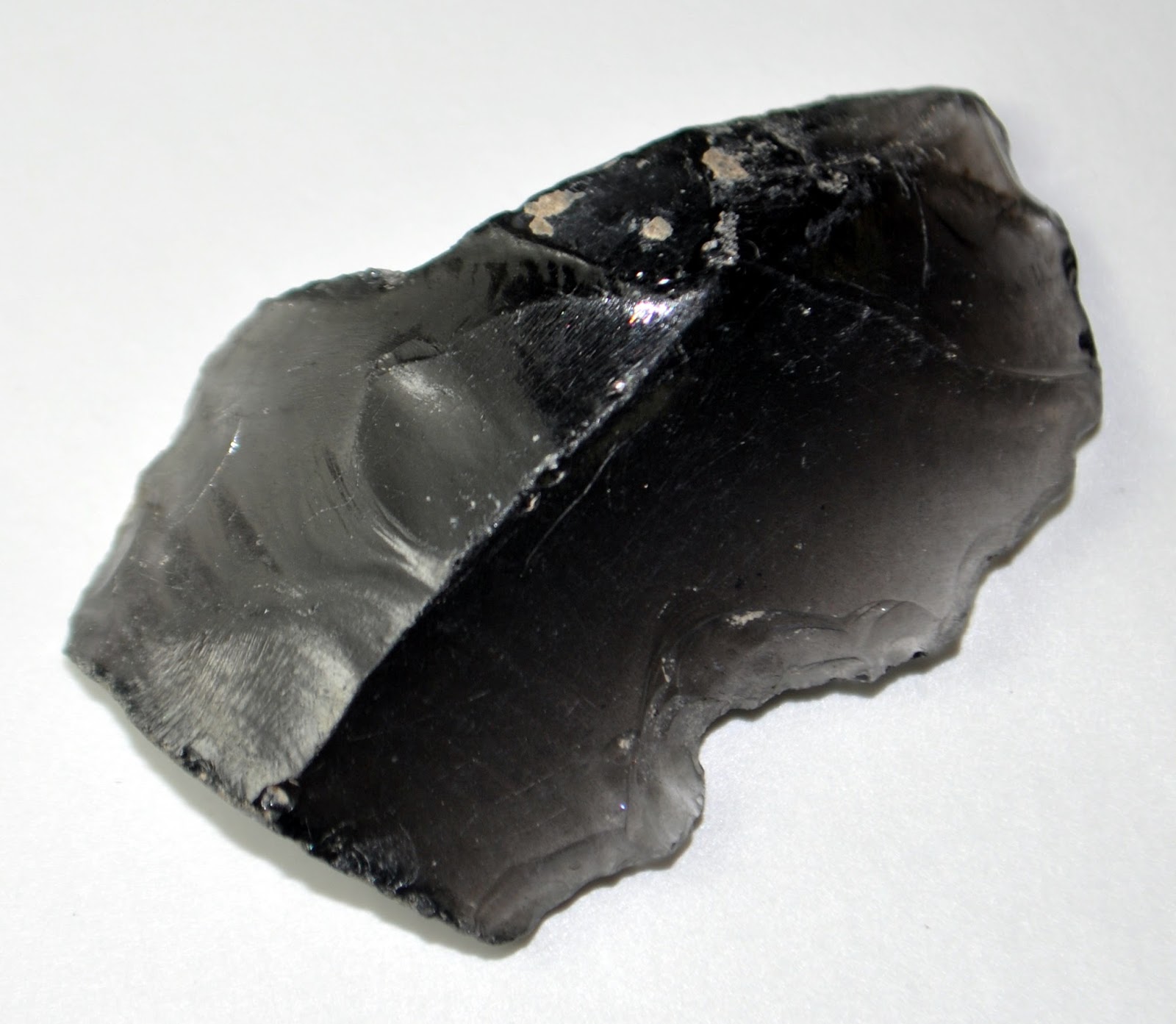
black ice?
If the symbol of “black ice” refers to Valyrian steel, then I would suggest that obsidian, which the Valyrians called frozen fire, is playing in to the black ice symbolism as well. Obsidian actually look like black ice, and Martin is already telling us that it is frozen. It can be called frozen fire because it is literally cooled magma, just as steel swords are created in a molten state before hardening or “freezing” in place. Most importantly, Valyrian steel probably kills Others, and dragonglass definitely does. If Valyrian steel is black ice that kills Others, then dragonglass must surely be black ice as well, at least that’s my thinking.
Frozen fire is actually the best way to summarize all of this ice and fire mixing with the King of Winter – he has an element of fire, but it’s frozen and black, just like cooled and hardened Valyrian steel or dragonglass. Valyrian steel, obsidian, and the King of Winter – all dark and strong and fighting the cold.
The scene with Robb continues:
When the guards brought in the captive, Robb called for his sword. Olyvar Frey offered it up hilt first, and her son drew the blade and laid it bare across his knees, a threat plain for all to see. “Your Grace, here is the man you asked for,” announced Ser Robin Ryger, captain of the Tully household guard. “Kneel before the king, Lannister!” Theon Greyjoy shouted. Ser Robin forced the prisoner to his knees.
It’s a threat plain to see, and it’s the exact pose of a King of Winter. Next, pay attention to his sword:
“Rise, Ser Cleos.” Her son’s voice was not as icy as his father’s would have been, but he did not sound a boy of fifteen either. War had made a man of him before his time. Morning light glimmered faintly against the edge of the steel across his knees.
Oh my, it’s a sword of the morning gleaming with dawn light. In the hands of the King of Winter. Some of you may be familiar with the theory that Dawn is actually the original Ice of House Stark, which I personally think is likely to be the case, and even if not, we can see a general symbolic overlap between the King of Winter and the last hero and using a sword to bring the morning. We have yet to figure out how House Dayne and House Stark both figure into the last hero story in terms of bloodlines, though we may not ever be able to beyond a general association. Nevertheless, the sword shining with morning light is a pretty good clue about the King of Winter having something to do with the last hero and ending the Long Night.
And lest we think that’s simply a poetic description and not a double meaning, here is Tyrion describing his memory of Robb meeting him with steel across his lap from the throne of the Kings of Winter:
He remembered Robb Stark as he had last seen him, in his father’s high seat in the Great Hall of Winterfell, a sword naked and shining in his hands. He remembered how the direwolves had come at him out of the shadows, and suddenly he could see them again, snarling and snapping, teeth bared in his face.
This time the sword is naked and shining – that’s pretty powerful imagery, and it starts to become hard to explain as a coincidence. Robb’s hellhounds emerge from the shadows, and the same thing happens in the scene with Robb holding court at Riverrun:
Yet it was not the sword that made Ser Cleos Frey anxious; it was the beast. Grey Wind, her son had named him. A direwolf large as any elkhound, lean and smoke-dark, with eyes like molten gold. When the beast padded forward and sniffed at the captive knight, every man in that hall could smell the scent of fear. Ser Cleos had been taken during the battle in the Whispering Wood, where Grey Wind had ripped out the throats of half a dozen men.
Here’s the thing about Cleos being afraid of the beast and not the sword: the beast IS the sword, in a manner of speaking. Grey Wind is described as “smoke dark,” and of course “grey wind” is a good way to describe billowing smoke clouds, but what it is important is that “smoke-dark” is also the description of Valyrian steel. The very first one, in fact, when we see Ned’s Ice: it’s called “spell-forged and dark as smoke.” When Jon Snow examines Longclaw with Sam in AFFC, it’s more of the same as Longclaw is described as “smoke-dark metal.” Longclaw is of course ornamented with a pale stone pommel in the likeness of Ghosts’s head, again drawing an analogy between the Valyrian steel sword and the direwolf. In addition to being the color of Valyrian steel, Grey Wind’s eyes are molten gold, adding to the general fiery symbolism present here and the idea of a fiery hellhound, and the notion of molten metal adds to the picture of Grey Wind as a sword. To punctuate this, one of the first things Robb demands of Cleos and the Lannisters after setting Grey Wind loose is that they return his father’s sword, ‘black Ice.’
As for that sword… well, Robb wasn’t getting it back, as it was instead split in two and made into a pair of Lannister swords. Funny thing, though, when Joffrey is given one of those swords at his wedding, Widow’s Wail, we read that “red and black ripples in the steel shimmered in the morning light” – just like Robb’s sword did when he was playing the role of King of Winter, and that’s no accident. Robb’s sword at Riverrun represented the sword of the King of Winter, and Widow’s Wail used to be the actual sword of the Starks, ‘black Ice.’
There is only one other time in the entire series that a sword glimmers or shimmer with morning light, and unsurprisingly, the culprit is Longclaw, where Lord Commander Jon Snow is “watching the play of the morning light across the ripples” of its blade in ADWD as he contemplates executing Janos Slynt. Just to make things abundantly clear, it happens again at the end of that same Jon chapter when he actually executes Janos; “pale morning sunlight ran up and down his blade” as he raises it high to strike the killing blow. This is yet another confirmation that Jon is fated to wield a sword which brings the morning, which may or may not be Dawn – two of the three swords that shine with morning light are made of dark Valyrian steel, after all. That’s a debate we can’t get caught up in right now, and I really could see it going either way, but the point her is the very clear association between the King of Winter and a sword which shines with morning light.
One last note on that Joffrey scene with Widow’s Wail – there is last hero math here. When he is looking for a name for the sword, he calls out for suggestions, and it says that “Joffrey dismissed a dozen before he heard one he liked,” which makes ‘Widow’s Wail’ the thirteenth member added to a group of twelve and thus symbolic of the last hero. That fits with my notion of the last hero or King of Winter as sort of frozen fire, a mix of fire and ice which can fight the cold, and further associates Valyrian steel with the last hero.
Like his sword, Joffrey too gets the last hero math in Jamie’s weirwood stump dream – that was the dream where Jaime found himself in the bowels of casterly Rock, wielding a silvery-blue flaming sword with Brienne and being confronted by various ghosts and spectres. He sees his son Joffrey, and behind him “a dozen more dark shapes with golden hair” – again, it’s one thing leading group of twelve, and “dark shapes” makes them sound like ghosts or dead things.
Jaime himself, Joff’s true father, was in turn prodded down the hallways of Casterly Rock in this dream by “a dozen tall dark figures in cowled robes that his their faces” who all hold spears, which puts Jaime in the last hero role, and this just emphasizes the idea of the last hero / Azor Ahai relationship as some sort of cycle or father / son type of thing. Those twelve nodded dream figures are pretty creepy, I have to say, and they remind me of Coldhands, whose face is also hidden by his cowl when Sam meets him.
Now it must be said, Joffrey makes for a shitty last hero, but I think the thing to focus on is his symbolism. Although Joff isn’t really Robert’s son, he wears a stag crown and claims Baratheon descent, making him a type of solar horned lord. On the day he is given the former sword of the Starks, gleaming with morning light, he dies.. which makes perfect sense if you subscribe to my awesome theory about the last hero becoming an undead skinchanger and then going out to fight the Others. Joff dies of strangulation, too, like so many other sacrificed figures with neck or throat wounds such as Jon, Renly, Beric, Robb (beheading counts as a throat wound, I’d say), and probably Coldhands. Even Cressen is wearing Patchface’s mockery of an antlered helm when he dies by ‘the Strangler,’ the same poison used on Joffrey.
Hearkening back to the last episode when we discussed the pattern of green horned folk and red horned folk killing each other, it’s worth noting that Joffrey’s death fits the pattern. The person who everyone thinks killed Joff is Tyrion, with his possible secret Targaryen lineage and copious demon and gargoyle imagery (you’ll recall the armorer in King’s Landing offering to make Tyrion a ferocious demon helmet, complete with horns, for example). Joffrey was actually killed by Lady Olenna, or perhaps you might say House Tyrell as a whole, and of course the Tyrells are the current occupants of Highgarden, the place associated with Garth and his Gardener kings.
The Supper After the Last Supper
This section brought to you by Direliz, the Alpha Patron, the earthly avatar of heavenly House Aquarius the Water-Bearer. A descendent of Garth the Green by way of Gilbert of the Vines, founder of House Redwyne.
Let’s actually talk about Robb’s death for a moment, and get these stupid Lannisters out of our King of Winter section. Robb dies tragically at the Red Wedding, and naturally, his death fits the same pattern. First of all, he was remotely “killed” by Mel and Stannis’s burning of the leeches, meaning that in a certain sense, he was killed by Stannis, a burning stag, half-corpse blah blah blah you know the drill. The actual killing blow came from Roose Bolton, who as we all know is an immortal skinchanging bodysnatcher.
Say what now? You haven’t heard of the Bolt-on theory that says that the spirit inhabiting the body of “Roose Bolton” is actually an eight thousand years old skinchanger who simply bodysnatches a new body when the current one gets old? Do yourself a favor and google that one when you are done with this. It sounds crazy, but there is just enough evidence to drive you mad thinking about it… but whether or not it’s true, it’s easy to see that the Boltons, who flay their enemies and are said to “wear their skins,” including the skins of a few Starks, can at the very least symbolize vampire skinchanger people. Additionally, Ramsay Snow has a weird kind of matching symbolism to Jon Snow. The other people responsible for killing Robb would be the Freys, and I actually am not sure if they fit the pattern, as they have no horns or skinchanging symbolism. We’ll just have to let Martin off the hook for that one, what can I say.
Robb wasn’t burned, as the wicker man King of Winter is, however in the same sense that he was killed by Stannis, you could also say he was killed by fire magic. When news of his death and the grisly stunt with the wolf head reaches Stannis, Melisandre, and their supporters, Axel Florent says that “it was the Lord’s wrath who slew him,” suggesting Robb’s death by fire in a symbolic sense. Just as beheading surely counts as a neck or throat wound, I’d have to say the being killed by a fire god counts for being burned.
The cool thing about dead Robb is that he is loaded with symbolism. Robb appears to us twice in vision form as a living corpse – once in Dany’s House of the Undying vision and once in a nightmare of Theon Greyjoy’s – and both times he appears as part of a feast of the dead. In the House of the undying, Dany sees Robb as “a dead man with the head of a wolf,” sitting on a throne and presiding over a feast attended only by corpses, like some grisly, beyond-the-grave version of the Last Supper of Jesus and the twelve disciples. And yes, that’s last hero math for Jesus, which at this point should not surprise you. In another podcast, I will explain how all of this relates to the zodiac, which is really the source of all of these twelves. The thirteenth in that case is usually the Morningstar, Venus, and accordingly, Jesus is a Morningstar deity, which we covered in our Lucifer means Lightbringer episode.

The King of Winter as an undead wolf-man
In any case, this vision of dead, wolf-headed Robb is a fairly clear foreshadowing of the barbaric stunt the Freys pull by mounting the head of Grey Wind on Robb’s headless corpse after the Red Wedding. But you know what else it might be foreshadowing? Undead Jon, the King of Winter, as a wolf-man, perhaps in the sense that we proposed in the last episode where Jon’s spirit merges with Ghost’s and the merged wolf/man spirit is what is returned to Jon’s body. At the very least, this vision of dead, wolf-headed Robb suggests an undead skinchanger, a part-wolf, part-man who is a walking corpse.
Robb also wears the black iron crown of the King of Winter in this vision probably just to make sure we know who we are talking about here. One other note on that crown of the King of Winter, which is nine iron longswords on a bronze circlet – it sounds a lot like the wartime crown of the Gardener Kings, even more than the rusted crown of the Barrow Kings does. The crown of the Gardener Kings was wrought in the shape of bronze and later iron thorns, and there is ample symbolism comparing swords and thorns in the series, so the two crowns really are a pretty good match. You’ll also note that the Gardener’s crown of thorns is very suggestive of the mocking crown of thorns that Jesus was made to wear at his crucifixion.
The other vision of Robb as a corpse King of Winter comes to Theon in a nightmare, and like Dany’s vision of corpse Robb Stark, it too comes in ACOK, before Robb’s actual death, and is thus a foreshadowing of his death. Theon’s dream starts with a memory of the feast thrown for Robert when he came to Winterfell, tying this scene to that chapter with Robert in the crypts telegraphing his own death. But then the music and wine turn sour, and Theon sees that the is dining with the dead – linking this scene with Dany’s HOTU vision of corpse Robb at a feast of the dead. Dead wolfman Robb was at the head of the table in that vision, but here it is dead king Robert, emphasizing the link between the horned god (Robert) and the King of Winter (Robb). Robb is of course named after Robert, which now earns a little chuckle from you and me. Here is the corpse feast from Theon’s dream Winterfell:
King Robert sat with his guts spilling out on the table from the great gash in his belly, and Lord Eddard was headless beside him. Corpses lined the benches below, grey-brown flesh sloughing off their bones as they raised their cups to toast, worms crawling in and out of the holes that were their eyes. He knew them, every one…
It then lists all the people Theon had a hand in killing, plus a few he didn’t such as Lyanna and Brandon Stark, Ned’s siblings. Which reminds me – the grisly murder of Rickard and Brandon… well, Rickard is burned like a true King of Winter, and Brandon is strangled, like all of the other throat-wound sacrificial victims. But continuing with Theon’s nightmare of the corpse feast:
Along the walls figures half-seen moved through the shadows, pale shades with long grim faces. The sight of them sent fear shivering through Theon sharp as a knife. And then the tall doors opened with a crash, and a freezing gale blew down the hall, and Robb came walking out of the night. Grey Wind stalked beside, eyes burning, and man and wolf alike bled from half a hundred savage wounds.
This terrifying vision of a corpse King of Winter again unites fire and ice – the cold winds swirl about Robb, but his wolf, Grey Wind, has eyes which are burning like a true hellhound. We hear that half the hells are frozen in Westerosi folklore, so perhaps the King of Winter simply has all the powers of hell behind him, of both ice and fire. And boy does he look pissed. Great Caesar’s Ghost! That’s what you get for having a corpse feast without inviting the King of Winter.
So why the corpse feast associated with the King of Winter? Well, two reasons, I believe. The first is to show an inversion of the bounty and vitality of the fertility god, as with everything else about the King of Winter and the Barrow King – that seems straightforward enough.
The second would be to specifically invoke the Last Supper, which was the final meal Jesus had with his twelve disciples before he was betrayed by one of them, arrested, tried, and crucified… and then, famously, resurrected. The parallels between Jesus and our image of the last hero are really apparent, so casting the corpse King of Winter as Jesus is essentially a clue about the King of Winter having something to do with the last hero and ending the Long Night.
As I mentioned, Jesus is a Morningstar figure, and like the various corn king figures, Morningstar deities are killed and resurrected, just not in conjunction with the cycle of the seasons. Jon and the last hero are thoroughly draped in Morningstar symbolism, just as they are with corn king symbolism, so what we are seeing here with dead Robb and the last supper for the dead is the King of Winter joining the club. The King of Winter is already a resurrected green man figure, and now he has Morningstar symbolism to go along with it. We actually saw Morningstar symbolism with the King of Winter already with all the shining swords glimmering with morning light. Once again, all of this is basically telling us that this figure of the undead King of Winter is a weird kind of savior figure, and that’s more or less the premise of this series about skinchanger zombies.
We are almost done with Robb, but this Theon chapter with the corpse feast does end with a nice clue about Starks and horned people which I cannot pass up:
On their iron spikes atop the gatehouse, the heads waited. Theon gazed at them silently while the wind tugged on his cloak with small ghostly hands. The miller’s boys had been of an age with Bran and Rickon, alike in size and coloring, and once Reek had flayed the skin from their faces and dipped their heads in tar, it was easy to see familiar features in those misshapen lumps of rotting flesh. People were such fools. If we’d said they were rams’ heads, they would have seen horns.
These heads are not really Starks, but they are representing Starks, and we are given three pieces of information about these heads – and they are all clues in the same direction. They have been skinned, suggesting skinchanging (and of course Bran and presumably Rickon are skinchangers anyway); they are actually the children of a miller – think of milling as in milling corn, creating a corn king association with ‘dead’ Bran and Rickon; and of course the final line about them having horns like a horned lord.
Robb actually gets a horned reference too in a less direct fashion. In AGOT, as he awaits to cross the Twins, he agrees to the marriage pact with an unspecified Frey girl in order to cross, and we have this:
They crossed at evenfall as a horned moon floated upon the river. The double column wound its way through the gate of the eastern twin like a great steel snake, slithering across the courtyard, into the keep and over the bridge, to issue forth once more from the second castle on the west bank. Catelyn rode at the head of the serpent, with her son and her uncle Brynden and Ser Stevron Frey.
Try to picture this scene from the river: the reflected image of the horned, crescent moon appears to float on the surface of the river, and at this moment, a steel snake slithers across the river. The image we get is of a horned serpent, which is of course another way of saying “dragon.”
The more important thing here though is the foreshadowing. The horned moon connotes sacrifice, being compared to sickles and curved knives, especially in Bran’s last chapter in ADWD where the moon is four times described as “a crescent, thin and sharp as the bade of a knife,” and don’t forget that the chapter ends with a human being sacrificed in front of the heart tree with a sickle shaped blade. Not only do the crescent moon and horned moon resemble the curved blades often used in ritual sacrifice, they also resemble the horned animals who are sacrificed, like stags, bulls, goats, and rams. You’ll notice the classic horned god figure is the embodiment of all of this, having horns and also being ritually sacrificed. And although he’s a solar figure himself, he is often pictured at night with a crescent moon floating above his head, in between his antlers.
So now that we’re all up to speed on sacrificial aspect of the horned moon symbolism, we can see that this is indeed an omen, a bit of foreshadowing – it’s not a good sign that he horned moon appears on the river as Robb’s army crosses the river. As we all know, Robb and his army will indeed be slaughtered when they returns here to the Twins for the Red Wedding. There’s other death foreshadowing in this scene too – as they pass through the castles on either end of the bridge, the glittering eyes of Walder Frey and his Frey-folk peer down at the Starks through the ‘murder holes.’
I am proposing that the dead King of Winter is a personification of the winter and death phase of the horned god resurrection cycle, so it’s really quite nice to see the horned moon used to foreshadow Robb’s death. I mean it’s not nice nice, but it fits the symbolism we find elsewhere, which is always a good thing.
Whispers in the Wood
This section is brought to you by Patreon supporter Ser Imriel of Heavenly House Orion, earthly avatar of the Sword of the Morning and spinner of the great wheel
So far, Robb Stark has given us a ton of information about the King of Winter, tying him to the last hero, the sword that brings the morning, the horned god ideas, and to being a zombie wolfman skinchanger. To this I would add the suggestion of the King of Winter as a greenseer, and that comes at the scene of Robb’s greatest victory, the battle of the Whispering Wood. That chapter opens with “the woods were full of whispers,” and the very idea of a whispering wood is simply a clever way of referencing greenseers and weirwoods, because whispering is the communication of the weirwood, as we have seen many times. The wood that is full of whispers is the weirwoodnet, and that is precisely where we find the King of Winter, fighting a battle. Hmm, this is starting to sound like The Matrix or Lawnmower Man or something.
The first thing that stands out is the whispering wood seems to be attacking along with Robb as if they are one. As the battle begins, Robb’s soldiers conceal their weapons under the thick carpet of dead leaves which covers the ground, and his bowmen let loose while hidden in the trees. The exact line as they spring their trap was “the whispering wood let out its breath all at once, as the bowmen Robb had hidden in the branches of the trees let fly their arrows..” In other words, the exhalation of the whispering wood is the storm of arrows.
We saw the same thing when the mountain clans dressed up as trees and shrubs and attacked the Ironborn at Deepwood Motte under the command of Stannis, who is of course an undead horned god / Azor Ahai figure. When Asha Greyjoy realizes why the trees seem to be creeping closer, she remarks..
Oho, these mountain goats have cloaked themselves in pine boughs.
Goats are of course a prime horned animal often chosen for sacrifice, so the implication here is of Stannis’s army of tree people as horned folk. That’s pretty explicit – people that are like horned animals and walking trees, and again, fighting for Azor Ahai reborn as a corpse-like burning stag. And remember Renly’s knights of summer? Consider this passage as Catelyn approaches the tent right before Renly’s murder:
The long ranks of man and horse were armored in darkness, as black as if the Smith had hammered night itself into steel. There were banners to her right, banners to her left, and rank on rank of banners before her, but in the predawn gloom, neither colors nor sigils could be discerned. A grey army, Catelyn thought. Grey men on grey horses beneath grey banners. As they sat their horses waiting, Renly’s shadow knights pointed their lances upward, so she rode through a forest of tall naked trees, bereft of leaves and life.
Renly is a sacrificed green man, and his army is a shadow army of dead trees. I actually forgot to mention this last time, but right after Renly dies, his green tent catches on fire, giving us the image of a burning green horned god, as resurrected Renly does at the Blackwater. Taken with Stannis’s army of tree-wearing northmen and Robb’s army attacking from inside the Whispering Wood, we can see that the dead horned god is supposed to lead an army of tree people in some fashion, quite possibly dead tree people.
Death symbolism abounds at the whispering wood as well. We mentioned that the weapons are concealed under a thick carpet of dead leaves, and as Robb marshaled his forces to deploy for this battle, we read that..
It was dark among the trees where the moon did not reach. When Robb turned his head to look at her, she could only see black inside his visor.
That’s pretty creepy, I have to say, and it’s a good way to reinforce this idea of the King of Winter as a dead person even while Robb is still alive. As the horns sound the attack of the Northmen, Grey Wind’s howling fills the whispering wood, and Catleyn thinks to herself “so this is what death sounds like.” Robb is like a grim reaper with a hellhound tolling the sound of doom, more or less. In other words, to the extent the King of Winter, the lord of the whispering wood, is a greenseer, he’s one associated pretty strongly with death. I would explain this by suggesting that he is simply a resurrected greenseer or skinchanger.
The idea of the King of Winter as a greenseer is also suggested in Bran’s vision of Ned which he sees through the eyes of there Winterfell heart tree while in Bloodraven’s cave hopped up on weirwood paste:
Lord Eddard Stark sat upon a rock beside the deep black pool in the godswood, the pale roots of the heart tree twisting around him like an old man’s gnarled arms. The greatsword Ice lay across Lord Eddard’s lap, and he was cleaning the blade with an oilcloth. “Winterfell,” Bran whispered. His father looked up. “Who’s there?” he asked, turning …
… and Bran, frightened, pulled away. His father and the black pool and the godswood faded and were gone and he was back in the cavern, the pale thick roots of his weirwood throne cradling his limbs as a mother does a child. A torch flared to life before him.
Notice the parallel here – Bran’s weirwood throne cradles him like a mother does a child, while the weirwood at Winterfell cradles Ned with an old man’s arms. This places Ned in the role of a greenseer, and I believe this is suggestive of the latent greenseer / skinchanger ability in the Stark bloodline. It also speaks of the King of Winter as an archetype: one who has weirwood branches wrapped around him. When he wakes, he tells Bloodraven that Ned could hear him, and Bloodraven responds that “he heard a whisper on the wind, a rustling amongst the leaves.” It’s the whispering wood motif again, a whispering to one descendent of the King of Winter from another descendent of the King of Winter.

Ned & Ice by Michael Komarck
There’s also a nice metaphor in a Bran chapter of AGOT. It may simply be poetic description, but Winterfell is described as a “grey stone labyrinth” which “had grown over the centuries like some monstrous tone tree.” Of course a stone tree is exactly what weirwoods become if they are killed – after a few centuries, they essentially petrify in place and turn to stone. The best example of that is with Nagga’s Ribs which are almost certainly petrified weirwood – I believe they are actually the ribbing of an overturned ship’s hull made from weirwood – but which are taken as the rib cage of a dead sea monster by the Ironborn. I wrote about that extensively in my Grey King and the Sea Dragon episode if you are curious, but the point here about Winterfell is simple. A dead weirwood tree is synonymous with a dead greenseer, because a greenseer becomes one with his weirwood tree. Winterfell being symbolized as a dead, stone weirwood fits perfectly with the idea of the dead greenseer King of Winter, a personification of the death phase of the corn king cycle.
Again, it may be nothing, but calling the stone tree of Winterfell a “labyrinth” may be a nod to the myth of the Minotaur, a bull-man monster who lived in side of the labyrinth. That’s a totally different line of horned symbolism from the corn king ideas, but I thought I would mention it. Is Martin trying to suggest a monstrous, horned, half-human / half-animal being inside of Winterfell, or inside its trees (as in ‘in the weirwoodnet’)? Does this have something to do with the seemingly magical truism that there “must always be a Stark in Winterfell?”
Here I will throw out one of my favorite little speculative predictions: there could be a weirwood throne underneath Winterfell’s heart tree, perhaps accessible through the crypts. If Bran ever leaves Bloodraven’s cave, this would be the logical place for him to end up, the true “Ghost in Winterfell.” Perhaps Jon might see it if he can ever carryout his dream of walking through the crypts to its full extent. This will no doubt allow the Stark sitting in this throne to wake all the Stark dead in the crypts and the lichyards and form an army of the dead to fight the Others.
It may be tinfoil, but there is ample foreshadowing of the spirits of the Kings of Winter rising somehow, including one of Jon’s dreams where they are literally walking out of their tombs. I would draw your attention back to Ned’s line in AGOT which is taken as a foreshadowing of Jon Snow as a King. Robert Baratheon says “I’ve never seen such a vast emptiness, where are all your people,” and Ned says they are likely too shy to come out, and that kings are a rare sight in the north, to which Robert famously responds “More likely they were hiding under the snow. Snow, Ned!” which is taken as a double meaning to refer to kings being under the snow, as in Jon Snow.
Robert’s intend meaning, however, is that Ned’s people are hiding under the snow, which suggests Ned’ s people as wights, who lie under the snow under nightfall. The Kings of Winter actually did bury their “faithful servants” in a lichyard in the shadow of the First Keep, as we learn in AGOT. So… if the undead King of Winter Jon Snow needs an army of the undead for some reason… I mean it’s right there is all I’m saying. We have dead winter kings and faithful servants both, ready to go.
Now even if none of that ever happens and the corpses stay in their graves and crypts, the repeated emphasis on the dead of Winterfell in general and the crypts in particular do effectively convey the idea of the Kings of Winter as the lord of death. Consider our very first glimpse of Ned – as an executioner, passing the sentence and swinging the sword… and teaching his children to do the same.
It must be said that just because the king of Winter is a death figure and a lord of the dead does not make him a villain by any means. Osiris and Hades are two well known “Lord of the Dead” figures, and they definitely would not be called villains. Mythology is full of resurrected heroes, even beyond the corn king traditions, as we saw in our Lucifer means Lightbringer episode where we examined the phenomena of Morningstar deities. And remember, we are actually looking for a zombie hero to save us from the zombie apocalypse. I think that man will be GhostJon, the fiery undead wolfman, corpse-king and corn king, Azor Ahai reborn as the King of Winter, the light that brings the dawn. As they say, titles, titles.
But he’s gonna need some help, he can’t do it on his own, can he? And neither did the last hero or Azor Ahai win their war alone, so it’s time to talk about the Night’s Watch and the last hero’s twelve companions. I hope you enjoyed that unpacking of the Barrow King and King of Winter mythology, and I am actually saving some of the best King of Winter material for the third head of this green zombie dragon, so we aren’t through yet. At the end of it all, I think it makes sense from a narrative point of view to use the mythologies of the the various houses in the North to tell us about the northern part of the War for the Dawn business, as seems to be the case. And what we see so far is a story about dead green men, in one sense or another.
The Last Hero and the King of Corn
Hey everyone, today we are going to talk about one of the more perplexing elements of ASOIAF, and that would be zombies. We’re to talk about a lot of things, like green men and the last hero and Coldhands and Jon Snow, but they will all be related to zombies. Resurrected people. The walking.. well you know. ASOIAF has got some serious zombie-creep going on, and I am pretty sure I know why. That is the point of this episode – to explain why exactly it is that George just can’t let sleeping corpses lie. It’s not only interesting for its own sake, it’s actually quite central to the puzzle of defeating the Others and dealing with the Long Night. This will be a bit of an unusual essay in that you don’t need to have read or listened to any Mythical Astronomy to understand what we will be talking about today. I may occasionally mention ideas we’ve discussed elsewhere, but for the most part, this essay will not be based on any previous theories. As is my general policy, we will be “spoilers all books,” but we will not discuss any TWOW sample chapters, nor anything from the TV show after seasons 5, which is the point where the show passed the books on most plotlines.
So, zombies. There are some transformed beings out there who blur the lines between life and death, but what we are going to talk about today are zombies. The reanimated dead. Human beings, brought back from death. We have seen three distinct varieties of them: icy undead, fire undead, and whatever you call what Qyburn did with Gregor’s corpse.
The first are the wights raised by the Others, which we will refer to as cold wights or icy undead. They rise with eyes like cold burning blue stars and are swathed in cold in every sense of the word – their flesh is frozen, and they make the air colder in their immediate vicinity, just as the Others do. They appear to have only the vaguest of remnants of memory and no free will whatsoever. They are zombies in the classic sense – they represent corpses reanimated with some kind of necromancy. I think it is safe to say they are reanimated by what we would call “ice magic,” although that’s a loose term by necessity, because we do not understand what if any delineations there are between what seem like different types of magic.
Coldhands is a bit of an unusual case, and I’ll offer my explanation for his current state in a moment, but for the most part, he’s also in the category of icy undead. He has important differences between himself and the cold wights such as speech, apparent free will and no blue star eyes, but in terms of physiology, he appears to be the similar to the cold wights – a dead and frozen corpse with no vital processes. We’ll talk more about Coldhands in a minute.
The second example would be, for lack of a better term, fire undead people, such as Lord Beric Dondarrion and Lady Stoneheart, formerly Catelyn Stark. Their indisputably dead bodies are resurrected by “the fiery kiss,” a R’hllorist tradition which up until recently was not known for reanimating corpses. Thoros, a red priest, resurrected Beric six different times, and when Beric gave Catelyn the same fiery kiss, Thoros says in AFFC that “the flame of life passed from him to her.” Beric has the trademark black blood of someone transformed by fire magic (regular listeners and readers of mythical Astronomy will know what I am talking about), and his own blood is capable of lighting his sword on fire. Again I think it is safe to say that it is the magic we associate with fire and R’hllor which has reanimated Beric and Catelyn. We can speculate as to why this ritual suddenly started resurrecting people and if that might have had something to do with the weirwoods that grow in the Riverlands, but nevertheless, it is fire magic and a fire sorcerer who is making these particular undead people. That means that so far, we have zombies of ice and fire. Makes sense, right?
King Bran
✧ Greenseer Kings of Ancient Westeros
✧ Return of the Summer King
✧ The God-on-Earth
End of Ice and Fire
✧ Burn Them All
✧ The Sword in the Tree
✧ The Cold God’s Eye
✧ The Battle of Winterfell
Bloodstone Compendium
✧ Astronomy Explains the Legends of I&F
✧ The Bloodstone Emperor Azor Ahai
✧ Waves of Night & Moon Blood
✧ The Mountain vs. the Viper & the Hammer of the Waters
✧ Tyrion Targaryen
✧ Lucifer means Lightbringer
Sacred Order of Green Zombies A
✧ The Last Hero & the King of Corn
✧ King of Winter, Lord of Death
✧ The Long Night’s Watch
Great Empire of the Dawn
✧ History and Lore of House Dayne
✧ Asshai-by-the-Shadow
✧ The Great Empire of the Dawn
✧ Flight of the Bones
Moons of Ice and Fire
✧ Shadow Heart Mother
✧ Dawn of the Others
✧ Visenya Draconis
✧ The Long Night Was His to Rule
✧ R+L=J, A Recipe for Ice Dragons
The Blood of the Other
✧ Prelude to a Chill
✧ A Baelful Bard & a Promised Prince
✧ The Stark that Brings the Dawn
✧ Eldric Shadowchaser
✧ Prose Eddard
✧ Ice Moon Apocalypse
Weirwood Compendium A
✧ The Grey King & the Sea Dragon
✧ A Burning Brandon
✧ Garth of the Gallows
✧ In a Grove of Ash
Weirwood Goddess
✧ Venus of the Woods
✧ It’s an Arya Thing
✧ The Cat Woman Nissa Nissa
Weirwood Compendium B
✧ To Ride the Green Dragon
✧ The Devil and the Deep Green Sea
✧ Daenerys the Sea Dreamer
✧ A Silver Seahorse
Signs and Portals
✧ Veil of Frozen Tears
✧ Sansa Locked in Ice
Sacred Order of Green Zombies B
✧ The Zodiac Children of Garth the Green
✧ The Great Old Ones
✧ The Horned Lords
✧ Cold Gods and Old Bones
We Should Start Back
✧ AGOT Prologue
Click to open in iTunes
As for Melisandre, she’s another unusual case. I tend to think the signs point to her undergoing a transformation process, as I’ve said before, as opposed to a death and resurrection process, but we cannot know for sure and some people do think she has died and been resurrected. If so, it would have been with fire magic. We’ll talk more about her later as well.
The third kind of “zombie,” to use that as a catch-all term, would be Franken-Gregor, or un-Gregor as he is called. This is the one we know the least about – Qyburn seems like a fairly straightforward Dr. Frankenstein parallel, using some kind of fantasy pseudo science to reanimate the dead based on his knowledge gained from vivisection and other twisted pursuits… but it’s pretty vague. There is no sign of any kind of elemental force at work, no icy clouds wafting out of Qyburn’s laboratory or sulphur and brimstone stink, nothing like that. Un-Gregor himself doesn’t give us many clues as to his nature except that he seems to be even stronger than before, and he might not be able to speak – he might not even have his own head, actually. Our main clue as to what Qyburn is up to comes from a comment he made to Cersei about blood magic being the most powerful type of sorcery, and the seemingly implied possibility that he is using the blood sacrifice of the people delivered to him in the dungeons to work some kind of blood magic, but that’s about all we can say. Gregor is not the type of zombie we are interested in anyway, so we won’t have too much more to say about him.
One final outlier – Patchface. He does seem to have drowned, but we can’t say for sure. If he has undergone a death and resurrection process, which does seem like the most probable scenario, then it would have been accomplished through some freaky kind of water magic. This magical process might even be the origins of the Ironborn’s drowning-and-CPR ritual. Like Gregor, Patchface isn’t really the kind of zombie we are looking for, so we’ll only mention him in passing.
We also have other sorts of magical beings who have extended their lifespan and become something other than human, such as the Undying of Qarth, who have become mostly shadow; or the Others, who are god-only-knows how old and appear to be vaguely human-like, with icy bones and blood. This is also the category I believe Melisandre probably belongs in – magically transformed humans – and the point is that these creatures are something more than resurrected human corpses. As such, they aren’t quite what we are talking about. We are talking only about human beings who die and are then resurrected, and really what we care about are the fire undead people and Coldhands.
There’s some dispute about what has raised Beric and Stoneheart, so let me pull the quote from ASOS, and this is Thoros speaking:
I have no magic child. Only prayers. That first time, his lordship had a hole right through him and blood in his mouth, I knew there was no hope. So when his poor torn chest stopped moving, I gave him the good god’s own kiss to send him on his way. I filled my mouth with fire and breathed the flames down into him, down his throat to lungs and heart and soul. The last kiss, it is called, and many a time I saw the old priests bestow it upon the lord’s servants as they died. I had given it a time or two myself, as all priests must. But never before had I felt a man shudder as the fire filled him, nor seen his eyes come open. It was not me who raised him, my lady. It was the Lord. R’hllor is not done with him yet. Life is warmth, and warmth is fire, and fire is God’s and God’s alone.
Again, it is certainly a mystery as to why this last kiss suddenly was able to bring a dead man or woman back to life, but I think it is should be beyond dispute that it is primarily what we would call fire magic that is at work here. The two main candidates for explaining this sudden potency would be the birth of the dragons, which seems to have made all magic stronger throughout the world, or something having to do with the magic of the weirwoodnet. There are some weirwoods and weirwood stumps in the Riverlands, such as the High Heart and in Beric’s cave (which may well be below the High Heart). However Thoros is not a greenseer and no greenseers are present at any of Beric’s many resurrections, so all we can speculate on is some sort of regional effect, perhaps something like the Wall being a hinge of the world which makes magic stronger in its vicinity.
One bit of speculation I will throw out here – what if the original purpose of the ‘last kiss,’ which is given to people as soon as they die, was to resurrect people? Similar to the way the Ironborn CPR ritual may have an origin in a real water magic resurrection, it could be the same for the last kiss of the R’hllorists. As I’ve mentioned before, the R’hllorists do seem quite fixated on becoming fire people, wearing robes meant to look like shifting flames and tattooing flames on their faces. It’s not really hard to picture ancient R’hllorists making fire undead people like Beric.
The thing I want to focus on here is Beric’s quality of life and state of being. He’s much better off than the cold wights, completely different in fact, because Beric has free will and conscious thought, whereas the wights seem enslaved and retain very little of their original consciousness or memory. Beric even has a measure of vital function – his black blood still flows, and he can eat and drink, and presumably digest. At the same time, Beric also lost quite a bit of himself, as he tells Thoros in ASOS:
“Can I dwell on what I scarce remember? I held a castle on the Marches once, and there was a woman I was pledged to marry, but I could not find that castle today, nor tell you the color of that woman’s hair. Who knighted me, old friend? What were my favorite foods? It all fades. Sometimes I think I was born on the bloody grass in that grove of ash, with the taste of fire in my mouth and a hole in my chest. Are you my mother, Thoros?”
It seems that Beric is losing something of himself each time he comes back. Later in ASOS, we have the following quote from Beric to Thoros, right after Thoros admits that lighting his tourney blades on fire wasn’t a good way to treat a sword. Beric walks up unannounced and sort of kills the vibe with:
“Fire consumes.” Lord Beric stood behind them, and there was something in his voice that silenced Thoros at once. “It consumes, and when it is done there is nothing left. Nothing.”
“Beric. Sweet friend.” The priest touched the lightning lord on his forearm. “What are you saying?”
“Nothing I have not said before. Six times, Thoros? Six times is too many.” He turned away abruptly.
Beric doesn’t even have it as bad as Lady Stoneheart, who was dead for three days before she was resurrected. Her physical state is decomposed, and it seems her mental state may be as well. While Beric rides around and employs strategy and thinks about logistics and feeding people and so on and so forth, while Stonehart simply gazes with malice and condemns people to die – her other names are “Mother Merciless” and “The Hangwoman”). She can speak, albeit in a strangled fashion, so some part of herself does remain… but she seems like further decomposed than Beric in every way. Thoros actually refused to give her the kiss, in fact, because she had been dead so long, but for some reason Beric chose to give up his burden and pass the flame of life along to Lady Catleyn-turned-Lady Stoneheart.
If I had to characterize the state of existence of Beric and Stoneheart, I would compare it to the way ghosts are portrayed in pop culture and myth. The most prevalent belief about ghosts is that they linger on the earthly plane clutching at something – some grievance or tragedy or remorse or other form of unresolved attachment to their life. It is almost always tied to whatever they were doing and however they were feeling when they died, and they key to helping set a ghost free to move on to the next realm generally has to do with bringing resolution to whatever the ghost is fixated on.
The last thing Beric was doing when he died was attempting to bring Gregor Clegane to justice and defending the Riverlands – and this becomes his sole motivation for existence after he is resurrected. He stays loyal to the mission he was sent on by Ned in the name of King Robert even after Robert and Ned are both dead. In similar fashion, Stoneheart is completely consumed with revenge for the Red Wedding, which is classic ghost material – a tragedy so heinous and unjust that there is no way the victim’s shade can find rest. She is a spectre who haunts the Riverlands, taking revenge on Freys and and anyone else connected to the Red Wedding.
I think all of this is indicative of Beric and Stoneheart as remnants of their former selves, not the complete soul returned to the body. They seem more like ghosts inhabiting their own reanimated corpses. We can’t hope to be too technical here about what is a soul and what is a shade, but the point is that Beric and Cat are both significantly deteriorated…
…and we don’t want that to be true of Jon Snow. That’s really what this comes down to – Jon is dead, and we don’t want to see him turn up like Beric or Stoneheart. This has led people to try to rationalize a way that Jon didn’t actually die there in the snow, because they just can’t accept the idea that Martin is going to turn the beloved Jon Snow into a Beric. Well, I am pretty sure Jon is dead – bleeding out from a neck wound so fast he loses consciousness in less than a minute – but take heart. I don’t think he’ll be a Beric, a remnant who can barely remember his former life or where his castle is. I don’t think that resurrected Jon will be obsessed with avenging his death on his conspirators, and if he does return to the last thing he was doing – planning an assault on Ramsay at Winterfell – I would expect that to not be the end of the line fore Jon. No, I think there is very good reason to think that Jon will turn out to be the optimal type of ‘zombie,’ the kind who can help save us from the Long Night.
The key is that Jon is a skinchanger.
Jon of the Dead
This section is brought to you by Patreon supporter and newest claimant to one of the 12 houses of heaven, Wyrlane Dervish, woods witch of the Wolfswood, Earthly Avatar of Celestial House Scorpio
With his dying words, Jon calls out to Ghost. And we know from the Varamyr prologue of ADWD that when a skinchanger’s human body is killed, his spirit goes into his animal, there to linger for an unspecified amount of time before it eventually fades away into the beast spirit – this is known as a skinchanger’s “second life.” We hear the same thing from Bloodraven as he and Bran are chatting after Bran’s first successful attempt to skinchange a raven in ADWD:
“Someone else was in the raven,” he told Lord Brynden, once he returned to his own skin. “Some girl. I felt her.”
“A woman, of those who sing the song of earth,” his teacher said. “Long dead, yet apart of her remains, just as a part of you would remain in Summer if your boy’s flesh were to die upon the morrow. A shadow on the soul. She will not harm you.”
While this spirit of this singer is no threat to Bran, something of the original skinchanger does linger inside the animal and can have an effect on any new skinchanger tp take possession of that animal . When the wildling skinchanger Orell is killed by Jon Snow, his spirit lives on inside his eagle with a fierce hatred for Jon. Later, Varamyr Sixskins takes possession of Orell’s eagle and says to Jon:
“Once a horse is broken to the saddle, any man can mount him,” he said in a soft voice. “Once a beast’s been joined to a man, any skinchanger can slip inside and ride him. Orell was withering inside his feathers, so I took the eagle for my own. But the joining works both ways, warg. Orell lives inside me now, whispering how much he hates you.
We get the most information about this in Varamyr’s prologue of ADWD, which practically seems like it is designed to function as a kind of skinchanger 101 for the reader:
“They say you forget,” Haggon had told him, a few weeks before his own death. “When the man’s flesh dies, his spirit lives on inside the beast, but every day his memory fades, and the beast becomes a little less a warg, a little more a wolf, until nothing of the man is left and only the beast remains.” Varamyr knew the truth of that. When he claimed the eagle that had been Orell’s, he could feel the other skinchanger raging at his presence. Orell had been slain by the turncloak crow Jon Snow, and his hate for his killer had been so strong that Varamyr found himself hating the beastling boy as well.
In fact, this process of a skinchanger merging with his beast can happen even without death being involved, as Jojen warns Bran in ASOS when Bran is gone too long in Summer’s skin:
“Bran the boy and Summer the wolf. You are two, then?”
“Two,” he signed, “and one.” He hated Jojen when he got stupid like this. At Wintefell he wanted me to dream my wolf dreams, and now that I know he’s always calling me back.
“Remember that, Bran. Remember yourself, or the wolf will consume you. When you join, it is not enough to run and hunt in Summer’s skin.”
Jojen’s point is punctuated by just how wolfish Bran acts when in Summer – he thinks and acts like a wolf, more or less. Jojen asks him to mark trees as a means of exercising his human thought while in the wolf, but Bran fails. This shows us that the beast presence is very strong and is always trying to take over the human presence, given enough time. It is no wonder that upon entering second life, a skinchanger would begin to become beast-like before too much time goes by.
So, getting back to Jon Snow’s body, lying in the bloody snow… Jon is dead and his spirit has almost certainly gone into Ghost. It will almost certainly be put back into Jon’s body somehow, lest we have only wolf-POV’s from Jon for the rest of the series, but we know there is a limited time in which to do so. This is probably the meaning of a vision Melisandre sees of Jon in the flames in ADWD:
The flames crackled softly, and in their crackling she heard the whispered name Jon Snow . His long face floated before her, limned in tongues of red and orange, appearing and disappearing again, a shadow half-seen behind a fluttering curtain. Now he was a man, now a wolf, now a man again. But the skulls were here as well, the skulls were all around him. Melisandre had seen his danger before, had tried to warn the boy of it. Enemies all around him, daggers in the dark . He would not listen. Unbelievers never listened until it was too late.
A man, and then a wolf, and then a man again – that seems pretty straightforward as far as prophecy goes. Almost everyone takes this to mean that Jon’s spirit will “go into” Ghost for a time and then eventually be returned to his body – a man and then a wolf and then a man again. In this scenario, Ghost is essentially acting as a soul-jar for Jon’s spirit, a storage vessel to keep it protected from dissolution until it can be put into a new host body… or a resurrected host body. This is a common trope in fantasy stories, the ancient wizard who keeps coming back no matter how often he is killed because he has a soul jar hidden somewhere which he returns to upon death, only to have his acolytes bring him a new host body so he can reincarnate.
Although I doubt Martin is imagining anything quite so fantastical as that, Ghost is in fact serving as a protective vessel for Jon’s soul – that is likely the meaning behind Martin’s choice to name the wolf ‘Ghost.’ This is the main reason why Jon will not be a Beric or a Stoneheart – his spirit will not dissolve into the ether upon death. When a normal person like Beric is called back, even right after his death, we’ve seen that large part of the self is already gone. But from everything we know about skinchnagers and second life, the human soul goes into the animal, and I think we are talking about the whole thing here. He will start to merge with Ghost and become more wolf-like, but assuming that someone can act in time, I believe that we have hope of getting a resurrected Jon who can still remember where his castle is, what fired bread dipped in bacon grease tastes like, and how to crack dick jokes with Tormund. And that is the beginning of why skinchangers make the best zombies, because their animals can act as storage vessels for a short time.
Sounds great, but there are three major obstacles.
First, his dead body will need to be reanimated or resurrected. That’s actually the least difficult problem, as we have multiple means by which this could occur. Jon is in the north, so ice magic is a possibility, and Melisandre is nearby, so fire magic is in play as well. It may even be possible that there is a way to resurrect people with greenseer magic, primarily based on this line from ADWD which comes after Bran wakes from his first round of greenseer visions through Winterfell’s heart tree and reports back on what he saw:
Bran’s throat was very dry. He swallowed. “Winterfell. I was back in Winterfell. I saw my father. He’s not dead, he’s not , I saw him, he’s back at Winterfell, he’s still alive.”
“No,” said Leaf. “He is gone, boy. Do not seek to call him back from death.”
It’s an odd line, because Bran isn’t even talking about attempting some sort of resurrection magic or anything, and Leaf just volunteers that a greenseer should not try to raise people from the dead. The only reason to really warn Bran against resurrection would be if it is indeed possible for a greenseer to raise the dead, and presumably this would have dire consequences. I tend to think greenseers can and have raised the dead, and we will talk about that more later, but for now we can simply say that there are multiple avenues to raise Jon’s body, be it a process based in ice or fire magic, or even a more theoretical greenseer-based process involving Bran and/or Bloodraven.
Jon’s body will be preserved from decomposition by the extreme cold – likely inside an ice cell – so the method of resurrection will determine the state of Jon’s physical body when he is returned to live. A fire resurrection seems to have a chance to restore some manner of vital processes like flowing blood and the ability to eat and drink, so I tend to favor that over ice, but who knows, maybe Jon doesn’t need to eat or drink to make for an interesting POV. Bran does see Jon in his coma vision “sleeping alone in a cold bed, his skin growing pale and hard as the memory of all warmth fled from him,” which could certainly be foreshadowing to Jon’s dead body becoming pale and hard like an ice wight or like Coldhands.
Now If Jon’s body is raised by cold magic, that means his body will have been wighted, and that presents the additional problem of having to drive the wight spirit out of the body so Jon can repossess it – that could make for some interesting drama, certainly. This may have happened to Coldhands, a cold wight who is not possessed by the Others’ blue-star-eyes magic, so we have to say this is a possibility for Jon too.
Old Nan had told her there were spiders down here, and rats as big as dogs. Robb smiled when she said that. “There are worse things than spiders and rats,” he whispered. “This is where the dead walk.” That was when they heard the sound, low and deep and shivery. Baby Bran had clutched at Arya’s hand. When the spirit stepped out of the open tomb, pale white and moaning for blood, Sansa ran shrieking for the stairs, and Bran wrapped himself around Robb’s leg, sobbing. Arya stood her ground and gave the spirit a punch. It was only Jon, covered with flour. “You stupid ,” she told him, “you scared the baby.”
This is one of the well-known foreshadowings of Jon’s death and resurrection – Arya’s punch mimics Bowen Marsh stabbing of Jon in the gut, which was also described as a punch. Jon is a pale white spirit with a shivery sound, so you could lean towards interpreting Jon as a cold resurrected being, but it’s not what I would call conclusive. His ghost could be pale white with red eyes, like his wolf Ghost, after all.
Consider also that if he is to wield a burning red sword, being an ice-wight might pose a problem – Coldhands stays well away from the fire, indicating that he is as vulnerable to fire as other ice wights are. And although I am probably biased in the way of fire, I really do like the idea that Ghosts’s red eyes are a foreshadowing of what Jon’s ghost will look like – pale white with eyes like two red suns. The second sun, if you will.
Heck, maybe Jon’s body will be raised by the Others ice magic and repossessed with the aid of Melisandre’s fire magic. I am trying to keep our speculation grounded in the examples of magic that we have already been given in the books, but we also do not know what limits of any magic are, so I am also suggesting things that may be one step further that what we have seen. Common fire breaks the spell over the wights by destroying them, perhaps fire magic could be used to simply break the hold of the Others on the corpse, whereupon can be repossessed by the original skinchanger spirit.
We don’t have any idea what a theoretical greenseer resurrection might look like, so that option is pretty much wide open. It may well be the best way, since both ice and fire resurrections seem to have certain limitations. A greenseer resurrection could be the ticket to getting a resurrected Jon that is basically whole, one that could perhaps sire children on a certain thought-to-be-infertile-but-maybe-isn’t Silver Dragon Queen.
The second obstacle to achieving resurrected skinchanger Jon is that we don’t know how long we have to get Jon’s spirit out of Ghost before his memories fade and he begins to merge with Ghosts’s spirit. If Jon is only in Ghost for a day or three, perhaps the human spirit can be separated from the wolf spirit and returned to his body. This leads to the third problem, which is ‘how do you put a skinchanger’s soul back into his resurrected body after he’s already begun his second life,’ but assuming that can be managed, this would be the more straightforward of the resurrection scenarios that we can imagine with the information we have. Ghost keeps Jon’s soul safe for just a couple of days, then it is somehow returned to his body, more or less intact.
But if he is in there longer… it’s possible his spirit could have merged with Ghost’s to the point where they can no longer be separated. In this scenario, the only way to get Jon back in his body would be to bring the wolf spirit along too, to put the merged man / wolf spirit back into the human body. This would make for some kind of badass wolfman zombie, the kind of dude I can see whooping ass on the Others or anyone else who gets in his way…. that’s pretty cool. The downside to this is that the wolf body would have to die, because if the merged wolf / man spirit is going back to Jon’s body, there is nothing left in the wolf.
This would actually line up very well with Jon’s many parallels with Mithras, because as we know, the white bull who is a friend to Mithras and even a part of Mithras in a sense has to be sacrificed so that Mithras can be reborn. In our other podcasts, we have seen that Ghost has several scenes of foreshadowing involving bulls and sacrifice, so I feel like there is a good chance this will happen. In this case we could look at the idea of a merged wolf-man spirit going back into Jon as a silver lining, because Ghost won’t really be dead – just his wolf body. Ghost will live on in Jon… with Jon’s ghost.
The third problem, which I already mentioned, is how to get Jon’s spirit or the merged Jon / Ghost spirit out of the wolf and into the man again. A skinchanger cannot do this himself – once he begins second life in his animal, he cannot then skinchange other animals or a new human body. Someone is going to have to help, and I think were got a likely foreshadowing of this in ASOS when Orell recalls being kicked out of his eagle:
One moment, he had been soaring above the Wall, his eagle’s eyes marking the movement of the men below. Then the flames had turned his heart into a blackened cinder and sent his spirit screaming back into his own skin, and for a little while he’d gone mad. Even the memory was enough to make him shudder.
This isn’t exactly like Jon’s scenario will be, because Orell is not dead, merely inhabiting his eagle when the eagle is killed, but if we look at this as potential literary foreshadowing, what we just saw was Melisandre use fire to drive a skinchanger’s spirit from his animal. It could be a similar scenario with Ghost being burned to send the wolfman spirit back into the reanimated Jon body.
Another potential foreshadowing of Jon’s resurrection comes from Mirri Maz Duur’s attempts to save Drogo’s life. Consider Mirri’s words as she sacrifices the stallion:
“Strength of the mount, go into the rider,” Mirri sang as horse blood swirled into the waters of Drogo’s bath. “Strength of the beast, go into the man.”
If Drogo had been a skinchanger, this ceremony might have actually worked. Drogo’s body wasn’t quite dead, but it was slipping into a coma and his spirit could easily have been beginning to separate from his body – we don’t know the theoretical rules of magic in this fictional universe. But the point is this – if Drogo was a skinchanger, this whole thing would have made a lot of sense. His spirit would have gone into that horse as he died, and therefore killing the horse in such a way as to have the strength of the horse go into the rider would be akin to returning Drogo’s spirit from his horse back to his body. Mirri’s leaf-shaped bronze knife, engraved with runes, almost reminds us of a First Men type of blood sacrifice ritual.
And just to tell you, there is a really cool theory that the Dothraki bond with their horses – they let other share their wives but not their horses, for example, and their horse are slaughtered when they die – is a leftover remnant of a time when Dothraki actually skinchnaged their horses. This is speculative, but not impossible, because in TWOIAF we learn of the Ifequevron, the Woods Walkers, who sound more or less exactly like cotf – and they live in a forest just north of the Dothraki sea and were revered by the Dothraki. There are tales of centaurs in the ancient past in that area, which could be accounts of horse skinchangers. If that’s the case, Mirri might well have been using a skinchanger resurrection ceremony quite intentionally, knowing it would not work on Drogo and produce a vegetable. Now, regardless of whether any of that is true, I do think this botched resurrection involving the horse and Drogo might be serving as a loose parallel to the resurrection process for Jon.
George has also given us a Biblical zombie reference here, as Mirri is of the people known as the Lhazar, a seeming variant of Lazarus, whom Jesus raised from the dead.
Thinking again of Qyburn and un-Gregor, it may be that Qyburn was somehow using blood magic to send the strength or life force of the various torture victims into Gregor’s corpse to animate it, just as Mirri tried to send the strength of the horse into the rider.
It’s pretty interesting to note that both Qyburn and Mirri are practicing what we would call blood magic, and both studied magic in Asshai. But while Qyburn’s blood magic has neither fire or ice involved, Mirri’s blood magic performed on Drogo gives us a whiff of both, and here we find another parallel between this ceremony and Jon Snow’s potential resurrection. This is Dany’s inner monologue from AGOT:
Inside the tent the shapes were dancing, circling the brazier and the bloody bath, dark against the sandsilk, and some did not look human. She glimpsed the shadow of a great wolf, and another like a man wreathed in flames.
Jon Snow, being the son of Rhaegar and Lyanna, of dragon and dire wolf, is very much a representation of the unity of ice and fire. Sometimes I like to call him ‘Azor Ahai reborn in an icy sheath’ – consider his dream in ADWD where is manning the Wall alone, armored in black ice with a sword that burns red in his fist. So when we consider the man wreathed in flame and the great wolf in Mirri’s tent, we can see a personification of Jon Snow. The flaming man can represent his Targaryen side – dragons are fire made flesh, Dany proclaims herself fire made flesh when she wakes the dragons, and Azor Ahai reborn is the “warrior of fire.” The great wolf, on the other hand, seems like an obvious callout to the dire wolf of House Stark.
Why would there be parallels to Jon’s resurrection here at Drogo’s botched resurrection? For one, simply as a means to foreshadow the animal sacrifice component of Jon’s resurrection in a clever way; two, equating Jon with Drogo , Dany’s husband, may serve to foreshadow a union between Dany and Jon; and three, because both Jon and Drogo play into the larger “solar king” archetype which is a part of the Azor Ahai character. Regular listeners and readers of Mythical Astronomy will know what I am talking about here, and if you’re curious about this, simply check out the first episode of the Bloodstone Compendium, our very first podcast. The main point is that the death of the solar king is the first part of the Azor Ahai reborn process. In Dany’s case, Drogo the solar king dies at the same time Daenerys rises as Azor Ahai reborn, the new solar king. She takes his place as Khalessi and wears the lion pelt to signify to all that she “has Drogo’s strength inside her.” In Jon’s case, he is both the dying solar king and the reborn Azor Ahai. Dany had a symbolic rebirth in the pyre, and Jon will have a more literal resurrection, becoming Azor Ahai reborn the zombie, which is kind of what we are getting at here.
So let’s return to the matter at hand, which is how to get Jon’s spirit or a combined Jon / Ghost spirit back into Jon’s resurrected body. So far, it doesn’t look good for Ghost’s wolf body surviving, and we aren’t done yet. We have other examples of skinchangers being forced out of their animal by pain – it happens to Bran in ACOK when he tries to climb a tree in Summer’s body as the Ironborn are invading – Summer falls and Bran is forced out by the pain. It also happens to Jon and Ghost in the skirling pass – Jon is forced out of Ghost in ACOK when Ghost is viciously attacked by Orell’s eagle. And in A Storm of Swords, Bran’s wolf Summer takes a wound while saving Jon’s life from the wildling party, and when Bran tries to reach out to Summer afterward, we read that:
Bran had reached out for Summer time and time again, but the pain he found drove him back, the way a red hot kettle makes you pull your hand back even when you mean to grab it.
Pain seems to be a pretty reliable way to force a skinchanger out of an animal, and here the pain is even compared to a red hot kettle, another potential allusion to the idea of burning Ghost.
Approaching this problem from the opposite end, how else might we accomplish the moving of Jon’s soul back into his body? Well, we have one other example of how this might be done, and I’m happy to say that it actually gives Ghost a chance to live! Wouldn’t that be nice. It comes from Varamyr’s prologue in ADWD:
None of them had been as strong as Varamyr Sixskins though, not even Haggon, tall and grim, with his hands as hard as stone. The hunter died weeping when Varamyr took Greyskin from him, driving him out to claim the beast for his own. No second life for you, old man.
Again, the important difference between this example and Jon’s resurrection scenario is that Haggon was simply driven out of his wolf and back into his still living body; what we need to do with Jon is going to be harder, because we need to put the spirit back into a reanimated corpse, and because Jon’s spirit may have merged with Ghost’s to some extent. Nevertheless, this is the only other precedent for forcing a skinchanger spirit out of an animal, so it is worth considering.
The obvious candidates for a skinchanger powerful enough to pull off something like this would of course be Bloodraven or Bran. I’d like to give a shout-out to radio Westeros here, whose episode “Jon Snow: Only the Cold” suggests Bran’s involvement in Jon’s resurrection, perhaps in the Weirwood ‘Grove of Nine’ where the Night’s Watch brothers say their vows in front of heart trees. They also suggested the idea of a merged Jon-Ghost which produces a more wolfish Jon, which I obviously think is a terrific idea with a good chance of shaking out to be true.
Alright, so we’ve presented multiple ways by which Jon might be resurrected, and two different ways he might be sent out of Ghost and back into his body. Let’s say that some combination of these possibilities works out, and now we’ve raised Jon from the dead. His skinchanger status has hopefully preserved his spirit more than other zombies we have met. Maybe he’s a wolfman, maybe it’s mostly same old Jon, but either way, he’s a skinchanger zombie, and he’s the best zombie we ever met. He’s got to be handsome enough to woo Daenerys, after all.
So what’s the point of killing Jon and raising him from the dead, other than a dramatic narrative cliffhanger where we all think Jon is dead for five years while George writes the next book? I’ve made this point elsewhere in passing, but it really deserves it owns time in the sun, and that’s why I made this stand along episode about zombies. This is the ultimate purpose of not only Jon’s resurrection, but of the general increase in zombie activity in the story which admittedly, strikes some people as out of place or odd.
So what’s all this zombie stuff about?
This is about the last hero. The old last hero and the new last hero.
This is about creating the ideal person to journey into the cold, dead lands and confront the Others. We don’t know if that means fighting the Others or something more complex, some kind of negotiation, trade, or sacrifice; but the main thing we do know is that the last hero journeyed into these “cold dead lands” and confronted the Others, and this is thought to have somehow brought about the end of the Long Night. We’ll talk about all that, but just think for a moment about the skill-set offered by a fully conscious resurrected person.
“There’s been too much going around,” Meera insisted, “and too many secrets. I don’t like it. I don’t like him. And I don’t trust him. Those hands of his are bad enough. He hides his face, and will not speak a name. Who is he? What is he? Anyone can put on a black cloak. Anyone, or any thing . He does not eat, he never drinks, he does not seem to feel the cold.”
It’s true. Bran had been afraid to speak of it, but he had noticed. Whenever they took shelter for the night, while he and Hodor and the Reeds huddled together for warmth, the ranger kept apart. Sometimes Coldhands closed his eyes, but Bran did not think he slept.
He doesn’t need to eat.
He doesn’t need to sleep.
He doesn’t need to seek warmth or shelter.
Like I said, pretty much the ideal skill set to survive north of the Wall, right? Those are the major problems – food, shelter, warmth, and all solved by zombie-hood. This is exactly what is going on with Coldhands, who has been ranging the frozen dead lands beyond the Wall for God-only-knows how long. I’m not saying Coldhands is the original last hero – though it is possible – but what I am proposing is this: both Coldhands and the last hero have something in common with Jon Snow, and that is being a resurrected skinchanger or greenseer. I am proposing that only a resurrected skinchanger can ultimately face down the Others and their cold winds and that Jon is going to become a resurrected skinchanger precisely because he will be the man to confront the Others, the new last hero for a new Long Night which is surely coming.
We have a lot less to go on with the last hero, so we will start with him and then go on to Coldhands, one of the best mysteries in ASOIAF… I have been waiting since like forever to talk about Coldhands, and he might be my favorite character, as odd as that sounds. Talk of Jon will be woven throughout, and we might see some little Green Men pop up here and there.
The Last Hero Was a Zombie
This section is brought to you by Patreon supporter and newest claimant to one of the 12 houses of heaven, Lady Jane of House Celtigar, the Emerald of the Evening and captain of the dread ship Eclipse Wind, earthly avatar of Heavenly House Cancer
This is the theory in a nutshell – the Last Hero was a skinchanger or greenseer who became a zombie in order to defeat the Others. Again, we don’t know how exactly this was done – the annals of the Night’s Watch speak of the Last Hero slaying Others with a blade of Dragonsteel, so fighting is probably involved, but in a story like AOSIAF, it’s also unlikely that the fate of the world will come down to just sword fighting. That’s not really important for the matter at hand though – however he confronted the Others, being a skinchanger zombie is what made it possible in my opinion. Jon will be called upon to do the same, and he is about to be a skinchanger zombie.
That’s actually one of the best supporting pieces of evidence for this theory – Jon IS in fact going to be a resurrected skinchanger, and we are left to ask why. I believe this theory provides compelling reason for it, and I cannot think of any other reason for him to be undead other than ‘it uniquely prepares him to journey into the cold dead lands,’ as Coldhands does now and as the Last Hero once did.
Alright, so let us consider the last hero. We are told of him in AGOT by none other than Old Nan:
“So as cold and death filled the earth, the last hero determined to seek out the children, in the hopes that their ancient magics could win back what the armies of men had lost. He set out into the dead lands with a sword, a horse, a dog, and a dozen companions. For years he searched, until he despaired of ever finding the children of the forest in their secret cities. One by one his friends died, and his horse, and finally even his dog, and his sword froze so hard the blade snapped when he tried to use it. And the Others smelled the hot blood in him, and came silent on his trail, stalking him with packs of pale white spiders big as hounds—”
The idea that the last hero might have been a Stark, together with the dog in this story, have been taken by many as clues that the last hero was a skinchanger. We generally associate the First Men with skinchanging and the Starks with being wargs, so it just kind of feels right. The tradition of creating stone effigies of the Kings of Winter with a wolf at their side which goes back eight thousand years in the past or more speaks of a family that has always been a family of wargs. When you consider that Bran and Jon, the characters who most closely parallel the last hero, are both skinchangers, it starts to seem more and more likely.
In any case, we are all familiar with the basics: twelve companions who died, a dog and horse who also died, a sword broken from the cold, the Others and their ice spiders… and then there’s a gap in the story, as Martin interrupts Old Nan with other events in the chapter. But later in the chapter, Bran and the rest receive news from Yoren that BenJen Stark has not been seen in a while, and we get a clue about the resolution of the last hero’s story:
All Bran could think of was Old Nan’s story of the Others and the last hero, hounded through the white woods by dead men and spiders a big as hounds. He was afraid for a moment, until he remembered how that story ended. “The children will help him,” he blurted, “The children of the forest!”
Theon Greyjoy sniggered, and Maester Luwin said “Bran, the children of the forest have been dead and gone for thousands of years. All that is left of them are the faces in the trees.”
“Down here, might be that’s true, Maester,” Yoren said, “but up past the Wall, who’s to say? Up there, a man can’t always tell what’s alive and what’s dead.”
Truer words were never spoken – north of the Wall, it’s hard to tell what is alive and what is dead. Lots of foreshadowing in this passage, which is why I quoted a bit more of it than necessary. The key point is the last hero’s story – at some point after the death of his twelve companions, his horse, and his dog, he receives some kind of aid from the children of the forest that allows him to triumph.
That’s pretty wide open – we don’t know what kind of help he received or how that enabled him to win. We can immediately speculate that they might have sheltered him from the Others, because we have seen the children do that for Bran in Bloodraven’s hollow hill, which is warded by spells that the wights cannot break. (Those same spells keep Coldhands out as well, confirming that Coldhands is basically similar in nature to the cold wights except for not being possessed.) But sheltering the last hero from the Others doesn’t defeat Others or win the War for the Dawn, so there must be a few more pieces to the puzzle.
The only other clue about the last hero comes in AFFC when Sam reports back to Jon his findings in the annals of the Night’s Watch. It’s short, so we’ll just quote it to be exact:
“I found one account of the Long Night that spoke of the last hero slaying Others with a blade of dragonsteel. Supposedly they could not stand against it.”
Somehow, the last hero goes from cold and alone and chased by the Others to possessing this mysterious sword of dragonsteel which the Others could not stand against. That is all we have to go on regarding the last hero, and it leaves a lot of questions. The children in ancient day provided dragonglass weapons to the Night’s Watch, so if dragonsteel is simply a big, sword-sized hunk of dragonglass, then maybe the children gave him the sword and that is that. But if it is something more, some kind of metal, then it’s hard to see how the children could have provided it.
Aziz from History of Westeros suggested on our recent collaborative episode on the Great Empire of the Dawn that the rumors of the children trading with seafaring traders in the Dawn Age at Battle Isle could account for the children somehow coming into possession of an advanced steel weapon that they could have later provided to the last hero. That is one possibility, and otherwise it’s hard to see how the children could have provided the last hero with a sword.
The other possibility is that they didn’t – perhaps they provided him some other kind of help crucial to defeating the Others. .
Perhaps they raised the last hero from the dead.
If the Last Hero was an undead skinchanger as I suggest, then someone has to raise him from the dead. It could have been anyone, someone not pictured in the story, but the children are the obvious candidate.
“Do not seek to call him back from death.”
So you’re saying there’s a chance… ha ha. There’s another clue about the children being able to interact with the dead in ACOK, when Lord Commander Mormont leads the ranging into the haunted forest and they come upon Whitetree and its monstrous weirwood. Mormont is contemplating a human skull found in the maw of the weirwood like some kind of barbarian Hamlet:
“Would that bones could talk,” the Old Bear grumbled. “This fellow could tell us much. . How he died. Who burned him, and why. Where the wildlings have gone.” He sighed. “The children of the forest could speak to the dead, but I can’t.”
For what it’s worth, Martin did create a “Yorick Yronwood” who apparently joined the Night’s Watch sometime in the past, so the odds are good that this scene is a humorous nod to Hamlet. In any case, this idea that the children could speak to the dead could be a garbled account of greenseers “speaking with the dead” in the sense that they can hear the words spoken in the past by people who are now dead. But from what we have seen so far, the most greenseers seem to be able to do is to rustle their leaves a bit for the person in the past or breathe a word on the wind in the present time, as Bran does by making the Winterfell heart tree whisper Theon’s name. That’s not really speaking with the dead though, so perhaps this is a clue about the children being able to actually interact with deceased souls – and maybe, just maybe, call them back.
A slight variation on this idea would be the possibility that the last hero was killed by the Others and wighted, and the children helped him by driving out the Other’s magical possession, freeing his soul and making him a conscious cold wight. This may be how Coldhands was created, and it could happen to Jon, as I mentioned. If the last hero was a skinchanger, then the same logic applies to him that applies to Jon – his soul might have been stored in an animal until his body could be freed of Other-possession, and the children are a likely candidate to have helped accomplish this.
Once again, on the most basic level, Jon will be an undead skinchanger, so his parallels to the last hero – which we will discuss in more detail as we go – demand that we consider the possibility that the last hero might have been an undead skinchanger, however he might have been resurrected. If we look at the last hero story as a fable, we can see that his very act of journeying into the “dead lands” is thematically symbolic of someone journeying into the realm of death, into the grave, and seeking for a way to defeat it. Thematically, it’s about defeating death, and thus, resurrection, and it may well be literally about those things too.
Jon parallels the last hero, but he also parallels Azor Ahai, a character who is, as it happens, fundamentally about being reborn. He ain’t called Azor Ahai reborn for nothin, right? Jon is about to become Azor Ahai reborn as a zombie, so again, we must consider it possible that the original Azor Ahai was a zombie.
If you know anything about Mythical Astronomy of Ice and Fire, you know that I believe the concept of ‘Azor Ahai reborn’ does not apply to merely one person, that it is more like an archetypal role which multiple characters play into. Jon Snow and Daenerys Targaryen are the two most obvious and important manifestations of the idea of ‘Azor Ahai reborn,’ but other characters seem to parallel Azor Ahai as well, such as Beric Dondarrion and Stannis Baratheon, two people who wield flaming swords in the series. That does not mean that every single person who echoes some part of the Azor Ahai symbolism will play a part in ending the Long Night as we expect Jon and Dany to. Beric, for example, is already dead – dead as in permanently dead – so we know that his echoes of Azor Ahai are probably meant to be symbolic in nature. Stannis is basically an imposter Azor Ahai with a fake Lightbringer, and he too I tend to view as a symbolic echo, meant to inform us about the nature of Azor Ahai.
With that brief explanation of archetypes and how there are used in mind, consider Beric and Stannis, two of our flaming sword wielders, because both give us clues about an undead skinchanger or greenseer version of Azor Ahai. Stannis is an obvious Azor Ahai parallel by virtue of being called Azor Ahai reborn and wielding a flaming sword called Lightbringer, but it goes further. Stannis heads north to the Wall and he is primarily concerned with facing the threat of the Others, just like the last hero. And wouldn’t you know it, Stannis is often described as half a corpse. He’s apparently been drained by making shadow babies with Melisandre, as Davos observes in ACOK:
Now that Stannis Baratheon had come into his power, the lordlings buzzed around him like flies round a corpse. He looks half a corpse too, years older than when I left Dragonstone.
Half-corpse Azor Ahai, in other words. He also keeps a fire-magic user at his side and even practices a bit of fire magic as well, seeing a vision or two in the flames in his own right.
As for clues about skinchanging or greenseeing, we must look to his House. Stannis is a Baratheon, whose sigil is the stag (Stannis’s is a burning stag enclosed in a fiery heart) and the Baratheons typically wear helms with antlers on them. The ancient Storm Kings of Durrandon also wore “the stag crown,” which is more of the same symbolism. Naturally, this reminds us very much of the green men on the Isle of Faces who are said to either have antlers on their heads or to wear antlered head gear, and who are likely to be greenseers of some fashion or another. Thus, Stannis is a half-corpse stag man who carries Lightbringer. Apologies for just dropping something tasty like the Green Men in there offhandedly, but we’ll talk about green men quite a bit in just a minute.
Then we have Beric, owner of perhaps the largest inventory of meaningful symbolism in the entire series. He’s got the flaming sword, and he’s a resurrected corpse, and he’s strongly tied to fire magic, so like Stannis, he implies Azor Ahai the fiery half-corpse. Beric has weaker parallels to the last hero in that he heroically leads a noble brotherhood against long odds and wears a black cloak, although admittedly Beric’s black cloak is speckled with stars and that is clearly against the Night’s Watch dress code.
Beric isn’t a stag man, but he is sworn to one – King Robert, in whose name he fights on. Beric also has several clear parallels with Bloodraven which I am sure most of you are familiar with which work to imply Beric as a stand-in for a greenseer. When we first see resurrected Beric, he’s in a cave threaded through with weirwood roots, just like Bloodraven’s cave, and he is seated in a tangle of weirwood roots, very like Bloodaven and the other greenseers in the cave who sit in weirwood thrones. Beric had one eye put out, just like Bloodraven. Beric is called “a scarecrow knight” while Bloodraven is the three-eyed crow and was once a crow of the Night’s Watch. Beric is also called “the lord of corpses,” while Bloodraven is called the corpse lord in a Bran chapter of ADWD. Beric is called the “wisp o’ the wood,” and wisp means ghost, while Bloodraven is essentially a ghost turning into a tree.
All of which is to say, Beric is showing us the symbolism of a resurrected greenseer or skinchanger who wields Lightbringer, just like Stannis, and just like Jon. And perhaps, just like the last hero.
Jon and Stannis also have the blood of the dragon in their veins, while Beric parallels someone who does, Bloodraven. The notion of the last hero being a resurrected skinchanger with the blood of the dragon meshes well with the idea of the last hero being connected to Azor Ahai, who almost certainly had the blood of the dragon in his veins. Once again, Jon seems to be the culmination of all of this, uniting greenseer blood and dragon blood, wielding a burning red sword (only in his dreams so far, but you know it is coming in real life too), becoming a resurrected person, leading the fight against the Others… And if you are curious about hearing some of the other evidence for the idea of Azor Ahai being a greenseer, check out my episode called “The Grey King and the Sea Dragon” if you haven’t already. This is my current hypothesis about Azor Ahai, that he was a greenseer, and that’s irrespective of whether or not he is the hast hero, although obviously I think there is some sort of close connection.
It’s also worth noting that fire magic is the key to the transformation process of both Stannis and Beric. Beric is resurrected by fire magic, and Stannis has been drained and turned corpse-like though the use of Melisandre’s fire magic. This may be another clue about Jon’s resurrection coming via fire magic, and / or a clue about the last hero being raised with such, though I want to stay open minded about that. I am holding out hope for a greenseer resurrection, if only to see what happens.
Alright, I think our theory makes sense. A skinchanger zombie is ideally suited to face the cold dead lands, and that is what the last hero did. Jon will be a skinchanger zombie, and he’s probably fated to journey into those same cold dead lands. Several major characters who parallel Azor Ahai reborn to some extent suggest the idea of a resurrected skinchanger or greenseer. But Jon hasn’t been resurrected yet, and we may have already seen a resurrected skinchanger… so let’s talk about Coldhands.
Hands of Cold are Always Old
This section is brought to you by Patreon supporter and newest claimant to one of the 12 houses of heaven, Lord Brandon Brewer of Castle Blackrune, Sworn Ale-smith to House Stark, Grand Master of the Zythomancers’ Guild, Keeper of the Buzz, and earthly avatar of Heavenly House Sagittarius
“Brother!” The shout cut through the night, through the shrieks of a thousand ravens. Beneath the trees, a man muffled head to heels in mottled blacks and greys sat astride an elk. “Here,” the rider called. A hood shadowed his face.
He’s wearing blacks. Sam urged Gilly toward him. The elk was huge, a great elk, ten feet tall at the shoulder, with a rack of antlers near as wide. The creature sank to his knees to let them mount. “Here,” the rider said, reaching down with a gloved hand to pull Gilly up beside him. Then it was Sam’s turn. “My thanks,” he puffed. Only when he grasped the offered hand did he realize that the rider wore no glove. His hand was black and cold, with fingers hard as stone.
And with that memorable scene from ASOS, Coldhands rides into our imagination, giving rise to a thousand fan theories and one. First off, I have to say that I do not think Coldhands is being skinchanged by Bloodraven, a theory which is out there. I think this is apparent from the way that Coldhands speaks and acts, as we will see in our analysis here. No, I believe Coldhands is his own man – his own dead man, rather. I am proposing that is an undead skinchanger or greenseer. Not only that, but he seems to still be in possession of his greenseer magic, which is a good sign for resurrected Jon being able to use magic. It probably couldn’t be any other way, if you think about it – it doesn’t make much sense to take away Jon’s magic before the conclusion of the books. If anything, I am expecting resurrected Jon to potentially have more access to magic, not less. So let’s start there, with why I think Coldhands is a skinchanger or greenseer, and why I think he is still in possession of his magic.
The first clue is that the great elk which Coldhands rides is not terrified of him, as animals usually are of the corpse stink of the wights, which Coldhands definitely has. We are introduced to the idea that animals are not keen for the smell of wights in AGOT, when Jon and the Night’s Watch discover the corpses of Jafer Flowers and Othor in the haunted forest. None of the dogs will go near the corpses, no matter if they are kicked and dragged by mean old Chett. Even when the corpses are wrapped up in cloaks, they cause the horses to go mad when the brothers try to put the corpses on their back. The horses kick and scream and bite to the point where the black brothers had to rig up sleds to drag the bodies back to Castle Black themselves.
The direwolves are not quite as terrified of the cold wights – recall that it was Ghost who found the corpses and tore off a hand to bring back to show Jon. But they still smell the peculiar cold corpse stink of the wights and they do not like it. This is from the first Bran chapter of ADWD when the party is starting north with Coldhands:
The elk stopped suddenly, and the ranger vaulted lightly from his back to land in knee deep snow. Summer growled at him, his fur bristling. The dire wolf did not like the way Coldhands smelled. Dead meat. dry blood, and a faint whiff of rot. And cold, cold all over.
Notice that there’s only a faint whiff of rot – the cold and or the cold magic seems to preserve the wighted bodies. It was the same when Jon and company found Other and Jafer Flowers – they did not smell like decomposing bodies. So the smell of these icy undead is different than a dead body, and presumably not as bad – nothing is as bad as decomposing flesh, after all. Despite this, normal animals are terrified of them, and even direwolves are not too keen on them. There is something about their smell which is just plain old wrong, and thematically, this makes sense because the wights are essentially an abomination of natural life.
The great elk, however, shows no signs of being troubled by Coldhands ‘wrong’ smell, permitting Coldhands to ride on its back as if it were a horse or a mule. The only explanation is magic, of one sort or another.

Note the puny humans in the background.
Even without the corpse-stink problem, riding a great elk is basically a miracle. How many of you know what a great elk actually is? It’s a real thing, and it’s absolutely terrifying. Do yourself a favor, right now if you can, and look up ‘irish elk skeleton’ or ‘monoceros skeleton’ and take a look at these beasts. Ten feet tall at the shoulder is not an exaggeration, and a rack of antlers the same distance across is no lie either.

Why does this elk have dragon wings instead of antlers?
And saying “rack of antlers” doesn’t really do it justice – they look like two five foot dragon wings made of bone with swords attached to them. Take a look and tell me if you have a better description, because that’s pretty much whether look like. The muscle necessary to lift a head with those giant multi-pronged man-skewers must’ve been stupendous – this was an immensely powerful, truly terrifying creature if angered. Normal stags are symbolic of wild male virility, the ultimate untamable animal, and this is basically like a stag reimagined in some sort of demonic alternate universe. Dragon wings, with swords sticking out, made of bone, I’m telling you. You don’t want nunna this.
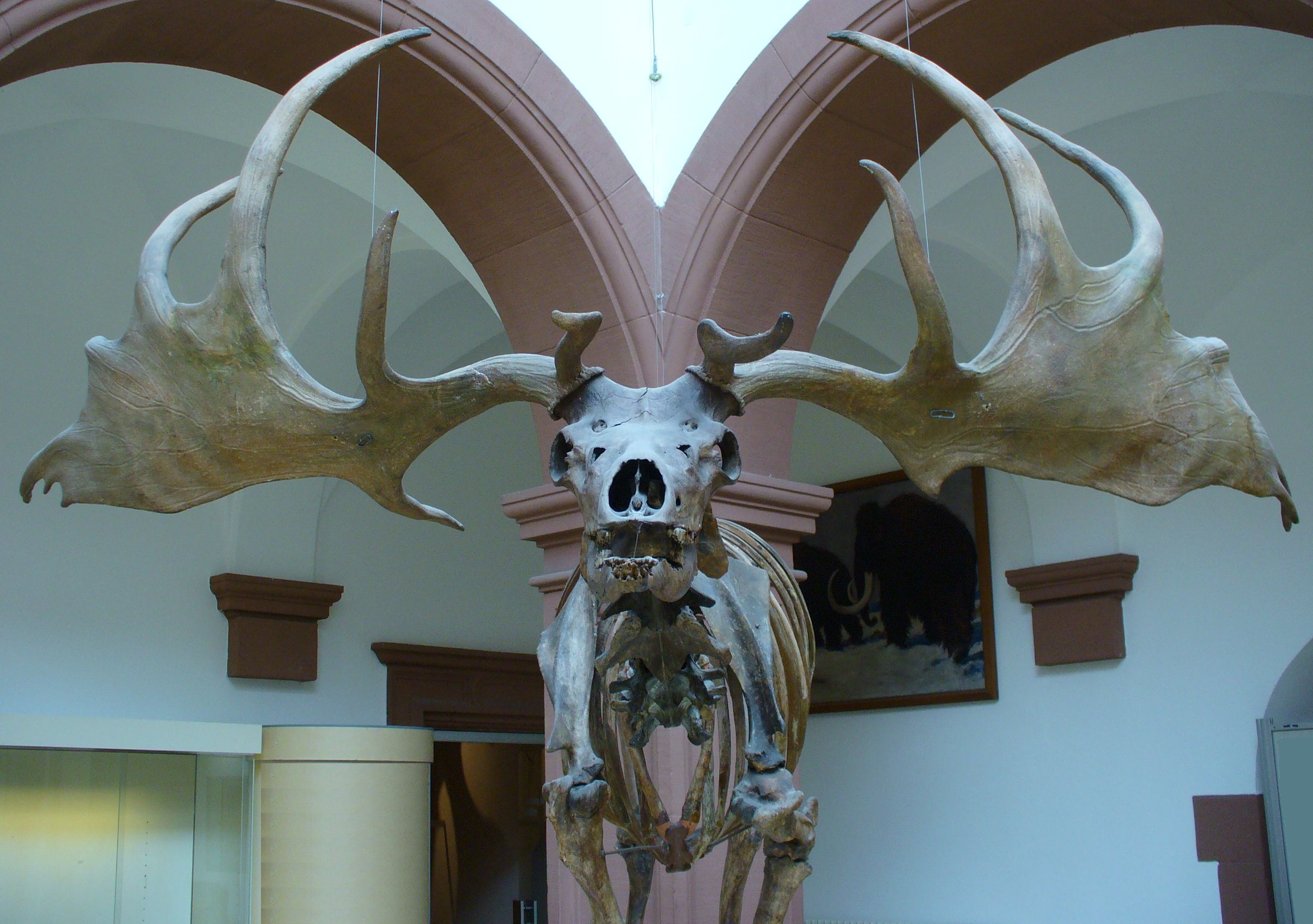
All your nightmares have come true.
I’ve been meaning to rant about irish elk for a while now, but the point is that this is a wild beast, not a mule, and the only way anyone could ride one is through greenseer magic. Additionally, and of course this is the point, Coldhands isn’t just any old person, he’s an icy undead, with his unnatural smell that animals really do not like – so Coldhands is not only taming a fearsome wild beast, but he’s somehow overcoming the fear of wighted corpses which all animals seem to share. It’s a mystery deserving of an answer.
Perhaps more inexplicably, the elk seems to obey Coldhands’ commands even after he separates from the party to go after the rogue Night’s Watch mutineers. The elk carries the children to a pre-designated spot, or at least very close to it, which is the little abandoned wildling village by the lake. On the way, Bran thinks how he cannot tell from the snow-covered landscape where the lake ends or begins but that the elk seemed to know the way – and indeed it did. This is highly intelligent, coordinated, cooperative behavior between the elk and Coldhands, and again it really doesn’t make any sense without greenseer magic as an explanation. And on the flip side, greenseer magic very neatly explains what we see – except that Coldhands is dead.
Here we come upon a problem with the idea that Bloodraven is skinchanging Coldhand’s corpse – if he is inhabiting Coldhands’s body, who is working magic on the elk? It seems unlikely Bloodraven is doing all of that at once – we’ve never been shown a skinchanger who can split his consciousness and inhabit two beings simultaneously – much one less one who can simultaneously inhabit something that is dead and something that is living. It make more sense that the relationship between the elk and Coldhands is more typical of a skinchanger and his animal, as it appears to be.
Skinchangers do not need to literally inhabit an animal to control it. Varymyr Sixskins is able to ride his snow bear without actually skinchanging it for example – the mere fact that he has established a skinchanger bond with the bear is enough to control it. We are told the bear hated Varamyr’s bonding with it, so we know that when Varamyr rides it, he is in fact using his skinchanger magic to control a wild beast without actually inhabiting its consciousness from moment to moment. Otherwise, he’d be in a dream state on top of the bear and he would fall off. It just wouldn’t work, you know?
We could also look to the Starks and their wolves as examples – the wolves are fearsome deadly beasts, but never hurt the Stark children, and the Stark children don’t need to be skinchanging their wolves from moment to moment to make it so. What we can say from all of this is that if Coldhands has access to skinchanger magic, it explains the problem of the elk very well.
The one major possibility are those children of the forest greenseers Bran sees in Bloodraven’s cave. They seem pretty far gone, but who knows, maybe they reforming the elk to carry a corpse on its back against its will. The main argument I have against this is that there are signs of a personal relationship between Coldhands and the great elk which smacks of a typical human – animal bond or a skinchanger – animal bond. I am mentioning it in the interest of good scholarship, but I think this option unlikely, as you will see.
The next sign of Coldhands using skinchanger magic that we need to discuss is his communication with ravens. Although we associate the idea of using ravens to communicate with the maesters, this practice actually originated with skinchangers, as we learn from Lord Brynden Rivers a.k.a. the three-eyed crow in ADWD:
“Do all the birds have singers in them?”
“All,” Lord Brendan said. “It was the singers who taught the First Men to send messages by raven… but in those days, the birds would speak the words. The trees remember, but men forget, and so now they write the messages on parchment and tie them round the feet of birds who have never shared their skin.”
The last line makes it clear that the original practice was to share the skins of the birds being used to communicate, not just a matter of training the ravens to speak or even understanding the speech of ravens, though the children are also said to be able to understand animal speech. But here Bloodraven is specifically indicating that human skinchangers in ancient day used ravens communicate with each other by means of sharing their skin. Right after this quote, Bran thinks that Old Nan had told him similar stories, and in TWOIAF the maesters also refer to the idea that children of the forest “could speak with ravens and make them repeat their words,” and that the children taught this “higher mystery” as they call it to the First Men so they might use ravens to communicate. In other words, the idea is out there, but Bloodraven has the insider information – it was originally skinchangers, first children the forest and then First Men – who used their magic to communicate via raven.
And so, in the first Bran chapter of ADWD, we see Coldhands… well let’s just read it:
From a nearby oak a raven quorked, and Bran heard the sound of wings as another of the big black birds flapped down to land beside it. By day only half a dozen ravens stayed with them, flitting from tree to tree or riding on the antlers of the elk. The rest of the murder flew ahead or lingered behind. But when the sun sank low they would return, descending from the sky on night-black wings until every branch of every tree was thick with them for yards around. Some would fly to the ranger and mutter at him, and it seemed to Bran that he understood their quorks and squawks. They are his eyes and ears. They scout for him, and whisper to him of dangers ahead and behind .
If Bloodraven was skinchanging Coldhands, there would be no need for Coldhands to use the ravens for scouting, because Bloodraven can already see anything he wants through the weirwoodnet. But if we look at Coldhands as a greenseer or skinchanger, this scene makes perfect sense – he’s communicating with the ravens just like an ancient First Man skinchanger would. If it weren’t for the fact that he is dead, he would be easy to recognize as a greenseer or skinchanger.
In fact, we might even recognize him as a green man, as in the Sacred Order of Green Men that keep watch on the Isle of Faces. When Samwell emerges for the well at the Nightfort to the great surprise of Bran and company in ASOS, he begins to tell them about Coldhands:
“He said.” Jojen frowned. “This … Coldhands?”
“That wasn’t his true name,” said Gilly, rocking. “We only called him that, Sam and me. His hands were cold as ice, but he saved us from the dead men, him and his ravens, and he brought us here on his elk.”
“His elk?” said Bran, wonderstruck.
“His elk?” said Meera, startled.
“His ravens ?” said Jojen.
“Hodor?” said Hodor.
“Was he green?” Bran wanted to know. “Did he have antlers?”
The fat man was confused. “The elk?”
“Coldhands, ” said Bran impatiently. “The green men ride on elks, Old Nan used to say. Sometimes they have antlers too.”
We do not really know what the green man are – humans, or elves, or something in between – but it is worth noting that Coldhands seems to be imitating one by riding the elk and keeping watch over the deep wood… except that he’s a dead man in blacks instead of a living one in green. Whatever the green men are, they are certainly associated with greenseeing and the children of the forest, as we know they are said to “keep their silent watch” on the Isle of Faces, one of the only places in the south where the weirwoods were not cut down. The story goes that in the Dawn Age, the children of the forest and the First Men gathered on the Isle of Faces to sign the Pact. Maester Luwin picks up the story on AGOT:
So the gods might bear witness to the signing, every tree on the island was given a face, and afterward, the sacred order of green men was formed to keep watch over the Isle of Faces.
Personally, I think it would make sense that the people stuck on the Isle of faces with nothing but trees with faces would be able to… you know, use the trees with faces. Bran thinks to himself in ASOS that “All the tales agreed that the green men had strange magic powers,” and the most likely magic to associate with green men on an island full of weirwood trees would be greenseer or skinchanger magic. I definitely think we can take the association drawn between Coldhands and the green men as another clue about Coldhands having something to do with greenseers and their magic, if nothing else. We are going to find more signs of green men as we go, however, so there may be something more specific to green men going on here.
Turning back to evidence that Coldhands currently uses skinchanger magic, we find that he seems to have a great deal of remote knowledge. This is most likely though the scouting of the ravens, as we’ve seen, but it’s not impossible that he has some more direct connection to the weirwoodnet and / or Bloodraven. Just because I do not think Bloodraven is skinchanging Coldhands doesn’t mean they can’t have a method of communication. Perhaps Bloodraven speaks to Coldhands through the ravens, or perhaps he can send Coldhands occasional visions as he does to Bran.
The picture being painted here is that the ranger Coldhands has the haunted forest on lockdown. Not only does Coldhands detect the Night’s Watch mutineers from Craster’s keep and go back to slaughter them – with great savagery, it would seem – he also knows that Bran and company are waiting for Sam at the top of the well at the Nightfort, as Sam tells us in ASOS:
“He said there would be people,” he huffed. “People in the castle. I didn’t know you’d be right at the top of the steps, though.”
Coldhands even knows what is going on south of the Wall, it would seem. Again the choices seem to be that his ravens flew over the Wall to the Nightfort and reported back to Coldhands, or that he has a link to either Bloodraven, or most ambitiously in terms of Coldhands’ power, perhaps he can directly access the weirwoodnet itself.
And don’t forget, the ravens don’t just talk to Coldhands and act as his eyes and ears. They also attack in coordinated fashion with Coldhands when he saves Sam and Gilly from the wights. It’s quite dramatic – they descend on the wights in “angry clouds,” tearing them apart and filling the sky to the point where Sam cannot see the moon. Then one of the ravens tells Sam to go, go, go, and Coldhands appears and whisks them away. This is less conclusive that Coldhands talking to the ravens, because the ravens certainly seem intelligent enough to attack wights on their own, or it could be Bloodraven sending the ravens to attack. However, it fits with all the other Coldhands scenes in which he works together with the ravens and the elk in a highly coordinated fashion, and all of it is very neatly explained by the possibility of Coldhands being a greenseer or a skinchanger. Except that he’s dead.
A final clue about Coldhands having access to magic lies in the fact that Coldhands seems to be able to detect the presence of the wights. At the start of the chapter where Bran, Coldhands, Jojen, Meera, and Hodor fight their way up the hill to enter Bloodraven’s cave, Coldhands reaches the base of the hill and simply announces “they’re here.” It’s almost like he can smell them, but Coldhands has no flowing blood or appetite, and therefore it’s unlikely that he has a functioning olfactory system. There was no raven talking to Coldhands here either, so it wasn’t like he was warned by them. I think the only explanation can be that Coldhands can use magic.
I think the one of the main narrative purposes of Coldhands is to tell us about Jon, and by extension, the last hero. I could be totally wrong about this – maybe he’s Bloodraven’s meat suit after all. Maybe the children are controlling the elk and Coldhands is just a corpse with no magic. But I don’t think so, for all the reason I’ve laid out and for more yet to come. In particular, I return to the argument that it makes no sense for Jon Snow to be resurrected and lose his magic. And if Jon’s going to retain his magic or better yet, gain new magic, that means that resurrected people can do magic. Beric proves it as well when he lights his sword on fire with his own blood. It’s a small magic, but it’s definitely magic. Therefore the idea of Coldhands having access to magic is not only reasonable, it has precedent. And Beric wasn’t even a skinchanger!
Here’s what I think: just as Varamyr’s prologue is there in large part to inform us about what will happen to Jon when he dies, Coldhands is there to show us a bit about what’s going to happen when he’s resurrected. Coldhands is primarily here to show us that a skinchanger can be resurrected and still retain his magic, and that when this happens, what we get is an immortal zombie impervious to cold, hunger, fatigue, and other human failings that can whoop ass on the Others by day or by night.
Did I just say immortal? Well, some qualifications. First, I assume Coldhands can be killed, or re-killed you might say, just as any other wight can be. He stays well away from the fire, as I mentioned. But who knows how long a zombie lives, if undisturbed?
…what is dead, may never die, after all…
…and if a skinchanger’s soul is preserved in its animal and thus is in a more intact state than other souls when it is put back in its body, who’s to say how long the resurrected person can ‘live?’
The famous line about Coldhands’ age comes from Leaf, when she says “they killed him long ago,” seemingly referring to the wights and the Others killing Coldhands long ago. The thinking is that “long ago” to the children of the forest, who live for several centuries, must be long ago indeed. There’s another clue that Coldhands is very, very old which comes when they are forced to butcher the elk, after it finally collapses:
It had been twelve days since the elk collapsed for the third and final time, since Coldhands had knelt beside it in the snowbank and murmured a blessing in some strange tongue as he slit its throat.
That “some strange tongue” is likely to be the Old Tongue. There are some wildlings north of the Wall who speak the Old Tongue, particularly the Thenns, but it is not common at all for a member of the Night’s Watch to speak it… not for thousands of years, at least. Even if it was something other than the Old Tongue – what language would we be talking about? Everyone in Westeros now speaks the common tongue, so whatever the language here that Coldhands is speaking, it is still an indicator of a Coldhands having knowledge that does not belong in modern Westeros.

Coldhands and his elk.
It’s also worth noting that Coldhands’ behavior here does not speak of being skinchanged by Bloodraven, but rather of having a personal set of beliefs. There’s an elegant, sad beauty to the description of Coldhands kneeling in the snow and uttering a prayer of blessing for his loyal steed as he puts it out of its misery. It seems ritualistic, perhaps consistent with older beliefs about hunters who respect the forest and the animals they take from it that we see in hunter-gatherer societies all around the world. This could be consistent with Coldhands being a green man or simply a First Man in tune with the forest and the mindset of the greenseers, and it is also suggestive of a bond between Coldhands and the elk.
Put it all together, and I think they killed Coldhands very long ago indeed. A greenseer or skinchanger who speaks the Old Tongue, rides a great elk, is attended by flocks of ravens with which he communicates, and who joined the Night’s Watch at some point – Coldhands seems like something from the ancient past. In fact, I don’t think it’s hyperbole to say that Coldhands may literally be eight thousand years old.
Think about it. Even if he has only been a zombie ranger for eight hundred years, or even just eighty years – it indicates that zombies do not wear out on their own, at least not very quickly, when in the frozen North. Aging has to do with cell growth and cell death, but Coldhands is already dead. There is nothing to wear out. The cold magic apparently preserves his body, and if his spirit isn’t fading out like Beric’s because he is a resurrected skinchanger… there is potentially no limit to how old he is.
It’s worth noting that Coldhands seems much more agile than other cold wights as well – in the first Coldhands quote that we pulled, Coldhands “vaulted lightly” off the back of the ten-foot-tall-at-the-shoulder great elk. It’s quite the contrast to the wights, which Sam noted to be clumsy things (though strong and persistent). Coldhands, on the other hands, is limber and lithe, and he also seems a good fighter – he made short work of the rebel Night’s Watch brothers, although he was probably aided by the ravens; and if he fights wights or Others with any regularity and has ‘lived’ to tell the tale… it bodes well for resurrected Jon Snow’s potential physical abilities. I would suggest that something about being a skinchanger is what explains Coldhands’ un-zombie-like physical and mental capabilities and his ability to persist for however long he has.
Think about the possibility of a merged Ghost / Jon spirit returning to Jon’s body – might not resurrected Jon inherit a bit of Ghosts’s quick reflexes or wolfish instinct? Perhaps a resurrected skinchnager created in this way, with a merged human animal sprint, is actually stronger than a regular human. The wights are very strong as it is; perhaps Coldhands has some sort of animal spirit inside him giving him strength or skill. You need every advantage you can get in the cold dead land, after all.
The King of Corn and the Green Monster
This section is brought to you by Patron supporter and newly minted priestess of Starry Wisdom Church Ennovy, Shadowbinder from the Eastern Mountains and Lakes.
Meera’s gloved hand tightened around the shaft of her frog spear. “Who sent you? Who is this three-eyed crow?”
“A friend. Dreamer, wizard, call him what you will. The last greenseer.” The longhall’s wooden door banged open. Outside, the night wind howled, bleak and black. The trees were full of ravens, screaming. Coldhands did not move.
“A monster,” Bran said.
The ranger looked at Bran as if the rest of them did not exist. “Your monster, Brandon Stark.”
“Yours ,” the raven echoed, from his shoulder. Outside the door, the ravens in the trees took up the cry, until the night wood echoed to the murderer’s song of “Yours, yours, yours.”
“Jojen, did you dream this?” Meera asked her brother. “Who is he? What is he? What do we do now?”
“We go with the ranger,” said Jojen. “We have come too far to turn back now, Meera. We would never make it back to the Wall alive. We go with Bran’s monster, or we die.”
Here in Bran’s first chapter from ADWD, we can really see Martin’s love of horror writing come through – the wind blowing the door open, the tree full of a murder of ravens screaming, Coldhands watching implacably with his black eyes as they realize he’s a walking dead man… yeah. That’s the stuff. In any case, the thing I want to zero in on is Coldhands as Brandon Stark’s monster. Because of the wording, it is initially unclear if Bran is calling Coldhands a monster or the last greenseer a monster, but Jojen makes it clear when he says “we go with Bran’s monster” in response to a question about whether or not they should follow Coldhands. Coldhands belongs to Bran in some sense.
A few people have speculated that this is because of a time loop – Bran at some point went back into the past and helped create Coldhands, something like that. The idea of a greenseer creating a zombie is obviously something I consider a reasonable possibility, but I am generally hesitant to use time travel as a way to explain mysteries in the books. I believe Martin maybe involving a bit of that, but I feel strongly that he’s going to strictly limit the sort of time travel paradoxes more common to science fiction. Basically, it’s something we can’t completely rule out, but it’s also a bottomless can of worms which quickly turns into wild conspiracy and tinfoil which attributes everything that ever happened to time-traveling Bran. My approach is to look for more logical answers that do not involve time travel first, and if and when Martin shows us Bran affecting the past or skinchanging Bran the Builder, we can draw conclusions based on what we see in regards to how limited time travel is in ASOIAF.
So setting aside the time-travel interpretation of Coldhands being Bran’s monster, what could this mean? I think the most logical answer is that Coldhands is bound to the Stark bloodline in some way, and perhaps to Bran in particular if he is some sort of special chosen one. Most people think the last hero was a Stark in some sense, and probably the Night’s King too, so if Coldhands does go back to the time of the founding of the Night’s Watch and the Long Night, he may well have been created by a Stark or had a duty laid upon him to wait for the promised Stark to come along. If anything like this is true, then Coldhands would be like 8,000 years old, which… kinda makes you feel sorry for the guy.
When I look at Coldhands, what I see is someone who is under some sort of eternal obligation, someone who is in a sense condemned to literally wander the frozen lands for hundreds or even thousands of years waiting for Bran Stark to show up, or perhaps guiding the occasional choices for the new ‘greenseer of the north’ to Bloodraven’s cave to assume the position. Recall that Bloodraven was the Lord Commander when he was supposedly lost on a ranging – perhaps Coldhands had a hand in that.
Think about what it would be like to be Coldhands – it would pretty much suck, right? I mean riding the great elk was cool at first, but really, there isn’t a whole lot to keep you busy with north of the Wall. Coldhands has not been seen by any wildlings that we know of, so he must keep a low profile. What is he doing? I mean again they killed him long ago, and even if long ago is only 80 years ago… that’s 80 years of wandering the tundra, staring at snow. And don’t forget, you’re dead. The savor of food, of sex, of laughter and fellowship – all gone. I have to think Coldhands could put himself out of his misery any time by simply walking into a fire. And yet, he doesn’t. Coldhands persists, faithful as ever, solely dedicated to his mission.
To me, this speaks of either sacrifice or punishment on Coldhands’ part. He’s either condemned to this boooorrrring-ass mission as a way of atoning for some great sin, or he’s the most self-sacrificing dude who ever lived. Speaking in terms of atonement, perhaps he is the Night’s King, chastened and humiliated, somehow compelled by guilt or other means to serve out this lonely watch as recompense for his crimes. My big theory about Azor Ahai is that he was a villainous type – he broke the moon when he forged Lightbringer, according to the legend, and I believe this was responsible for meteors which caused the Long Night. Perhaps that’s who Coldhands is – Azor Ahai the fallen, penitent zombie. I have speculated that Azor Ahai may have even become the Night’s King himself – I’m by no means sold on that, but their symbolism overlaps in some areas and Stannis seems to be impersonating both of them at once, a possible clue about Azor Ahai becoming the Night’s King…. any maybe that’s who Coldhands is.
It’s hard to say for sure without more information, but Coldhands’ current mission could be consistent with someone who has brought low and made to atone for their evil deeds, and the two likely suspects in that scenario would the Night’s King or Azor Ahai. This idea of atonement also fits into the larger theme of the Night’s Watch itself – in fact it is the theme of the Night’s Watch, as they are exiled criminals who atone for their sins by guarding the realms of men. Coldhands has kind of taken this duty to the next level.
The other possibility here is sacrifice, and that’s actually the one I want to focus on. Essentially, if Coldhands is not on his crappy, cold mission because of some evil he himself committed, then he is absolutely making a sacrifice of himself. He’s given up almost everything it means to be human for his eternal, lonely ranging. In this case, he might be connected to the last hero – either the last hero himself or one of his party of O.G. Night’s Watch brothers – because there are thematic clues about the last hero being something of a sacrifice, and because self-sacrifice is perhaps the ultimate in heroic virtue. Jon and Bran are the two characters who parallel the last hero most closely, and both have obviously sacrificed a lot, and probably are not done sacrificing either.
The fact that Coldhands keeps the scarf over his mouth and speaks with a raspy voice could indicate that Coldhands’ has a neck or throat wound of some kind, consistent with a sacrifice. Jon takes a throat wound as well, it should be noted. It’s the classic way to sacrifice animals or even people, as we see in Bran’s weirwoodnet vision of human sacrifice at Winterfell.
In fact, George has made a fairly direct allusion to Jon Snow as a ‘corn king,’ which is a term used to describe the very common mythological archetype of a sacrificed male god or king whose death brings about the turning of the seasons – typically they are sacrificed in the autumn, mimicking the death of the leaves and greenery, and are resurrected in the spring, bringing with them the return of fertility and fecundity. The corn king concept is very important to understand if we want to know what is going on with zombies and resurrection, and with Jon and the last hero and quite possibly Coldhands. That is why George gives us a direct reference to it, one of the most direct shout-outs to external mythology anywhere in ASOIAF. It comes in ADWD, out of the mouth of Mormont’s raven:
He rose and dressed in darkness, as Mormont’s raven muttered across the room. “Corn,” the bird said, and, “King,” and “Snow, Jon Snow, Jon Snow,” That was queer. The bird had never said his full name before, as best Jon could recall.
Jon’s Snow’s corn king status is pretty straightforward – Jon is the corn king whose death and resurrection will hopefully turn the seasons and bring the end of the Long Night, which seems to be about to fall. His death comes right as winter falls, and of course we hope his resurrection will bring a dream of spring. Before we go any farther with this line of analysis, I just want to stress how heavy a bit of foreshadowing this is: George is telegraphing to us that Jon will be resurrected and that that resurrection will help to bring the spring. I mean it’s not a big shocker – most people think Jon is a hero, the special Snowflake – but as corn king, he’s a specific type of hero who is defined by the death and rebirth cycle.
Another role of the corn king is to promote the fertility of the land – his death is a sacrifice which literally causes the earth to be fertile so it can feed the people. That’s something of the role Jon plays with the wildlings in ADWD, where he lets them through the Wall to find food and shelter – and this quote with the raven saying ‘corn king Jon Snow‘ is in fact the beginning of that chapter. The act of feeding the wildlings is the very act he is killed for, so he is indeed sacrificing himself to feed thousands of people. Earlier in ADWD, in the chapter where Jon is laying out his plans to let the wildlings through, the raven also says “Corn. King,” though without Jon’s name added on just yet. In other words, it’s no coincidence the two ‘corn king’ references come in conjunction with Jon’s act of feeding the wildlings… and thus eventually sacrificing himself.
As you can see, the last hero could very easily be a corn king figure, since he brought about the turning of the seasons after they had been a bit stuck for a while, particularly if he died in the process as I am proposing. As a matter of fact, there is big giant flaming red clue encouraging us to associate Jon’s corn king status with the last hero and Azor Ahai – that’s really why I brought this up in the first place. That chapter where Jon lets the wildlings through the Wall, the one where the raven says “corn king Jon Snow,” well, it actually begins with Jon’s Azor Ahai dream, the one where he is defending the Wall alone against the forces of the north which include dead men who scuttle up the ice like spiders, armored in black ice with his Valyrian steel blade burning red in his fist.
This dream is remarkable because it foreshadows Jon’s impending role as some kind of Azor Ahai reborn figure – he has a burning red sword, and later in the dream, he slays his love, Ygritte, just as Azor Ahai slew Nissa Nissa. But it’s also remarkable because it unites the roles of Azor Ahai with that of the last hero – Jon is the Lord Commander of the Night’s Watch, abandoned and alone, fighting the forces of the North, which parallels the idea of the last hero’s companions, dog, and horse dying while he sought for ways to defeat the Others in the cold dead lands.
The potential implication is clear – Azor Ahai and the last hero might be the same person, or closely linked to one another. At the very least, we already know they are parallel legends, stories of a hero who fought of the darkness of the Long Night with a magic sword. So what we have here is Jon dreaming of being some combination of Azor Ahai and the last hero, then waking to be labelled a corn king as goes about doing corn king things, feeding the people and eventually getting himself killed. Most importantly, the corn king’s resurrection brings the spring, just like the last hero and Azor Ahai did in ancient day, and just as our Azor Ahai reborn characters like Jon and Dany are expected to do.
This is why I say it’s critical to understand the basics of the corn king – because George has based his Long Night savior figures at least in part on the various corn king figures in world mythology. As an aside, I will just tell you that there are many, many myths and legends based around the turning of the seasons, and since George has chosen to make the cycle of the seasons a focal point of his world building and storyline, he is in fact incorporating elements of many of these world myths, of which the corn king ideas are but one. Another great one is tale of the abducted moon maiden Persephone, and you can read all about that on my friend sweetsunray’s blog, Mythological Weave of Ice and Fire.
All this corn king stuff might seem like a bit of a side-track from zombies, but it’s actually just the opposite – this is the deeper context in which we must think about resurrected people in the story, particularly Jon and my idea of the zombie last hero. Usually a corn king figure is reborn afresh in the spring, however, George has given us a literally resurrected corn king instead. Using a zombie in place of the reborn corn king is a kind of a dark twist on the classic tale, but then, that’s George R. R. Martin. Instead of looking for a hero to save us from the zombie apocalypse, we are actually looking for a zombie hero to save us from the apocalypse. We need Ghost-Jon, the King of Corn.

Cernunnos
by Shaneesja (DeviantArt)
So the corn king relates to zombies and Jon Snow and the last hero; does it relate to Coldhands, Brandon Stark’s monster? I believe it does, whether or not he is the last hero or one of the last hero’s party. We mentioned the possibility that Coldhands is a green man – an undead one, of course – due to the connection of elk riding and generally being a protector of the forest. Well, the green men are based on a particular type of corn king, the archetype known as the “horned god” whose examples include the Celtic Cerrunos, the English Herne the Hunter, the ubiquitous Green Man (who sometimes has branches on his head in place of horns), the Greek Pan, and many others. As far away as India we find him – his name in the Rig Veda is Pashupati, a testament to the proto-indo-european roots of the horned nature god idea. All of these figures have horns or antlers or sometimes branches on their heads, some have green skin or some kind of leafy decoration, they all have something to do with the spirit of male virility and fertility, they are usually thought of as “solar” deities, they all bring fertility to the land and act as protectors of the wood and of nature. Many can speak with animals. Most of all, they are killed and resurrected to bring about the turning of the seasons, because what they are is more or less a personification of the cycle of nature

The Gundestrup Cauldron, ca. 300 BCE, featuring Cerrunos in the center
Essentially, the stag-man is a forest-centric version of the corn king. There are other forest-dwelling or fertility based corn kings which match up most or all of this, but do not have the horns, such as Jack in the Green, Jon Barleycorn, the green-skinned Egyptian death and resurrection god Osiris, who is also a corn god, the Greek Dionysus (who is followed by satyrs, which are always some kind of goat-horned human).
A green man from the Green Man Festival in Crickhowell, Wales, UK
As you can see, some of that is consistent with the little we know of the Sacred Order of Green Men, who are said to have antlers on their heads, green skin or green clothing, and who are said to keep eternal watch over the Isle of Faces. I mean the green man is pretty famous, whose green, leafy face can be found decorating cathedrals and old buildings all over Europe, so calling these folks “green men” is basically not all that subtle. The children of the forest wears vines and leaves, and they certainly seem to have a strong connection to the green men on the Isle of Faces.
Like the rest of the corn king lore, the horned god ideas are also consistent with the idea of a last hero who is resurrected to end the Long Night and bring the spring. Said another way, both the last hero and the green men seem to be drawing from related mythology, and this has to make us wonder about a connection between the last hero and the green men. I would suggest that Coldhands may be the confluence of these ideas. I believe he is at the very least a prototype for making a last hero, a skinchanger zombie, and he reminds Bran, and us, of the green men in certain ways. Coldhands rides his elk and keeps eternal watch over the frozen north kind of like a green man exiled to the frozen dead lands.
The entire thing is like an twisted version of the story of the fertility god wandering a fertile land; Coldhands is like a corpse version of a fertility god wandering the cold and almost-dead lands. He still protects the woods that remain, however, and is obviously in communion with the animals that remain as well. He’s also dedicated to fighting the Others, so we know he is still on team green, deep down. This is actually pretty close to the English folktale of Herne the Hunter, a ghost version of the horned god who rides a horse and guards the woods in spectral form. In fact, if Martin is intending Coldhands to play into the green man / horned god ideas as I propose, then Herne the Hunter is the figure we should look to – he’s the clearly undead version of the horned god.
Besides being dead, Herne is associated with midnight and winter, which is another good match for Coldhands. If Coldhands’s mission is one of atonement as we speculated a moment ago, this would be highly consistent with Herne the Hunter, whose tale has him committing some great sin and then hanging himself from an oak for fear of shame and disgrace, only to become a ghostly guardian of the woods after his death. I mentioned before that Coldhands may have a neck or throat injury based on the scarf he wears and his voice – the exact description was “his voice rattled in his throat, as thin and gaunt and he was.” Coldhands is dead, so it makes sense his voice would ‘rattle,’ like a death rattle, and it could be yet another match for Herne and his strangulation form the oak tree. Finally, we know Martin is thinking about Herne the Hunter, because Herne gets a clear shout-out in the form of a Westerosi legend about a pair of brothers called Harlon the Hunter and Herdon of the Horne who took to wife a woodswitch and built the castle at Horn Hill in the Reach. That’s why their descendants, House Tarly, have a striding huntsman, red on green, as their sigil. Naturally, the first person to meet Coldhands, our Herne the Hunter impressionist, is Samwell Tarly – it’s almost like he is meeting his ancient ancestor. And the first word Coldhands says to Sam is “brother!”
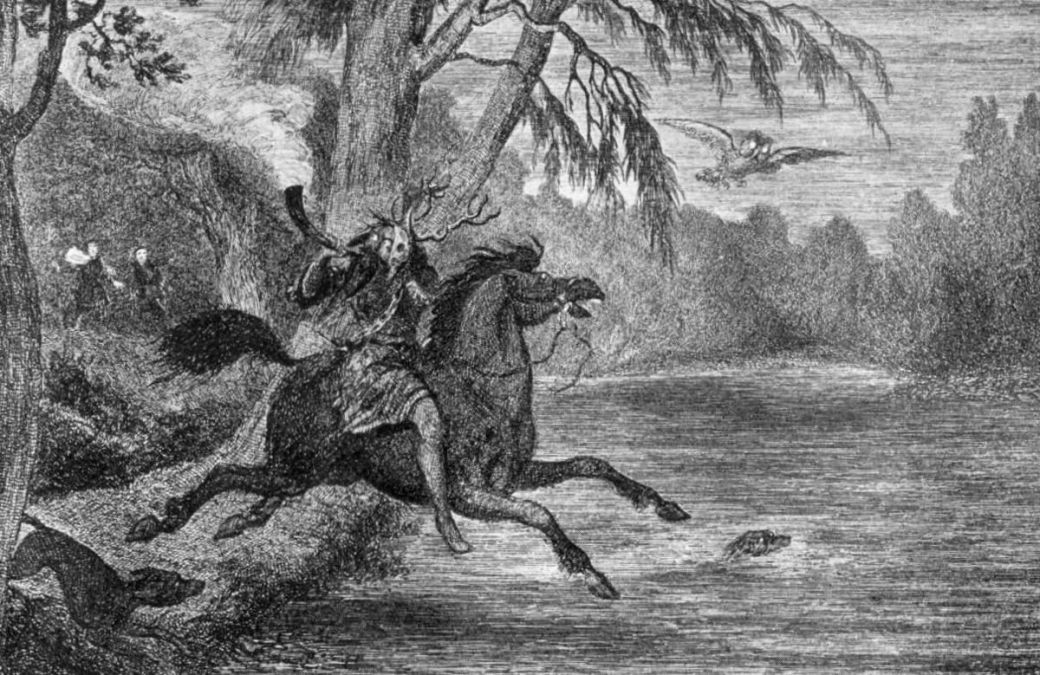
Herne the Hunter
Party on, Garth… Party on, Bobby B
This section is brought to you by Patron supporter and newly minted priest of Starry Wisdom Church The Black Maester Azizal, Lord of the Feasible and Keeper of the Records, whose rod and mask and ring smell of coffee
There’s actually an even more prominent allusion to Cerrunos and his horned cousins than the green men in ASOIAF, and it too is specifically associated with the theme of sacrificing the horned god to turn the seasons, and therefore may have something to do with the last hero and the Long Night. Here I speak of Garth the Green, the legendary founding father of many lineages in the Reach (and perhaps even the Starks, according to some tales). He’s also called Garth Greenhand, or Garth Greenhair, or the Green God, and much like the Green Men, he too is thought in some tales to have a stag’s antlers on his head, as well as green skin. He is actually a perfect incarnation of the horned god, causing maidens and the land alike to be fertile and fruitful in an almost over-the-top way – Garth is said to have made even barren women or old crones fertile with a touch.
Garth’s royal line of Gardener kings wore crowns of vines and flowers and sat in a living tree throne called the Oakenseat, which supposedly grew from an oak Garth the Green himself planted. To me, that sounds suspiciously like greenseer activity. The Oakenseat was destroyed in the ancient past, so we have no way of knowing the truth of the matter, but the general idea of a living wooden throne certainly has our attention. Garth also supposedly planted the three intertwined weirwoods in the godswood at Highgarden known as “The Three Singers,” which is a clue linking Garth to greenseers and their magic. Garth is referred to as a god in some tales, and in TWOIAF we read that:
A few of the oldest tales of Garth Greenhand present us with a considerably darker deity, one who demanded blood sacrifice from his worshippers to ensure a bountiful harvest. In some stories the green god dies every autumn when the trees lose their leaves, only to be reborn with the coming of spring. This version of Garth is largely forgotten.
This version of Garth this largely consistent with the horned god archetype, is what he is. He’s a signature corn king, proving beyond a doubt that the horned god and corn king mythology is woven into the fiber of the story. We can’t help but notice that Garth is more or less indistinguishable from the green men and wonder if perhaps Garth was a green man, or if perhaps the green men descend from him. The stories of both Garth the Green and the Sacred Order of Green Men are dated back to the time before the Long Night, so they could well be connected.
The corn king idea of sacrificing and resurrecting Garth to turn the seasons, given to us so clearly here, causes us to wonder again if Garth and the green men have some connection to the last hero. The story of Garth’s sacrifice and resurrection may be telling us a story about horned people having something to do with ending the Long Night – specifically, a story about horned people being sacrificed to help end the Long Night.
My notion of skinchanger zombies fits nicely here, explaining just how human sacrifice might actually lead to the capability to defeat the Others. Instead of sacrificing humans to harvest their magic as we have seen elsewhere, this could have been more like volunteerism – green men volunteering to become skinchanger zombies. Elsewise, someone might have raised green men slain in battle with the Others. If Coldhands were to be a green man, his origin story might be something along these lines.
In fact… we just talked about Sam Tarly’s ancestors, Herndon of the Horne and Harlon the Hunter, as a clear shout-out to Herne the Hunter, but what I didn’t mention is that in TWOIAF, we learn that Herndon and Harlon were one of the “twelve notable descendants” of Garth the Green. That’s right, the Herne the Hunter ideas which fit Coldhands so well are directly tied to an ancestry from Garth the Green, the horned god who is sacrificed to turn the seasons. Herne the Hunter was also associated with a particular oak tree, called “Herne’s Oak,” just as garth was associated with a specific oak tree, the Oakenseat. My my my. Finally and somewhat humorously, we find that the greatest Gardener King in the history of the Reach was named Garth Goldenhand. Much ado is made about “hands of gold are always cold,” if you recall, so perhaps George is making a hands of gold / hands of cold joke here if Coldhands is descended from Garth or the Green men. Golden hands comes from Garth, in other words, so perhaps Coldhands does too.
There might be a clue about a connection between green men and the last hero to be found in the idea of Bran the Builder having possibly descended from Garth the Green. Another one of those twelve notable children of Garth the Green is someone called “Brandon of the Bloody Blade,” who according to some legends in the Reach may be an ancestor of Brandon the Builder. It’s all very old folktale and legend of course, but the suggestion here is of a connection between House Stark and Garth the Green, who might have been a green man. If the last hero was a Stark, he may be descended of the green men too. We’ll have more to say about his in part 2 of our zombie extravaganza, where will we will have a look at the myth of the King of Winter.
In fact, many of the Houses of the Reach and even the Lannisters are thought to descend from Garth, and thus potentially from green men. If only we knew what green men are! Are they closer to humans, children of the forest, or something else entirely? Do they really have horns on their head like a satyr or a stag man, or just very creative hats? Or are they perhaps skinchangers who ride elk, like Coldhands? Could they have been some of the first First Men to whom the children taught their magic?
If I were to try to narrow it down a bit, I would say that they are probably not children, or else they wouldn’t use the word “men” to them. If they are a cousin to the children, a different type of elf species, perhaps taller, that would really be something. I really want to believe in some sort of awesome Cerrunos-like beings, but the more conservative or skeptical option would be that the green men are human skinchangers or greenseers. However, the idea that they have lived essentially isolated and self-sufficient on the Isle of Faces for 8,000 years or more would make a bit more sense if they were long-lived beings like the children who did not breed very often or in large numbers.
Here’s the thing: memories of the stag-man are to be found all throughout Westeros, even as far north as the lands beyond the Wall! As Jon is letting the wildlings through the Wall, doing his corn king thing, he sees the fearsome men of the frozen shore riding bone chariots with hounds as big as dire wolves – a bad lot, those, Tormund says – and we get these lines:
Some of the men wore antlers on their hats, and some wore walrus tusks. The two sorts did not love each other, he soon gathered.
It could be nothing, or it could be something done in memory of horned green men. Additionally, there was a wildling King Beyond the Wall in ancient day called “the Horned Lord.” He led an attack on Westeros, allegedly using sorcery to pass by the Wall. He’s also the guy who gave us the famous ASOIAF-truism “sorcery is a sword without a hilt. There is no safe way to grasp it,” so it seems that the “Horned Lord” was associated with sorcery and magic, which is consistent with the idea of the green men being able to use magic. The Wildlings named a constellation after him, The Horned Lord (which is called “the Stallion” in Westeros), so he must have been an important dude… or perhaps the idea of horned lords was important, and he was just playing into a powerful idea which already existed.
The wildlings live in something of a cultural time capsule north of the Wall, so any cultural beliefs they have in common with people from Westeros proper most likely originated before the Wall was built. The horned lord ideas fit this pattern – they are found in the very oldest legends from the Reach, and so even though the Reach is very far away from the Frozen Shore, this could be one of the old First Men cultural ideas carried over into wildling culture, dating back to a time before the Wall cut off the wildlings from the rest of Westeros. That’s about the approximate time when the Sacred Order of Green Men was established and when Garth was said to live.
By the way, “The Horned Lord” is also the particular name that practitioners of Wicca use to name their version of the horned god – the full title is “the Horned Lord of Death and Resurrection” – so we can see that what George is doing is referencing various types of horned gods and corn kings in various places… and there’s more to come!
Now if Coldhands or the last hero is connected to the green men, it could mean the green men actually came north and left a more direct impression on the people there. Osha the wildling does say that the children and the giants “and the other old races” are still alive north of the Wall, and we know she is right about children and giants. Other old races? Could these include green men?
Of course, we’ve actually been seeing horned folk front and center from day one – or at least, people who have a strong recollection of horned folk. I mean, it’s a fact that somebody with antlers on their head sure made a big impression on the Durrandon Storm Kings, who have been wearing antlered helms and antlered crowns for thousands of years. The Storm Lords of House Baratheons picked up this habit when Orys Baratheon defeated the last Storm King Argilac Durrandon, took his daughter to wife, and took on all the trappings of the Storm Kings. That’s why we see Robert and Renly gallopping around in antlered helms, and why Stannis has a black stag in his sigil. Renly goes further, wearing green armor – he’s called “the green knight” when he is first introduced to us in AGOT.

Ser Duncan the Tall vs. Lyonel Baratheon, by Chase Stone
Where did they get this image? The Stormlanders don’t have any references to Garth the Green in their folklore, but they have the same taste in headgear, it would seem. And they are definitely cut from the same mythological cloth: Martin hangs an allusion to the horned god mythology on Robert in AGOT as Ned lies delirious in the dungeons of King’s Landing:
He found himself thinking of Robert more and more. He saw the King as he had been in the flower of his youth, tall and handsome, his great antlered helm on his head, his warhammer in hand, sitting his horse like a horned god. He heard his laughter in his eyes, blue and clear as mountain lakes.
The idea of sacrificing the horned god at the end of summer is present with the Baratheons too, as Robert and Renly are both associated with being summer kings who are sacrificed as winter draws close. Robert’s reign consists of a long summer and he comes to Winterfell talking of the rich fertility of the south, from the food to the wine to the women – a scene which is broken down in detail by sweetsunray in her chthonic cycle essays. Robert is also mimicking the fertility aspect of Garth and the horned god, spreading his royal oats everywhere he can. Meanwhile, Renly’s warriors are literally dubbed “the knights of summer” by Catelyn, and Renly’s armor is described thusly before he is killed: “a deep green, the green of leaves in a summer wood, so dark it drank the candlelight.” That’s a nice way of evoking summer while also perhaps foreshadowing something darker. This description also associates Renly the green knight with the woods… just where a green man belongs.
Robert’s and Renly’s deaths are, of course, both laden with appropriate symbolism. Just before he is killed by the boar, Robert is hunting a white hart – a stag – in the Kingwood. The idea of hunting the symbol of your own house symbolizes Robert’s own self-destruction, which he achieved by getting himself too drunk to survive the encounter with the boar and by essentially ignoring the ills of the kingdom and outsourcing the duty of governance irresponsibly. Ned remarks on this upon leaving Robert’s death chamber, saying:
“Even the truest knight cannot protect a king against himself.”
Robert aims to sacrifice a stag and becomes the sacrificed stag himself, in other words. After he does, summer is over, the good times are over, and everyone starts dying, burning and starving. Robert was also wearing green clothing – his hunting greens – when he was wounded, and wore them until his death.
Renly’s death is even more apropos of the horned god, because he is slashed across the throat like a sacrifice right at the the moment that he is putting on his green armor and antlered helm. All the lights gutter out, and Renly’s last word is “cold…” which could be to put us in mind of the end of summer and the Long Night, the appropriate time to sacrifice the horned god. Similarly, as Robert lay dying in a very warm room, he says “Gods, why is it so cold in here,” and of course Jon the corn king never felt the fourth knife, only the cold; so this looks like a depiction of winter’s onset at the death of the horned god or corn king, as the legend demands.
Adding to this imagery, Catelyn thinks to herself in the aftermath of Renly’s murder that “Death came in that door and blew the life out of him as swift as the wind snuffed out his candles,” which is a nice way to tie Renly’s death to the fall of an evil darkness. He was killed by a shadow-being with a “shadowsword,” after all. Recall his armor being a green so dark it drank the candle light – everything about this death scene is associated with snuffing out light and bringing darkness. Recall also that the stag man is typically a solar character – note that Renly is all green and gold – so killing the sun is implied here anyway just by killing the stag man. And killing the sun, of course, is more or less the theme of the Long Night.
This is one of my favorite scenes in the books, as dark as it is, because the way Martin worked the sacrifice of the horned god scene into his fiction here is absolutely stupendous. This is a scene that people alive on earth four thousand years ago would understand in a visceral, intrinsic way, and that’s not an overstatement.
The Baratheons are proving to be excellent horned gods so far, and don’t think resurrection is left out of the mix – oh no, not by a long shot. See, I told you this green man / horned god stuff had something to do with zombies! Here is Robert’s death scene, from AGOT:
“By rights, he should be dead already. I have never seen a man cling to life so fiercely.”
“My brother was always strong,” Lord Renly said. “Not wise, perhaps, but strong.” In the sweltering heat of the bedchamber, his brow was slick with sweat. He might have been Robert’s ghost as he stood there, young and dark and handsome. “
It’s almost like Renly is showing us Robert’s ghost leaving his dying body and standing over his own corpse. And in ACOK, after Robert is safely in the grave, we get this description of King Renly from Catelyn when she finds him holding a tourney on the road to King’s Landing:
In their midst, watching and laughing with his young queen by his side, sat a ghost in a golden crown. Small wonder the lords gather around him with such fervor, she thought, he is Robert come again.
So twice now we have seen Renly called a ghostly version of Robert the Horned God, and here in this quote he is specifically associated with a resurrected Robert. He’s a ghostly, resurrected horned god, just the fellow we are after. He even allies with Highgarden, the former seat of Garth’s royal line of Gardener Kings, now ruled by House Tyrell, and his stag crown is worked in the colors of Highgarden to symbolize his union with Margarie Tyrell. In other words, the ghostly green resurrected horned god Renly is specifically tied back to Garth by his union with Highgarden.
Best of all, after Renly dies in his “emerald castle,” he himself is “resurrected,” in a manner of speaking. You’ll recall that Garlan Tyrell dons Renly’s green antlered armor at the Battle of the Blackwater and saves the day masquerading as Renly’s Ghost. Davos hears the story of the end of the battle in ASOS:
“The Lannisters had taken him from the flank, and his fickle bannermen had abandoned him by the hundreds in the hour of his greatest need. “King Renly’s shade was seen as well,” the captain said, “slaying right and left as he led the lion lord’s van. It’s said his green armor took a ghostly glow from the wildfire, and his antlers ran with golden flames.”
Alright, that’s cool, now he really is a resurrected green horned god. And consider who is in side the armor: Garlan, a Tyrell whose name is derivative of Garth (Garlan, Garth). This simply adds to the horned god symbolism and anchors resurrected Renly back to Garth the Green once again. It also implies using skinchanging to bodysnatch, like Bran does with Hodor, as we have one person wearing another’s “skin” and masquerading as them. That could be trouble. But what’s with those fiery golden antlers? Is this going to turn into an Azor Ahai thing again?
Garth Vader
This section is brought to you by Patron supporter and newly minted priestess of Starry Wisdom Church, Kristin House – Lord Commander Daenyra Flint of the Nightfort, LC of the Night’s HoWatch and avenger of Brave Danny
This is Ser Dontos recounting the tale of resurrected Renly to Sansa in ACOK:
They plunged through Stannis like a lance through a pumpkin, every man of them howling like some demon in steel. And do you know who led the vanguard? Do you? Do you? Do you? ”
“Robb?” It was too much to be hoped, but …
“It was Lord Renly! Lord Renly in his green armor, with the fires shimmering off his golden antlers! Lord Renly with his tall spear in his hand! They say he killed Ser Guyard Morrigen himself in single combat, and a dozen other great knights as well. It was Renly, it was Renly, it was Renly! Oh! the banners, darling Sansa! Oh! to be a knight!”
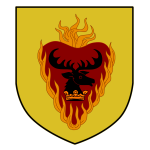
A fiery hart and a fiery heart.
A fiery warrior leading an army of demons conforms very well with my interpretation of Azor Ahai as a villain who brought on the Long Night. Most importantly, this resurrected burning stag man which Renly has become is simply a mimicking of the burning stag symbolism of Stannis, who is of course playing the role of Azor Ahai. There’s actually a clever pun to be found in Stannis’s sigil, because a stag can also be called a hart, and therefore his sigil is actually saying the same thing in two different ways: it’s a fiery hart, and a fiery heart. It’s clever wordplay, to be sure, but it’s sending us a very, very important message – the burning stag man fiery hart is intrinsically connected to the fiery heart of R’hllor, symbol of fire magic and Azor Ahai.
The image that Renly and Stannis are showing us is a fiery horned lord version of Azor Ahai, but one who is a corpse in some sense. Again I say this makes perfect sense in terms of mythology – the Azor Ahai and Last Hero stories are all about the fixing the broken cycle of the seasons, and that’s exactly what horned god and corn king mythology is about – turning the seasons. The horned god does this by dying and being resurrected, and thus we see all of this resurrection and zombie action around the last hero and Azor Ahai. Now that we have a better idea of what the stag-man implies, we can see that this is another clue about Garth and / or the green men being wrapped up in this whole Azor Ahai / last hero / ending the Long Night business.
I believe that’s also why George makes such a big deal of the dragon’s horns, even showing us musical horns made from dragon horns, just as other animals’ horns are. Azor Ahai is strongly tied to dragons, and so I think the idea of Azor Ahai the fiery horned lord basically overlaps with the idea of a horned dragon person.
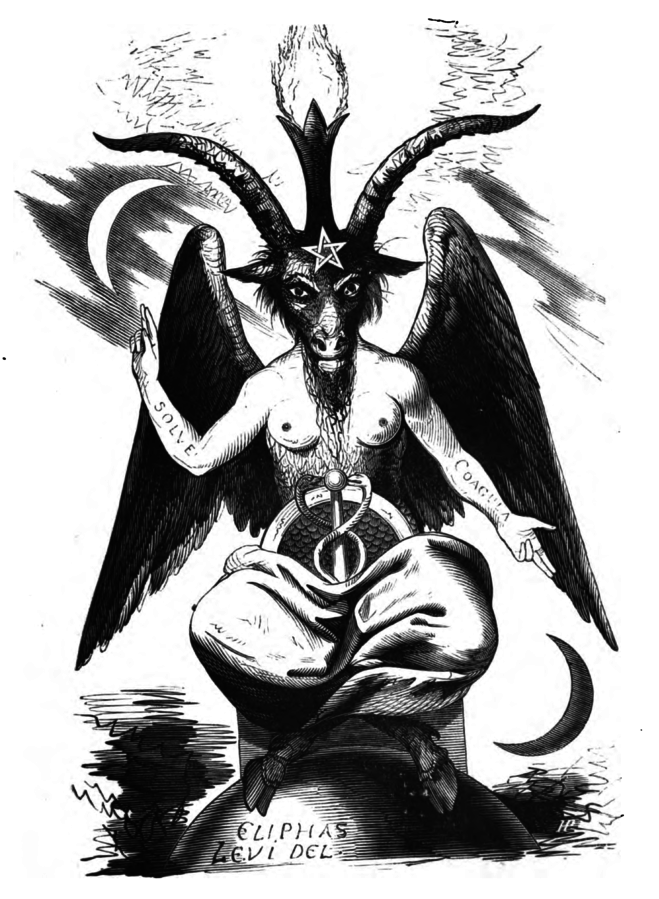
The 19th century image of a Sabbatic Goat, created by Eliphas Levi.
George is also taking advantage of the fact that the modern Christian image of Satan as a goat horned or goat-legged devil is essentially a corrupted version of the classical horned god idea, and this was done primarily as a way to tarnish pagan religions with evil in the eye of believers. Eli Levi’s baphomet, created in 1855, is another example of a darker, more occult twist on the horned god archetype, and I believe George is dipping into some of this mythology to create Azor Ahai. Baphomet is actually not as nefarious as he looks, and there’s a lot of interesting ideas there about balance between male and female, higher awareness, knowledge, and learning. That’s a subject which we shall have to expand on another time, but it’s useful to point out that there is plenty of precedent for a darker or even demonic version of the horned god, as we see with Stannis and resurrected Renly (and there are plenty of references to Stannis worshipping a demon god as well to complement this idea).
House Morrigen: a black crow on storm green
Returning to that scene from the Battle of the Blackwater we just quoted, we have last hero symbolism! Consider the deeds of fiery resurrected Renly – he slew Guyard Morrigen in single combat and a dozen other great knights. Guyard is leading a group of twelve, plus one, just like the last hero and his twelve. Guyard himself would be the last hero then, and his symbolism lines up. He is called Guyard the Green, a former member of Renly’s own rainbow guard, meaning that he’s a green knight too, like Renly was before he was killed. House Morrigen’s castle in the Stormlands is named Crow’s Nest, and their sigil is a black crow in flight on storm green.
In other words, Guyard is a green knight and a black crow who leads a group of twelve like the last hero, very suggestive of a green man joining the Night’s Watch and becoming a crow last hero. Unfortunately, the last hero dies, oh no! What to do! Time to make a green man zombie.
At this point, the idea of Coldhands being an undead green man isn’t looking so far-fetched, huh?
This grouping of twelve things being led by a thirteenth thing is what I like to call ‘last hero math’ – Guyard is a great knight, worth of Renly’s Rainbow Guard, and his died along with a dozen other ‘great knights.’ This math is always around the last hero character in a given metaphor, as we see with Guyard the Green in this battle. We see the same thing thing when Renly is playing the role of green man to be sacrificed – you’ll recall the line from that scene “Death came in that door and blew the life out of him as swift as the wind snuffed out his candles.” By ‘his candles,’ Cat is referring to the twelve iron braziers in Renly’s tent which transformed it into an “emerald castle, alive with light.” Renly’s death is specifically likened to the snuffing out of a candle, and then compared to twelve other candles, so it’s the same thing – a group of twelve, lead by a thirteenth, who all die. As a further reading exercise, look for any example you can find of twelve things with a thirteenth thing that is somehow set apart. The word “dozen” is thrown around a lot, but it’s that extra thirteenth thing which makes the pattern.
So, Guyard and Renly are both playing the role of green man last hero when they die, surrounded by a dozen companion of a sort. Who kills the last hero? It’s the same person in both scenes – someone playing the role of a demonic, undead Azor Ahai. You’ll recall that it was Stannis’s shadow, complete with a shadowsword version of lightbringer, who murdered Renly when Renly was playing the role of green man. Guyard the Green is killed by resurrected Renly, a fiery horned god with a demonic host who, again, is just mimicking the burning stag symbolism of Stannis, a clear Azor Ahai symbol.
What does this tell us? Well, Azor Ahai and the last hero seem to be fighting or killing each other, and there might be some kind of cycle going on, because we see Renly play both roles, a last hero being sacrificed and an undead Azor Ahai killing the last hero. I have proposed that the connection between Azor Ahai and the last hero might have been a father-son or brother-brother relationship, and an adversarial one at that where the one opposes the other, which might be what we are seeing here.
Robert’s death actually plays into the pattern of the green horned man being killed by a horned Azor Ahai too – he’s wearing green when he dies, and he is killed by a “black devil” of a boar which Robert says must’ve been sent by the gods to punish him. Azor Ahai the wild boar? One thinks of TV-show Renly’s joke about Azor Ahai’s smoke and salt making him sound like roast ham, and chuckle all you want (it’s a good joke), but the key thing here is the idea of the “black devil sent by the gods” killing the green man, with the boar’s tusk being similar to a horn.
House Morrigen from which Guyard hails is a great example of how George uses the sigils and history of each House to support important metaphors in the story. The entire history of House Morrigen is built around this moment when Guyard plays the last hero in a metaphor, a black and green crow leading group of twelve, only to be killed by an Azor Ahai figure. To whit: the only two historical members of House Morrigen that we know of get killed by things which symbolize Azor Ahai – dragons and people who are the blood of the dragon. Dickon Morrigen was killed by Queen Rhaenys’s dragon Meraxes at the battle known as “The Last Storm.” That’s also where Argilac, the last of the Durrandon Storm Kings, met his fate, reinforcing the metaphor of a dying stag man at that scene. Argilac was in turn slain by a dragon-blooded person, the Targaryen bastard Orrys Baratheon, who then became a stag man himself… only, he would be a dragon-stag man at that point.
Then we have a Morrigen who left his name behind to become Ser Damon the Devout of the Warrior’s Sons, only to be killed in a trial of the seven going against Maegor I Targaryen, called Maegor the Cruel. All together, we have three dead crows of House Morrigen, killed by demonic fiery stag Renly, actual golden dragon Meraxes, and the most monstrous Targaryen in history, Maegor the Cruel. All of this history only serves to reinforce the idea that the last hero is apparently supposed to be killed by Azor Ahai.
But here’s the important part – the last hero is famous for winning, not losing. All of these scenes with the green man last hero being butchered signaled a loss for their side – they are not heroic sacrifices to achieve victory. I believe the answer is simple: the death of the last hero is merely one of the first steps in his quest to end the Long Night. According to my theory, the last hero has to die so he can become a skinchanger zombie, and only then is when he can face the others and end the Long Night. It’s the resurrection of the horned god and the corn king that bring the spring.
In fact, what best describes what we are seeing here with a horned Azor Ahai killing the green last hero is a cycle of two horned gods killing one another, and that’s no accident. Some versions of the horned god see him as a pair of brothers or a father and son who kill each other every six months – the most famous version of this is the Oak and Holly King. You could write a whole essay on those two, but the point is that they are like two aspects of the same god, and yet also like rival brothers, with the Holly King representing winter and the Oak King summer. Their cycle of fraternal deicide is yet another depiction of the cycle of the seasons by means of a dying god.
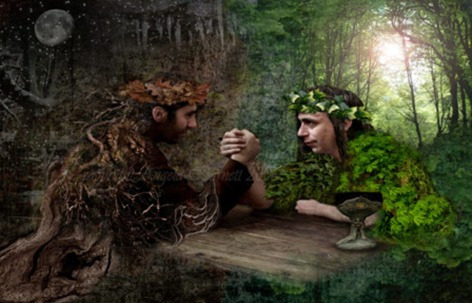
The Holly King and Oak King.
It plays out nicely with Stannis and Renly – fiery, demonic Stannis kills green Renly, and then fiery “resurrected Renly” returns with a host of steel demons to defeat Stannis’s forces at the Battle of the Blackwater. It goes both ways, too – Robert the Horned God killed the dragon man, Rhaegar, on the Trident. Robert was called the “demon of the trident however,” so the green horned people can be demons too. At the Blackwater, the wildfire unleashed by Tyrion – who is on the same side as resurrected Renly – was called the “jade demon” which seemed to have hands and whips of green fire, which is the same idea. All of this points towards a cycle, with both types of horned gods being killed and resurrected. It’s ASOIAF, folks: everyone dies. The important part is that a lot of things rise harder and stronger afterward.
I’ll have more to say about this idea of rival horned gods in the future, but for now the thing to take away here is that the last hero and Azor Ahai are both tied to this collective horned god mythology, and that the events which surrounded their deaths and resurrections seem to be right at the heart of the story of the Long Night and the War for the Dawn.
To sum up what we’ve just learned, we can see that Martin is working the theme of the horned god and the corn king in to the story in several intertwined ways. The idea of the turning of the seasons being personified as a dying and resurrected fertility god is a natural match for Martin’s world, where the turning of the seasons is kind of a big fucking deal, to quote Joe Biden. It make sense to align the sacrificed fertility god who is resurrected to bring the spring with characters who undergo a death and resurrection process in the process of bringing an end to the Long Night such as the last hero and presumably Jon Snow. While it’s not conclusive, Coldhands does seem to fit into this line of symbolism as well, which is why I think he might be a green man, or one of the last hero’s party or both, and at the very least, a resurrected skinchanger or greenseer who ranges the haunted forest.
So what about those twelve companion of the Last Hero? What about the original brothers of the Night’s Watch? Could they have been zombies too?
But of course… But we are out of time for today, so in three days this topic will rise from the dead and give birth to another podcast, titled “Sacred order of Green Zombies 2: The Undead Night’s Watch. It’s already written and recorded, and was original part of this script, but instead of releasing a three-hour plus podcast, I took out my zombie-slaying sword and cut it in twain. Part 2 will actually be a lot shorter, so look out for that by moonrise on the third day.
I originally set out to write about zombie skinchangers only, not green men, but I kept running into green men and horned god references, as you’ve seen, and there are more yet to come in the next episode . I even tried to split it into a zombie episode and a green men episode, but there was no keeping them separate – their spirits had co-mingled too long. As I said, I believe the resurrected fertility god ideas are the lens through which we must view Jon’s resurrection and impending zombie-hood, and the context in which we must understand the last hero and the problem of ending the long night. And that’s why I’ve given you my thoughts on zombies and the last hero AND the Sacred Order of Green Men at the same time – because they belong together.
See you in three days, and if any crows ask you for corn, don’t give them any.
As always, a deep debt of gratitude is owed to our Patreon supporters who fuel the fires of Mythical Astronomy. We’ve started having pre-episode chats on the topics for upcoming podcasts and it’s been a lot of fun, so that’s one of the things you can look forward to if you choose to join our patreon campaign. As always, thanks to Animals as Leaders for providing the music to our show – their new album The Madness of Many just came out, and it’s awesome, of course, so go check it out. A huge thank you to Martin Lewis, who did the vocal performances podcast version of this episode, with an assist from the Amethyst Koala. Martin is currently performing chapters from the first novel, A Game of Thrones, on his Facebook page, “Echoes of Ice and Fire,” so check that out, and you will recognize him from our joint podcast with History of Westeros on the Great Empire of the Dawn, which he did the vocals for as well.
The Grey King and the Sea Dragon
Hey there friends, patrons, and fellow myth heads of the Starry Host! It’s your starry host, Lucifer Means Lightbringer, and today I am bringing you a slight update to an old episode: Weirwood Compendium 1: The Grey King and the Sea Dragon. We are going to be building on this episode so much in the Signs and Portals series that I decided it was worthwhile to revisit it, and with the benefits of hindsight and two years of podcasting experience, a revision seemed in order as well. So whether you’re listening again or for the first time, listen closely, for these are some of the most important symbols and myths we have covered in the history of our podcast. I’ll also note that I live performed these on the lucifermeanslightbringer YouTube channel the past two weeks, so check that out if you like your Mythical Astronomy spiced with a bit of discussion and humor, plus Sanrixian’s amazing weirwood submarine work of art. This, however, is the standard edited and cleaned up podcast version.
We spent the entire Bloodstone Compendium talking about Azor Ahai, dragons, moon meteors, Lightbringer, and what you might call “fire magic.” Of course in ASOIAF, there are really three major powers: fire magic and dragons, yes, but also ice magic and the Others, and of course the weirwoods and the magic related to greenseers and skinchangers. If Others are your thing, you’ll want to check out the Moons of Ice and Fire series, but this is of course the Weirwood Compendium, and that means it’s time to talk about those creepy bleeding trees with faces and leaves like bloody hands!
The great thing is that we don’t have to quit Azor Ahai and his moon meteors cold turkey, oh no. As it happens, the amazing and fairly esoteric mythology of the Ironborn actually serves to unite all that fiery moon meteor / Lightbringer stuff with the greenseers and the weirwoods. As strange as that sounds, that’s the best way I can sum up the symbolic purpose of Ironborn folklore: it puts the fire in the weirwood tree. That’s the overarching framework for this episode: a dichotomy of fiery moon meteors and weirwood tree. As you’ll see, these can be considered the two forms of the fire of the gods… and that’s always what we’re reaching for.
Hearken back, if you will, to chapter four of the Bloodstone Compendium, where we analyzed the trial by combat between Ser Gregor the Mountain vs. Oberyn Martell, the Red Viper of Dorne. The highlight of that entire scene was the Gregor eclipse – Gregor the moon warrior creates a solar eclipse by standing in between Oberyn and the sun. At that moment, Oberyn’s oily black sun-spear flashed like lightning and finally made contact with Ser Gregor, punching through his armor to strike him in the arm.
We interpreted this and many other arm-wounding scenes where lightning is featured as clues about there being a link between the Hammer of the Waters which struck the arm of Dorne and the Storm God’s thunderbolt. That connection, of course, would be that they are really ancient, mythical accounts of moon meteor impacts. We talked about how the Norse Storm God Thor has a hammer which hurls thunderbolts, cluing us in to a link between divine hammers and thunderbolts from the Storm God. We also talked about how meteorites were sometimes called “thunder stones” in the ancient world. We examined scenes in which dragon attacks from the sky were described as being like thunderbolts. All in all, I think I laid out a strong case that the Hammer of the Waters and the Storm God’s thunderbolt were indeed moon meteors.
King Bran
✧ Greenseer Kings of Ancient Westeros
✧ Return of the Summer King
✧ The God-on-Earth
End of Ice and Fire
✧ Burn Them All
✧ The Sword in the Tree
✧ The Cold God’s Eye
✧ The Battle of Winterfell
Bloodstone Compendium
✧ Astronomy Explains the Legends of I&F
✧ The Bloodstone Emperor Azor Ahai
✧ Waves of Night & Moon Blood
✧ The Mountain vs. the Viper & the Hammer of the Waters
✧ Tyrion Targaryen
✧ Lucifer means Lightbringer
Sacred Order of Green Zombies A
✧ The Last Hero & the King of Corn
✧ King of Winter, Lord of Death
✧ The Long Night’s Watch
Great Empire of the Dawn
✧ History and Lore of House Dayne
✧ Asshai-by-the-Shadow
✧ The Great Empire of the Dawn
✧ Flight of the Bones
Moons of Ice and Fire
✧ Shadow Heart Mother
✧ Dawn of the Others
✧ Visenya Draconis
✧ The Long Night Was His to Rule
✧ R+L=J, A Recipe for Ice Dragons
The Blood of the Other
✧ Prelude to a Chill
✧ A Baelful Bard & a Promised Prince
✧ The Stark that Brings the Dawn
✧ Eldric Shadowchaser
✧ Prose Eddard
✧ Ice Moon Apocalypse
Weirwood Compendium A
✧ The Grey King & the Sea Dragon
✧ A Burning Brandon
✧ Garth of the Gallows
✧ In a Grove of Ash
Weirwood Goddess
✧ Venus of the Woods
✧ It’s an Arya Thing
✧ The Cat Woman Nissa Nissa
Weirwood Compendium B
✧ To Ride the Green Dragon
✧ The Devil and the Deep Green Sea
✧ Daenerys the Sea Dreamer
✧ A Silver Seahorse
Signs and Portals
✧ Veil of Frozen Tears
✧ Sansa Locked in Ice
Sacred Order of Green Zombies B
✧ The Zodiac Children of Garth the Green
✧ The Great Old Ones
✧ The Horned Lords
✧ Cold Gods and Old Bones
We Should Start Back
✧ AGOT Prologue
Click to open in iTunes
The most important aspect of the Grey King story, however, is that he stole the fire of the gods and possessed it for mankind, like Prometheus and Lucifer and so many others. We have identified this as a major, defining theme of the Azor Ahai story, and it’s certainly got our attention that this idea is prominently featured in the Grey King folklore. The Grey King was actually said to posses divine fire by two different methods: by taunting the Storm God into setting a tree ablaze with a thunderbolt, and also by slaying the sea dragon Nagga. Aaron Damphair gives us the quick summary of the sea dragon slaying in A Feast for Crows:
Nagga had been the first sea dragon, the mightiest ever to rise from the waves. She fed on krakens and leviathans and drowned whole islands in her wrath, yet the Grey King had slain her and the Drowned God had changed her bones to stone so that men might never cease to wonder at the courage of the first of kings.
And then a bit, later, we hear about the Grey King’s possessions of the Sea Dragon’s fire:
The hall had been warmed by Nagga’s living fire, which the Grey King had made his thrall.
Somehow not satisfied with making the living fire of the sea dragon his thrall, The World of Ice and Fire tells us that the Grey King also obtained fire from the Storm God’s thunderbolt:
The deeds attributed to the Grey King by the priests and singers of the Iron Islands are many and marvelous. It was the Grey King who brought fire to the earth by taunting the Storm God until he lashed down with a thunderbolt, setting a tree ablaze.
According to our theory, both the Storm God’s thunderbolt legend and the slaying of the sea dragon legend are mythicized descriptions of moon meteor impacts – fire from heaven, in other words. Both legends imply the Grey King as essentially calling down that fire from heaven, and then somehow possessed that fire. That… sounds a lot like someone else we know, right? Azor Ahai called down the fire from heaven by breaking the moon, and he possessed this fire of the gods by making Lightbringer the sword out of the fiery moon meteors. That’s practically the same story!
Furthermore, I suspect that just as Azor Ahai possessed the fire of the gods in the form of black weapons made from the moon meteorite, the Ironborn may have also quite literally possessed black moon meteor material. Consider this quote from The World of Ice and Fire which I left you at the end of chapter three, Waves of Night and Moon Blood:
“And when battle was joined upon the shores, mighty kings and famous warriors fell before the reavers like wheat before a scythe, in such numbers that the men of the green lands told each other that the Ironborn were demons risen from some watery hell, protected by fell sorceries and possessed of foul black weapons that drank the very souls of those they slew.”
Lightbringer supposedly drank Nissa Nissa’s blood and soul when it slew her, and I’ve been proposing that Lightbringer was a black steel sword made from a moon meteor from the very start, so it’s quite tempting to draw a connection between Azor Ahai’s dark Lightbringer sword and these sorcerous, soul-drinking black weapons in the hands of the Ironborn. Lightbringer was the fire of the gods, and I believe it was a black weapon. The Grey King and the Ironborn possessed the fire of the gods, and they also had these suspicious black weapons.

interesting, but not exactly…
The Ironborn also have that big, mysterious Seastone Chair, carved in the shape of a kracken from an oily black stone. As we examined in The Mountain vs. The Viper, there is abundant evidence tying the oily or greasy black stone to moon meteors – I have proposed that the oily black stone is either moon meteorite material or earth stone burnt black by the toxic magical fire of the moon meteors. The fact that the Ironborn possess the fire of the gods AND an oily black stone tends to make me wonder if that wasn’t the truth of those soul-drinking black weapons – that they were weapons made from oily black stone, the fire of the gods which was pulled down to earth. Perhaps the Seastone Chair used to be a couch before they carved so many swords off of it.
So the slaying of the Sea Dragon and the Storm God’s Thunderbolt – two myths about moon meteor impacts. Also, two myths about weirwoods. That’s right! For example, the means by which the Grey King took possession of the Storm God’a fire was the burning tree, set ablaze by the divine thunderbolt. As we mentioned at the end of the Mountain vs. the Viper essay, the weirwood tree is a symbolic depiction of a burning tree. Its five pointed red leaves are frequently described as “bloody hands,” when Theon sees the rising sun hitting the tops of the trees in the Winterfell godswood, “the red leaves of the weirwood were a blaze of flame among the green.” Together with the screaming face weeping blood, it’s basically the image of a tree person burning alive. Intense, I know. Burt the point is – when we hear about this special burning tree which brings the fire of the gods to earth, we should think of the weirwood tree, which looks like a burning tree and… well, it can impart the power of the Old Gods to man, can’t it?
Yes! The “fire of the gods” as a general concept represents the knowledge and power of the gods, and this is exactly what the weirwood bond bestows upon the greenseer. Furthermore, and as we’ll see in future Weirwood Compendium episodes, the Yggdrasil / Odin mythology behind the weirwoods and greenseers is absolutely saturated the notion of obtaining the fire, magic, and knowledge of the gods. So – a burning tree that imparts the “fire of the gods” to man? That’s probably a weirwood tree, especially when we think of the obvious parallel here with the burning bush that spoke to Moses with Gods voice.
The Sea Dragon myth is also related to weirwood trees, because the arching pillars of pale stone know as Nagga’s Ribs are almost certainly made of petrified weirwood. Weirwood trees, once cut down or killed, will turn into pale stone after thousands of years, and there is abundant evidence that’s exactly what the pale stone “ribs” of Nagga are made of, petrified weirwood.
A third Grey King myth also seems to involve weirwood – this one has him making the first longships of the Ironborn from the “hard pale wood of Ygg, a demon tree who fed on human flesh.” The name Ygg is a pretty blatant call-out to Yggdrasil, the mythical world tree on which the weirwood ideas are heavily based, and weirwoods are pale trees that occasionally receive human sacrifice – feeding on human flesh, if you will – so the implication here is that the Grey King was making boats out of weirwood. As it happens, there’s a good theory we will talk about today that the pale stone pillars that are seen as the ribcage of the sea dragon may actually be the upside-down frame of the hull of a large boat made of weirwood! I mean, the Worldbook is suggesting the Grey King built ships from weirwood – or more likely ships with keels and ribbing made from weirwood – and if one were beached and flipped over, the weirwood portion would indeed turn to stone after thousands of years and look something like a ribcage. More on this in a moment.
So, in our first foray in the stormy world of Ironborn theology, we’ll answer the question of why the Sea Dragon, Storm God’s thunderbolt, and the other elements of the Grey King mythology seem to reference both meteors and weirwoods. As strange as it sounds, there is a very logical and clear answer, and it reveals a dramatic truth about Azor Ahai, perhaps the most important thing I’ve told you about him since I first told you he was a bad guy who broke the moon and caused the Long Night. But you’ll have to wait till the end of the episode for that one 🙂
Let’s get this weirwood compendium underway!
The Sea Dragon
This section is brought to you by the Long Night’s Watch: Charon Ice-Eyes, Dread Ferryman of the North, Wielder of the Staff of the Old Gods, a weirwood staff banded in Valyrian steel; Cinxia, Frozen Fire Queen of the Summer Snows and Burner of Winter’s Wick; Antonius the Conspirator, the Red Right Hand of R’hllor, Knower of the Unknowable, Dispenser of Final Justice, and BlueRaven of the Lightning Peck, the frozen thunderbolt, whose words are “the way must be tried”
The first thing I need to do is convince you that the Grey King’s slaying of the sea dragon is in fact an account of a moon meteor impact. We’ve already talked about the thunderbolt a bit in the Mountain vs. the Viper essay, and we’ll certainly come back to it, as well as to the idea of burning trees. But we’ve been mentioning the sea dragon in passing all throughout the Bloodstone Compendium, and I haven’t really given you my full body of reasoning and evidence for the sea dragon being a moon meteor, so let’s start with that.
It begins with very basic logic: if the mythical idea of “dragons coming from the moon” really refers to falling meteors, then a “sea dragon” is probably nothing more than a dragon meteor which fell into the sea. We’ve seen that the Chinese have been keeping track of comets for thousands of years and have a history of depicting comets and falling meteors as fire-breathing dragons… but not just any old fire-breathing dragons – the Chinese always depict their dragons as water dragons and sea serpents. This is almost certainly the result of the Chinese having dealt with tsunamis brought on by the landing of dragons in the Pacific Ocean. The sea dragon Nagga was noted to “drown whole islands in its wroth,” and this is an excellent description of the enormous tsunamis which do indeed accompany the oceanic impact of a fair-sized meteor.
The Hammer of the Waters, another likely moon meter impact story, also involves drowning a lot of land: the formerly-whole-and-now-broken Arm of Dorne. I mentioned that Thor’s lightning hammer suggests a connection between the Storm God’s thunderbolt and the Hammer of the Waters, and the drowning of land involved in both tales sounds similar too. As we examine the sea dragon ideas here, watch out for hammers and hammering waves. When George references one moon meteor symbol, he usually finds a way to reference others as well. We’re going to see a lot of that today!
By tracing out the “moon blood” symbolic motif in past episodes, we have seen that floods are a major fallout of the Long Night / moon explosion disaster. George is doing a pretty clever, if uncouth, wordplay thing by using the phrase “moon blood” as a reference to the real floods of the Long Night that would have been triggered by moon meteor impacts, as well as to the meteors themselves. Remember that meteors can be called bleeding stars, so a storm of bleeding stars flooding the sky is like a tide of blood coming from the moon. As always, it’s a symbolic meaning piggybacking on a literal meaning – we have a metaphorical “flood” of bleeding stars that causes literal floods when they lands near or in water.
As we know, our earthly moon is the cause of the ocean tides, but this takes it to a new level – moon meteors causing titanic flood tides. To get a bit more scientific, a planet with multiple moons that lost one of them, even a small moon, would have some pretty serious issues with irregular tides. Scientists, correct me if I’m wrong, but the moon meteors wouldn’t even have to hit the ocean to cause flooding. Regardless, the Ironborn legends aren’t just about a flood, but a great, fiery thing falling from the sky, so it seems like someone around here actually saw something fall from the sky.
Turning from science to pseudo science (which is bad for people but good for folklore), consider also that in ancient times, the moon was (wrongly) believed to trigger a woman’s menstruation cycle, which is why menstrual blood is referred to as ‘moon blood.’ Since Martin is imagining a moon goddess dying while giving birth to bleeding stars and floods, the “moon blood” metaphor really does work well. It captures the sacrificial aspect of Lightbringer’s forging as well as the reproductive aspect, and we know both are important parts of the Lightbringer myth. It’s also a call-out to the tale of Mithras and his slaying of the white lunar bull whose blood flowed over the entire world and transformed it… that’s right, he slew the moon bull and the world was flooding with moon bull blood.
The description of Oathkeeper and Widow’s Wail’s black and red rippled steel as “waves of night and blood crashing upon some steely shore” was so important that I used for the title of an episode, and it happens to contain one of our first hints about the sea dragon aspect of Lightbringer. Lightbringer is a sword which brought darkness (waves of night) and flood tides from pieces of drowned moon (waves of blood), and that entire story is told right there in the folds of the swords formerly known as Ice.
The likely truth here is fairly simple – a moon meteor probably impacted on or near the Iron Islands, drowning the land and probably collapsing some of the land too, such as the area around Castle Pyke. The second Theon chapter of A Clash of Kings, which serves as our introduction to the Iron Islands, is some one the most vivid examples of mythical astronomy in the entire series, and it tells the tale in fairly clear language, all while the red comet hangs in the sky above the castle in typical menacing fashion:
The point of land on which the Greyjoys had raised their fortress had once thrust like a sword into the bowels of the ocean, but the waves had hammered at it day and night until the land broke and shattered, thousands of years past. All that remained were three bare and barren islands and a dozen towering stacks of rock that rose from the water like the pillars of some sea god’s temple, while the angry waves foamed and crashed among them.
Castle Pyke is a part of a point of land which thrust into the bowels of the ocean like a sword, and then broke. We took a long look at broken swords in the Tyrion Targaryen essay, and we saw that the broken sword is an important symbol which refers to the splitting of the Lightbringer comet, and to a long list of Azor Ahai / Last Hero figures with broken swords. Here in this quote, we read about a broken sword which was thrust into the bowels of the ocean thousands of years in the past: that’s our island-drowning sea dragon, thrusting into the ocean like a sword at the place where the waves hammer the land.
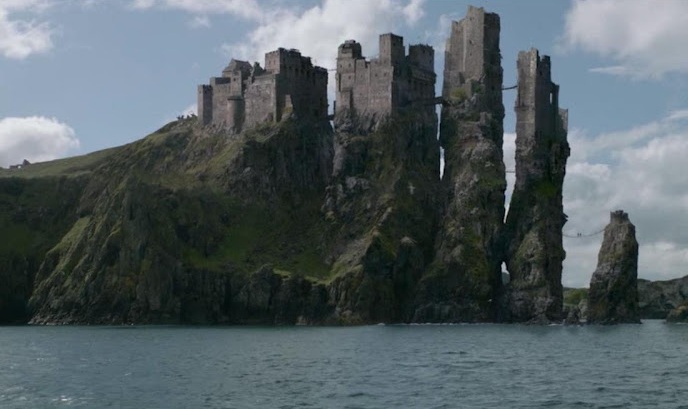
One of the things HBO’s Game of Thrones got very, very right: Castle Pyke
The castle Pyke itself seems to be a part of the broken sword land, as is noted several times in the chapter, and in the very next paragraph, we see that the Sea Tower at the point of the broken sword peninsula sounds a lot like Lightbringer:
The Sea Tower rose from the outmost island at the point of the broken sword, the oldest part of the castle, round and tall, the sheer- sided pillar on which it stood half- eaten through by the endless battering of the waves. The base of the tower was white from centuries of salt spray, the upper stories green from the lichen that crawled over it like a thick blanket, the jagged crown black with soot from its nightly watchfire.
A jagged black crown which lights on fire at night? You don’t say. Remember that the golden crown worn by kings was originally meant as a depiction of the sun’s rays which signifies that the king has the divine authority of the sun god. A black crown inverts this symbolism and implies a dark sun, or perhaps one who has taken his divine authority through force. The Ironborn kings sometimes wear a black iron crown such as Balon Greyjoy speaks of, and of course there are a lot of black crowns in A Song of Ice and Fire – and I believe they all refer to the idea of a darkened sun or an illegitimate sun king, the two things that define Azor Ahai. Thus, for the black tower at the tip of the broken sword to have a flaming black crown… well… let’s just say ‘that’s our man.’ Salt and smoke are here too – the soot which darkens the top of the tower, and the salt which turns the base of it white. I’ll quickly point out that the colors here – white, green, and black – mirror the colors of Dany’s dragons.
Only two paragraphs later, the red comet itself, infamous symbol of Lightbringer, makes an appearance to clue us in to what kind of dragon sword falls into the sea:
Theon had never seen a more stirring sight. In the sky behind the castle, the fine red tail of the comet was visible through thin, scuttling clouds. All the way from Riverrun to Seagard, the Mallisters had argued about its meaning. It is my comet, Theon told himself, sliding a hand into his fur-lined cloak to touch the oilskin pouch snug in its pocket. Inside was the letter Robb Stark had given him, paper as good as a crown.
So we have a castle with a very Lightbringer-like tower that sits on a point of land which thrusts into the bowels of the sea like a longsword or a sea dragon, and right behind it, like a red flag calling our attention to it all, we have the red comet, Lightbringer symbol par excellence.
Theon has a crown too; the parchment from Robb that was “as good as a crown.” It ends up mirroring the black, fiery crown of the Sea Tower when Balon casually tosses it in the fire upon receiving it later in the chapter. The parchment crown “curled, blackened, and took flame,” a good match to the curved Sea Tower with its black crown of flame. Before it is burnt, we see that Theon’s paper crown is kept in an oilskin pouch, perhaps to symbolize the oily black stone of the Lightbringer comet and the moon meteors. Theon is fingering the paper crown in the oilskin pouch as looks up and thinks that the comet belongs to him. And yes, all the wording in that last sentence was intentional.
In other words, the symbolism here paints Theon as a man with a flaming black crown to whom the Lightbringer comet belongs. We know who that is, right?
There’s actually one other Ironborn story about how they came to posses fire, and it leads right back to the conclusion that this fire we are talking about was Lightbringer. This is also from A Clash of Kings, and begins with Aeron Damphair speaking to Theon:
“Every morning brings a new day, much like the old.”
“In Riverrun, they would tell you different. They say the red comet is a herald of a new age. A messenger from the gods.”
“A sign it is,” the priest agreed, “but from our god, not theirs. A burning brand it is, such as our people carried of old. It is the flame the Drowned God brought from the sea, and it proclaims a rising tide. It is time to hoist our sails and go forth into the world with fire and sword, as he did.”
The red comet is like a burning brand, and proclaims a rising tide, which in retrospect, is pretty straightforward. The red comet = a time for floods. It also proclaims the time to go out with fire and sword… or perhaps with a “fiery sword?” It’s interesting that the Drowned God brought this fiery brand from the ocean – how did fire get in the ocean, I wonder? We think we know the answer – a fiery & wrathful sea dragon-comet-sword was thrust into the bowels of the ocean, shattering the land. Aeron directly compared the red comet to the burning brand the Drowned God brought from the see, so it seems we are to imagine a god emerging from the waves wielding the red comet as a fiery sword. This lines up well what the Ironborn say about themselves and their origins: the Iron Islands are named for their people, who are like iron, and that the Ironborn themselves come from the sea. Iron people that emerge from the sea with burning brands who will go forth with fire and sword, in other words. As we will begin to see, bringing fire out of the sea is an important aspect of the Ironborn mythos, starting here with the tale of the Drowned God carrying the burning brand from the sea.
As for the burning brand as a symbol, Aeron directly compares it to the red comet, but there’s actually another famous scene where the burning brand is used to symbolize the fallen star fire that is Lightbringer. This is from a Jon chapter of Clash, as Jon and Stonesnake prepare to climb up to the pass in the Frostfangs:
They could see the fire in the night, glimmering against the side of the mountain like a fallen star. It burned redder than the other stars, and did not twinkle, though sometimes it flared up bright and sometimes dwindled down to no more than a distant spark, dull and faint. {…}
“The wolf will remain with us,” Qhorin said. “White fur is seen too easily by moonlight.” He turned to Stonesnake. “When it’s done, throw down a burning brand. We’ll come when we see it fall.”
A “stone snake” will throw down a burning brand when he climbs high enough to reach the flaring bright red fallen star fire suspended in the night. Got it.
Taking a look at the major events of this chapter, we see that a stone snake (comet) collides with a red star fire (the fire moon), blood is spilled (three people at the fire for the three dragon meteors), Azor Ahai reborn-symbol Jon Snow does a Lightbringer forging scene with kissed-by-fire moon maiden Ygritte, and then the burning brand is thrown down to the earth below. That burning brand symbolizes the dragon meteors which fell from the moon, one of which became the sea dragon meteor which was thrust into the bowels of the sea at the Iron Islands, and that’s why we see it falling from the red star fire in the sky after a Lightbringer forging goes down.
Thus we see that the story of the Drowned God carrying the burning brand out of the sea is the same story as the Grey King possessing the fire of the sea dragon – that burning brand and the sea dragon’s fire represent moon meteors that fell into the sea and are then brought out of the sea by either the Grey King or the Drowned God. Even better, one of the wildlings Jon fights against at the fire actually uses the burning brand as a weapon before they thrown one down the cliff, drawing a connection between the burning brand symbol and the idea of fiery weapons that come from a fallen red star.
And who is the Drowned God anyway? Remembering that the moon is a goddess, the “woman wife of the sun,” the pieces of moon which drowned in the ocean as sea dragons would be pieces of a drowned moon goddess. In other words, what we really have here with the sea dragon is a Drowned Goddess, not a drowned god.
I’d also like to point out that burning brands, such as the Drowned God carried from the sea, are burning wood, and of course a burning tree represents fire of the gods in the myth of the Grey King and the Storm God’s thunderbolt. The burning brand is therefore connected to the fire of the gods concept in three ways: it’s burning wood like Grey King’s burning tree, it’s directly compared to the red comet, and it is the form of fire which the Drowned God carried from the sea, making it the fire of the sea god. You’ll recall that the pillars of the broken sword of land on which Pyke sits are described as the pillars of a sea god’s temple.
Putting it all together, we have a series of mythical metaphors, both in the main text of the story and in Ironborn folklore, which seem to be describing a meteor plunging into the ocean near the Iron Islands at the time of the Long Night and causing deadly floods. And lo and behold, all throughout those paragraphs we quoted concerning Theon’s arrival at Pyke, we have a ton of references to island-drowning waves, as well as a lot of hammering connected to waves to call us to mind of the hammer of the waters. We’ve seen it said of the broken sword of land that “the waves had hammered at it day and night until the land broke and shattered, thousands of years past,” and that “the angry waves foamed and crashed” among the remaining pieces of the peninsula, which are “like the pillars of some sea god’s temple.” We saw that “the sheer- sided pillar” on which the sea tower stood was “half- eaten through by the endless battering of the waves.” There’s more I could quote, but you get the idea.
Could these angry waves that did so much damage in the ancient past be the ones generated by the sea dragon’s fall from the heavens? The same event which was remembered as a Hammer of the Waters breaking the land and drowning islands? Aaron Damphair, from A Feast for Crows:
Outside, beneath the snoring of his drowned men and the keening of the wind, he could hear the pounding of the waves, the hammer of his god calling him to battle.
The same waves which “hammered” the land of Pyke are described here as God’s hammer. I would say that the sea dragon, a fallen moon goddess, was itself the hammer which broke the land and brought the drowning waves. This is a delightful parallel to the Hammer of the Waters drowning and breaking the land of the arm of Dorne. At the same time, the sea dragon meteor hammer is also the Storm God’s thunderbolt, which lines up well with Thor being a Storm God who hurls thunderbolts from his hammer. Again we are left with the idea that the hammer of the waters, the island drowning sea dragon, and the Storm God’s thunderbolt all refer to the same thing: moon meteor impacts.
Let me say this: although the Hammer of the Waters seems to refer to an impact on the Arm of Dorne and the sea dragon and thunderbolt myths seem to refer to an impact on or near the Iron Islands, both meteors would be from the same moon explosion, and therefore George has chosen to weave all the moon meteor symbols together. Thus the Ironborn myths have a ton of hammer references, and hammer of the waters scenes have dragons and spears and lightning and so forth.
A great example of this kind of parallel between different meteor myths are the waves of night and blood that appear to crash onto the steely shore of Oathkeeper and Widow’s Wail and their parallels to the scene at Pyke. Pyke sits on a point of land which is a broken sword, one which was washed over by the moon blood flood of the sea dragon, and in similar fashion, Ned’s split or broken swords have waves of blood washing over them. The bloody sea dragon flood came during the Long Night, and Ned’s swords have the waves of night to symbolize the Long Night. In turn, Aeron sees pounding and crashing waves as the hammer of his god, creating the image of a divine hammer pounding the steel of the broken sword peninsula at the Iron Islands. That broken sword of land thrusts into the bowels of the ocean, and thrusting swords into the ocean is how you get hammering sea dragon waves, the waves of moon blood which came in the Long Night and which are alluded to in the folds of Widow’s Wail and Oathkeeper. Back before Ned’s Ice was split and reforged, we saw it being dipped into the night-black waters of the pond in the Winterfell godswood while still bloody from the execution in A Game of Thrones, creating very miniature waves of night and blood.
The idea of god’s hammer being the one to smash the Iron Islands is reinforced all through this chapter via references to Robert Baratheon’s attack on Pyke during the Greyjoy rebellion. As I mentioned before, King Robert and his hammer are a rather clear manifestation of Thor and his mighty hammer mjolnir, and Robert’s entire attack on the Iron Islands is replaying the Storm God’s thunderbolt strike, the sea dragon landing, and the Hammer of the Waters… all at the same time.
It was nigh on sunset when they reached the walls of Pyke, a crescent of dark stone that ran from cliff to cliff, with the gatehouse in the center and three square towers to either side. Theon could still make out the scars left by the stones of Robert Baratheon’s catapults. A new south tower had risen from the ruins of the old, its stone a paler shade of grey, and as yet unmarred by patches of lichen. That was where Robert had made his breach, swarming in over the rubble and corpses with his warhammer in hand and Ned Stark at his side. Theon had watched from the safety of the Sea Tower, and sometimes he still saw the torches in his dreams, and heard the dull thunder of the collapse.
Pyke’s walls of dark stone are called a crescent, which puts in mind of the lunar crescent that was broken to create the sea dragon meteor, as well as all the related sickle / curving knife / crescent moon symbolism. Robert hurled stones at this crescent, then came through with his war hammer. As you’ll notice, Theon’s reference to thunder gives us the thunderbolt idea to go along with Storm King’s Robert’s hammer.
Continuing the pattern of weaving hammer ideas in with flaming sword ideas, we find that there was a flaming sword on the scene at the Battle of Pyke as well! Like I said, the gang is all invited. This is Gendry talking to Arya in A Storm of Swords:
“He liked feasts and tourneys, that’s why King Robert was so fond of him. And this Thoros was brave. When the walls of Pyke crashed down, he was the first man through the breach. He fought with one of his flaming swords, setting Ironmen on fire with every slash.”
“I wish I had a flaming sword. I can think of a few people I’d like to set on fire.”
The Ironborn were “set on fire” by a flaming sword, the one which crashed through the breach in the crescent of dark stone along with the thunderous hammer. That’s our sea dragon meteor, ‘giving the Ironborn fire,’ just as the Grey King was said to posses the sea dragon’s fire. Setting the Ironborn on fire serves as a nice metaphor for giving them fire, in this case the fire of a flaming sword in service to the Storm King Robert Baratheon. The flaming sword also parallels the Storm God’s thunderbolt which gave the Grey King fire as it “gives fire” to the Ironborn here.
Moving away from that Theon chapter of Clash, we find more confirmation that the idea of hammering waves can be connected to the sea dragon when Aeron prays to the Drowned God in A Feast for Crows:
My god, he prayed, speak to me in the rumble of the waves, and tell me what to do. The captains and the kings await your word. Who shall be our king in Balon’s place? Sing to me in the language of leviathan, that I may know his name. Tell me, O Lord beneath the waves, who has the strength to fight the storm on Pyke?
The word leviathan has a couple of meanings: it can refer to any large sea creature, particularly whales, and sometimes large people are derisively called leviathans. Sam is called a grey leviathan by Lazy Leo Tyrell, for example, while Yezzan the Yunkish slave master is called a yellow leviathan. But Leviathan is actually a well known mythological sea creature with a very specific description: it’s a monstrous, multi-headed sea dragon. That’s right, we’re talking about a multi-headed, fire-breathing dragon which lives in the ocean – a real sea dragon. So when Aeron is praying for the drowned god to speak to him through the waves in the language of leviathan, it’s simply another clue that that the Drowned God is actually the island drowning sea dragon, and that the hammering waves come from the sea dragon. The language of the sea dragon is the flood, the one which hammers and drowns the land.
While we are defining words that mean sea monster, we should briefly talk about the name which George gave the sea dragon – Nagga. Although the word nagga had sort of become a common word for snake in many fantasy universes, it is actually a specific word – ‘naga’ is the Vedic Sanskrit word for “cobra,” and the same word is used to refer to a specific type of deity or being which incarnates as a great snake – usually a king cobra (which is native to India), although it can sometimes be other snakes. In the Mahabharata, nagas are beings with both human-like and snake-like attributes.
The myth of the naga evolved as it travelled from India and sees other forms in nearby mythology, most of which show various forms of the snake-man idea. In Hindu myth, they are more like nature spirits which can bring fertility or sometimes floods and storms, and most notably, they are said to posses the elixir of immortality – the fire of the gods, in other words. In Buddhist mythology, naga became merged with myths of wise dragons and dragon men, and is frequently depicted as a man with multiple snake or dragon heads above him, or just as a multi-headed dragon or snake. The emphasis here is on a transcendent being who has gained the knowledge of heaven and attained enlightenment, which they specifically associated with a dragon’s fire. There are versions of naga in Laos, Thailand, Java, and Indonesia, and many of those are assorted with lakes or rives or oceans, but my favorite is the Cambodian idea of nagas: they were thought to be a reptilian race of beings under the King Kaliya who possessed a large empire or kingdom in the Pacific Ocean region until they were chased away to India by the Garuda, a phoenix-like incarnation of Lord Vishnu. The daughter of these lizard people married a brahmin from India and from their union sprang the Cambodian people. Thus, the Cambodian people have a saying which means “born from naga.”
So if we were to sum up the body of ideas which George may be implying by naming his sea dragon ‘nagga,’ we would include beings who are both snake and man or even dragon and man, multi-headed snakes or dragons, beings who posses magic and the knowledge and fire of the gods, and frequent associations with water. I think it’s easy to see how these ideas are generally in sync with George’s own dragon mythology, which encourages us to draw a link between the sea dragon ideas and the rest of his dragon lore – Azor Ahai, the three-headed dragon, people that are the blood of the dragon, and so on.
Next I’d like to turn our attention to the leviathan whose voice Aeron was seeking in the hammering of the waves, and also to the broader real-world phenomena of dragon-slayer myths where the slaying of the dragon results in a transformational global flood.
The Language of Leviathan
This section is brought to you by Visenya Ice Eyes, Starry Jewel-Queen of the Frozen Veil of Tears and Ser Brian the Prodigal Stark, the Good Other, Knight of the Last House, Wielder of the Valyrian Steel blade Red Song, two members of the Long Night’s Watch… and also by Ser Imriel Jordayne of the Tor, Spinner of the Great Wheel and Guardian of the Sword of the Morning, and Ser Harrison of House Casterly, the Noontide Sun, whose words are “Deeper than did Ever Plummet Sound,” Guardian of the Shadowcat
“Leviathan” is a Hebrew word meaning “twisted, coiled,” or “that which gathers itself into folds,” referencing the way that snakes coil up and fold in on themselves. The biblical sea dragon leviathan was probably based on similar, older ideas in the same region; specifically, that of “ocean of chaos” dragons Tiamat and Lotan (or his Greek incarnations Ladon and the Hydra ), all of whom were slaughtered to effect some kind of creative process on the world, usually accompanied by floods and storms. The legend of the island-drowning sea dragon Nagga and it’s associations with the fallen moon maiden myth we’ve been tracing out in all of the previous episodes could fit right in with this mythological family, which includes a long line of myths about dragon-slaying and world-transforming cataclysms, and thus I think it is appropriate to view it in that context.
As for Biblical leviathan, a true sea dragon, we read that in the beginning, Yaweh (who was originally a Storm God akin to the Canaanite Yam) created two leviathans, but he killed the female and neutered the male. Since we have one moon which gave birth to dragons as it died, and one moon that still survives, it’s tempting to draw a correlation. Many of these types of myths have one big dragon-slaying in the past and one big one prophesied yet to come…. exactly like the Qarthine moon dragons myth, which speaks of a second moon that perished in the past and a surviving moon that will crack in the future. I don’t want to let the cat out of the bag, but there is some potential foreshadowing that the red comet will return and crack open that remaining moon. That’s a subject we’ll dig into when we start our upcoming series called “Moons of Ice and Fire.”

“Destruction of Leviathan” | 1865 engraving by Gustave Doré
Even more interesting is the association with the skin of the Leviathan and light-bringing: Yaweh makes clothes of light from the skin of the slain female leviathan. That’s a very close match to the idea of making the sword Lightbringer from the moon meteors, and it also reminds us of the Grey King making a longhall from the skeleton of the sea dragon. Supposedly Yaweh will make an illuminating cover for the entire sky out of the skin of the male leviathan at the end times, showing us the “dragon slaying yet to come” idea I just referred to.
George seems to referencing these ideas, but inverting certain aspects, as he does with his inspirations – darkness covers the sky when the sea dragon was slain instead of light, and the body of the slain sea dragon seems to drink the light instead of giving it off as the Biblical leviathan’s skin does.
Returning to the idea of a leviathan or sea dragon being slaughtered to effect some huge transformation upon the world, let’s take another look at Persian and Vedic mythology. We’ve seen that much of the Lightbringer mythology comes from Persian Zoroastrianism, as well as Roman Mithraism, which itself was at least partially based on Persian ideas of Mithra (though there are many important differences and scholars dispute the level of connection). The loose translation of Azor Ahai as “fire dragon” derives from Avestan (which is an older dialect of Persian) and Vedic Sanskrit phonetic roots, and here I’ll actually clarify what was a bit of an oversimplification from the first essay.
The “Middle Persian” word for fire is ‘ādur,’ while the Avestan form is ‘ātar,’ and the modern version of the word is ‘āẕar.’ That’s where we get the similarity between Azor and “fire.” Meanwhile, ‘aži‘ is the Avestan word for “serpent” or “dragon.” For example, in Zoroastrian myth, there’s an evil three-headed dragon (or perhaps a dragon-man, the tales are not clear) named Aži Dahāka or sometimes ‘Aždaha’ who is chained up but is prophesied to burst his bonds at the end of the world and ravage the earth, Lion-of-Night-style. There’s another dragon that was apparently in need of slaying called ‘Aži Sruuara,’ the poisonous horned dragon. ‘Aži’ is a cognate to the Vedic Sanskrit word ‘ahi,’ which also means “snake” and sometimes “dragon.” The name of the big bad serpent-dragon villain of the Rigveda is usually named Vritra, but he is also called Ahi, and he’s a snake who has to be slaughtered by the hero, Indra, an act that unleashes a global flood. The Rigveda also speaks of the “dragon of the deep,” called ahi budhnya, who is said to dwell at the bottom of the heavenly rivers.
So, to sum up our loose translation of the name Azor Ahai, “Azor” is similar to the old Persian and Iranian words for fire, and Ahai is very similar to the Vedic Sanskrit word ahi, which means dragon or snake. The Avesta form of ahi is azi, which reminds us of the az- in ‘Azor.’
And then we have the fire dragon Gōčihr, who comes to us from Zoroastrian and Manichean astrology. Manicheanism was a highly dualistic religion that sprang up in Persia around 200 AD which was in part based on the Book of Enoch, and it has much in common with early Christian Gnosticism and the later gnostic beliefs of the Cathars of southern France, and the Cathars are another self-acknowledged point of inspiration for George R. R. Martin. The Manichean cosmology tells of two dragon monsters which are the enemies of the sun, moon, and stars, Gōčihr and Mūšparīg, who are chained to the sun so as to prevent them from causing harm. They are placed opposite of one another in the sky and are made to turn the celestial wheel of the sky. Mūšparīg may be the original demon responsible for lunar eclipses, which are of course know as “blood moons,” while Gōčihr seems to be associated with constellations and comets both. Here I will quote from the Encyclopedia Iranica’s summary of a work called the Bundahišn, which is a compilation of Zoroastrian cosmology derived from two older codices from the 8th and 14th century AD.
At the end of time Gōčihr will fall down on the earth, which it will terrify like a wolf does a sheep; its fire and halo will then melt the metal of Šahrewar in the hills and mountains, thus providing the river of molten metal necessary for the purification of men. At the end, after Ohrmazd himself has come down to earth to send Āz and Ahriman back to the Darkness whence they had come, Gōčihr the serpent burns in the molten metal and the pollution of Hell burns and Hell becomes pure (Bundahišn TD1, pp. 193.11-16, 195.17-196.2; TD2, pp. 225.3-8, 227.12-15; tr. Anklesaria. pp. 288-91; tr. West, pp. 125f., 129).
Gōčihr, as I said, is not an actual dragon, but a comet; or said another way, a stars which fell from a constellation to the earth. You remember when I said that many people all around the world have mythicized comets and meteors as fiery dragons, right? Well here you go, this is a pretty fantastic one. The comet dragon falls from heaven and melts the metal of the earth for means of purification, which is right in line with all the myths of dragons being slain to transform the world through floods as well as our own theory about the Long Night. A world-transforming comet dragon impact connected with rivers of molten metal has to remind us of the of making of Lightbringer from the moon meteor dragons, and also of the idea that George sometimes symbolizes the storm of falling stars as wave of blood in the sky – waves of “bleeding stars” or “bloodstones.” The idea of two dragons chained to the sun reminds us of the idea of the comet being split in two as it orbited the sun, creating two dragon comets; and the fact that one of these Manichean celestial fire dragons also causes eclipses of one sort or another is obviously something that makes me take notice. My point isn’t to say “Ah ha! George got all of this from the Gōčihr story! I’ve solved the puzzle!” but rather to point out that associating comet impacts with dragon slaying and world-changing cataclysms is a tradition which George is participating in with his own myth-making. He’s speaking the common language of myth and building off of established symbolism.
You can see the clear echoes of the Gōčihr story in the Tauroctony, Mithras’s slaying of the white lunar bull which was a part of himself. Mithras sacrifices the white bull, and the bull’s blood flows out into the world and triggers a regeneration of life. One of the differences between Roman Mithraism and its Persian ancestors is that dragons are pretty much always evil in Persian myth, while the same is not true for Roman Mithraism. In the Tauroctony, the white bull plays the role of the slain dragon, but the white bull is a friend to Mithras, just as dragons are seen as a source of knowledge and enlightenment by the initiates of the Mithraic Mysteries, as the Roman adherents to this secretive religion were named.
Part of the point of bringing all of this up is to speak of one of the common universal myths which can be found from the Middle East to India to the far east – that the slaying of the dragon to transform the world. The oldest version of this story may be the Babylonian myth of Tiamat and Marduk, as I alluded to at the beginning of this section. Tiamat is a symbol of the chaos of primordial creation, originally a shining mother goddess embodying femininity. When her children kill her husband, however, she incarnates in the form of a monstrous sea dragon, only to be was slain by Marduk, who used her divided body to form the heavens and the earth. She also gives birth to dragon children, monsters with poison instead of blood. The tale of Yaweh slaying the leviathan is thought to have been a version of this Babylonian myth, and it’s certainly very similar.
I would suggest that all of these dragon-slayer myths, many of which are derivative of one another, are playing into the same ideas and themes: death and resurrection, and word-changing natural and celestial disasters being personified as the wroth of dragons and sea dragons.
We can see many parallels to Martin’s own version of this myth – a sea dragon who makes or remakes the world, a dragon being slain to effect a creative act, a being who is a mother of dragons, etc. Marduk is actually a storm god, as is Yaweh, so we can see that the idea of a storm god slaying a sea dragon has ample mythological precedent. One thinks of Robert Baratheon slaying Rhaegar in the river Trident, a scene we’ve examined a couple of times now, which gives us an incarnation of the Norse storm god slaying a black dragon who falls into the water. We had hammers and falling rubies that flashed like fire in that scene as well. This slaying of the dragon and its line ushered in a new dynasty, with Robert reigning over a long summer of bounty and fertility.
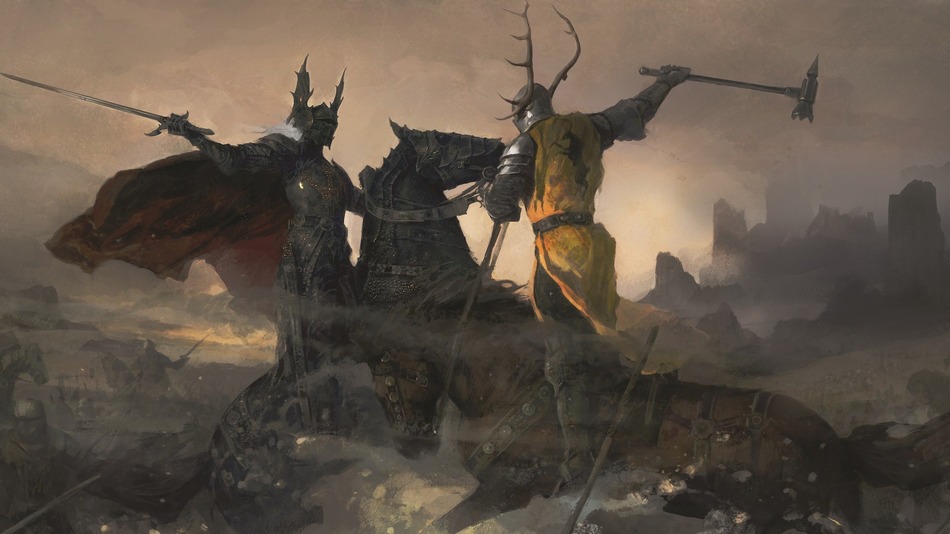
“The Battle of the Trident” by Justin Sweet
In Ironborn myth, the Storm God hurls the thunderbolt moon meteor, while it is the Grey King who slays the sea dragon meteor, but since both myths are referring to the slaying of the moon and the hammering of its meteor children, they amount to the same act. Slaying a sea dragon (or more accurately, slaying a moon which becomes a sea dragon) and hurling down the divine thunderbolt are essentially the same act, and that’s also the same thing as swinging the hammer of the gods. The point is – all of these Westerosi fables are derivative of the dragon slayer myths from the real world, and in many myths, it is the Storm King or Storm God who slays the dragon.
For further reading, I recommend this fantastic analysis of dragons in Persian mythology from the Encyclopedia Iranica. It’s their entry on aždaha.
I have a really awesome leviathan quote that I’ve been saving which gives us Robert the hammer-wielding Storm King creating dead leviathans. This is from that first Theon chapter of A Clash of Kings that we’ve been pulling from, the one with the repeated references to Robert’s storming of Pyke. As Theon is sailing to Pyke, he passes by the ruins of Lordsport and we get this:
When last he’d seen Lordsport, it had been a smoking wasteland, the skeletons of burnt longships and smashed galleys littering the stony shore like the bones of dead leviathans, the houses no more than broken walls and cold ashes. After ten years, few traces of the war remained. The smallfolk had built new hovels with the stones of the old, and cut fresh sod for their roofs. A new inn had risen beside the landing, twice the size of the old one, with a lower story of cut stone and two upper stories of timber. The sept beyond had never been rebuilt, though; only a seven- sided foundation remained where it had stood. Robert Baratheon’s fury had soured the ironmen’s taste for the new gods, it would seem.
Theon was more interested in ships than gods.
Remember how I said that the bones of Nagga might actually be the flipped-over hull of a weirwood boat? Well here we have a direct comparison between the wooden ships and sea dragons – in this case, burnt and smashed ships are compared the bones of dead leviathans. Theon is thinking of leviathans as in dead whale skeletons, but the hint here is about leviathan the sea dragon. Shortly thereafter, Theon compares the ships to gods, completing the circle and bringing us back to the notion of the leviathan as a fallen god or goddess. We’re going to get down to the “sea dragon as a boat” thing in a moment, so file that one away for now.
Let’s take a quick look around at the scene here at “Lordsport,” starting with the name. This is the place where the gods come into port. That’s our sea dragon goddess, coming in to port with her heavenly cargo. The name is similar in nature to the name “King’s Landing,” which symbolically refers to the landing of King Azor Ahai reborn the moon meteor, and the same is true of the name “Lordsport,” though it might have more literal implications since we think a meteor actually landed at the Iron Islands,
As for Storm King Robert Baratheon, he landed here with his hammer and his wrath, and he transformed it into what Theon remembers as “a smoking wasteland” littered with burnt sea dragon bones. In his attack, he’s reenacting the Hammer of the Waters, the striking of the Storm God’s thunderbolt (setting fire to wooden boats instead of trees), and the slaying of the sea dragon (leaving the burnt bones of leviathans laying around.) Toss in the other references to this battle, and we have the hammer cracking open the crescent of dark stone as well as Thoros’s flaming sword coming through the breach, giving us references to the Lightbringer myth and the Hammer of the Waters again. In fact, you could say that the entire reason the Iron Islands rebellion exists is so that Martin can depict Storm King Robert Baratheon repeatedly striking them with his hammer.
Just as we see Robert hammering away on the Iron Islands to suggest a link to the hammer of the waters and the thunderbolt of the Storm God, we have dragon attacks on the Iron Islands to suggest the sea dragon and flaming sword symbols. The first one involves House Volmark of the Iron Islands, whose sigil is a black leviathan on grey, which certainly invites further scrutiny.
image courtesy awoiaf.westeros.org
Geroge R. R. Martin is a well known lover of heraldry, and I believe he often makes use of heraldry to drop massive clues about the mysteries of the series. It turns out that the only significant member of the House of the Black Leviathan in history besides the young Lord Volmark in the main story is Quorin Volmark. He was a distant relation to King Harwyn “Hardhand” Hoare who briefly claimed the Seastone Chair in 2 AC after King Aegon the Conqueror roasted Black Harren Hoare and all his sons at Harrenhall. Quorin Volmark then declared himself the rightful heir of “the black line,” referring to the supposedly “black-blooded” members of House Hoare. Of course we’ve seen that black blood is a very important motif in our collection of moon death symbolism – having the”fire inside you” turns your blood black – so this detail stands out as significant. Quoin Volmark is a black-blooded, black leviathan, and we know what that’s all about. A black ‘bloodstone’ meteor – turned – sea dragon.
The crux of Quorin’s story is this, from The World of Ice and Fire:
“Other claimants soon arose on Great Wyck, Pyke, and Orkmont, and for a full year and a half their followers fought each other by land and sea. Aegon the Conqueror put an end to that fighting in 2 AC when he and Balerion descended upon Great Wyck, accompanied by a vast war fleet. The Ironmen collapsed before him. Qhorin Volmark died at the Conqueror’s own hand, cut down by Aegon’s Valyrian steel blade, Blackfyre.
Aegon wields the sword Blackfyre, while his dragon Balerion breathes black fire – they are matching symbols. Balerion descends upon Old Wyck, the exact location of “Nagga’s bones” – this is reenacting the sea dragon’s landing on the Iron Islands, perhaps on Old Wyk itself, where it might have created the crescent-shaped bay now know as “Nagga’s Cradle.” Meanwhile, Aegon kills Qhorin the black leviathan with Blackfyre the sword. The Grey King slew Nagga, and possessed her fire – and here that is represented by Aegon slaying the black leviathan and also possessing black fire in the form of a sword. Although technically he didn’t actually get the black fire from Quorin, nevertheless the symbolism is there. Aegean slew the sea dragon by slaying the black leviathan, and he possessed black fire in the form of a sword. This would seem a match for the idea of the Grey King and the ancient Ironborn fashioning black, soul-drinking weapons from the sea dragon meteor. It also equates the Grey King with our black dragon / Azor Ahai archetype, an idea we had as soon as we heard that the Grey King was a stealer of heavenly fire. More on this to come.
As a side note, the vast war fleet accompanying the black dragons would represent the meteor shower. This is yet another connection between sea dragons and ships – these ships are owned by a Targaryen, and thus they are dragon-ships, ocean-going dragons… sea dragons, after a fashion. We are totally going to talk about boats in a minute, I promise.
Aegon’s sacking of the Iron Islands is referenced in A Feast for Crows at the Kingsmoot by Eric Drum, wielder of the Valyrian sword Red Rain, and remember that when he refers to the black line being ended, he’s talking about Aegon’s slaying of Quorin Volmark:
“When the black line was consumed by dragon-fire, the ironborn gave the primacy to Vickon Greyjoy, aye … but as lord, not king.”
I’ve included this quote because its phrasing about the bloodline of the black leviathan being consumed in dragonfire suggests the idea of the moon’s blood being incinerated and blackened by the comet’s impact and the resulting explosion (the dragon fire). A black-blooded leviathan, burning with black dragon fire – it fits our picture of Lightbringer perfectly. I mean, that’s it, exactly, and I think the message is that the leviathan or sea dragon meteor was the same kind of black moon meteor from which Lightbringer was made.
There’s a nice companion to Aegon and Balerion’s attack on the Iron Islands to be found in A Dance with Dragons, as Daenerys rides her black dragon, Drogon. This too reinforces the idea of the Iron Islands having been shaped by the fire of sea dragon, the black leviathan:
In a dozen heartbeats they were past the Dothraki, as he galloped far below. To the right and left, Dany glimpsed places where the grass was burned and ashen. Drogon has come this way before, she realized. Like a chain of grey islands, the marks of his hunting dotted the green grass sea.
A chain of grey islands in a green sea burnt by black dragonfire – pretty nice, huh? These grey islands are all places where the dragon landed. It may also be a reference to the chain of islands known as the Stepstones, the former Arm of Dorne, which has a Bloodstone Island and a Grey Gallows island. Grey Islands chains in the sea…
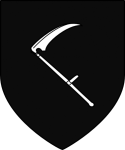
image courtesy awoiaf.westeros.org
There’s another nice clue about black fire and black weapons on the Iron Islands at the time of the Long night to be found in House Harlaw and their Valyrian steel sword, Nightfall. House Harlaw’s sigil is the silver scythe, indicating the harvest season and perhaps a bit of grim reaping – as we know, the Ironborn do not sew, they’re all about reaping. The silver scythe evoke a lunar crescent, and one that has turned into a deadly weapon. The lord of the Iron Islands also styles himself “Lord Reaper,” for what it’s worth. The sword Nightfall itself has a moonstone pommel, as we’ve talked about before, which is a nice clue about moon-stones causing the nightfall of all nightfalls. Nightfall was taken for House Harlaw by the Red Kracken Dalton Greyjoy. Nobody knows how the sword came in the possession of House Harlaw, but the Red Kracken himself is an Azor Ahai / Bloodstone Emperor symbol who will receive further analysis in the future – take my word for it, he’s the right guy to be associated with the moonstone Valyrian sword Nightfall. It’s also worth mentioning that House Volmark of the black leviathan sigil lives in the the Island of Harlaw and takes their lead from House Harlaw, like a kind of bannerman.
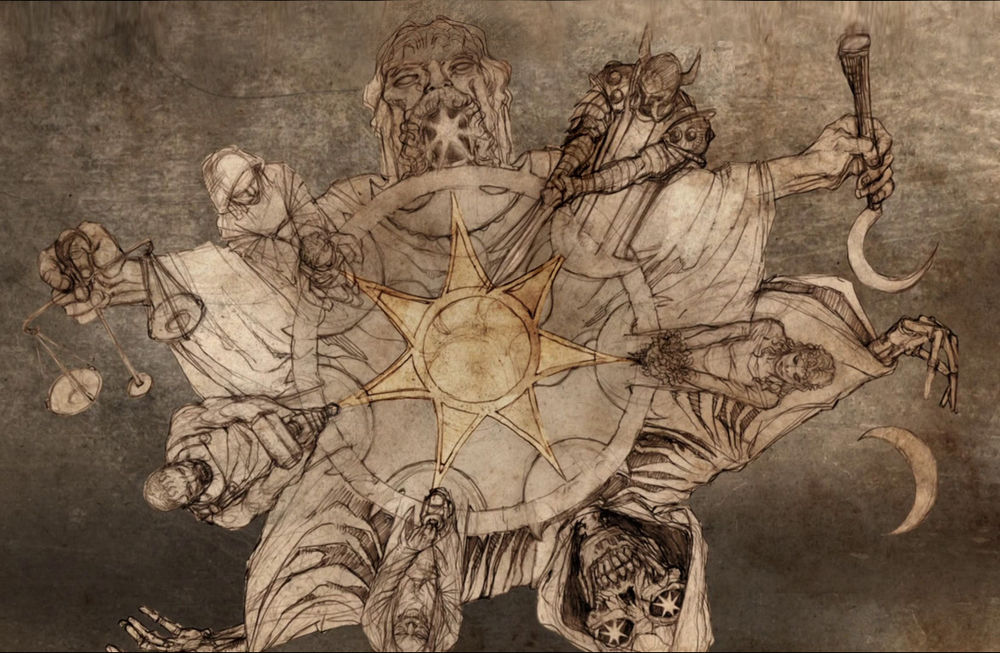
Image from “The Complete Guide to Westeros,” a feature on the home version HBO’s Game of Thrones Season One

image courtesy awoiaf.westeros.org
The parade of Ironborn sigil-based symbolism continues on Great Wyck, in the Hardstone Hills, at the Hammerhorn Keep of House Goodbrother, and here we’ll spice our discussion of black swords sea dragons with a bit more hammer of the waters flavor. House Goodbrother draws their wealth from their mines, which produce iron and other minerals. Their sigil is a gold-banded black warhorn on a field of red, which bears an uncanny resemblance to Euron’s dragonbinder horn (which “split the air” as “sharp as a sword thrust” when it is sounded) as well as the “fake” horn of Joramun that Melisandre burns at the Wall in A Dance with Dragons. These horns are associated with dragons and earthquakes, respectively, both of which come together at the Iron Islands, where the sea dragon caused an earthquake. The description of the breaking of the Arm of Dorne with the Hammer of the Waters – “giants awoke in the earth, and all Westeros shook and trembled” – matches the description of the horn of Joramun’s supposed effects, and here we find a “Hammerhorn” keep. If that weren’t enough, cadet branches of House Goodbrother are found at places with such symbolically rich names as “Crow Spike Keep,” “Downdelving,” “Corpse Lake,” and “Shatterstone.”
- Crow Spikes – a reference to the the black meteors, which are described as crows and ravens and of course sharp pieces of iron
- Down-Delving – literally a reference to the mines where they mine black iron, perhaps that of the sea dragon’s corpse, and it may symbolically refer to the downward trajectory of the falling meteors
- Corpse Lake – a reference to the corpse of the moon goddess / sea dragon landing in the water
- Shatterstone – a reference to Pyke’s broken sword of land which shattered
To reinforce these ideas, here’s a quote from the very first Ironborn chapter A Feast For Crows, where Aeron Damphair is coming up to Hammerhorn Keep after casually drowning some fanatics:
It was long after dark by the time the priest espied the spiky iron battlements of the Hammerhorn clawing at the crescent moon. Gorold’s keep was hulking and blocky, its great stones quarried from the cliff that loomed behind it. Below its walls, the entrances of caves and ancient mines yawned like toothless black mouths. The Hammerhorn’s iron gates had been closed and barred for the night. Aeron beat on them with a rock until the clanging woke a guard.
…
The hall was dank and drafty, full of shadows. One of Gorold’s daughters offered the priest a horn of ale. Another poked at a sullen fire that was giving off more smoke than heat.
If we were wondering whether the name “Hammerhorn” was supposed to be a clue about the Hammer of the Waters, the Hammerhorn’s spiky iron is clawing at the moon, connecting the idea of the moon being attacked and pulled down with hammers and horns and iron claws. The idea of the celestial horn plays on both the horns of the dragon comet which clawed the moon as well as the sound of the horn, which, again, in the case of dragonbinder, “split the air like a sword thrust.” I believe the horn and other references to loud sounds and screams refer to Nissa Nissa’s cry of anguish and ecstasy – that’s the sound which is actually said to break the moon in the Lightbringer story. In other words, the comet pierced the moon with its dragon horn, and the sound of the moon’s scream – of the impact – was like the sound of a screaming hell horn. These horns brought down the hammer of the waters. And yes, I think the implication here is that the horn of Joramun and dragonbinder may be the same thing, or the same type of thing, and one such horn may have even been involved in bringing down the moon… though that’s a subject for another day.
Returning to the scene, Aeron beats on the iron gate of the keep with a stone, creating a sound that “wakes the sleepers,” if you know what I mean, and I know you do. George often gives us a metaphor in more than one form in the same scene just to drive the point across. Aaron being offered a “horn” of ale after he wakes the sleeping folk of the Hammerhorn keep is an example of this technique.
Inside the keep itself, it’s full of shadows, and lit by a fire that gives off more smoke than heat, which is more or less how I have been describing the magic of the R’hllorists for a long time – more shadow than light. This “fire which does not give off much light or heat” is a reoccurring motif which always seems to apply to the shadowy, corrupted fire magic that we see throughout the series.
Finally, we saw the caves to the mines yawning like toothless black mouths, perhaps the place where they mine the sea dragon bones, or perhaps just symbolic of the general concept. The Grey King was said to have made a throne from Nagga’s fangs, so perhaps these toothless mouths refer to the defanged sea dragon, although that could certainly be a coincidence. Said another way, the Ironborn bring black iron out from the inside of the “black mouths” of the mountain’s mines, while the black bloodstone comes from the insides of the sea dragon.
Finally, there’s a sneaky clue about the Hammer of the Waters being connected to leviathan in The World of Ice and Fire. In the section on the breaking of the Arm of Dorne, which Maester Yandel rightly calls “the single most important event in Dornish history, and mayhaps the history of all Westeros,” they speculate about what real cause of the breaking might have been, given that the maesters reject the magical explanations.
“Archmaester Cassander suggests elsewise in his “Song of the Sea: How the Lands Were Severed,” arguing that it was not the singing of the greenseer that separated Westeros from Essos but rather what he calls the Song of the Sea – a slow rising of the waters that took place over centuries…”
But Aeron Damphair already told us that the Drowned God sings through the waves in the language of leviathan, and so we can see that the song of the sea – at least, the one which drowned the Arm of Dorne – is really the song of the island-drowning sea dragon whose language is the flood. Additionally, the lord of House Harlaw of the silver scythe has a boat named “Sea Song,” linking the hammer of the waters with the Ironborn and silver moon scythes, and to the idea of sea dragons as boats… which is what we will discuss next.
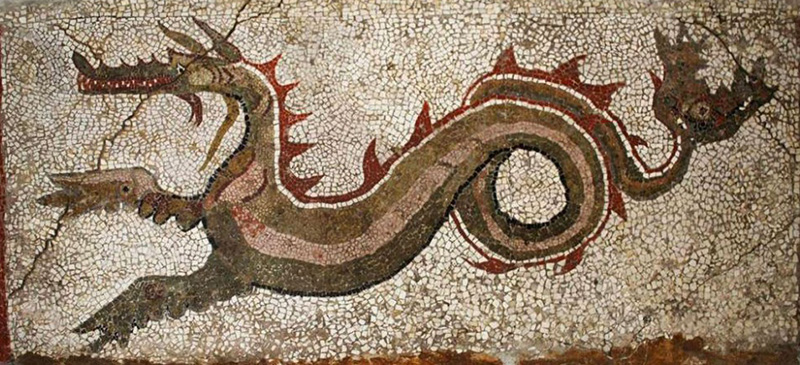
“The Sea Dragon of Kaulon” | 6th Century BCE Greek Mosaic | Kaulon, Italy
Some Smelly Fish
Mnemosyne, the poem on two feet, mother of muses, rider of the dragon Saga and Guardian of the Swan; Nienna the Wise, the Persephoenix, Guardian of the Ice Dragon, whose words are “from sorrow, wisdom”; Daphne Eversweet, Queen Bee of the Red Poppy fields, Guardian of the Crone’s Lantern, and keeper of the Black Rabbit with big, pointy, nasty teeth who can leap about… and Manami of the Jade Sea, the Merry Deviant, Keeper of Winter Roses, and Guardian of the Celestial Ghost
Ok, let’s talk about boats! Like most myth, I believe that the sea dragon and other Grey King mythology does refer to historical events – at least one, if not more. The first would be the moon meteor which seems to have fallen near or on the Iron Islands – the sea dragon as a falling meteor. The second may be a story about a foreign people who possessed fire in in some sense coming to Westeros in boats – sea dragons as boats carrying fire-associated people. What I can say for sure is that the boat is an important part of the sea dragon symbolism, so we’ll follow this line of symbolism and you can decide what you think it means. We are going to work our way to the idea of Nagga’s ribs being a boat, but first I want to break down two scenes involving Targaryens and their boats, because Targaryen boats work fantastically as symbol of the sea dragon as a boat.
We’ll begin with a lovely passage from A Storm of Swords when Daenerys is – and you’re going to like this – sailing to Slaver’s Bay on three ships named after Aegon’s three dragons. That’s right – not only do the boats belong to a dragon, they are actually named after dragons. This chapter begins by introducing the idea that Daenerys loves the sea, and builds on the sea dragon idea through the naming of the ships and finally the activity of the dragons themselves. Picking things up near the beginning of the chapter:
Her Dothraki called the sea the poison water, distrusting any liquid that their horses could not drink. On the day the three ships had lifted anchor at Quarth, you would have thought they were sailing to hell instead of Pentos. Her brave young bloodriders had stared off at the dwindling coastline with huge white eyes, each of the three determined to show no fear before the other two, while her handmaids Irri and Jhiqui clutched the rail desperately and retched over the side at every little swell.
Three ships for the three dragons of Aegon and Daenerys, and more importantly, for three primary dragon meteors coming from the moon. The three bloodriders play into the symbolism as well – I’ve mentioned before that the term bloodrider builds on the Dothraki’s interpretation of stars as horses by adding blood, creating the symbol of the bloodriders as bleeding stars, and here they have huge white eyes to remind us of the moon.
No squall could frighten Dany, though. Daenerys Stormborn, she was called, for she had come howling into the world on distant Dragonstone as the greatest storm in the memory of Westeros howled outside, a storm so fierce that it ripped gargoyles from the castle walls and smashed her father’s fleet to kindling.
Daenerys, a symbol of both the moon which was the mother of dragons and the reborn dragon herself, is called Stormborn because Azor Ahai was born during the storm that ravaged Planetos and caused the Long Night, you guys know about that. We saw in the Tyron Targaryen episode how the black stone gargoyles have a heritage involving stone dragons and therefore make tremendous fiery black meteor symbols. Describing the boats – the Targaryen boats – as kindling evokes the idea of burning wood, just as we saw with the burnt ships of Lordsport which resembled the bones of leviathans. The sea dragon brings fire to the earth of course, so burning ships fits right in, and also refer to the tree set ablaze by the Storm God’s thunderbolt.
The narrow sea was often stormy, and Dany had crossed it half a hundred times as a girl, running from one Free City to the next half a step ahead of the Usurper’s hired knives. She loved the sea. She liked the sharp salty smell of the air, and the vastness of horizons bounded only by a vault of azure sky above. It made her feel small, but free as well. She liked the dolphins that sometimes swam along beside Balerion, slicing through the waves like silvery spears, and the flying fish they glimpsed now and again. She even liked the sailors, with all their songs and stories. Once on a voyage to Braavos, as she’d watched the crew wrestle down a great green sail in a rising gale, she had even thought how fine it would be to be a sailor. But when she told her brother, Viserys had twisted her hair until she cried. “You are blood of the dragon,” he had screamed at her. “A dragon, not some smelly fish.”
He was a fool about that, and so much else, Dany thought.
I’ll cut in here to have a laugh at Viserys’s expense. We’ve already seen that Viserys isn’t too good with symbolism and metaphor – he got burned by that whole “I am the dragon, and I will be crowned!” thing, after all. We, however, pay much closer attention, and we cannot fail to miss all the dragon-fish comparison going on here.
The three ships are named for Aegon’s three dragons, and the narrative weaves the ships and Dany watching her dragons fly through the air together in the very first paragraph. Dany herself is a kind of sea-dragon, the blood of the dragon who loves the water and the sea. She’s at one with the storm, unafraid, the Stormborn. She’s born on a dragon-stone in the middle of the sea (itself a clue about dragons which are stones landing in the ocean), during the worst storm in memory. Of course, the only memories we have of the actual worst storm in history, one which also raged around dragon stones in the ocean, are hidden under layers of myth… but that’s why we are doing what we are doing, after all. Chasing down the worst storm in history.
The dragon – fish comparison take flight in the next paragraph with flying fish and dolphins like silvery spears that swim alongside Balerion the dragon-boat. There’s more talk of Dany herself loving everything about the sea, and then a direct comparison between dragons and fish as Viserys says that a dragon is not a fish. The next words are “He was a fool about that, and so much else.” That’s clear enough. The only way it could be any more clear is if Old Nan showed up with a copy of Septon Barth’s Dragons, Wyrms, and Wyverns: Their Unnatural History to read us a bedtime story about sea dragons.
Actually, is does get a bit more clear, as someone does directly compare the comet to a fish in A Clash of Kings:
Catelyn raised her eyes, to where the faint red line of the comet traced a path across the deep blue sky like a long scratch across the face of god. “The Greatjon told Robb that the old gods have unfurled a red flag of vengeance for Ned. Edmure thinks it’s an omen of victory for Riverrun— he sees a fish with a long tail, in the Tully colors, red against blue.”
So far, there seems to be a bit of truth to be found in every single thing the comet has been directly compared to, although the “fish with a long tail” description was one of the last ones to make sense. Returning to the scene with Dany and her sea dragon boats…
The captain appeared at her elbow. “Would that this Balerion could soar as her namesake did, Your Grace,” he said in bastard Valyrian heavily flavored with accents of Pentos. “Then we should not need to row, nor tow, nor pray for wind.”
The symbolic association between the boats and the dragons continues all throughout these paragraphs, as Dany and the captain compare dragons and ships to each other as a means of crossing the sea. And then… we get a more literal manifestation of the sea dragon idea:
Viserion’s scales were the color of fresh cream, his horns, wing bones, and spinal crest a dark gold that flashed bright as metal in the sun. Rhaegal was made of the green of summer and the bronze of fall. They soared above the ships in wide circles, higher and higher, each trying to climb above the other.
Dragons always preferred to attack from above, Dany had learned. Should either get between the other and the sun, he would fold his wings and dive screaming, and they would tumble from the sky locked together in a tangled scaly ball, jaws snapping and tails lashing. The first time they had done it, she feared that they meant to kill each other, but it was only sport. No sooner would they splash into the sea than they would break apart and rise again, shrieking and hissing, the salt water steaming off them as their wings clawed at the air. Drogon was aloft as well, though not in sight; he would be miles ahead, or miles behind, hunting.
He was always hungry, her Drogon. Hungry and growing fast. Another year, or perhaps two, and he may be large enough to ride. Then I shall have no need of ships to cross the great salt sea.
But that time was not yet come. Rhaegal and Viserion were the size of small dogs, Drogon only a little larger, and any dog would have out-weighed them; they were all wings and neck and tail, lighter than they looked. And so Daenerys Targaryen must rely on wood and wind and canvas to bear her home.
There’s nothing I love better a good dragon eclipse. It comes as the dragons try to get between each other and the sun (creating an eclipse) before dive-bombing, just as the moon was in eclipse position before it sent its moon dragon dive-bombing. At the moment of the dragon eclipse, we get our sea dragon meteor, plummeting towards the ocean, which is really a terrific confirmation of the eclipse idea and a good match for all the times Drogon’s wings passed before the sun and “darkened the world,” as we’ve seen in previous essays.
The falling dragons splash into the water in a scaly ball and then “break apart” (like the broken sword of land and all the broken sword symbols) and “rise again” – harder and stronger, perhaps? According to Ironborn theology, the sea dragon rose from the sea, as did the Grey King and the Drowned God himself, and the Ironborn conduct ritual drowning-and-resurrection ceremonies. As I mentioned, carrying fire from the sea is an important aspect of this combined myth, and that’s what we may be talking about here – harvesting sea dragon material from the sea.
In fact, the hissing and steaming as the dragons plunge into the water and fly back out reminds me of a sword being tempered in cold water, or a hot meteor stone landing in the ocean, the same idea on a large scale. This idea is directly implied by the choice to describe the dragons as metal – Rhaegal’s dark golden spinal crest, horns, and wing bones “flashed as bright as metal in the sun.” I mean, it really is like dragon metal dropping out of the sky from an eclipse and becoming the sea dragon, landing in the ocean and then rising from the waves. The folded wings of the soon-to-be sea dragon may be meant as callout to leviathan, whose name, of course, means “that which is gathered into folds.” And for what it’s worth, there’s a funny line where Jorah talks about Westerosi tales of dragons big enough to snatch krakens from the sea, reminding us of the idea that the sea dragon Nagga fed on krakens. At the least, it serves a s clue to make us think about sea dragons and Ironborn myth.
I just love the double metaphor in this scene – sea dragon as ships and sea dragons as metal dragons falling into the sea. Throw in the eclipse, and I’m a happy camper.
“Ninedragonwallpic1” by splitbrain – Nine Dragons Wall detail in Behei Park. Licensed under CC BY-SA 2.0 via Wikimedia Commons
This scene is actually quite reminiscent of another dragon attack scene which we examined in the Mountain vs. the Viper episode, and that one also features both a dragon eclipse and a sea dragon symbol, although it is sadly lacking in boats. I’m speaking of the dragon-on-dragon battle between Daemon Targaryen riding Caraxes “the Bloodwyrm” and Aemond-One Eye riding Vhaegar above the God’s Eye during the Dance of the Dragons, a battle recounted to us in The Princess and the Queen. The first relevant line was:
The attack came sudden as a thunderbolt. Caraxes dove down upon Vhagar with a piercing shriek that was heard a dozen miles away, cloaked by the glare of the setting sun on Prince Aemond’s blind side.
In this scene, we have a dragon eclipse to symbolize the moon which wandered too close to the sun, a dragon attack from the eclipse to symbolize the moon dragons, a comparison of the dragon attack to a thunderbolt to remind us of the Storm God’s thunderbolt, and there’s an off-the-charts ear-piercing shriek to remind us of the sound which broke the moon, Nissa Nissa’s cry of anguish and ecstasy. The sea dragon image comes as the dragons lock together – much like the scene with Viserion and Rhaegal – and plunge into the water:
Half a heartbeat later, the dragons struck the lake, sending up a gout of water so high that it was said to have been as tall as Kingspyre Tower.
There’s also a couple of clues about recovering the sea dragon meteor from the water here, because Caraxes, though mortally injured, managed to crawl back on to land beneath the walls of Harrenhall before expiring, while years later, Vhagar’s body was “found,” and we know that at least his skull was recovered, because we supposedly see it beneath King’s Landing in the current story. Also recovered was the Valyrian steel sword Dark Sister, which Daemon had jammed into Aemond’s blind eye before hitting the water. I’m not sure if they hired some merlings or squishers to go down there with a bone saw and recover this stuff or what, but somehow they did. So, recovered from the water, we have a red dragon, a black dragon sword, and at least the skull of another dead dragon, all of which are terrific Lightbringer symbols. It may be that these are metaphors referring to the Ironborn recovering sea dragon material, as their mythology would suggest.
Ah but where were we? Boats, that’s right, boats. Ships is really the correct word, but saying boats is more fun. In any case, the second major scene with Targaryen “ships” involves the burning of the Seven on Dragonstone, a famous scene where the forging of Lightbringer is reenacted literally and symbolically. This is a really creative one by George, I think you’re going to get a kick out of this.
So, burnt and broken ships can be like the bones of a leviathan, and ships owned by Targaryens are like sea dragons – dragons that swim or sail. Naming the ships after dragons is one better, especially when those dragons were themselves named after old gods of Vayria. The sea dragon is a drowned goddess, and the dragonships are named for gods and dragons both. Well. What if we could turn those sea dragon boats back into gods, and then.. I don’t know… set them on fire? That’d be some pretty cool symbolism…
The morning air was dark with the smoke of burning gods.
They were all afire now, Maid and Mother, Warrior and Smith, the Crone with her pearl eyes and the Father with his gilded beard; even the Stranger, carved to look more animal than human. The old dry wood and countless layers of paint and varnish blazed with a fierce hungry light. Heat rose shimmering through the chill air; behind, the gargoyles and stone dragons on the castle walls seemed blurred, as if Davos were seeing them through a veil of tears. Or as if the beasts were trembling, stirring… {…}
The burning gods cast a pretty light, wreathed in their robes of shifting flame, red and orange and yellow. Septon Barre had once told Davos how they’d been carved from the masts of the ships that had carried the first Targaryens from Valyria. Over the centuries, they had been painted and repainted, gilded, silvered, jeweled. “Their beauty will make them more pleasing to R’hllor,” Melisandre said when she told Stannis to pull them down and drag them out the castle gates.
Pulling down the true gods to make a bonfire to forge Lightbringer in – who would do such a thing? Azor Ahai impressionist Stannis Baratheon, that’s who. The wooden sea dragon ships which brought the Targaryens to Dragonstone became wooden gods, and then they became burning wooden gods. The fact that it was the masts of the ships – the part that still looks like a tree – that became the burning gods brings us right back to the burning tree motif, the one from the story of the Storm God’s thunderbolt setting a tree ablaze. That means that the burning wooden gods represent both the sea dragon AND the burning tree, and those are both mediums by which the Grey King obtained the fire of the gods. And what does Stannis pull from this burning tree which is also a piece of sea dragon? Why, Lightbringer, which is also the fire of the gods.
This lines up with what I have been saying all along: the sea dragon and the thunderbolt, both of which gave the Grey King divine fire, are in fact two halves of the same story. They represent different aspects of the same event, and that event is the landing of a black moon meteor near the Iron Islands and the making of evil black swords from its meteoric metal…. and perhaps an invasion of proto-Valyrian dragon people from Asshai.
There are two more quotes from the burning of the Seven scene on Dragonstone I want to pull, as they connect to Ironborn mythology:
Melisandre lifted her hands above her head. “Behold! A sign was promised, and now a sign is seen! Behold Lightbringer! Azor Ahai has come again! All hail the Warrior of Light! All hail the Son of Fire!” A ragged wave of shouts gave answer, just as Stannis’s glove began to smolder. Cursing, the king thrust the point of the sword into the damp earth and beat out the flames against his leg. “Lord, cast your light upon us!” Melisandre called out.
They are standing on the beach, and Stannis Ahai shoves his flaming sword in the damp earth… it’s not quiiiiite a sea dragon, but it’s close, and honestly, if the Ironborn somehow harvested the meteorite, then it probably landed close to shore or even right on the shore. You can’t rule out those Deep Ones recovery units, but still. The sequence here is great: Stannis is angry, and even curses as he jams Lightbringer into the earth, and then Melisandre says “Lord, cast your light upon us!” That about sums it up – angry, wrothful sea dragon meteors and a cursed Lightbringer – the light of the lord, everyone. Soak it in.
Next we have an appearance of the unholy tide:
Melisandre sang in the tongue of Asshai, her voice rising and falling like the tides of the sea. Stannis untied his singed leather cape and listened in silence. Thrust in the ground, Lightbringer still glowed ruddy hot, but the flames that clung to the sword were dwindling and dying. By the time the song was done, only charwood remained of the gods, and the king’s patience had run its course.
Melisandre is a prime fire moon symbol, and her song brings the tides. We know which tides those are – tides of moon blood. Meanwhile, Lightbringer is cooling in the wet ground where it landed. The sea dragon gods are now charwood, much like the burnt ships at Lordsport which were like the bones of dead leviathans.
As I said a moment ago, the sea dragon and the thunderbolt stories both refer to falling moon meteors and the fire of the gods, but represent two different aspects of this event. We’ve got a pretty good idea about what the sea dragon is – a black moon meteor – and what its fire was – the black meteorite metal to make magic swords with, the kind Azor Ahai used to make Lightbringer. As for the Storm God’s thunderbolt, the fire from the sky aspect is easy to understand, and we’ve caught on to the connection to the hammer of the waters via the incorporation of Thor’s lighting hammer symbolism, but what exactly is the meaning of this burning tree? I’ve suggested that the symbol of a burning tree refers to wierwood trees, with the red hands of blood and flame, and that is where the bones of Nagga and the idea of a weirwood boat come in.
A Fishy Rack of Ribs
This section is sponsored by the Patreon support of Han Never-Solo, the Scorpion Mind, Cyber-Pincher of the Weirwoodnet and Guardian of the Celestial Stallion and the Horned Lord; Direliz, the Alpha Patron, a descendant of Gilbert of the Vines and Garth the Green, earthly avatar of Heavenly House Aquarius; Lord Leobold the Victorious, the Firelion of Lancasterly Rock, earthly avatar of the Heavenly House Leo; Wyrlane Dervish, Woods Witch of the Wolfswood, earthly avatar of Celestial House Scorpio
Let’s talk about those ribs, shall we? This is the full run down on the Grey King and the sea dragon from Aeron’s “The Prophet” chapter of A Feast for Crows:
On the crown of the hill four- and- forty monstrous stone ribs rose from the earth like the trunks of great pale trees. The sight made Aeron’s heart beat faster. Nagga had been the first sea dragon, the mightiest ever to rise from the waves. She fed on krakens and leviathans and drowned whole islands in her wrath, yet the Grey King had slain her and the Drowned God had changed her bones to stone so that men might never cease to wonder at the courage of the first of kings. Nagga’s ribs became the beams and pillars of his longhall, just as her jaws became his throne. For a thousand years and seven he reigned here , Aeron recalled. Here he took his mermaid wife and planned his wars against the Storm God. From here he ruled both stone and salt, wearing robes of woven seaweed and a tall pale crown made from Nagga’s teeth. But that was in the dawn of days, when mighty men still dwelt on earth and sea. The hall had been warmed by Nagga’s living fire, which the Grey King had made his thrall. On its walls hung tapestries woven from silver seaweed most pleasing to the eyes. The Grey King’s warriors had feasted on the bounty of the sea at a table in the shape of a great starfish, whilst seated upon thrones carved from mother- of- pearl. Gone, all the glory gone. Men were smaller now. Their lives had grown short. The Storm God drowned Nagga’s fire after the Grey King’s death, the chairs and tapestries had been stolen, the roof and walls had rotted away. Even the Grey King’s great throne of fangs had been swallowed by the sea. Only Nagga’s bones endured to remind the ironborn of all the wonder that had been.
Before we discuss the ribs themselves, there’s a couple of tasty “sea dragon as a piece of drowned moon” clues I want to point out. The notion of the Grey King’s throne being made from Nagga’s fangs introduces the idea of furniture made of sea dragon, and the table made in the shape of a starfish and mother-of-pearl thrones actually play into this idea as well. By now we know what kind of star becomes a fish – a moon which turns into a sea dragon. The mother-of-pearl thrones suggest same thing, because pearls have always been associated with the moon due to their clear resemblance, and pearls are also found in the ocean, as our sea dragon meteorite was. The point is that all of the “furniture” in this scene is made of things which symbolize the sea dragon.
Now to the important stuff: the bones of the sea dragon look like the trunks of great pale trees. Most people believe that’s exactly whether are – petrified weirwood. They are used in place of beams and pillars, things normally made of wood. We are given the exact same analogy by Victorian in his “The Iron Captain” chapter of Feast:
The wind was blowing from the north as the Iron Victory came round the point and entered the holy bay called Nagga’s Cradle. Victarion joined Nute the Barber at her prow. Ahead loomed the sacred shore of Old Wyk and the grassy hill above it, where the ribs of Nagga rose from the earth like the trunks of great white trees, as wide around as a dromond’s mast and twice as tall.
It seems that George really wants us to think of those ribs in relation to weirwood trees. Best of all, there’s a direct comparison drawn between the sea dragon’s ribs, white trees, and the masts of ships, which does a splendid job of firming up our interpretation of the sea dragon / boat symbolism in the burning of the Seven scene. Recall that it was the masts of the Targaryen ships that became the burning gods, and so it seems we are indeed meant to associate the masts of ships with the trunks of trees, or burning trees when they are on fire. Masts are after all made from the trunks of trees, so we are not really talking about anything super esoteric here. As an aside, this is a really big ship we are talking about if Victarion’s estimation of size is anywhere close to accurate. This thing is like the Ironborn version of Noah’s arc.
There’s yet another thinly-veiled reinforcement of the idea that Nagga’s bones are made of weirwood in The World of Ice and Fire:
The power wielded by these prophets of the Drowned God over the Ironborn should not be underestimated. Only they could summon kingsmoots, and woe to the man, be he lord or king, who dared defy them. The greatest of the priests was the towering prophet Galon Whitestaff, so-called for the tall, carved staff he carried everywhere to smite the ungodly. (In some tales his staff was made of weirwood, in others from one of Nagga’s bones.)
Nagga’s bones and weirwood are interchangeable because they are the same thing – that’s the clear implication here. As for weirwood turning to stone, we learn from Lord Tytos Blackwood that the maesters say that weirwood trees turn to stone after a thousand years or so – they apparently never rot. Never rotting is a good thing for making boats, but turning to stone is not. Remember to not skimp on the 500 year warrantee for your weirwood boat – make sure to get at least go with the 1000 year option, you know? Of course, if your boat does turn to stone, you can always make a building out of it. Petrifying pale trees give us pale stone, naturally, which is how Nagga’s bones are described. Also noteworthy is the fact that weirwood trees are repeatedly referred to as “bone white” or “blood and bone.” The trees are like bones… and the bones are like trees.

image courtesy awoiaf.westeros.org
George has given us a sigil-based hint about this too: there’s a House Stonetree who, like House Volmark of the Black Leviathan, does fealty to House Harlaw of the silver scythe. The sigil of House Stonetree is, predictably, a grey stone tree on a field of black. What is this sigil even supposed to mean? ..and I’m talking about inside the context of the story, not symbolic meaning. There must be some idea about stone trees floating around out there. Get it? Stone trees, floating around? It’s a sea dragon joke… anyway. When Asha comes to Ten Towers, the seat of Rodrick the Reader Harlaw, she sees the stone tree and black leviathan sigils amongst those gathered, which is a nice pairing of sea dragon symbols ready to serve the grim reaper and his moon sickle. The black leviathan and stone tree are like parallel symbols, each representing one aspect of the sea dragon – the black sea dragon meteorite, and the petrified stone trees remembered as Nagga’s bones.
I think the evidence is overwhelming – Nagga’s ribs are made of petrified weirwood. I used to think about them as a dead weirwood circle, such as we find on a place called Sea Dragon Point (as a matter of fact), but History of Westeros forum user Vaxis convinced me otherwise with his excellent arguments, pointing to this quote from A Feast for Crows regarding the Damphair:
It was there beneath the arch of Nagga’s ribs that his drowned men found him, standing tall and stern with his long black hair blowing in the wind.
So they aren’t just pillars or tree trunks – they apparently form an arch. This is what would make them look like ribs – if they weren’t arched together, they would just look like pillars. The Grey King was said to have built a longhall “about her bones, using her ribs as beams and rafters” in the Worldbook, meaning that he built around the “skeleton” as is, as opposed to sawing the bones into boards and beams and then building out of them. He couldn’t have used the ribs as rafters unless they curved together to make a roof. No, I think we are to imagine something that really looks like a rib cage – or more likely, the overturned hull of a boat made from weirwood.
As I said at the top, this is exactly what the Grey King was said to do:
The Grey King also taught men to weave nets and sails and carved the first longship from the hard pale wood of Ygg, a demon tree who fed on human flesh.
As I mentioned, the weirwood trees and the greenseer bond are heavily based on Yggdrasil and Odin, making this talk of Ygg a clear reference to weirwood, and thus to making a boat of weirwood. The reference to feeding on human flesh would seem to refer to the ancient Northman custom of human sacrifice in front of heart trees, again pointing to Ygg as a weirwood. I think it all fits together pretty nicely – the Grey King was said to have made a boat from weirwood, and there it is, flipped upside down and used for a longhall. Very utilitarian of Grey King – waste not, want not, after all. The next question is where the boat was made – locally, as the myth implies, or is this the boat of of an immigrant people sailing to Westeros? It’s certainly big enough to be the sort of ocean-going vessel need for long distance sea travel. Perhaps when they arrived they used the frame of the boat hull for a longhall because it was simply all they had.
The giveaway clue about about the Grey King’s hall being a flipped over boat hull can actually be found when the wildlings attack the Wall with something they call a turtle in ASOS. It says “The turtle had a rounded top and eight huge wheels, and under the hides was a stout wooden frame. When the wildlings had begun knocking it together, Satin thought they were building a ship. Not far wrong. The turtle was a hull turned upside down and opened fore and aft; a longhall on wheels.” And there you have it – the hull of a boat, flipped over, is like a longhall. It’s even named after a sea creature! I know a turtle isn’t quite as impressive as a sea dragon, but then again the turtle god of the Rhoynish, the Old Man of the River, does make quite an entrance in ADWD. He’s even got a mean pair of horns and a fearsome bellow! Anyway, you see the point: if a boat were made of weirwood, and the frame of it flipped over, it would look like a Longhall. After a few centuries, the weirwood would turn to pale stone, everything else would rot away and disappear, and you’d have something that might look like the huge stone skeleton of a sea monster.
Figuring out that Nagga’s “ribs” is actually the hull of giant boat made of weirwood tells us a couple of things. First, it corroborates the legend of the Grey King making weirwood boats, making his overall legendary status just a bit more historical. It opens up the question of foreign immigrants to the Iron Islands, or rather adds fuel to that fire which was already burning. We will return to the discussion about the possible foreign origins of the ancestors of the Ironborn another time, but now I want to focus on the other implication of Nagga’s bones being made of weirwood, and that’s the persistent and seemingly inexplicable involvement of weirwood in Ironborn myth.
I mentioned weirwood circles at a place called Sea Dragon Point a moment ago – you know there’s bound to be some good sea dragon clues at a place called Sea Dragon Point, right? To begin with, it has weirwood circles, which makes perfect sense when you figure out that Nagga’s bones were once weirwood. Consider the name, Sea Dragon POINT – sea dragon has a point like a sword because the sea dragon meteor was the sword which plunged into the bowels of the ocean. That’s a nice one, right? There’s more Sea Dragon point goodness in Asha’s “the Wayward Bride” chapter of A Dance with Dragons, one of my very favorite chapters, and it’s there that we’ll find our next clues about the mysterious presence of weirwoods in Ironborn myth.
“And there is still Sea Dragon Point … if I cannot have my father’s kingdom, why not make one of my own?” Sea Dragon Point had not always been as thinly peopled as it was now. Old ruins could still be found amongst its hills and bogs, the remains of ancient strongholds of the First Men. In the high places, there were weirwood circles left by the children of the forest.
“You are clinging to Sea Dragon Point the way a drowning man clings to a bit of wreckage. What does sea dragon have that anyone could ever want?”
. . .
“What’s there? I’ll tell you… tall pines for building ships.”
There’s the line about weirwood circles at Sea Dragon Point. Asha thinking about setting up a new kingdom there make me think of the first Ironborn, perhaps setting up a new kingdom at the place where the sea dragon landed, the Iron Islands. Also found at Sea Dragon Point – tall trees to build ships with, a great sea dragon-as-a-boat clue. Trisitifer Botley says that Asha clings to Sea Dragon like a drowning man clings to a bit of wreckage, creating the image of sea dragon as the wreckage of a boat in similar fashion to Theon calling the broken hulls of the boats at Lordsport leviathans.
One of the primary conclusions to draw from this repeated association between weirwood and the sea dragon has to do with the hammer of the waters: the greenseers were said to be the ones who called down the hammer. Weirwoods and greenseers go hand in hand, so associating weirwood with the sea dragon makes sense if the sea dragon and the Hammer of the Waters were both moon meteors, as I propose. To support this idea, I will return to the Wayward Bride chapter. By the way, Asha herself is the wayward bride, as she has fled her arranged marriage to Eric Ironmaker, and the phrase more broadly refers to a moon goddess who has wandered out of course.
She wondered who was in command of her foes. If it were me, I would take the strand and put our longships to the torch before attacking Deepwood . The wolves would not find that easy, though, not without longships of their own. Asha never beached more than half her ships. The other half stood safely off to sea, with orders to raise sail and make for Sea Dragon Point if the northmen took the strand. “Hagen, blow your horn and make the forest shake. Tris, don some mail, it’s time you tried out that sweet sword of yours.” When she saw how pale he was, she pinched his cheek. “Splash some blood upon the moon with me, and I promise you a kiss for every kill.”
We have some ship burning being suggested, giving us the burning wood / burning sea dragon idea again, and then talk of the moon maiden’s fleet descending on sea dragon point to represent the fall of the sea dragon moon meteors. Then comes a rapid fire sequence of symbolic references: the sea dragon, then a horn blowing that makes the forest shake – think of the celestial tree shaking here as well as the earth as the horn sounds – then moon maiden Asha wants to see Tristifer’s sweet sword, and finally, there’s talk of splashing blood on the moon amidst some sex and sword play language – “a kiss for every kill.” There’s a line from earlier about killing moons and kissing moons at the same time:
Asha took Tris Botley by the ears and kissed him full upon the lips. He was red and breathless by the time she let him go. “What was that?” he said. “A kiss, it’s called. Drown me for a fool, Tris, I should have remembered— ” She broke off suddenly. When Tris tried to speak, she shushed him, listening. “That’s a warhorn. Hagen.”
This time Asha the moon maiden says “drown me” right after kissing Tristifer means Lightbringer— I mean Tristifer Botley. And then, a horn sounds. The wording here is exceedingly clever – the moon maiden “breaks off suddenly” when the horn sounds. The moon.. breaks off suddenly… I’ve actually read this passage many times but I only just recently noticed that line. The allusion to the Qarthine lunar origin of dragons myth is clear: the moon wandered too close to the sun, kissed it, and was cracked; when Asha the Wayward moon bride is kissed, she breaks off suddenly and commands people to drown her.
The symbolic references to the idea of greenseers calling down the Hammer of the Waters by breaking the moon gets really thick a bit later in this chapter:
Tall soldier pines and gnarled old oaks closed in around them. Deepwood was aptly named. The trees were huge and dark, somehow threatening. Their limbs wove through one another and creaked with every breath of wind, and their higher branches scratched at the face of the moon. The sooner we are out of here, the better I will like it , Asha thought. The trees hate us all, deep in their wooden hearts.
Just as we saw the spiky iron battlements of the Hammerhorn keep clawing at the moon, here we have the finger-like tree branches scratching the face of the moon. Now that’s what I call threatening. This chapter is full of personification of trees as human, including the Northmen who actually dress as trees. The trees seem to whispering to each other in a secret language, Asha thinks to herself, and we know that whispering leaves is the communication of the weirwoods. Later, Asha thinks that “the trees will kill us if they can.” That’s pretty great – they’ll kill everyone by scratching the moon and bringing it down. Asha represents the moon, so it makes sense that the trees have antipathy for both Asha and the moon. To be clear, I am interpreting the personified trees here as greenseers, people who have symbiotic relationships with trees, and the clues about them scratching the moon as referring to the idea of greenseers bringing down the moon. There’s another line about this:
The trees hid the moon and stars from them, and the forest floor beneath their feet was black and treacherous.
The treacherous forest hides the moon and stars because treacherous greenseers brought down the hammer of the waters, and the hammer was a moon meteor which brought on the Long Night. That’s my theory, anyway. There’s a wonderful companion line back in Feast, from the Damphair as he calls for the Kingsmoot, an idea he got while listening to the language of leviathan in the surf:
“Seek the hill of Nagga and the bones of the Grey King’s Hall, for in that holy place when the moon has drowned and come again we shall make ourselves a worthy king, a godly king.” He raised his bony hands on high again. “Listen! Listen to the waves! Listen to the god! He is speaking to us, and he says, We shall have no king but from the kingsmoot! ”
The moon drowns at the place where the sea dragon died, because the sea dragon was a piece of dead moon. That’s when we will make a new godly king, or perhaps god-king is the right expression. That would be Azor Ahai reborn, who symbolizes the reborn sun and moon. Azor Ahai reborn is the drowned moon come again – it’s the same thing as saying Azor Ahai reborn can also be considered Nissa Nissa reborn. Damphair may be prophesying the rebirth of Azor Ahai and another moon disaster right here!
In support of the connection between Azor Ahai reborn and a drowned moon which rises again from the sea, I have found a little-noticed line in A Storm of Swords which suggests that Azor Ahai reborn may indeed have some kind of oceanic origin:
His hand swept across the Painted Table. “How many boys dwell in Westeros? How many girls? How many men, how many women? The darkness will devour them all, she says. The night that never ends. She talks of prophecies … a hero reborn in the sea, living dragons hatched from dead stone … she speaks of signs and swears they point to me.”
Reborn in the sea, you don’t say. Apparently Stannis has heard a slightly different version of the Azor Ahai reborn prophecy than we have, presumably from Melisandre. This seems like a total throw-away line when you first read it, as there’s no immediately obvious way to connect Azor Ahai with being reborn in the sea… but now that we know that the sea dragon is one aspect of Azor Ahai being reborn, we can connect the idea of the Ironnborn bringing the sea dragon’s fire out of the ocean with Azor Ahai being reborn in the sea. We can also take that as further corroboration that the fire of the sea dragon which the Ironborn possessed is directly related to Lightbringer and the moon meteors, and to the idea that Azor Ahai was reborn as a merling. Ha, just checking to see if you were paying attention. I will also mention that Daenerys was reborn in the Dothraki Sea, and was of course born on Dragonstone, a rock in the middle of the sea associated with dragons.
So, after exploring the weirwood symbolism of the sea dragon, we have several parallels emerging between the Grey King, Azor Ahai, and greenseers, and they raise some interesting questions. First and foremost, who broke the moon?
If the sea dragon was a moon meteor, and the Grey King slew the sea dragon, then doesn’t that make the Grey King the moon breaker? He also called the fire down from heaven in the Storm God’s thunderbolt story, again putting him in the position of moon breaker.
But if the Hammer of the Waters was a moon meteor called down by some group of treacherous greenseers, that means that greenseers broke the moon too…
…and then there’s that fellow Azor Ahai who also has a thing or two to say about breaking the moon. What’s the deal here? Who actually performed this dastardly deed?
The point of stealing the moon seems to have been possession of the fire of the gods, and all three of these do indeed possess that very fire. The Grey King stole the fire of the gods twice over, Azor Ahai stole the fire of the gods in the form of Lightbringer and the black meteor, and the burning tree represents a weirwood, whose power also represents the fire of the gods, and is possessed by the greenseers! How does this all fit together?
The Weirwood Crown
This section is brought to you by our newest member of the Long Night’s Watch: The Smiling Wolf, Lord Steven Stark of the Broken Tower, Jedi of Just-Ice, he who awaits the Corn King; our newest zodiac Patron, Durran Durrandon, the red fish blue fish, earthly avatar of Heavenly House Pisces whose eyes are ruby and sapphire and whose sword is pale fire, and our beloved Mallory Sand, Storm Witch, the Hand of the Dragon, Rider of Zulfric the Black Beast, and Guardian of the Celestial Galley (a.k.a. The Weirwood Submarine)
So how does all of this fit together? Well for starters, I think there is a good case to be made for the Grey King being a greenseer at one point. That’s one way the stories can begin to line up – if the Grey King was a greenseer, then both greenseers and the Grey King can be said to have called down the meteor fire from heaven.
As to Grey King’s greenseer status, consider the three things that he supposedly had that were made from Nagga’s bones: besides the longhall he made from her ribs, we have the throne made from her jaws and the pale crown made from her teeth. All of these make a great deal more sense when thought of as being made of weirwood, and since Nagga’s “rib bones” turned out to be made of weirwood, let’s consider the throne and crown in that light. The Grey King’s pale crown, instead of being made of sea dragon teeth, becomes a weirwood crown – this would have perhaps been the model for the driftwood crowns later worn by the Driftwood Kings of the Ironborn. In fact, The World of Ice and Fire also talks of the Grey King being remembered in some tales as having worn the first driftwood crown, which would indicate some kind of pale wooden crown is likely to be the truth here, not a crown of teeth.
There’s a clue about this in the paragraph we already cited where Aeron describes Nagga’s Hill:
On the crown of the hill four- and- forty monstrous stone ribs rose from the earth like the trunks of great pale trees.
It’s a weirwood crown, get it? The weirwood ‘ribs’ rise from the ‘crown’ of the sea dragon hill, giving the hill a weirwood crown. I thought that was a pretty nice one. The name of the island – Old Wyk – could be intended to suggest fire, as in a candle wick, so the idea of a burning weirwood crown may be here as well.

The Grey King upon his throne, as depicted by Arthur Bozonnet in The World of Ice and Fire
Grey King’s throne, instead of being fashioned from jaws of a sea monster, becomes a weirwood throne, and this too would make more sense than a throne made from a sea dragon skull, as metal as that would be. A weirwood throne would also make Grey King sound an awful lot like a greenseer – sitting in a weirwood throne in a weirwood hall with weirwood branches wrapped around his head. I mean, shit, he sounds just like Bloodraven:
Before them a pale lord in ebon finery sat dreaming in a tangled nest of roots, a woven weirwood throne that embraced his withered limbs as a mother does a child. His body was so skeletal and his clothes so rotted that at first Bran took him for another corpse, a dead man propped up so long that the roots had grown over him, under him, and through him. What skin the corpse lord showed was white, save for a bloody blotch that crept up his neck onto his cheek. His white hair was fine and thin as root hair and long enough to brush against the earthen floor. Roots coiled around his legs like wooden serpents.
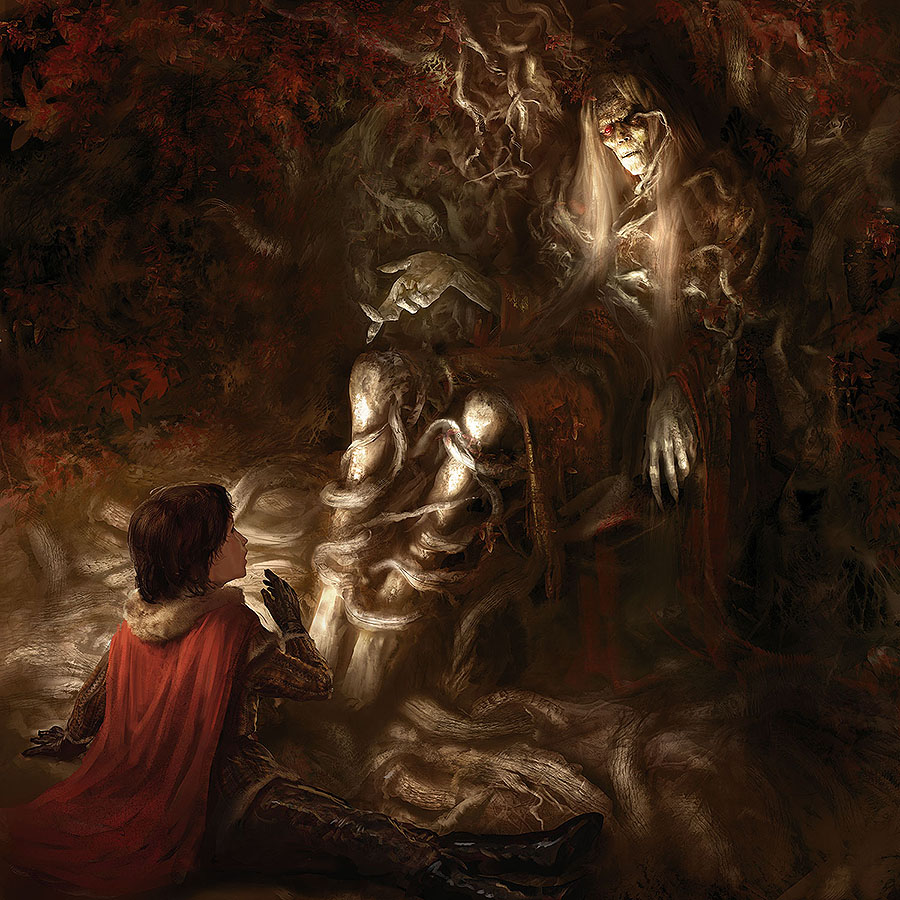
The three-eyed crow – by Marc Simonetti ©
The corpse lord sits in a weirwood throne, wrapped in weirwood – famously, one goes through his blind eye. Coiled around his legs are white wooden serpents, a perfect companion to the idea or a weirwood boat remembered as a sea dragon. White weirwood sea dragon, white weirwood serpents – it’s a nice match. Bloodraven himself is a white weirwood dragon, for that matter, combining both dragon and weirwood symbolism, just as the sea dragon does. We also need to remember one other detail about the Grey King: he was something of a corpse lord too. From The World of Ice and Fire:
From there he ruled the Iron Islands for a thousand years, until his skin had turned as grey as his hair and beard.
Aeron Damphair is more specific, saying that the Grey King reigned for “one thousand years and seven.” The point is – he had an unnaturally long life span, like Bloodraven (and then some), and turned grey, which I would call corpse-like. In fact, we’ve seen a thousand year old face before, and it resembles a corpse:
It was white weirwood, and there was a face on it. A glow came from the wood, like milk and moonlight, so faint it scarcely seemed to touch anything beyond the door itself, not even Sam standing right before it. The face was old and pale, wrinkled and shrunken. It looks dead. Its mouth was closed, and its eyes; its cheeks were sunken, its brow withered, its chin sagging. If a man could live for a thousand years and never die but just grow older, his face might come to look like that.
That was from A Storm of Swords, at the Black Gate below the Nightfort. “If a man could live a thousand years and never die but just grow older…” …well that’s what the Grey King was said to have done. We’ve found a match for Grey King’s description as a thousand year old man, and it’s a dead-looking weirwood face that talks. You can see how this begins to come together: when we read about Grey King living a thousand years and growing grey and corpse-like and when we realize that his throne and crown were probably weirwood, he really begins to sound a lot like some sort of greenseer.
Here’s where the fire of the gods stuff comes in again. Our pal the Grey King possessed the fire of the gods in two forms: he possessed the “living fire of the sea dragon” and he stole fire from the Storm God via the burning tree. Both of those myths have a laying of meaning which points to weirwood, as we have seen – the “sea dragon” bones are really weirwood, so possessing the sea dragon’s fire could imply possessing the power of the weirwoods… which you do by sitting in a weirwood throne, as the Grey King may have done. The burning tree, on the other hand, is a symbol for a weirwood, and possessing the the fire of the gods through the burning tree again sounds like the Grey King was sitting under a ‘burning tree’ and possessing its fire.
Therefore, I think we have every reason to believe he was a greenseer in one form or another.
Just as we’ve seen that the sea dragon seems to refer to both white weirwood and black meteors, we find the same dichotomy expressed in the crowns and thrones of the Ironborn. As an opposite to the Grey King’s white weirwood throne, supposedly made of sea dragon jaws, we have the Seastone Chair, a throne carved from an oily black stone. But if the oily black stones are meteorites as I suggest, then this too is sea dragon furniture. As an opposite to the Grey King’s weirwood crown, we have the black iron crown worn by the iron kings and more recently Balon Greyjoy. It isn’t said to be made of oily black stone, but it is simply the familiar black iron crown symbol which signifies an inverted solar king, and black iron was taken from the meteorites to make swords with.
Recall Theon carrying Robb’s letter which he thought of as being as good as a crown, because it fits the pattern too. The white parchment crown is a clever way of alluding to a pale wooden crown, since parchment is made from trees or plants, and of course it later turns black, curls up, and catches on fire, making it a perfect match to the round tower top of Castle Pyke which is blackened by soot from the nightfires.
Throughout all of its symbolism, the sea dragon continues to show us black meteors and white weirwood trees. The big question is, how do those two things come together? What is the link between weirwoods and the moon meteors?
The first part of the answer I’ve already suggested: the greenseers were said to have called down the hammer of the waters, and the hammer of the waters was a moon meteor. The Grey King called down moon meteors in two different stories, so this would all make a lot more sense if the Grey King is a greenseer – one of the ones who was somehow responsible for bringing down the moon. As to how you steer a comet into a moon… well more on that in a future episode.
As I’ve said before, I’ve never bought the idea that the children of the forest were the greenseers who broke the Arm of Dorne and called down the hammer; rather, I’ve always thought it more likely that human greenseers were the ones who abused their access to magical power and caused this great disaster. I’m thinking that eventually, all deeds ever committed by greenseers of any kind probably came to be attributed to the children of the forest, because the memory of human greenseers has almost completely faded. I believe human greenseer kings were a thing in the Dawn Age, to say the least.
I’ve also jokingly called these potential greenseers who broke the moon “naughty greenseers,” because I believe they were doing something quite naughty, for lack of a desire to use a more serious word. These would have been treacherous, rebel greenseers who were violating the natural order. Stealing from the gods, breaking the cycles of nature – that’s the idea. The children of the forest are content to pass quietly into the night, having elapsed their given time on the earth, but the anyone who tries to gain the cup of immortality is defying the life and death cycle. The Grey King seems like such a figure, potentially, a greenseer who called down the black moon meteors in order to possess the fire of the gods.
It’s probably also pretty obvious to you that Azor Ahai fits this description as well, someone who brought down the moon goddess to possess her fire. It could be that Azor Ahai and Grey King are completely separate dudes on separate continents whose mythology both sprang up around becoming a powerful king at the time when the black meteors fell. But as I’ve said before, I think the Azor Ahai story has to end in Westeros, or else it’s simply hard to see how it’s relevant to the main story, and we’ve spent way too much time on it in the books for it to be irrelevant.
I’ve found many clues indicating that Azor Ahai did indeed come to Westeros, by dragon and by boat, and therefore it is entirely possible, and I’d even say probable, that the Grey King mythology does in part refer to the deeds of Azor Ahai, perhaps transposed on top of a more local hero or heroes who established the Ironborn fishing and sea going culture – making the first boats, being the first great king who founded a dynasty there, etc. The sea dragons as boats idea also suggests a storm of invading sea dragon boats – fiery people from over the sea, immigrating to or invading Westeros, which could be Azor Ahai’s fleet of “pirates from Asshai,” as I like to call them. As we have seen in our study of the Great Empire of the Dawn and Asshai with History of Westeros, there is credible reason to think that some sort of Asshai-to-Westeros contact did occur around or before the time of the Long Night, and thus there may be a plausible mechanism to explain how the matching mythologies of Azor Ahai and the Grey King may be referring to the same events and people, at least in some cases.
Now, if the Grey King and Azor Ahai are in some sense the same person or at least, if their stories refers to the same deeds and events, and if the Grey King was one of these naughty greenseers, does it follow that Azor Ahai was a naughty greenseer?
Yes, absolutely, that’s exactly the point. Azor Ahai was a greenseer! – a naughty one who transformed himself with fire magic through the stealing of the moon. It’s the same logic here as with the Grey King – if the greenseers had something to do with calling down the hammer, and if the hammer was a moon meteor, and if Azor Ahai broke the moon as his legend says he did, then it is possible that the answer to these seemingly conflicting tales is that Azor Ahai was a greenseer who broke the moon. I think that’s the case, and there’s a quite a bit of really excellent symbolism to support this idea. It begins with the burning tree symbol.

Burning tree by beingstoned on DeviantArt
The central aspect of the Lightbringer forging metaphor is transformation. Nissa NIssa and the moon she represents were transformed when they were stabbed by Lightbringer, and Azor Ahai and the sun he represents were transformed and turned dark through the dark deeds that went down during the Long Night. We’ve talked about the moon transformation quite extensively, and here I’d like to focus on Azor Ahai’s transformation, which mirrors that of the sun. The smoke and ash from the moon meteor impacts are what clouded the sky and darkened the sun, transforming it into the night sun, and in parallel fashion, I think the black meteors were used by the Bloodstone Emperor Azor Ahai to work dark magic that had a transformative effect on himself. That’s how he became the Bloodstone Emperor, after all. This transformation act was a result of his taking possession of the fire of the gods.
This exact idea is also found in the Grey King myth, I believe. If the tree set ablaze by the thunderbolt represents a weirwood, the Grey King must have bonded with it, thereby transforming himself to obtain the fire of the gods, just as Azor Ahai did. He may have even had to die and be resurrected at some point, and the same is true of Azor Ahai.
Similarly, we might also interpret the lighting of the tree on fire as the activation of the weirwood bond – before the tree was ablaze, it wouldn’t look like a weirwood, after all. Without the weirwood bond, a human cannot access the god-like power of the weirwoodnet. The powers of astral projection, limited time travel, unlimited peeping tom-ability, and long life which the weirwoodnet connection offers IS the fire of the old gods, the knowledge and magic of the old gods. If the thunderbolt set the tree on fire, it might mean that the meteor strike triggered some sort of change to the weirwoods, perhaps activating them or corrupting them or allowing humans access to the weirwoodnet. These are all ideas we will follow up on in the future.
And now it’s time to get to the really really good part of this episode, something I’ve been working to get to for a long time now. Thus it is my pleasure to present to you…
Greenseers of Fire
This final section is brought to you by these redoubtable zodiac patrons: Ser Dionysus of House Galladon, wielder of the milkglass blade the Just Maid, earthly avatar of Heavenly House Virgo and Libra; Turin the Elf, Tavernkeep of the Winespring Inn, Master of the Abyss, earthly avatar of Heavenly House Cancer; Sarah Stark of the Wolfblood, the shining hand of Phaesphoria and earthly avatar of the Heavenly House Sagittarius; Queen Cameron, Lady of the Twilight, Keeper of the Astral Cats, earthly avatar of Heavenly House Aries; and Melanie Lot7, a.k.a. The child of the forest known as FeatherCrow, the Weircat Dryad, earthly avatar of Heavenly House Capricorn
Alright friends, we’ve got one section left and it’s a really important section. I almost broke it off into its own little podcast, but it’s really the cherry on top of everything we’ve established so far in this episode. Having just presented you with the theory that the Grey King and Azor Ahai stories are both referring to a greenseer (or group of greenseers) who pulled down the moon and transformed himself or themselves through the fire magic of the moon meteors, I feel the need to provide some supporting evidence, beyond what we have laid out already. Obviously we are near the end of the episode here so we’re only just going to scratch the surface, which is why I’m calling this episode the start of a new compendium based around weirwood and greenseers – subsequent episodes will build on these ideas.
Right now we are going to tie a bow on this episode by examining the all-important burning tree symbol and how it relates to the idea of a fiery greenseer.
Azor Ahai is a fiery sorcerer. He’s a magician and a warrior of fire, and he seems to have transformed himself through he use of fire magic and blood magic, and possibly a bit of “meteor magic.” The thing is, there is a persistent connection between burning trees – especially burning weirwoods – and fiery sorcerers. Many times, we find burning wood present at Lightbringer forging scenes, and from those symbolic bonfires, we see descriptions of fiery sorcerers waking and emerging. We’ve actually been seeing them for five books now, and I think you’ll be surprised to see all these quotes that have them hidden in plain sight. This will be kind of like a Where’s Waldo-style hunt for fiery sorcerers that runs through many of the best Lightbringer forging reenactment scenes in the series. We are going to take a look at six such scenes where the fiery sorcerers appear:
- Arya and the Night’s Watch recruits the abandoned holdfast near Harrenhall
- the scene at the Red Temple where Benerro pantomimes the destruction of the moon
- the burning of the Seven on Dragonstone
- the Alchemical Wedding
- the dragon-on-dragon battle between Moondancer and Sunfyre from the Targaryen civil war known as the Dance of the Dragons
- Jon and Quorin in the Frostfangs right before Jon is forced to kill Quorin
The premise is this: the burning tree symbol represents the weirwoods, and more specifically, it represents the weirwoods as a source of divine power that man can tap into. The burning tree is set ablaze by the thunderbolt strike of the Storm God, which represents a meteor strike, and thus we can say that the burning tree seems to exist at the location of a moon meteor impact, or perhaps more generally that the burning tree and the moon meteors landing on the Planetos are somehow linked. What we will see in the following scenes are depictions of fiery sorcerers waking and emerging from burning wood at the same time and place that the forging of Lightbringer or the landing of one of the Lightbringer meteors is symbolized. What exactly this means, we will try to discover as we go, but right at the start I am asserting that these fiery sorcerers are representative of a greenseer transforming himself through fire, and that this seems to have been made possible by the moon meteors and / or the events of the Long Night. This, I believe, is the truth behind the myths of the Grey King and Azor Ahai.
The first scene we will take a look at is the scene from A Clash of Kings where Arya, Yoren and the Nights Watch recruits are trapped in the small abandoned holdfast near Harrenhall. The star of the scene is an actual burning tree, but the set up to that is important. Yoren’s company are besieged by Ser Amory Lorch, whose sigil contains a black manticore and three golden coins (gold coins being dragons in Westeros). As we are about to see, Ser Amory’s attack is very much a reenactment of the attack of the dragon meteors on Planetos:
For a moment she thought the town was full of lantern bugs. Then she realized they were men with torches, galloping between the houses. She saw a roof go up, flames licking at the belly of the night with hot orange tongues as the thatch caught. Another followed, and then another, and soon there were fires blazing everywhere. Gendry climbed up beside her, wearing his helm. “How many?”
Arya tried to count, but they were riding too fast, torches spinning through the air as they flung them. “A hundred,” she said. “Two hundred, I don’t know.” Over the roar of the flames, she could hear shouts. “They’ll come for us soon.”
“There,” Gendry said, pointing. A column of riders moved between the burning buildings toward the holdfast. Firelight glittered off metal helms and spattered their mail and plate with orange and yellow highlights. One carried a banner on a tall lance. She thought it was red, but it was hard to tell in the night, with the fires roaring all around. Everything seemed red or black or orange. The fire leapt from one house to another.
There are two ideas in those quotes which work as a set-up to the payoff line in this scene: the flames personified as a living thing, and the living soldiers personified as beings of fire. These are two sides of the same coin which work to show us beings made of fire – the fire is described like a person, and the people are described like flame. Starting with the anthropomorphized fire, we see flames lick at the belly of the night with orange tongues and leap from one house to another, like some kind of wild animal, and twice the fire is also roaring like an animal, as if the fire has become some kind of beast.
More importantly, we have the fiery soldiers. Ser Amory’s men with torches are first equated with lantern bugs – flying things associated with fire. The fire reflects off their helms and armor, making them look as if their armor were made of fire. These fiery lantern bug knights send their torches spinning through the air like spinning meteors. There’s a line a bit further on that says “A torch sailed spinning above their heads, trailing fingers of fire as it thumped down in the dirt of the yard,” after which which Yoren immediately shouts “Blades!”, which I take for a clue to associate the spinning torches with blades, as in the flaming swords of the moon meteor shower. Notice that the torch trails “fingers of fire,” almost as if the lantern bug men had thrown their fiery hands at Arya and company – this is a representation of the fiery hand of R’hllor symbol which we know and love. Like the fiery tongues, “fingers of fire” also works to create the image of a being made of fire.
We also get spears being hurled from out of “the fire-bright shadows,” reminding us of the meteors-as-sun-spears symbolism and the idea of fire shadows – Melisandre’s shadow babies born of Stannis’s life fires, or Drogon the Winged Shadow who spits black fire, both of which are prime black meteor symbols. After the soldiers get inside the holdfast, there’s a line where they are described as “steel shadows” with “flames shining off their mail and blades,” meaning that our steel shadows have fiery swords now as well as fiery armor. Recall that when the Ghost of High Heart sees the shadowbaby assassin in a vision as “a shadow with a burning heart.”
Finally, there are two references to storms: right before the spinning torches that make Yoren say “blades” comes flying over the wall, Ser Amory says “storm the gates,” so that’s a storm of meteor torches or fiery knights with fiery blades or however you want to say it. Right before they storm the the castle, there’s a long discussion about whether or not Yoren’s group of Night’s Watch pledges might not be serving the rebel Lord Beric, the Lightning Lord with a flaming sword, and this serves to remind us of the connection between lightning and flaming swords. There’s a terrific line where the sarcastic Yoren says “Are you blind man? You see a bloody lightning bolt?” That’s a tasty one because it links thunderbolt idea with blood, which is convenient if you have a theory about the Storm God’s thunderbolt being a bleeding star or a bloodstone moon meteor.
And then we get the payoff line:
Arya saw a tree consumed, the flames creeping across its branches until it stood against the night in robes of living orange.
In the center of it all, we have the burning tree, set ablaze by one of these twirling meteor-torches in a terrific echo of the Storm God’s thunderbolt meteor setting the Grey King’s tree ablaze. The burning tree here is rendered in grandiose fashion as it “stands against the night in robes of living orange,” almost like some kind of fire priest… actually, just like a fire priest. We are going to see that robes of flame are the hallmark of these fire sorcerers, beginning here with this burning tree. This entire scene with Arya and the burning tree specifically evokes the symbols of the temple of R’hllor, so let’s take a look at our actual fire priests next.
This is the scene in Dance where Benerro pantomimes the moon destruction with his fist, a scene we’ve dissected several times. I won’t quote it all – suffice to say it is a scene with heavy lightbringer forging and moon destruction symbolism going on. There are many symbols in common with the Arya scene we just read, including fiery spears, the fiery hand, fiery knights, and those fiery robes.
The acolytes were clad in robes of pale yellow and bright orange, priests and priestesses in red.
Benerro’s high voice carried well. Tall and thin, he had a drawn face and skin white as milk. Flames had been tattooed across his cheeks and chin and shaven head to make a bright red mask that crackled about his eyes and coiled down and around his lipless mouth. “Is that a slave tattoo?” asked Tyrion.
The knight nodded. “The red temple buys them as children and makes them priests or temple prostitutes or warriors. Look there.” He pointed at the steps, where a line of men in ornate armor and orange cloaks stood before the temple’s doors, clasping spears with points like writhing flames. “The Fiery Hand. The Lord of Light’s sacred soldiers, defenders of the temple.”
Fire knights. “And how many fingers does this hand have, pray?”
“One thousand.”
And then comes the moon destruction pantomime. This time we are focused instead on the fiery people and their fashionable attire. The burning tree in the last scene wore robes of living orange, and here we see robes of pale yellow and bright orange and red – it seems clear that the fire priests of R’hllor are trying to look as though they were robed in fire. Benerro and the other high priests of fire, such as Moqorro, take it one step further with their masks of writhing flame – they are tattooed to look like they literally made of living fire. I’ve speculated that this might be done in remembrance of some lost art of fire transformation, one which Melisandre may have rediscovered – and perhaps Moqorro too, since he survived ten days floating in the ocean without drowning or freezing. The idea of people made of fire is also represented in the fire knights, who are counted the fingers of R’hllor’s fiery hand, making them meteor symbols. The fire knights actually make a nice parallel to the knights with flames reflecting on their armor and swords in the last scene.
Melisandre, our first example of a fire priestess, has robes which are often described in similar terms: Davos recalls her in A Storm of Swords with the line “..her red gowns moving like flames as she walked, a swirl of silk and satin.” That compares very well with our tree wearing fiery robes of living orange. Melisandre, of course, burned the wooden statues of the Seven-Who-Used-To-Be-Sea-Dragon-Boats on Dragonstone. We’ll revisit that scene to observe the fire sorcerers woken there in a moment, but first there are some storm clues to clean up from the Benerro scene.
For a while Tyrion could still hear Benerro’s voice growing fainter at their back and the roars his words provoked, sudden as thunder.
Thunder, you don’t say? That was the guy just hollering about the moon breaking into fiery fingers, right? In the very next line after the thunder reference, we get a hammer reference:
They came upon a stable. The knight dismounted, then hammered on the door until a haggard slave with a horsehead on his cheek came running.
The hammering brings a horsehead, reminding us of the Dothraki custom of perceiving stars as horses, and what the horsehead person brings is yet another meteor symbol:
The manacles were black iron, thick and heavy, each weighing a good two pounds, if the dwarf was any judge. The chains added even more weight. “I must be more fearsome than I knew,” Tyrion confessed as the last links were hammered closed. Each blow sent a shock up his arm almost to the shoulder. “Or were you afraid that I would dash away on these stunted little legs of mine?”
Another hammering, and this time it sends a shock – think lightning and electricity – up his arm. Think about an arm shocked by a hammer, and you’ll have it. It’s that bloody lightning bolt Yoren was talking about, hammering the Arm of Dorne. You’ll recall Tyrion’s arm-wounding scene from the Battle of the Green Fork which we examined previously, where he was hit by the Morningstar of a “white star wolf” (a Karstark), a scene which also symbolized the Hammer of the Waters breaking the arm of Dorne. The chain of black iron that sends hammer shocks up Tyrion’s arm is also a clue about the arm of Dorne, which, thanks to the hammering of black iron thunderbolt meteorites, is now a chain of islands. I don’t have time to break down this whole chapter, but right after this, Mormont and Tyrion cross the long bridge of Volantis – a bridge made of fused black stone with the aid of dragonfire and sorcery. The black iron chain of the “bloody” manacles, as Tyrion calls them, is a perfect miniature symbolic companion to the black dragon stone bridge. Jorah and Tyrion even cross this bridge from East to West, just as the First Men would have crossed the Arm of Dorne from east to west in the Dawn Age before it became a chain of islands burnt by dragonfire.
Our next scene with fiery sorcerers and burning trees is the burning of the Seven on Dragonstone. Again we don’t need to quote very much of it, just the relevant lines. Remember that these burning gods represent both sea dragons, by way of their being Targaryen ships, as well as burning trees, because they are wooden masts, which are symbols of tree trunks, and also because what are thought of as the “bones” of the sea dragon are actually dead trees.
In any case, these burning gods apparently bought their outfits at the Red Temple outlet store in Asshai:
The morning air was dark with the smoke of burning gods.
They were all afire now, Maid and Mother, Warrior and Smith, the Crone with her pearl eyes and the Father with his gilded beard; even the Stranger, carved to look more animal than human. The old dry wood and countless layers of paint and varnish blazed with a fierce hungry light.
. . .
The burning gods cast a pretty light, wreathed in their robes of shifting flame, red and orange and yellow.
It’s those same fiery robes of red and orange and yellow. They are blazing and shining, but their smoke darkens the morning sky. Those are the burning sea dragon gods, and they are dressed like our fiery sorcerers. They were set on fire by Lightbringer, in a manner of speaking, or at least we can say that they burned while pierced with Lightbringer. Lightbringer is the fire of the gods come down to man, and it comes when the gods are set ablaze. This may support the idea that the thunderbolt-burning-a-tree-with-godly-fire idea translates to the weirwoodnet being made accessible or altered in some way by the impacts of the moon meteors.
There’s an additional tie to wierwood here as the wood of the statues of the gods of the Seven is called “old ,” like the Old Gods. Melisandre proceeds to burn the Seven on Storms End shortly after this, and this time she also burns a giant weirwood from the Storm’s End godswood – what was in all likelihood at an 8,000 year-old tree at the least, from the days of Durran Godsgrief, the first Storm King.
All in all, this scene is tremendous and continues to yield up valuable clues: the fiery sorcerers emerge from the fire of the burning wooden sea dragon gods, a fire which also produces Lightbringer.
Let’s now take the search for fiery sorcerers to the Alchemical Wedding. If the fiery sorcerers are an important part of the Lightbringer forging chain of events, then they will surely put in an appearance at the Alchemical wedding… and indeed they do.
The flames writhed before her like the women who had danced at her wedding, whirling and singing and spinning their yellow and orange and crimson veils, fearsome to behold, yet lovely, so lovely, alive with heat. Dany opened her arms to them, her skin flushed and glowing. This is a wedding, too, she thought.
The flames were so beautiful, the loveliest things she had ever seen, each one a sorcerer robed in yellow and orange and scarlet, swirling long smoky cloaks.
Once again, fiery sorcerers dressed in fiery robes of red, orange, and yellow are awakening from the bonfire of lightbringer’s cradle, just as they did at the burning of the Seven on Dragonstone. The language is quite explicit here – they are fiery sorcerers, and they come to life along with the moon dragons at lightbringer’s forging. You can see that George is really sticking to the same language – fiery robes and cloaks, red, orange and yellow… and perhaps a bit of smoke.
We also see the inclusion of fiery dancers waking from the flames, and actually I think these are the same people, because there’s a whole line of symbolism about dancing and the horned moon that we’ll get into eventually. Consider the dragon known as Moondancer, whom we hear about the The Princess and the Queen – moon dancer is a green dragon with pearl horns and claws. She’s actually set on fire by a dragon named Sunfyre in a reenactment of — oh what’s that, you want to hear the quote? That’s terrific, because there is more fire-masquerading-as-clothing going on, and because this is just as sweet paragraph of hot dragon-on-dragon action:
They met amidst the darkness that comes before the dawn, shadows in the sky lighting the night with their fires. Moondancer eluded Sunfyre’s flames, eluded his jaws, darted beneath his grasping claws, then came around and raked the larger dragon from above, opening a long smoking wound down his back and tearing at his injured wing. Watchers below said that Sunfyre lurched drunkenly in the air, fighting to stay aloft, whilst Moondancer turned and came back at him, spitting fire. Sunfyre answered with a furnace blast of golden flame so bright it lit the yard below like a second sun, a blast that took Moondancer full in the eyes. Like as not, the young dragon was blinded in that instant, yet still she flew on, slamming into Sunfyre in a tangle of wings and claws. As they fell, Moondancer struck at Sunfyre’s neck repeatedly, tearing out mouthfuls of flesh, whilst the elder dragon sank his claws into her underbelly. Robed in fire and smoke, blind and bleeding, Moondancer’s wings beat desperately as she tried to break away, but all her efforts did was slow their fall.
Pretty epic, right? This is really fantastic mythical astronomy here – sun and moon colliding and destroying each other, exactly the picture of the eclipse followed by the explosion which the Qarthine myth describes as the moon “wandering too close to the sun and cracking from thereat.” The thing that falls out of the sky represents the Lightbringer meteor, and it is made of the sun and the moon, just as I’ve been saying, and it is a bloody and flaming dragon ball that is like a second sun, reinforcing the idea of Lightbringer as a second sun. Moondancer is blinded, representing the torn-out-moon-eyes symbolic motif we’ve talked quite a bit about…
…but more importantly, Moondancer is gloriously robed in fire – the line is, “robed in fire and smoke” – just like the fiery dancers that woke from Dany’s Lightbringer forging ceremony and just like all the fiery sorcerers we have seen so far waking from Lightbringer wood-burning incidents. The fact that these signature fiery robes are worn by a moon-dancing green dragon is rich with symbolic import, and all of it corroborates our theory about these fire sorcerers: they were greenseers and dragon people (green dragons) awoken in the fires which forged Lightbringer. I’d also add that some part of their magic may involve dancing and singing, just as the children of the forest’s true name is “those who sing the song of earth.” When Dany’s dragons hatch, it says that the night came alive with the music of dragons. Those are actually the last words of A Game of Thrones.
As an aside, let me say that I love that he took the time to write such epic metaphor and symbolism in even his supplementary A Song of Ice and Fire material such as The Princess and the Queen and the The World of Ice and Fire.
Now that we have introduced fiery moon dancers to the family of fire people, there’s actually a pair of loose details to clean up from the Alchemical Weding scene which relate the Ironborn mythology:
And there came a second crack, loud and sharp as thunder, and the smoke stirred and whirled around her and the pyre shifted, the logs exploding as the fire touched their secret hearts.
This entire solar pyre is made of carefully arranged pieces of wood, and the reference to secret hearts certainly seems like a reference to the heart trees, trees which appear to be on fire and harbor basically every secret there is. Secret hearts, know what I mean? Their hearts are set on fire when the dragon’s lunar egg cracks open with a thunderous sound, just as the thunderbolt moon meteor / sea dragon set the tree ablaze. This is the second egg, which means Rhaegal, the green dragon, for what it’s worth, reminding us of moon dancer the green dragon, and of greenseers who were dragon people. When I see the thunderous green dragon touching the secret wooden hearts with fire, I am again seeing a possible suggestion that the weirwoodnet was activated or altered (‘set on fire’) by the meteor strike.
To conclude the Alchemical Wedding scene, I’ll note that Drogo too wears the fiery garments:
And now the flames reached her Drogo, and now they were all around him. His clothing took fire, and for an instant, the khal was clad in wisps of floating orange silk and tendrils of curling smoke, grey and greasy.
The reason I point this out is because Drogo is the dying solar king here, and he wears the robes of the fire sorcerer. He represents the death of the sun and Azor Ahai, while his perceived resurrection as the red comet parallels the waking of the dragons and the rebirth of Azor Ahai as a dark solar king. That’s why the inclusion of “greasy” smoke and oil to light the wood a bit earlier. The point is – the fiery sorcerer woken from the Lightbringer pyre is none other than the reborn Azor Ahai. This is the burning tree we have been tracking down – it’s Azor Ahai, the greenseer who transformed himself through fire magic by cracking open the moon and waking the stone dragons. Drogo is consumed in the fire here, but in a moment he appears to rise from the flames, mounted on a smoky stallion, just as the tree was consumed in the fire of the Storm God’s thunderbolt and gave birth to a Grey King who was now armed with the fire of the gods.
Basically any time we find burning weirwoods, we have Azor Ahai making an appearance. Melisandre the fire sorceress has all the wildlings burn a piece of weirwood as they cross through the Wall and enter the Seven Kingdoms – and look who’s standing there, none other than Azor Ahai impressionists Stannis Baratheon and Jon Snow. That was the same fire in which they burned the horn that bears an uncanny resemblance to dragonbinder but was called the horn of Joramun. Hell, even almost-weirwood burnings are linked to Azor Ahai figures – when Jon Snow is offered Winterfell and the Stark name by Stannis, it comes with the condition of having to burn the heart tree in the Winterfell godswood, which Jon simply cannot do. While he’s considering this choice, however, he does dream of swimming in the black pond before the weirwood tree with fiery moon maiden Ygritte , showing us the drowning of a fiery moon in yet another iteration. Remember also that that is the same pond Ned sticks his bloody dragon sword into, as we examined in “Waves of Night and Moon Blood.”
Sticking with Jon Snow, we find more fiery sorcerers woken by Azor Ahai burning some wood, and this is from A Clash of Kings:
“I’ll do as you say,” Jon said reluctantly, “but … you will tell them, won’t you? The Old Bear, at least? You’ll tell him that I never broke my oath.”
Qhorin Halfhand gazed at him across the fire, his eyes lost in pools of shadow. “When I see him next. I swear it.” He gestured at the fire. “More wood. I want it bright and hot.”
Jon went to cut more branches, snapping each one in two before tossing it into the flames. The tree had been dead a long time, but it seemed to live again in the fire, as fiery dancers woke within each stick of wood to whirl and spin in their glowing gowns of yellow, red, and orange.
“Enough,” Qhorin said abruptly. “Now we ride.”
“Ride?” It was dark beyond the fire, and the night was cold.
Oh man, that’s a great one – I told you you would be surprised by how flagrant these quote pulls are, right? The tree had been dead a long time but seemed to live again as it gave birth to fiery dancers wearing the familiar uniform of red, orange, and yellow clothing… I mean that one was pretty on the nose. This comes as Jon is about to commit a blood betrayal of sorts, as he is forced by circumstance to turn his sword on his brother. That fight occurs by a dead tree – the one the eagle perches on when they emerge from the cave.
There’s an additional tie between the dead tree that was resurrected in the fire and the Night’s Watch, because at the end of this chapter, Quorin’s body is burned on a wooden pyre made of broken branches, mirroring the earlier fire of broken branches from which the fiery dancers emerged. This is important because the Night’s King and the Last Hero were members of the Night’s Watch, and I suspect that one of those peoples either Azor Ahai or his offspring. Linking Quorin’s burning corpse to the fire in which the dead tree lived again is suggestive of Night’s Watch brothers as fire sorcerers. As you may recall, we’ve seen other evidence suggesting that the original Night’s Watch may have been fire-undead people, perhaps even greenseers and skinchangers who were resurrected in a similar manner to Azor Ahai or the Last Hero or the Grey king or however many people are behind the truth of these myths.
In conclusion… I give you Azor Ahai the greenseer in the form of Beric Dondarrion. He wields a flaming sword: check. Reference to lightning: check. Resurrected through fire magic and bleeds black blood: check. Sits on a wierwood throne: actually, yes, check. Not a live greenseer throne such as Bloodraven sits in, but as we have seen before when we have quoted the scene this scene, Beric sits in a tangle of weirwood roots in a cave full of weirwood roots, just like Bloodraven. He’s called the “Lord of Corpses” by the Ghost of High Heart, while Bloodraven is called the “corspe lord”in the scene where Bran first meets him (we quoted that one earlier). Beric has a missing eye, just like Bloodraven. Both wear black cloaks, though Bloodraven’s does not have the stars and lightning.
Many have noticed the parallels between Beric and Bloodraven, but I am not sure that anyone has known what to make of it. I would submit that the likeness is there to tell us something important about Azor Ahai: he was a resurrected and transformed fiery sorcerer who sat in a weirwood throne and wielded a flaming sword, like Beric. He was a greenseer, as Bloodraven is, and also someone with the blood of the dragon in his veins, as Bloodraven has, being that Azor Ahai comes from the original race of dragon riders from Asshai (according to my theories about the Great Empire of the Dawn which we discussed with History Westeros). \He was a Night’s Watch brother in some fashion, like Bloodraven and Jon Snow.
In fact, Jon Snow is where a lot of these ideas lead. He matches the sketch of Azor Ahai we’ve just laid out very well. First of all, Jon has the blood of the dragon in his veins through his genetic father, Rhaegar (#Nedwillalwaysbehisrealdad). Jon is a skinchanger instead of a greenseer, but I think the two are basically the same thing, since all Bran is really doing is skinchanging a tree. Jon is killed and soon to be resurrected, he dreams of wielding a flaming sword, he has a wound in one eye (the eagle attack from Clash), and he has associations with weirwood through his Stark lineage and through his wolf, who has the coloring of a weirwood and is compared to one by Jon. The biggest thing I am curious about is what magic Jon will be resurrected with: fire magic, ice magic, or weirwood magic? What I am sure of is that his status as a skinchanger will enable a full resurrection, as opposed to Beric, who is more like a remnant of his former self. I think it’s very likely that Azor Ahai’s theoretical status as a greenseer enabled him to be resurrected in whatever terrible form he happened to take.
We find a very similar story when decode the Ironborn mythology: the Grey King sat on a weirwood throne, transformed himself through taking possession of the fire of the gods in the forms of the burning tree – weirwood magic – and the black sea dragon meteorites, such as the Sea Stone Chair. It’s taken me a long time to sort through all the layers of this Ironborn folklore, but I believe that is what is at the heart of it: fiery greenseers. Naughty ones who broke the moon in order to steal the fire of the gods for their own, and in doing so transformed themselves and the entire world.
Well folks, I hope you enjoyed this essay, and if you did, please consider becoming a Patreon sponsor of Mythical Astronomy to help keep this kind of stuff coming hot and heavy. You can find the link for our Patreon page here. 🙂
This was a really densely-packed episode with a lot of interwoven ideas, and it has certainly raised a whole host of new questions. Questions about these naughty greenseers – who they were, where they come from, what exactly they became and what they did afterward. Questions about the timeline and human access to the weirwoodnet, and what change the meteors might have wrought on the weirwoods. Questions about ancient migrations patterns from east to west and the questions about who came to Westeros and the Iron Islands and when and how these peoples might have integrated their cultures and left behind a tapestry of mythology woven together from different peoples and different places of origin. Questions about how it is that a magician of any variety takes a hand in steering a comet into a moon.
Stay tuned to the mythical astronomy of ice and fire and we’ll explore these questions together, and many more besides. We still have to talk about the Others, after all, and they have an icy body of symbolism every bit as rich as that of the dragons and dragon people..
Lucifer means Lightbringer
If you’ve found your way here straight from the internet or by researching Lucifer or morningstar-related ideas and you’re wondering what you’re reading, this a blog about A Song of Ice and Fire, a.k.a. “Game of Thrones the books.” Feel free to read this one as a stand-alone, but it will make more sense if you start at the beginning.
Cheers & thanks for reading! – LmL
Now we come to the subject which actually started this process of exploration into the mythology and folklore of ASOIAF. Researching the legend of Lucifer and several related Morningstar deities was in fact the light-bringer which showed the way for this entire work. In my very first draft of what would become the mythical Astronomy of Ice an Fire, way back in February of 2015, I included a section about Lucifer and Lightbringer, but decided to separate it out into its own topic when I set about rewriting my material for podcasting. I thought it would be better to begin with more strictly A Song of Ice and Fire-related material for the first few podcasts… but now that I’ve lured you in– I mean earned your trust, it’s time to go back to the underlying fundamentals of what I am calling mythical astronomy. The ideas in this podcast will build on what we discussed in the last episode about George R. R. Martin writing modern mythology, so the timing seems right to explain why I chose the handle “Lucifer means Lightbringer,” which really means that we are going to discuss the tremendous influence that Venus-related mythology has had on A Song of Ice and Fire.
Morningstar, Evenstar, Lightbringer, Nightbringer
The second planet from the sun, known to us as Venus, is truly the mother of some of the best examples of mythical astronomy in the real world. The planets visible to the naked eye from earth appear to us as stars, and Venus, being the closest to earth, is the brightest of them all. Now of course the planets orbit the sun and do not move with rest of the stars in the sky; hence they have been called ‘wandering stars’ for thousands of years. Mercury and Venus, having orbits closer to the sun than earth’s, exhibit very unique behavior, even more so than the other ‘wandering stars.’ But tiny and more distant Mercury is greatly overshadowed by beautiful Venus, for not only is Venus the brightest of the wandering stars, it’s actually the brightest star in the sky. Because of this fact, and because of its remarkable behavior (which we are about to discuss), Venus has inspired myth-makers all around the world to spin epic yarns of gods and goddesses which have shaped and defined culture of thousands of years.
All of these myths have common elements which are based on the observable qualities and characteristics of the planet Venus, and the different mythological interpretations of Venus’s behavior are quite fascinating to study. The list of deities which are based on the second planet includes such notable personages as Quetzalcoatl, Osiris, Mithras, Prometheus, Jesus of Nazareth, and some fellow with a bad reputation named Lucifer. Female deities aren’t left out either – the name Venus is of course taken from the Roman Goddess of love and beauty, whose Greek counterpart is called Aphrodite; and one of the oldest of most fearsome goddesses who has countless incarnations across Europe and the Middle East is the goddess Ishtar, whose symbol is the eight-pointed star of Venus.
Because of the detailed myths its unique character and behavior inspired, Venus is a terrific example of mythical astronomy to use as a device to explain exactly how mythical astronomy works (hint hint, that’s what we are about to do). It’s also a good choice to use for this purpose because George has woven the real-world mythology of Venus into some of the most central aspects of his story: the Night’s Watch, the ancestral sword of House Dayne know as Dawn, and the legend of Lightbringer itself. Throw in the Titan of Bravos, the red comet, and House Tarth for good measure, and I think it’s safe to say this is one of the most important pieces of real world mythology to understand in order to see what George is doing behind the scenes of A Song of Ice and Fire.
King Bran
✧ Greenseer Kings of Ancient Westeros
✧ Return of the Summer King
✧ The God-on-Earth
End of Ice and Fire
✧ Burn Them All
✧ The Sword in the Tree
✧ The Cold God’s Eye
✧ The Battle of Winterfell
Bloodstone Compendium
✧ Astronomy Explains the Legends of I&F
✧ The Bloodstone Emperor Azor Ahai
✧ Waves of Night & Moon Blood
✧ The Mountain vs. the Viper & the Hammer of the Waters
✧ Tyrion Targaryen
✧ Lucifer means Lightbringer
Sacred Order of Green Zombies A
✧ The Last Hero & the King of Corn
✧ King of Winter, Lord of Death
✧ The Long Night’s Watch
Great Empire of the Dawn
✧ History and Lore of House Dayne
✧ Asshai-by-the-Shadow
✧ The Great Empire of the Dawn
✧ Flight of the Bones
Moons of Ice and Fire
✧ Shadow Heart Mother
✧ Dawn of the Others
✧ Visenya Draconis
✧ The Long Night Was His to Rule
✧ R+L=J, A Recipe for Ice Dragons
The Blood of the Other
✧ Prelude to a Chill
✧ A Baelful Bard & a Promised Prince
✧ The Stark that Brings the Dawn
✧ Eldric Shadowchaser
✧ Prose Eddard
✧ Ice Moon Apocalypse
Weirwood Compendium A
✧ The Grey King & the Sea Dragon
✧ A Burning Brandon
✧ Garth of the Gallows
✧ In a Grove of Ash
Weirwood Goddess
✧ Venus of the Woods
✧ It’s an Arya Thing
✧ The Cat Woman Nissa Nissa
Weirwood Compendium B
✧ To Ride the Green Dragon
✧ The Devil and the Deep Green Sea
✧ Daenerys the Sea Dreamer
✧ A Silver Seahorse
Signs and Portals
✧ Veil of Frozen Tears
✧ Sansa Locked in Ice
Sacred Order of Green Zombies B
✧ The Zodiac Children of Garth the Green
✧ The Great Old Ones
✧ The Horned Lords
✧ Cold Gods and Old Bones
We Should Start Back
✧ AGOT Prologue
Click to open in iTunes
Most of you are familiar with the idea that Venus is sometimes called the Morningstar. This is because it appears low in the horizon in the hours just before sunrise, like a kind of herald for the dawn. Indeed, the Latin word for the ‘Morningstar’ is ‘Lucifer,’ and it also translates to “dawn-bringer,” “son of the morning,” and… “light-bringer.” That’s the reason why I took the name “Lucifer means Lightbringer,” because this fact is the tip of an iceberg of important and inflammatory mythology (multiple puns intended). Because Venus is the brightest star in the sky, its rise just before the sun was something that all cultures took note of, and as a result it features prominently in most world mythology.
 The thing is, Venus doesn’t always rise in the morning. Venus also can appear as the Evenstar, the first star which rises at sunset and heralds the coming of nightfall. How can this be? Well, the reason is that Venus’s orbit is smaller than Earth’s, and therefore closer to the sun. Because of this, Venus will never appear too far from the sun when viewed from earth, meaning that it will always appear near sunrise or sunset, and always in the approximate part of the sky the sun is entering or leaving. The Earth rotates counter-clockwise, so we’ll either see Venus right before we see the sun, to the cosmic right of the sun in other words, and in this case we call it the Morningstar. When it’s to the cosmic left of the sun, we see it right after the sun passes out of view at sunset, in the same general direction as the sunset, and we call it the Evenstar.
Let’s do a fun little experiment in your house right now. It you’re driving, don’t worry about it, come back to it later, but for everyone else, here’s what I want you to do. Pick an object on the far side of the room . You are the Earth, and that object is the sun. Then pick an object a couple of feet to the right of your sun object, and that will be Venus. Now, face away from the ‘sun’ (it’s nighttime on your personal earth), close your left eye, and then slowly turn to your left, like the earth turning counter-clockwise on its axis. The bridge of your nose will act as earth’s horizon line. As you turn, you will see your Venus object come into view first out of the left side of your field of vision, rising from your nasal horizon before your sun object is visible. This is Venus appearing as the Morningstar, rising into view in the east just before the sun does. You can see why it is called the dawn-bringer, right? It comes just before the sunrise and lets us know the sun is on its way, like an usher or herald of daybreak. As you continue to turn, you will see your sun object rise into view, and in real life, its brightness causes the stars to no longer be visible, including Venus.
From earth, what you will see is Venus literally rising up from the eastern horizon like a spirit rising to heaven, at which point, Venus gradually fades into the daytime sky. It really does look like a star that ascends to heaven! To make it really come together for you at home, you’d have to do this experiment with your head tiled to the right side, but that would make you look ridiculous and I wouldn’t ask that of you.
Now just to finish off the experiment, let’s illustrate how Venus appears as the Evenstar. This time I want you to pick an object a couple of feet to the left of your ‘sun,’ and make that Venus. Start by facing the sun object, but this time close your right eye, and then continue to turn to your left. As long as the sun is in your field of view, it’s ‘daytime,’ meaning that you wouldn’t be able to see lovely Venus, but just as the sun begins to slip out of your field of view on the right side at what would be sunset, Venus will still be visible for a few moments longer in the western sky. With that big, rude sun exited stage right, Venus has a couple of hours to reign supreme as the brightest star in the sky, the Evenstar, before it too passes from view, falling back towards the western horizon (your nose) as Earth turns its face further from the sun.
What we see from earth is a bright star gradually becoming visible in the west as the sun sets and before the other stars appear. This bright star pops into view about a third of the way up into the sky, and then over the course of the next few hours, it falls toward the horizon and disappears, just like a being falling from heaven to earth. The fire of the gods comes down to man, everyone. Blow your trumpets of doom.
Venus alternates between these two positions on a regular cycle based on the speed of orbits of the Earth and Venus. For 263 days, Venus appears to the cosmic left of the sun from the perspective of earth, ushering in the night as the Evenstar. It begins this part of its cycle at its maximum distance from Earth and gradually gets closer, and therefore brighter, over the course of those 263 days. Every night, the Evenstar falls to earth, and every night, its peak altitude also decreases, adding to the impression of a star gradually falling from heaven as it approaches its transformation point. Eventually Venus begins to cross over the face of the sun – to move in between the earth and sun – on its way to its Morningstar position on the sun’s right. For those eight days of solar transit, Venus is not visible from Earth with the naked eye. Then it emerges on the right side of the sun, reborn as the Morningstar where it shines the brightest of any point in its orbit. Over the next 263 days of nightly ascension into the heavens, it gradually gets farther away from Earth, and therefore dimmer, until it passes ‘behind the sun’ from the perspective of earth. Being farther away, it takes Venus 50 days to emerge again on the left, reborn as the Evenstar. And on and on it goes, 263 days as the Evenstar, 8 days of invisibility and transformation, 263 days as the Morningstar, then 50 say of invisibility and transformation.
For this reason, almost all Morningstar deities such as I listed above are killed and resurrected. Specifically, they come down from heaven or bring something down from heaven or both, mimicking the way that Venus seems to fall from the sky. Sometimes these figures are killed, and then descend to the underworld, eventually becoming reborn as a lord of the afterlife – the Evenstar, the Lord of Night. It’s not just reborn the same as before, but reborn and transformed as well, just as Venus transforms. Osiris becomes the lord of the afterlife and the underworld after being resurrected by Isis, and Jesus is reborn and ascends to heaven to rule the happier side of the Christian afterlife. Lucifer, who is associated by some with the Christian devil, was evicted from heaven only to become the king of Hell, the darker side of the Christian afterlife. All of these are different interpretations of Venus’s mystifying switch between Morningstar and Evenstar, and of the way it appears to ascend and descend from heaven.
I should briefly point out that most of these characters I’m referring to as “Morningstar deities” are really “Morningstar / Evenstar deities,” but that’s just a little clunky to say a bunch of times. In casual conversation, people frequently just use the word ‘Morningstar’ to refer to Venus in general, and although it’s not very polite go around to playing astronomy snob at parties and correcting people, it is important for our purposes here to keep the correct terminology in mind.

Montezuma II Watching Comet, Diego Duran (1537-1588)
The Aztecs thought it signified the return of Quetzalcoatl…
Perhaps one of the best examples of a deity who is a vivid and details personification of Venus is the famous Quetzalcoatl of Mesoamerican myth, who also has equivalent figures with different names all through the Mexican subcontinent and South America. Quetzalcoatl is a hugely important figure in the native mythology of this region, and his importance and cultural relevance persists to this day. Now it must be said, no matter which part of the Morningsta-Evenstar cycle a myth-maker chooses to start with, mythical figures based on the planet Venus tend to undergo transformation and resurrection, and Quetzalcoatl is a great example of this. They saw his life beginning as the Evenstar, when Venus was at its farthest and dimmest, like a young child being born. As Venus gets brighter, it was perceived as Quetzalcoatl growing into manhood… at which time he is, rather inevitably, sacrificed. He disappears for eight days – four where he is dead and four where he is emaciated – and then reappears, reborn as the Morningstar in all his splendor, whereupon he ascends to rule heaven. He’s prophesied to return one day, naturally, and his return will supposedly be heralded by a comet, just as Jesus’s birth was. As just as Drogon’s birth and Dany’s rebirth was! What a coincidence.
I want to draw attention to the fact that the eight day period of Quetzalcoatl’s sojourn in the underworld exactly matches the eight-day transition period between Venus’s Evenstar and Morningstar alignment, when it passes before the sun and is hidden from view. This is what detailed mythical astronomy is all about, folks. Encoded within the Quetzalcoatl myth, we find basic astronomy and science – this is Joseph Campbell’s “cosmological function” of mythology, that of a proto-science. These observations of the cycles of nature and of the heavens form the skeleton and the backbone of the myth. But also encoded into the myth are the defining virtues and spiritual beliefs of the culture, and these are the ‘meat on the bones’ of the legend. This is the societal and religious function of myth. Quetzalcoatl’s transformative journey through the underworld simultaneously expresses defining cultural ideas and detailed observation of the heavens, nicely wrapped up in the form of an esoteric fable. The fable then acts as a vehicle to transmit those ideas and observations down through time. As long as the important facts of the myth are not changed, the astronomical message remains intact, even if other details evolve over time. Numbers tend to be one of the aspects of myth which survive the longest, because they are not subjective like descriptions.
What’s cool is that hundreds of years later, disconnected in time and space from the original authors of the myth, we can nevertheless determine that Quetzalcoatl is a personification of Venus because his actions match that of Venus. We can then in turn deduce that the ancient people of the Americas observed the heavens with some level of detail (a fact also corroborated by celestial alignments in their monuments) and then passed on this information encoded in myth and fable. Along the way, the story has no doubt been carried along and retold by people who did not understand the astronomical truths behind the story, but they remained there intact nevertheless, surviving nestled amongst the folds of the myth awaiting their chance to be recognized for what they are – basic astronomy and scientific observation.
On the other side of that coin, the realization that the ancients were doing a lot more than telling goofy fables might inspire a bit more respect from modern man for our ancestors’ understanding of the human condition and our place in the universe. Hopefully, this renewed sense of awe and respect on our parts can lead to people learning more about the context and history that goes along with the myth, and to a better understanding of the cultures which wrote them. In other words, the power of myth can be transformative if we open ourselves up to it.

I mentioned a moment ago that the Romans called Venus ‘Lucifer’ when it appeared as the Morningstar, and to this I will add that when it was in the Evenstar position, they called it ‘Vesper.’ In Greek, the word for Morningstar is ‘Eosphorus’ or ‘Phosphorus,’ and the word for the Evenstar is “Hesperus.” There’s an old philosopher’s riddle about semantics and naming known as Frege’s Puzzle, which ponders the potentially confusing reality that although ‘Hesperus’ and ‘Phosphorus’ have different qualities, such as one appearing at dawn and the other at nightfall, they are in fact the same thing. Hesperus IS Phosphorus, because they are both Venus. However, you cannot always equate Hesperus and Phosphorus – for example if you are instructing someone when to look for the Morningstar, the instructions are different than one would give to find the Evenstar. In some senses, they are the same thing, and in others, not.
It’s very like the minefield comparative mythology is doomed to walk – we can compare myths which have common elements and figures and say they are in some ways telling the same story, but we must also never lose sight of the very important differences. We have to hold different ideas and contexts in mind simultaneously, thinking of both the specific, personalized details that make each myth unique and also the more universal themes and archetypes which bind us all together to a common humanity. It’s quite an engaging and enjoyable challenge which I am sure you all have a taste for, either one which you brought with you to the podcast or one which may be budding and growing as we speak. 🙂
Are you… THE DEVIL?
Most people are familiar with the concept of Lucifer as being another name for Satan, the devil of the Christian religion. However, this is a recent association and the concept of Lucifer goes much further back into history. The Hebrew word translated as Lucifer, הֵילֵל בֶּן-שָׁחַר (Helel ben Shaḥar), is simply the Hebrew word for Venus as the Morningstar – just like the Latin word ‘lucifer,’ it also translates to “light-bringer,” “shining one,” “son of the morning,” etc. Helel ben Shaḥar actually only appears once in the Old Testament of Bible (the New Testament, including Revelation, was written in Greek), and most scholars agree that it was being used metaphorically to refer to the Babylonian king Nebuchadnezzar II, who conquered Jerusalem, but then suffered great setbacks – he rose and fell like Venus, in other words. The word ‘lucifer’ was only later associated with Satan as a fallen angel by Pope Gregory the Great (540-604 AD), an idea which was then popularized by John Milton in ‘Paradise Lost.’ Here’s the verse:
Isaiah 14:12: “How art thou fallen from heaven, O Lucifer, son of the morning! How art thou cut down to the ground, thou which didst weaken the nations!”
Saying that Satan’s name is “Lucifer” is no different than saying his name is “Phosphorus,” except that ‘Lucifer’ is much catchier. As I mentioned before, Lucifer is a Latin word much older than Pope Gregory or John Milton, and it simply refers to the planet Venus when it appears as the Morningstar. Pope Gregory wasn’t mad, however – in fact, he had very good reason to make the association between Satan and Venus. The fable of a high angel who challenges god and is thrown out of heaven to become the king of hell is one interpretation of the universal mythological archetype known as the Morningstar deity.
But then again, so is the story of Jesus Christ, who is named the Morningstar in the New Testament book of Revelation, chapter 22, verse 16:
“I, Jesus, have sent my angel to give you this testimony for the churches. I am the Root and the Offspring of David, and the bright Morning Star.”
Now at first glance, it certainly seems confusing that both Jesus and lucifer would be described as the Morningstar in the bible. I mean it doesn’t get much more opposite than Jesus and Lucifer, right? Allow me explain. Many cultures saw Venus, the brightest star in the night sky who rises just before the sun, as a kind of usurper, a kind of wanna-be sun. He rises from the horizon in the early morning, trying to get the jump on the sun, and tries to shine bright enough bring the day… but before Venus can rise very high, the real king of the sky – the sun – rises and basically erases Venus from the sky. As a result, we see some Morningstar figures try to usurp the high god, just as the Biblical Lucifer does when he challenges God and loses. Lucifer’s Morningstar status is glorious – he’s the high angel of music, the most beautiful of the angels, you get the idea. Conversely, his Evenstar version is rather un-glorious: cast out of heaven to live forever in hell until God drags his ass back up to earth for Armageddon and one final butt-kicking.
Jesus too descends from heaven – but significantly, he incarnates on earth willingly, to save mankind, a gift from the high god to man. This is the Evenstar as the son of god, the son of the sun. It’s still the same idea, however – a luminous being descending from heaven to earth, which is what Venus appears to do every night as the Evenstar. Myth makers can say it was kicked out of heaven or that it descended from heaven as a gift, as they see fit, but they are both describing the same astronomy.
Another facet of Venus which both Jesus and Lucifer share is that of light-bringing- specifically, the transmission of the power or knowledge of the gods to mankind. This is a major feature of the Morningstar / Evenstar deity archetype, whether his descent from heaven is depicted as a tumultuous fall or a divine landing. Quetzalcoatl supposedly taught the natives almost everything they know of farming, husbandry, astronomy, mathematics, etc., while Prometheus is famous for stealing the fire of the gods for mankind. Jesus descends from earth to give man a path to salvation and heavenly righteousness, literally bestowing upon man the gift of the Holy Spirit, a kind of godly presence which is thought to reside in men’s hearts.
So what about Lucifer, the supposed devil? Well, think back to the Garden of Eden. The serpent is trying to convince Eve and Adam to eat of the fruit of something called “the tree of the knowledge of good and evil,” which the serpent says will make them like gods, having awareness of good and evil. Presumably, this implies that man was previously in some sort of more innocent, animal-like state where he was unaware of the possibility of choosing evil… although choosing to eat of this fruit was itself supposedly a sin, which is basically a paradox. But setting that aside, the serpent did in fact bring the knowledge of the gods to man as his Morningstar status requires.
Thus, you can see why Pope Gregory might have seen the Biblical tale of Lucifer the fallen angel as a villainous incarnation of the Evenstar figure, a kind of dark-lightbringer.
It’s worth noting that the serpent gave his gift of terrible knowledge to man from the branches of a mythological world tree, much like Yggdrasil, whose upper branches and their contents representing the celestial realm. I’ve said before that this is a well-worm mythological concept, and the Bible is no exception. The fruit of knowledge and the serpent itself come from the divine realm into the hands of mankind, bringing enlightenment, for better or worse.
The idea of the Morningstar deity challenging god can be found everywhere – there’s the Canaanite deity Attar, who attempted to steal the heavenly throne of Ba’al, failed, and became the ruler of the underworld. There’s an older Caananite myth of a lesser god, Helel, who tried to overthrow the high god El, who lived on top of a mountain (this is a version of the same word we encountered earlier, “Helel ben Shaḥar,” literally “day-star, son of the morning”). He failed too, and descended to the underworld. The Chaldean myth of Ishtar and Inanna is similar – deities associated with the morning star descending to the underworld. The Babylonian myth of Etana and Zu tells the same tale – you get the idea. When Venus changes from appearing before dawn to appearing after sunset, it was seen as being resurrected as the “lord of the underworld,” or “lord of night.” This resurrected deity now has power over death. For what it’s worth, even the Morningstar figures who don’t challenge God but rather have his blessing, like Jesus or Mithras, still gain power over death after their resurrection.
Speaking of having divine blessing… there’s a strong correlation between solar deities and Morningstar deities, especially when Venus is depicted as the son of the morning, the son of the sun. God almighty is almost always the sun, and this is the role which the Christian God plays. His son, Jesus, is the Morningstar, the son of god who is also a part of the Trinity which IS God. Jesus is like a smaller piece of the sun, the son’s sun, the avatar of his solar father on earth. Mithras plays this role as well – he’s the avatar of the sun on earth, just as Azor Ahai is the “champion of R’hllor.” These Morningstar figures are often “solar champions,” so while they are distinct from the almighty “father god,” they carry their essence and power. Sometimes they are even reborn as the new high god, taking their father’s place – the lines are blurry, in other words.
I often speak of Azor Ahai Reborn and Lightbringer as being both the offspring of the sun in one sense and a reborn sun in another. This is very much like Jesus being the Morningstar and the sun of God in one sense, but also a part of God who ascends to heaven in another sense. It seems that George is showing us something similar with the transformation of the sun and Azor Ahai. It can be seen in two ways: a sun figure who dies, falls to earth, and is reborn, or a sun figure who gives birth to Morningstar children which fall to earth.
So let’s review what we’ve learned so far about this nor star fellowthe Morningstar deity fellow. He’s known for bringing the fire and knowledge of the gods to mankind, sometimes by stealing from the gods and sometimes because he is a child of god himself (or herself). He falls to earth like a star, he’s resurrected, and his name means “Lightbringer” and “son of the morning.” If you’ve been paying any attention at all to the previous podcasts, you will already be seeing that all of these ideas are present in the Azor Ahai myth and the prophecy of his return. He’s originally painted as a savior of man, while our research indicates more of the opposite. Thing is, either idea can fit the Morningstar archetype.
The big question we have to ask about Azor Ahai is this: is he the devil? Or is he the savior?
Or perhaps both?
Returning to the idea of the Venus being both Hesperus and Phosphorus, both Vesper and Lucifer, Evenstar AND Morningstar, consider the implications for Azor Ahai and the flaming sword of legend which symbolizes him called Lightbringer. Could he have transformed from Evenstar, the herald of the night, to the Morningstar, the herald of dawn? A similar scenario which also matches this symbolism would be Azor Ahai the father as the herald of night and his son as the Last Hero, the herald of dawn.
This actually gets down to an even deeper question about the swords and the moons: one thing with two halves or two things which are a pair? Meaning, were there two swords, as I suggest – a black sword made from a moon meteor with blood sacrifice by Azor Ahai and the white sword know as Dawn – or was it one sword which was transformed from black to white somehow?
The same question applies to the moon – I tend to lean towards their actually having been two moons, with one being destroyed in the Dawn Age, as opposed to one moon which has transformed, but I can’t be certain. I have an essay coming which explores the moon question specifically, and what I see are moon maidens which seem to be associated either with fire or ice, suggesting we may have had an ice-associated moon and a fire-associated moon. But it’s possible that we had a fiery moon which was not destroyed, but instead took damage during the Long Night and was transformed into the current, ice-associated moon whose cold light the Others seem to like so well. The ice and fire moon maidens could be showing us a process instead of a pair, though I think the pair makes more sense.
I also think it makes sense to have two opposite “Lightbringer” swords, because you can’t have a good fight with only one magic sword, you know? Similarly, I favor the Last Hero as Azor Ahai’s son – the sword of the morning and evening as two different people. Though I do think it could be twisted and interesting if resurrected, zombie Azor Ahai turns out to be the do-gooder and his son became the Night’s King or whatever.
So are these pairs of heroes, swords, and moons two stages in a transformation, or a pair of opposites? Hesperus IS phosphorus, in a sense, because they are both Venus, but hesperus is also not phosphorus, because those two words describe different configurations of Venus which do very different things.
Sorry to leave you dangling with a riddle there, but that’s what we have. Unravelling A Song of Ice and Fire isn’t a case of putting together the clues and crying “ah ha! The butler did it!” and then we all go home. No, the mystery of Lightbringer and Azor Ahai and the Last Hero is a bit more subtle and complex than that. But now that we have a working understanding of the Morningstar / Evenstar mythology and how it can manifest as different kinds of figures, we can at least place the riddles Martin is giving us in some kind of context. We all know Martin loves grey area and tends to frown on binary, black or white thinking, and I believe that’s why he found this Morningstar / Evenstar mythology so appealing to work with – it’s full of seeming paradoxes. In order to prevents his or her story from becoming shallow, robotic, predictable, or pedantic, a writer must have the ability to create what I would call ‘meaningful ambiguity,’ and this is an area in which Martin clearly excels. A good writer doesn’t always give the reader clear answers, but invites them to ask questions and make judgement calls, so that the reader has a level of participation in the story.
At the root of all storytelling, Martin often says, is the human heart in conflict. If we apply the lessons of Venus to the heart in conflict, we see that in every man and woman there is the potential for darkness and light, evil and good, yin and yang, or whatever pair of opposites you like, and whatever qualities you ascribe to them – every person has the potential to be a Morningstar or an Evenstar.
Or as Davos would say, we’re all a buch of half-rotten onions!

A Three-Headed Morningstar
I mentioned at the top that there are three key elements of the story which are infused with Morningstar mythology: the Night’s Watch, House Dayne and Dawn, and of course Azor Ahai and Lightbringer. We’ve already pretty well covered Azor Ahai and Lightbringer, but before we move on to Dawn and the Night’s Watch, there is one more aspect of Lightbringer we need to quickly cover, and that’s the red comet.
THE SWORD OF THE EVENING
In the main plot of A Song of Ice and Fire, the Lightbringer comet is playing the role of Morningstar and Evenstar. In other words, George has transferred the mythology of Venus on to the comet. He’s telling us as much by calling his red sword “Lightbringer” and then introducing the red comet to us as a symbol of Lightbringer. When Dany first sees the comet, on the night she burns Drogo, wakes the dragons, and generally re-enacts the destruction of the second moon, she sees the red comet as the first star of the evening – the Evenstar. This is the first in a long line of Venus associations laid on to the red comet. This is from the climax of A Game of Thrones:
“Jogo spied it first. “There,” he said in a hushed voice. Dany looked and saw it, low in the east. The first star was a comet burning red, blood red, fire red. The Dragon’s tail. She could not have asked for a stronger sign.”
It’s interesting to note that the wandering star that supposedly led the three magi to Bethlehem and Jesus’s birth was also said to have been sighted in the east. Although it is merely conjecture, one of the ideas about this star is that is was a comet. In any case, there’s another reference to Daenerys sighting the red comet as the Evenstar at the very beginning of the very first Dany chapter of A Clash of Kings:
The Dothraki named the comet shierak qiya, the Bleeding Star. The old men muttered that it omened ill, but Daenerys Targaryen had seen it first on the night she had burned Khal Drogo, the night her dragons had awakened. It is the herald of my coming, she told herself as she gazed up into the night sky with wonder in her heart. The gods have sent it to show me the way.
I sometimes talk about Azor Ahai’s theoretically black meteor sword as an opposite of Dawn, a kind of “Sword of the Evening.” I believe George is introducing it to us in just this fashion – the red comet is literally playing the role of the Evenstar and heralding the coming of Daenerys, who has become Azor Ahai reborn, as we discussed at the end of the first podcast. The Evenstar heralds the coming of night, and Azor Ahai reborn is, according to me, an inverted solar king and an Evenstar figure. A ruler of night, a night sun, a lion of night. A black dragon. And this is exactly what we see – the Evenstar in this all-important scene is the red comet, it heralds the coming of a black dragon (Drogon) and a dark solar queen – Daenerys as Azor Ahai reborn. This scene is also re-encating the events which brought us the original Long Night, so basically everything about it screams out “Herald of Nightfall” …and this is exactly what the Evenstar is, just as the Morningstar version of Venus is the dawn-bringer and light-bringer.
Consider this: the Evenstar is famous for falling from the sky every night, as I mentioned, and so aligning the comet with the Evenstar in this scene implies the idea of bleeding stars descending from heaven. That, of course, is exactly what we think the original cause of the Long Night was, so we are right back to the red comet heralding the nightfall of nightfalls.
The entire scene, in other words, is consistent – consistent with Evenstar mythology. This shows us the truth about Lightbringer and reveals the lies lurking within the myth. Daenerys is Azor Ahai reborn, and she’s re-encarting the events of Lightbringer’s forging, but nothing about this ceremony says “Morningstar” or “light-bringing,” and I think that is a clear message that the original forging of Lightbringer was the same. Azor Ahai’s “Lightbringer” was a sword of darkness, and the red comet which symbolizes Lightbringer was responsible for turning out the lights on Planetos.
Stepping away from the alchemical wedding scene and looking more broadly at the red comet, I think the clues point in the same direction. We don’t need actually pull all the quotes of the various things people associated the red comet with, as we’ve done so before, but a quick glance at them shows that they all point to our proposed scenario of the original Lightbringer comet and as being the destroyer of the moon, the bringer of dragon meteors, and the herald of the Long Night. It’s called the red messenger which portends fire and blood, and it apparently – according to Old Nan – smells like dragons. It’s called the father’s scourge, the dragons tail, a red hot sword or a bloody sword. It’s a wound across the sky, or even a scratch across the face of god one time in A Clash of Kings. It’s even called “Joffrey’s Comet” – how much more proof could you need?! 😉
It’s the Evenstar, the herald of the night. The Long Night, which was caused by bleeding stars that fell like flaming swords and landed like dragons.
One last note on comets and dragons and Venus. As I mentioned before, originally ‘lucifer’ is the Latin word for Venus as the Morningstar, and was only later associated with Satan in 600 AD. But for what it’s worth, Satan is called the “Great Dragon” in the Bible many times, and he takes the form of a talking serpent in the Garden of Eden scene. Lucifer is regarded by occultists as a primary source of magic, even THE source of magic, and in A Song of Ice and Fire… it is said by some that DRAGONS are the cause of magic’s return to the world. Or perhaps it’s the red comet, or maybe the red comet had something to do with the dragons waking so they can return magic to the world… the point is, dragons may be the source or a source of magic in A Song of Ice and Fire, and Lucifer is associated with dragons and with being the source of magic. These are all Venus-related ideas. In particular, Satan represents the Evenstar aspect of this figure, just as Azor Ahai, bringer of fire and dragons and black swords and the Long Night, seems to be an incarnation of the Evenstar, the herald of nightfall.
THE SWORD OF THE MORNING
And now on the other side, we have Dawn. The “Sword of the Morning.” I mentioned that Lucifer also means “son of the morning,” which sounds a damn lot like “sword of the morning.” The son of the morning (Venus) brings dawn as in sunrise, and the Sword of the Morning brings Dawn the sword. To top it off, Dawn is rather famous for its status as a star-sword. The sword of the morning carries star of dawn – it’s really laid on pretty thick here.
It’s important to note that we are talking about a star that fell from heaven, just as all Venus-related deities descend from heaven to bring the fire of the gods… which in this case was a meteor to make swords with. This is another confirmation of something I’ve said many times: the ‘fire of the god’s in our story is represented by the moon meteors and the swords and magic they gave birth to. The Grey King was said to have stolen the fire of the gods from the Storm God’s thunderbolt and the Sea Dragon, and I believe that the fire these stories are referring to is the moon meteors, their magic, and the swords people made from them. And by the way, yes, I believe this might indicate that the Ironborn have some connection to Azor Ahai’s contact with Westeros.
To sum up, both Lightbringer as a concept and the moon meteors and comet in particular represent the fire of the gods, and Lightbringer the sword is, according to me, made from comet-fertilized moon meteors. Lightbringer is named after the Morningstar, and Morningstar deities are notorious for bringing the fire of the gods to earth.
You can see how this all fits together, right?
I must say, many people have noticed the correlations between Dawn and the Morningstar mythology – it’s laid on pretty thick, as I said – and as a result, have come to believe that Dawn is Lightbringer. According to my thinking, Dawn is one half of a pair of “Lightbringer swords.” I would say that it is likely to be the sword which brought the dawn and ended the Long Night – I mean it’s right there in the name, right? – but I do not think that it is the sword that Azor Ahai made with blood magic in Asshai or wherever. So I would say that it’s a Lightbringer sword, but probably not the Lightbringer sword, as far as my theorizing goes.
One intriguing possibility is that Dawn and this hypothetical black sword of Azor Ahai represent the same ancient technology, but with some key difference. Perhaps Azor Ahai’s sword was made with blood magic, while Dawn was not. I think this idea makes a certain amount of sense, as I am pretty certain that Martin is showing us that blood magic is simply evil.
A variation of this idea is the possibility that the two swords were made from two different types of meteors. Dawn is a white sword supposedly made from a pale stone, and the meteor the Bloodstone Emperor worshipped was said to be black. These stories are impossibly old, so grain of salt and all that, but it would seem we have a accounts of two different kinds of meteors. If I am right that greasy black stone has something to do with the moon meteors, that would corroborate the existence of black meteors. Dawn on the other hand is the sword we actually have to examine, and it is distinctly white, which would seem to corroborate the existence of at least one white meteorite. Like I said before, either we found a way to turn black meteor swords into white meteor swords, or we had two kinds of meteors and two kinds of meteor swords.
Any of these possibilities would be a legit interpretation of the Morningstar / Evenstar dichotomy, but I really think the one that makes the most sense that somehow the same catastrophic event gave us the material to make two kinds of swords, just as one star gives us both Morningstar and Evenstar. Despite the fact that the name Lightbringer means Morningstar, all of the symbolism we’ve examined pertaining to Azor Ahai and his sword seems to shout “Evenstar,” herald of nightfall, etc., while everything about Dawn says “Morningstar,” “herald of the day,” and so on.
One other thing about Dawn to consider is its symbolic link to things which relate to ice and to the moon. For example, the bones of the Others are described pale and shiny like milkglass, while Dawn is of course described as “pale as milkglass, and alive with light.” That’s a whole ‘nother tangent which I will explore fully in a future podcast, but it lends credence to the idea proposed by myself and others such as my friend Voice of the First Men, which is that the big, conspicuously white sword might have been originally called “Ice,” that it might have been the original sword of House Stark and the King of Winter. This doesn’t preclude Dawn having a meteoric origin, either – comets carry ice, and Dawn really need not be made of ice to be associated with icy magic. The fiery dragon people have black swords… might not the King of Winter look good wielding a white sword called Ice? It makes a certain amount of sense.
Whatever the case, if Dawn does have some connection to the North, then it is almost certainly not the sword that came from the east and was associated with Azor Ahai. I like the dichotomy this sets up – a white icy swords that burns, and a black fiery sword made of frozen metal and perhaps a bit of frozen fire, meaning dragon glass. North vs. South. Ice vs Fire, but burning ice and frozen fire. Call me a lover of symmetry, but it makes a lot of sense to me, and it might be what Martin is building up to by constantly describing ice as having burning properties and making such a big deal out of the idea of “frozen fire.” It’s much more interesting than portraying ice vs. fire as just hot vs. cold. I think each side of the ice and fire split has frozen and burning qualities, and each seems have have light and shadow aspects as well.
Yet another version of the idea that Dawn and the black sword which I believe Azor Ahai possessed represent the same technology with some important difference is the idea that both swords originally came from the east, and represent the same technology. This based primarily on the vision Daenerys sees in A Game of Thrones which seems to show the gemstone emperors of the Great Empire of the Dawn, the vanished high civilization of legend from the Far East whom I believe were the common ancestor of both Valyria and House Dayne, and probably a few others. Here’s the quote, and this is from her “wake the dragon” dream she has while giving birth to dead lizard baby Rhaego:
“Ghosts lined the hallway, dressed in the faded raiment of kings. In their hands were swords of pale fire. They had hair of silver and hair of gold and hair of platinum white and their eyes were Opal and Amethyst, Tourmaline and Jade. “Faster,” they cried. “Faster, faster!”
She raised her feet, melting the stone wherever she touched.
“Faster!” The ghosts cried as one, and she screamed and threw herself forward.”
A great knife of pain ripped down her back and she felt her skin tear open, and smelled the stench of burning blood, and saw the shadow of wings.
And Daenerys Targaryen flew.
“Wake the dragon.”
These kingly ghosts rooting for Daenerys to wake her inner dragon have gemstones for eyes, and those gemstones – opal, amethyst, tourmaline, and jade – just so happen to match 4 of the 8 listed “gemstone emperors” of the Great Empire of the Dawn. They all have silver-gold hair that matches the description of Valyrian hair, but most notable is the one with eyes of amethyst. This person with purple eyes and silver-gold hair would seem to be a Valyrian, but the Great Empire of the Dawn is remembered as having collapsed during the Long Night, while Valyria arose after the Long Night. There’s a lot more to theory that this vanished Great Empire was the predecessor to Valyria in terms of magical and genetic lineage, and we will be exploring that theory in detail in our upcoming collaboration with History of Westeros. But setting aside the question of whether these Valyrian looking kingly ghosts were just Dany’s ancestors from Valyria or a vanished fore-runner of Valyria, the point is – they hold swords of pale fire.
Even according the myth which paints Azor Ahai as a hero, Lightbringer burns with red fire, and we have seen ample to evidence to suggest the metal itself was black. These ancestors of Dany, whom I believe lived before the Long Night, hold swords of pale flame. The description of the flame could be nothing, but I think it might indicate a commonality with Dawn, the pale sword which glows a bit. If Dawn were to take fire, I think “pale flame” or “white fire” would make a lot of sense. Perhaps these swords of pale fire represent the original flaming sword technology, and perhaps Dawn is like the one remaining vintage model in the world. The Bloodstone Emperor, whom I believe to be Azor Ahai, seems to have completely defiled the magic and knowledge of the GEotD, so perhaps his black sword is basically the corrupted version of Lightbringer tech, while Dawn is the original version. This idea has appeal because it might give us a way to have a flaming sword without human sacrifice, and wouldn’t that be nice.
Again, we’ll go into more detail on this idea in the future, but for now I just wanted to mention it as a possibility relating to the “two lightbringer swords” theory.
Another note on Dawn and House Dayne, and this is something I mentioned our appearance on History of Westeros’s House Dayne Part 2 episode: although House Dayne is famous for producing the white knights of virtuous repute who are deemed worthy of the title “Sword of the Morning” and of carrying Dawn, it also produces the opposite sort of character. We have three known Swords of the Morning – Arthur Dayne, Davos Dayne who married Nymeria, and Ulrick Dayne, known only as a remarkable swordsman – but then we have these other rotten fellows which seem drawn up as polar opposites to the white knights. Ser Gerold Dayne, known as Darkstar, who is willing to kill little children to start wars in which thousands of people will die… quite possibly for the simple reason that he is bored and suffering from a neglected ego. We have Vorian Dayne, who was actually called “The Sword of the Evening.” He was the Lord of Starfall when Nymeria landed, and he opposed her, lost, and was sent to the Wall. Darkstar and the Sword of the Evening Dayne – these two stand in direct contrast to the Sword of the Morning archetype, and they are a good match for what we think about Azor Ahai, darkener of stars and bringer of the swords of nightfall. We’ve also got a fellow named Ser Davos Dayne who sacked and burned Oldtown. He’s not as clearly associated with darkness, but Oldtown is the city which represents the light of knowledge, and has a white lighthouse as its defining feature. Burning it is pretty metaphorically significant – snuffing out the light, if you will.
In other words… the same house gives us both Morningstars and Evenstars, both bright stars and dark ones. It’s oh so very Venus.
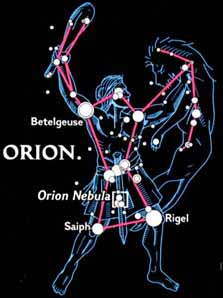 One final point on the Sword of the Morning: it’s also a constellation – Orion, I’m almost certain – and here I get sneak attack you with the first zodiac patron mini-essay! Haha! All thanks to Imriel of Heavenly House Orion, earthly avatar of the Sword of the Morning, whose patronage and timely choice of Orion has brought this next bit to you. For starters, there’s a notable scene in A Storm of Swords where the Sword of the Morning constellation acts kind of like the Morningstar:
Ghost was gone when the wildlings led their horses from the cave. Did he understand about Castle Black? Jon took a breath of the crisp morning air and allowed himself to hope. The eastern sky was pink near the horizon and pale grey higher up. The Sword of the Morning still hung in the south, the bright white star in its hilt blazing like a diamond in the dawn, but the blacks and greys of the darkling forest were turning once again to greens and golds, reds and russets. And above the soldier pines and oaks and ash and sentinels stood the Wall, the ice pale and glimmering beneath the dust and dirt that pocked its surface.
It seems like the Sword of the Morning is the last constellation visible in the southern sky, and this is indeed indicative of Orion, which is visible in the southern sky just before dawn when it first appears in the fall (and that’s when Orion is viewed from the northern hemisphere, because in the southern hemisphere it look upside down). Orion lies on the celestial equator, so it will always be near the horizon, much like Venus. Because of this fact, the Greek legend about Orion had him as the lover of the Goddess of the Dawn, Eos. You’ll note that “Eos” is part of third “Eosphorus,” which is the Greek word for Morningstar.
The line in this passage about ‘the bright white star in its hilt blazing like a diamond in the dawn’ reminds us quite a lot of Venus as the Morningstar, the bright white star which blazes in the dawn sky. This makes a lot of sense with all the Venus imagery that has been woven into the Sword of the Morning ideas, such as the fact that the ‘Sword of the Morning’ Dayne carries a star sword called Dawn. This passage with the constellation of the same name acting like and being described like the Morningstar simply adds to this line of symbolism.

image courtesy NASA
Although I am positing that George’s Sword of the Morning constellation is Orion, it also seems that some bits of Orion mythology have been used in the fashioning of Azor Ahai, Sword of the Evening. As we just discussed, Azor Ahai as the Sword of the Evening and the Last Hero as the sword of the Morning are like two opposite sides of the same coin, and House Dayne in particular can also give us darkstar and evening sword Daynes. For example, the myth of Orion is one of a great hunter and subduer of beasts. He was a warrior who knew no fear or respect, and in this he has to remind us a bit of both the Night’s King, supposedly a “warrior who knew no fear,’ and of Azor Ahai, who challenged the gods.
The Last Hero, too, was certainly a brave warrior, setting off into the cold dead lands to try to save mankind, persevering even when his twelve companions had perished.
Orion is a legendary blacksmith… and if you think about, that’s basically what Azor Ahai is: an extremely famous blacksmith.
Sky maps of Orion usually depict him as a hunter facing off against Taurus, the bull, which certainly reminds us of the ‘Mithras slaying the bull’ ideas Martin has translated in the story as Azor Ahai slaying the moon with the Lightbringer comet.

Orion & Taurus Flamsteed, John. Atlas celeste. Ed. J. Fortin. Paris, 1776. J. Fortin was an engraver and globe maker who greatly improved on the aesthetic qualities of atlas of John Flamstead (1646–1719), the first Astronomer Royal and Greenwich Observatory astronomer
Returning to Orion’s Last Hero / Sword of the Morning correlations, we find that seemingly invincible Orion was finally brought low by a scorpion’s poisonous sting in one tale. He was stung on his ankle in a somewhat Achilles-like incident, and the scorpion eventually became the zodiacal constellation Scorpio. This reminds us of the Sword of the Morning, Arthur Dayne, who perished in Dorne, a land infested with and associated with scorpions. If Howland Reed perhaps finished Arthur with a poisonous weapon of some kind, we may have a further correlation between poisoned Orion and the Sword of the Morning. There’s an additional ramification to the idea of Orion being felled by a scorpion which correlates to Arthur’s death at the Tower of Joy, but I will have to save that for the Scorpio zodiac essay lest I give away the good Scorpio stuff, which is one of the best ones. hint hint One of the reasons why the Greeks imagined Scorpio and Orion to be enemies is the fact that they appear on opposite sides of the celestial equator, and therefore never appear in the sky at the same time. The story goes that Scorpio and Orion were placed on opposite sides because they are such bitter rivals. That’s a pretty cool bit of myth based on astronomy.
Astronomers group several constellations together with Orion and call them the Orion family of constellations, and those are Lepus (the hare), monoceros (the unicorn), and more interestingly, Canis Minor and Major, the little and big dog. You’ll recall that the Last Hero set out with a dog and horse along with his twelve companions, and Orion has himself two dogs and unicorn-horse. Coincidence perhaps, but taken with everything else, we can see that Orion is a nice fit for the Sword of the Morning constellation.
So, Orion is the Sword of the Morning, and the the Sword of the Morning is probably the Last Hero, in some sense. The Last Hero had twelve valiant companions who died, likely the first rangers of the Night’s Watch, so does Orion have twelve companions, perhaps that died nobly?
Well yes, he does: as I mentioned, Orion is just below the path of the ecliptic, making it oh-so-very close to being a member of the zodiac. The thing about the constellations of the zodiac is this: with the exception of Libra, they are all people or animals who died nobly and were rewarded by being placed in the sky as one of the twelve constellations of the zodiac. They are twelve dead heroes, in other words. And that is one part of how the Sword of the Morning and Orion has been roped into the zodiac ideas in ASOIAF, with the rest of that explanation coming when I introduce the general concept behind the zodiac in A Song of Ice and Fire.
Saving the best link between Orion and Morningstar mythology for last, I’d like to tell you about something called Venus’s mirror. This is an asterism – that’s a small grouping of stars within a constellation – inside the constellation of Orion. It’s a diamond-shaped mirror with a handle made up of Orion’s belt stars as the top of the diamond and Orion’s sword as the handle of the mirror. In other words, there is already a direct correlation between Orion’s sword and Venus, one which Martin surely discovered with a cry of ‘Eureka!’ You can really see why Orion was a natural fit as the Sword of the Morning. The most important takeaway from all of this is that the Venus mythology is the cradle from which George birthed the ideas of Lightbringer, Dawn, the Sword of the Morning.
That about does it for Orion and the Sword of the Morning. Thanks again to Ser Imriel for choosing Orion, may you represent his heavenly light justly, and may you always hold divine Venus’s mirror with a steady hand.
So we’ve talked about Azor Ahai, Lightbringer, and the comet; we’ve talked about House Dayne and Dawn; now, let’s talk about the Night’s Watch. That’s a pretty easy transition to make, because the Night’s Watch leads right back to both House Dayne and Azor Ahai, wouldn’t you know it.
THE NIGHT’S WATCH
The Night’s Watch vows contain a clear reference to Venus when they say that they are “the light that brings the dawn.” As we’ve seen, words which translate to Morningstar also translate to “light-bringer” and “dawn-bringer,” and Venus is indeed the herald of the dawn, the bright star which brings the dawn. The Night’s Watch is also a sword in the darkness, and we’ve seen that in George’s world, the Morningstar ideas have been grafted on to swords in a major way. A sword in the darkness that brings the dawn – are we talking about the Night’s Watch here or Lightbringer? It could just as easily be a description of the Sword of the Morning and the Dawn. The fact that they all draw from Venus mythology is no coincidence – on the contrary, it tells us that all of these things are connected: Dawn, Lightbringer, the Night’s Watch, and the Last Hero’s blade of dragonsteel.
They kind of have to be connected, don’t they? If Dawn is the sword that brings the morning, it had to have been used by the Last Hero, right? The thing is, we are missing huge pieces of the puzzle. For example, if Dawn is Lightbringer, either THE Lightbringer or one of a pair, how did Azor Ahai and his sword from the east get wrapped up in Westeros history?
As we’ll discuss in that joint podcast with history of westeros on the great empire of the dawn, there are two important things which seem to indicate the migration of dragonlords from the far east to southern Westeros in the Dawn Age, and those would be the occasionally purple-eyed and silver-haired members of House Dayne and the fused stone fortress at Oldtown that serves as the base of the Hightower which we learn about in The World of Ice and Fire. In other words, I definitely believe that there is a connection between east and Westeros which has something to do with Azor Ahai, Lightbringer, and House Dayne. But there are a lot of gaps in the story, as I said – was this an invasion of some kind, or a migration, or both? What happened, and what does it have to do with the Long Night? The place in Oldtown where the fused stone fortress stands is called Battle Isle – was there a historic battle here, as the Wordbook suggests? Did we have some kind of epic magic-sword fight? Was the this the opening salvo of the War for the Dawn? How did the action eventually get up north?
If Dawn the sword is connected to the North, perhaps the original Ice… well what’s the deal with that? And why does George introduce us to the King of Winter archetype in the form of Ned with the noticeably smoke-dark dragon-forged sword? The Starks, whose stone kings rule the crypts with hellhound guardians at their side, seem like more of Evenstar / lord of the afterlife figures to me, so it makes sense for them to have a black sword, “Black Ice” as it were. The Starks are also somewhat sneakily associated with fire and hell, as I mentioned in the Tyrion Targaryen episode. Whatever the mysterious link is between ice and fire is involving Azor Ahai and the Last Hero, it no doubt runs through Winterfell and House Stark, and we still have some deep mysteries to uncover there.
The children of the forest, too, might be involved in all of this, as the story of the Last Hero talks about him being protected and rescued by the children of the forest, so again, there are a lot of pieces of the puzzle missing. We still don’t know who built the Wall, when it was built, or why, and surely that has something to do with all of this. We probably won’t be able to really make a good solid dedicated guess at the original events of the Long Night and the War for the Dawn until the books are finished and we can see how the conclusion parallels what we have reconstructed of the Dawn Age / Long Night events.
One caveat: I do think we can get closer to the truth than we are now, and we will definitely be working on that in future podcasts. The upcoming pod with History of Westeros will attempt to highlight the evidence for migration by sea and by dragon from the Far East to Westeros in the Dawn Age, and as we pivot to the topics of weirwoods, greenseers, and the Others, we’ll try to pin down the Last Hero / frozen North side of things.
Now, to wrap this up, let’s dig a little deeper into just exactly why Lucifer, the light-bringer of man, was remembered as a bad guy by the Christian religion.
A TALE OF TWO DEITIES
Everyone knows the Garden of Eden story: Adam and Eve are in a state of paradise, without knowledge of good or evil. They literally cannot choose evil – they don’t even realize it exists. God gives them only one commandment, saying ‘whatever you do, don’t eat from the Tree of the Knowledge of Good and Evil.’ Along comes the snake, our buddy Lucifer in this interpretation, and convinces them to eat of the fruit, saying they can become like gods – that is, having the knowledge of good and evil, also known as ‘free will.’ They eat and become aware of right and wrong, and are ashamed. God kicks them out of paradise, and life gets much harder for mankind thereafter. The Garden of Eden is even guarded against reentry by an angel with a flaming sword!
Flaming swords aside though, this is a pretty weird story, if you think about it . Paradise is depicted as an animal-like, automaton state. The Jehovah God of Genesis wants to keep man in this state of blissful ignorance, while Lucifer, the “light-bringer,” wants to bring us the knowledge of higher consciousness. So who’s the good guy here, exactly?
George has said that he drew influence from (among a million other things) the Gnostic Cathars of medieval France, and the Gnostics have an interesting interpretation of the Garden of Eden story: Jehovah is an evil demon (a demiurge) who wants to keep man as unthinking worshippers of himself, and the snake is the one trying to help mankind, encouraging him to eat the fruit out of the gods and expand his consciousness – bringing the light of heavenly knowledge. This ability to conceive of abstract concepts like morality is one of the defining elements of human consciousness, one of the main things that separates us from our ancestors who were stuck on using the same stone tools for over a million years with little progress. Mankind is surely still leaning to wrestle with this great responsibility that comes with the gift of consciousness, but in order to have any hope of progressing to the next level, we must do just that – we must master ourselves. This cannot happen if we were to remain in an animal-like state of awareness. ‘Ignorance is bliss,’ perhaps, but free will is a necessary step on the road to progress, and Lucifer is remembered for bringing us the light of free will. The gnostics view Jehovah, therefore, as a demon, a ‘demiurge.’
In the couple of centuries following the emergence of Christianty, there were many different versions and sects, some differing greatly from one another. The original Gnostics were one such, and they considered themselves Christians. After 300AD, the Catholic Church began to crystallize something resembling the modern Bible and doctrine of Christianity beginning with the council of Nicaea in 325AD, and taking final shape by 397AD at the council of Carthage, and the Gnostics and other sects were deemed heretics. By 600AD, lucifer, the bringing of light and free will, was a bad guy.
If you are a group of religious leaders that wish to turn a religion towards authoritarianism, control by fear and shame, moral puritanism, and suppression of the divine feminine spirit, then this free will stuff isn’t such a good thing. This could explain why a mythological figure like that of Lucifer may have been viewed as “the bad guy” by those who wanted to take Christianity in that more authoritarian and patriarchal direction. One of the things Lucifer is typically associated with is androgyny, or at least balance between the masculine and em feminine.
In the Old Testament, we get another great example of a potential deity confusion. There are actually two very different Canaanite (Phoenician) deities who have been mixed up together and remembered as the same guy. Originally, we had El, or Elohim, who is more of a standard “Father God” deity – the “creator of creatures,” “father of the gods,” “King,” “God eternal,” “father of wisdom,” etc. El is basically the oldest Caananite deity anyone knows of, the original bull deity and father of Ba’al, who’s actually the most famous of all bull-gods.
A quick aside: Ba’al is perhaps the original resurrected deity tied to the cycle of the seasons, who are sometimes called Corn Kings because their death is associated with the harvest season, and their resurrection is associated with the return of spring. We will return to take a closer look at Ba’al and Corn Kings when we get to the section about Garth the Green, but I will mention that George makes a clear reference to Jon Snow as a Corn King in A Dance with Dragons, and this has been caught by many attentive readers familiar with the Corn King mythological archetype:
Mormont’s raven muttered across the room. “Corn, ” the bird said, and, “King, ” and, “Snow, Jon Snow, Jon Snow.” That was queer. The bird had never said his full name before, as best Jon could recall.
Many Corn King figures are also Morningstar figures, such as Tammuz and Osiris, and resurrection always features prominently in both. Fitting then, that the father of sacrificed and resurrected Ba’al is El, the high father god who is equated with the sun, just as the father of Jesus the Morningstar is a solar god.
So that’s El – he’s the sun god and the all-father.
Then we have this other fellow named Jehovah or Yaweh, who was originally the Canaanite storm god, similar to the god Yam. Typical of a storm god, Yaweh is the jealous and angry god, the guy who killed everyone on earth who wouldn’t obey him with a flood. He’s the guy that demanded Abraham be willing to sacrifice his own son to “please God,” and the guy who didn’t want us to posses the knowledge of good and evil. Storm gods are always seen as wrathful because they are really just a personification of the forces of the storm, which are turbulent, merciless, and deadly.
Worship of Jehovah / Yaweh, which had been around for a millennia or more already as part of a pantheon of Caanaanite deities, began to replace worship of El throughout Canaan between 1000BCE – 600 BCE, as his followers began to asset his primacy over El, Ba’al, Asherah, and other Caananite deities. The followers of Yaweh became increasingly intolerant of the existence of other deities, eventually asserting that no other gods existed at all, attributing all divine attributes of the other gods to Yaweh. This was a conversion from decentralized pantheism to hierarchical monotheism, which is quite significant as these are basically opposing worldview. At least, we can say that monotheism and hierarchy or authoritarianism have no tolerance for pantheism and decentralized authority. A clash was inevitable, and the results did a lot to shape the world going forward.
Now, because the Old Testament is composed of various books that were written hundreds and even thousands of years apart, Yaweh and El have been written and interpreted as being the same god, even though they were originally very different gods who had very different characteristics. Modern Christians use Yaweh and El and their variations interchangeably as simply being different names for god, but if you go through the Old Testament and separate out the references to El and Yaweh, you begin to the two personalities emerge. Sometimes the Christian God is portrayed as loving and merciful, the god who takes care even the tiniest birds and insects, as Jesus points out, and sometimes he is portrayed as a wrathful and terrible god whose judgement is awesome to behold. He’s not schizophrenic, he’s two different people zipped up into one.
This is what happens with religion and mythology over time. ‘Mythology’ is really just very old religion – there’s essentially no difference. Stories of gods and heroes are symbols crafted by man, and then later re-crafted and shaped, and sometimes twisted outright to serve an agenda of a given group of people. The same symbol can be used by people committing great acts of evil and by people committing great acts of love, even. At times, these stories are passed down by people who have forgotten the original meaning – this is actually very common, and we’ve got a lot of it going on in A Song of Ice and Fire in my moon disaster theory is at all close to the truth. As we consider the mythology of Planetos, we must consider these phenomena and how legends like that of Azor Ahai or the Night’s King may have been altered over time, either intentionally or accidentally. Intentionally is far more interesting, so we’ll keep an eye on that one. Personally, I think the Church of Starry Wisdom created R’hllorism as a PR campaign for their lord of darkness, Azor Ahai a.k.a. the Bloodstone Emperor, but I’ll save that bit of Ice and Fire conspiracy theory for another time.
Kidding aside, history is written by the victors, and so is theology. If the gnostic view of the Bible has won out… well, the world would be a different place. All of this is interesting to ponder on its own, but what I am really trying to do here with his little foray into the history of the Bible and Canaanite deities is to provide a bit of context in which to view the Azor Ahai myth and the other myths of heroes and villains in A Song of Ice and Fire. The question of who is the hero and who is the villain is a question people have been asking about gods and heroes for eons, and it’s a damn good question to ask. Under no circumstances should we simply accept that Night’s King was a villain and Azor Ahai a hero without question.
The Morality of A Song of Ice and Fire
I’d also like to say something about the idea of evil and good in A Song of Ice and Fire, lest I give the wrong impression here. It’s well known that Martin has a fondness and a skill for creating morally grey characters who, like real people, have the capacity to do right or wrong, and who find themselves in situations where right and wrong become very difficult to see clearly. This is good storytelling, and George talks about this idea openly, as well as his tendency to eschew the Sauron-esque “dark lords” which are typical of fantasy. However, some people have gone too far with this and come away with he impression that there is no right and wrong in A Song of Ice and Fire. I would strongly disagree with that sentiment. People themselves are usually a shade of grey, but right and wrong definitely do exist as abstract concepts. The reason people are thought of as “grey” is because they are a mix of black and white, of good and evil. No good and evil, and everybody is like fuchsia or turquoise or something. You get the idea.
When we consider whether someone like Azor Ahai is a “villain” or a “hero,” we speak not of their entire personality and character, but of their defining actions. The heroes of legend are created around important deeds which echo out into history. Someone who builds something great, wins a great war, negotiates a great treaty, or establishes a House, tribe, or nation. Over time, many details of the story turn from truth to fiction, but at the center of it will be that one, momentous deed. When we ask whether or not Azor Ahai was a villain, we are asking what he defining action was. Whoever it was that brought down the moon is a “villain” as much anyone can be. We can talk about whether the dedd was done intentionally, through hubris, or accidentally through playing around with the wrong magic, but bottom line, they fucked up. As we’ve discussed, we remain open to a redemption arc, carried out by Azor Ahai the villain himself or perhaps his son who may be the Last Hero, and in this case we’d have a figure who was first villain and then hero.
The point I am making is this: the first deed was in fact evil and villainous, and whatever was done to restore the sun to the sky must be regarded as heroic.
The story of or Ahai presents us with a moral conundrum: in order to save the world, Azor Ahai had to do something horrible. It’s the height of Machiavellian logic – it’s the same logic which seeks to justify the red wedding because it ended the war, and thus ultimately may have saved lives in sum total. The same logic which says Daenerys was justified in sacrificing Mirri Maz Dur to work blood magic. Martin is asking us to choose what to believe. Are we machiavellians? Can the abomination of blood magic and human sacrifice be justified it is used to “save the world?”
I’ve always been one to reject Machiavellian logic, and in general, I tend to believe in process-oriented thinking over results-oriented thinking. The right process will tend to yield the right results – that’s the idea. It’s always been very hard for me to accept that Martin is telling a story about how sometimes you just have to use a bit of human sacrifice to save the day. I could be wrong about this, admittedly, but that’s always been my take.
But guess what! I think the mythical astronomy has something to say on the matter. We see that at the moment Azor Ahai stabs Nissa Nissa, the moon cracks. The mythical astronomy shows us that the cracking moon is what lead to the Long Night – yet in the Azor Ahai tale, the Long Night has already fallen, which is why he has to sacrifice Nissa Nissa to make Lightbringer in the first place. In other words, the mythical astronomy indicates that this deed which caused the moon to crack was in fact the deed that caused the Long Night. That scenario makes Azor’s Ahai’s act of human sacrifice and blood magic an evil deed of great magnitude, and doesn’t that make more sense? The story of the Bloodstone Emperor lines up with this – he kills his sister, the Amethyst Empress, in what was surely an act of dark magic – a deed was so foul that it was called “the Blood Betrayal” and was remembered as having caused the Long Night.
There’s an oft-quoted passage from A Game of Thrones where Syria Forel is telling Arya the story of how he became the first sword of Bravos. The Sealord, who kept a menagerie of exotic animals, is interviewing swordsman for the newly vacated post of First Sword. In his lap is an ordinary tomcat, but the sealed has apparently been telling all the potential First Swords that the cat was a rare beast “from an island beyond the sunrise.” Syria was the only one to say “that’s just an ordinary tomcat,” and was thus named the first sword. Syria punctuates the lesson to Arya by explaining that the others saw what they expected, and not what was actually there.
What I think we have with the Azor Ahai fable, on a surface level at least, is a story of a horrific act of human sacrifice and blood magic being sold to us as an act of heroism and valor. It’s a test, basically, to see if we are suckers for extreme machiavellian thinking. I’d go out on a limb for the rejection of machiavellian thinking anyway, but I am glad that the mythical astronomy supports this conclusion as well.
As for the idea of Nissa Nissa as a heroic but tragic figure, it is still there, but we have to look to a deeper layer of meaning – that’s the interpretation of the Lightbringer story as an act of procreation which we’ve talked about many times. When a woman goes through pregnancy and risks her own life to bring another human being into the world, it is one of the greatest acts of love and sacrifice in all of human existence. This was even more true before the advent of modern medicine, and George draws attention to this fact with many examples of women who die in childbirth in the story.
To me, it makes a lot more sense to match the concept of a brave woman’s sacrifice with the act of procreation, of creating life, than to making swords with blood magic. This is another reason why I favor the scenario where the Last Hero is the son of Azor Ahai and Nissa Nissa. Azor Ahai may have killed her to work blood magic and make his evil sword, but she must have given birth at some point before she died, and this son, also representative of the concept of “Lightbringer,” would be the one to actually bring the dawn as the Sword of the Morning and the Last Hero.
If you think about it, our probable three heads of the dragon all have terrible fathers: Daenerys has mad King Aerys, Tyrion probably has Mad King Aerys as a biological father and Tywin as his father in a functional sense, and Jon has Rhaegar, who pretty much started a war by running off with Lyanna. Brandon gets blame to, as does Aerys; and there are redeeming qualities to Rhaegar… but bottom line, he started a war with politically reckless behavior. Not only that, he was well aware of his father’s madness and cruelty, and was basically dragging his heels on doing something about it… until it was too late. Rhaegar, as the abductor of moon maidens and the black dragon, is an strong Azor Ahai / Bloodstone Emperor figure, and was indeed a major part of starting the war. Jon’s real father was of course Ned, because Ned raised him, but the point here is that the terrible fathers of these three heads of the dragon may parallel the idea that the Last Hero had a terrible father known as Azor Ahai, bringer of the Long Night.
I think one of the other lessons here concerns the fire or knowledge of the gods, so to speak, and the knowledge of the gods in this case really means any kind of power. The knowledge of the gods can be obtained by man, but it has to be earned, slowly, and treated with respect. It is a dual edged sword which can also be quite deadly when in the hands those who do not treat it with respect, who have not slowly built up knowledge and ability. Stealing it, as the Bloodstone Emperor did – that’s definitely a recipe for disaster.
Even those who have “earned it,” so to speak,” must always be held account able by themselves and others, and must maintain the high level of respect and mindfulness at all times, or else it can be disaster. Think of technology in this sense – bioengineering can produce super-viruses. Nuclear power can be nuclear meltdowns or even nuclear weapons. I mean, take one of the first human inventions, actual fire – a fairly good stand in for the fire of the gods if there ever was one. Fire can cook and keep warm and bring life, and it can also burn and kill on a tremendous scale if vigilance slips even a little bit. That’s really what I think George is telling us about power, and that’s more or less what I take from the Garden of Eden story. The awareness of god and evil may be a burden of consciousness, but it’s one we have to accept and master in order to keep evolving.
This line from A Dance with Dragons seems relevant:
He turned back to the red priestess. Jon could feel her warmth. She has power . The thought came unbidden, seizing him with iron teeth, but this was not a woman he cared to be indebted to, not even for his little sister. “Dalla told me something once. Val’s sister, Mance Rayder’s wife. She said that sorcery was a sword without a hilt. There is no safe way to grasp it.”
“A wise woman.” Melisandre rose, her red robes stirring in the wind. “A sword without a hilt is still a sword, though, and a sword is a fine thing to have when foes are all about.
Astronomy as Mythology – the Book of Revelation
Before we get out of here, I’d like to quote a couple of verses from the Biblical book of Revelation. I’m grabbing verses from several chapters somewhat out of context; the point is not to follow the narrative of the apostle John’s vision, but rather to look at some of these verses as metaphors for astronomy-related disasters and to illustrate the myth-makers have been working with these elements in conjunction for quite some time now. I definitely, definitely think George was drawing on some of the ideas in these verses, as they intersect with his “comet, dragons, and flamings swords” motifs that he already had going. Take a look and see how these verses read, with what we have learned about mythology and astronomy in mind… (A huge hat-tip and thank you to pal Westeros.org forum user and Equilibrium.)
The Biblical Book of Revelation
Ch. 1 14The hair on his head was white like wool, as white as snow, and his eyes were like blazing fire. 15His feet were like bronze glowing in a furnace, and his voice was like the sound of rushing waters. 16In his right hand he held seven stars, and coming out of his mouth was a sharp, double-edged sword. His face was like the sun shining in all its brilliance.
Ch. 2 26The one who is victorious and keeps My works to the end: I will give him authority over the nations– 27and he will shepherd them with an iron scepter; he will shatter them like pottery — just as I have received this from My Father. 28I will also give him the morning star.
Ch. 6 12Then I saw Him open the sixth seal. A violent earthquake occurred; the sun turned black like sackcloth made of goat hair; the entire moon became like blood; 13the stars of heaven fell to the earth as a fig tree drops its unripe figs when shaken by a high wind; 14the sky separated like a scroll being rolled up; and every mountain and island was moved from its place.
Ch. 8 5The angel took the incense burner, filled it with fire from the altar, and hurled it to the earth; there were rumblings of thunder, flashes of lightning, and an earthquake. 6And the seven angels who had the seven trumpets prepared to blow them. 7The first angel blew his trumpet, and hail and fire, mixed with blood, were hurled to the earth. So a third of the earth was burned up, a third of the trees were burned up, and all the green grass was burned up. 9a third of the living creatures in the sea died, and a third of the ships were destroyed. 10The third angel blew his trumpet, and a great star, blazing like a torch, fell from heaven. It fell on a third of the rivers and springs of water. 11The name of the star is Wormwood, and a third of the waters became wormwood. So, many of the people died from the waters, because they had been made bitter. 12The fourth angel blew his trumpet, and a third of the sun was struck, a third of the moon, and a third of the stars, so that a third of them were darkened. A third of the day was without light, and the night as well.
Ch. 9 1The fifth angel blew his trumpet, and I saw a star that had fallen from heaven to earth. The key to the shaft of the abyss was given to him. 2He opened the shaft of the abyss, and smoke came up out of the shaft like smoke from a great furnace so that the sun and the air were darkened by the smoke from the shaft.
As you can see, much of Revelation could serve as Long Night meteor-impact mythology. Now I am not claiming that Revelations is actually referring to a specific disaster in Earth’s history, particularly because Revelations is supposedly a vision of the future. Let us draw this conclusion instead: when ancient peoples imagined and wrote about the most terrible divine apocalypse event that might ever befall the earth, they could only describe it terms of celestial catastrophe and astronomical calamity.
Whether you go forwards or backwards in time, the idea of things called “gods” which live in the heavens or the celestial realm has always been based on the luminous bodies which streak across the sky in a cosmic dance of interlocking orbits and cycles. When something appears to fall from heaven, as Venus does, or actually falls from heaven, as meteors do, you better believe that ancient man interpreted it as an act of the gods. When ancient man spoke of fearing the gods, they spoke of the same fear that one has for floods, fires, earthquakes, or god forbid, meteor strikes. There’s not much you can do with earthquakes, but the rest – fire, flood tides, and meteorites – contain power that can be harnessed by man, but this power must always be feared, lest it turn to destruction. Thus we can see that the personalities of many or even most ancient gods and goddesses are actually artistic and mystical personifications of thee forces of nature and the universe, and that is what Mythical Astronomy is all about.
If you’re a fan of the HBO show, be sure to check out History of Westeros end of season book-to-show Q&A episode, where I was grateful to appear as guest.
The Books Already Told Us Who Made the Others (TV SHOW spoilers)

Well, so much for the show not having huge book spoilers. Egads. So that’s how you make an Other! …maybe. One thing is for sure – we already knew the Others had something to do with weirwoods, and with the children of the forest. In this sense, the show simply confirmed what has been telegraphed. I’ll talk about the black stone inserted into the Other at the bottom, but first, have a look at what I am talking about.
The Others are tied to two things via symbolism: the children of the forest, and weirwood trees. My favorite line is Cotter Pyke talking to Sam Tarly, incredulous at the tale of Sam slaying an Other:
“Sam the Slayer!” he said, by way of greeting. “Are you sure you stabbed an Other, and not some child’s snow knight?”
This isn’t starting well. “It was the dragonglass that killed it, my lord,” Sam explained feebly. (ASOS, Sam)
Some child’s snow knight. That’s what the Others are. Apparently, there’s a rumor of this in Ironborn folklore:
Asha saw only trees and shadows, the moonlit hills and the snowy peaks beyond. Then she realized that trees were creeping closer. “Oho,” she laughed, “these mountain goats have cloaked themselves in pine boughs.” The woods were on the move, creeping toward the castle like a slow green tide. She thought back to a tale she had heard as a child, about the children of the forest and their battles with the First Men, when the greenseers turned the trees to warriors. (ADWD, The Wayward Bride)
Trees as warriors is an idea we see all over the place in the books, with my favorite being Jon Snow perceiving the trees as warriors waiting to storm the Fist of the Fist Men right before the Fist is attacked by wights and probably Others:
The trees stood beneath him, warriors armored in bark and leaf, deployed in their silent ranks awaiting the command to storm the hill. Black, they seemed … it was only when his torchlight brushed against them that Jon glimpsed a flash of green. (ACOK, Jon)
And again, this is right before the Others launch their wight attack on the Fist.
The Others also have a tree-related nickname which isn’t used as often:
The horn blew thrice long, three long blasts means Others. The white walkers of the wood, the cold shadows, the monsters of the tales that made him squeak and tremble as a boy, riding their giant ice-spiders, hungry for blood …
White Walkers of the Wood.
The term “white shadow” or “pale shadow” is used to describe the Others many times in the books, including twice in the prologue of AGOT. Interestingly, there’s one occasion when a weirwood is described as a pale shadow, just like an Other, and it happens when a tree is frozen in ice:
Outside, the night was white as death; pale thin clouds danced attendance on a silver moon, while a thousand stars watched coldly. He could see the humped shapes of other huts buried beneath drifts of snow, and beyond them the pale shadow of a weirwood armored in ice. (ADWD, Prologue)
Dany’s dream of slaying Others on dragon back at the Trident involves warriors armored in ice, which everyone takes for the Others. So a tree which is a pale shadow and armored in ice has two references to the Others, who wear ice armor.
The Others’ bones are pale and shiny like milkglass, and their flesh milky white; while their swords shine with faint moonlight:
The Other slid forward on silent feet. In its hand was a longsword like none that Will had ever seen. No human metal had gone into the forging of that blade. It was alive with moonlight, translucent, a shard of crystal so thin that it seemed almost to vanish when seen edge- on. There was a faint blue shimmer to the thing, a ghost- light that played around its edges, and somehow Will knew it was sharper than any razor. (AGOT, prologue)
The Other slid gracefully from the saddle to stand upon the snow. Sword-slim it was, and milky white. (ASOS, Sam)
Milk and moonlight and a faint glow – these things are associated with the Others… and the weirwood face known as the Black Gate:
It was white weirwood, and there was a face on it.
A glow came from the wood, like milk and moonlight, so faint it scarcely seemed to touch anything beyond the door itself, not even Sam standing right before it. The face was old and pale, wrinkled and shrunken. It looks dead. Its mouth was closed, and its eyes; its cheeks were sunken, its brow withered, its chin sagging. If a man could live for a thousand years and never die but just grow older, his face might come to look like that.
The Others are also known as the “white walkers of the wood”
And finally, we have the prologue of AGOT, which basically spells out the whole thing, with repeated anthropomorphizations of the trees as being antagonistic to the Night’s Watch (way mar in particular) right before the confrontation with the Others:
Down below, the lordling called out suddenly, “Who goes there?” Will heard uncertainty in the challenge. He stopped climbing; he listened; he watched. The woods gave answer: the rustle of leaves, the icy rush of the stream, a distant hoot of a snow owl. The Others made no sound. Will saw movement from the corner of his eye. Pale shapes gliding through the wood. He turned his head, glimpsed a white shadow in the darkness. Then it was gone. Branches stirred gently in the wind, scratching at one another with wooden fingers.
Right after the shadows come through the wood, the tree is portray as humanoid with its clutching fingers. Lots more of this all through the scene:
Behind him, he heard the soft metallic slither of the lordling’s ringmail, the rustle of leaves, and muttered curses as reaching branches grabbed at his longsword and tugged on his splendid sable cloak.
I won’t quote all of them – just re-read the prologue and think about the trees as symbols for tree warriors who become Others.
In the show scene, we have a person up agains the weirwood when they are transformed by insertion of the black stone. What the show did not touch on is what role the WW really plays in Other creation – I’m talking book canon here. I suspect it has to be a skinchanger or greenseer who is transformed, perhaps a greenseer bonded to a tree. The Other would then be a kind of ghost of the tree / greenseer union.
What I want to know is: was there anything special about the human victim? Was he a skinchanger or greenseer? What role did the weirwood play?
Also, why is Night’s King so different looking than the rest of the Others? He’s got those spiky horns around his head, much like the cotf, whereas the other White Walkers do not. I have to suspect the NK is something other than a simple human transformed like the other WWs, perhaps a male cotf or some related species.
As for Bran being told to leave but also that he has to take Bloodraven’s place, the only possible answer is that he is to sit beneath the weirwood at Winterfell, probably deep in the lowest level of the crypts or something.
Also interesting was the Ironborn imagery present. We saw a resurrection and then a horny crown – tree branches are very similar to stag antlers, and can symbolize each other. I think there is some ancient horned lord creature – the Green Men on the Isle of Faces – which is related to the children. People all over Westeros remember these horny folk. The Storm Kings wear an antlered helm. What are they remembering? Garth the Green, the progenitor of many First Men houses, is taken directly from real myths of Cerrunos and the larger horned god archetype. The Gardener Kings wore crowns of vines and twigs, a livelier version of the driftwood crown. Those Gardener kings sat on a living tree throne also. The old Ironborn sit on a tree throne, the one made of Nagga’s fangs, which means weirwood, and wear tree crowns too, but the emphasis is on death. The lord of the vale sits in a weirwood throne, and the Velaryons have a driftwood throne. The Marsh Kings were chosen for their gifts of greensight, indicating that greenseers may have been kings.
In other words, I think the First Men have a collective memory of greenseer kings with horned helms or horned heads. He juxtaposition of the resurrection and driftwood crown with the horned NK and horned cotf was quite interesting, to say the least.
As for the black stone which transformed the victim, and the black obelisks surrounding that tree, I believe those are oily black stones, and in turn, I believe the oily black stone to be moon meteors from the second moon which exploded in the Dawn Age. I have theorized that these black moon meteors can be used to work dark magic, and I even postulated that these black meteors may have been used to make the Others. I can’t help but think the black stone which created the Other in the show is reference to this idea.
Now we don’t know what is the same between show and books of course, but the broad strokes should be similar, and I don’t think the answers to major things like “who is Jon’s father” and “where do the Others come from” will be different.
And creating Others is apparently accomplished by inserting a black stone into a man’s chest while he’s tied to a weirwood.
Now this is an idea I haven’t gotten into too much – I’ve been saving it for a proper episode – but I have discussed in comment threads that I believe there may be a piece of black fire moon – one of the black meteors – lodged in the hypothetical “ice moon,” which is the moon that survived and still exists. This frozen fire would be the thing which animates the forces of ice with a burning quality, as in the burning star eyes of the Others. I keep finding examples of black moon meteor symbols which become encased in ice or buried in snow and ice, and I believe it’s talking about a black meteor lodging inside the ice of the ice moon. Parallels to this idea would be black stone under the Wall, a moon meteor in the Heart of Winter… or a piece of moon meteor inside an Other.
I’m not sure if the show creators were thinking of that black stone as obsidian or not, but the fact that the tree was surrounded by spirals of black obelisks, which are definitely not obsidian, suggests some other kind of black stone being involved there. And I don’t think that it makes sense for WW to be created with obsidian if they can be killed by obsidian.
Ergo, my theory about a black fire moon meteor being lodged in the ice moon gained a lot of support when the children shoved that black stone into that dude’s chest. I’ve speculated that black moon meteors were somehow used to create the Others, and it’s REALLY damn tempting to think that’s what we just saw.
And of course, the Hodor scene was done brilliantly and was quite moving. That was really something.
Tyrion Targaryen
Hello everyone and welcome! We’re experimenting with format again; last time we tried a chapter-centric episode, and this time we’ll keeping the focus primarily on one character, Tyrion Lannister – who, for my money, is a Targaryen bastard, born of King Aerys II Targaryen and Joanna Lannister. Why do I think this is so? Well, for a start, because of passages like this:
When the magister drifted off to sleep with the wine jar at his elbow, Tyrion crept across the pillows to work it loose from its fleshy prison and pour himself a cup. He drained it down, and yawned, and filled it once again. If I drink enough fire wine, he told himself, perhaps I’ll dream of dragons.
When he was still a lonely child in the depths of Casterly Rock, he oft rode dragons through the nights, pretending he was some lost Targaryen princeling, or a Valyrian dragonlord soaring high o’er fields and mountains. Once, when his uncles asked him what gift he wanted for his nameday, he begged them for a dragon. “It wouldn’t need to be a big one. It could be little, like I am.” His uncle Gerion thought that was the funniest thing he had ever heard, but his uncle Tygett said, “The last dragon died a century ago, lad.” That had seemed so monstrously unfair that the boy had cried himself to sleep that night. Yet if the lord of cheese could be believed, the Mad King’s daughter had hatched three living dragons. Two more than even a Targaryen should require.
The quote you just heard from A Dance with Dragons is basically slapping us about the face with a rubber chicken that looks like a dragon, and it’s not the only one. What we’ll be doing today is examining all of Tyrion’s personal symbolism, with a particular eye on anything that could be a clue about Tyrion’s potential Targaryen lineage.
There is a terrific “Aerys + Joanna = Tyrion (A + J = T)” thread on Westeros.org which covers all the basics of the theory, and I highly recommend that as supplemental reading material. I won’t be covering all the logistical elements of the theory, except to say that The World of Ice and Fire seems to have gone out of its way to suggest that Joanna and Aerys were in the same location sometime in the right window for Tyrion’s conception, and that Aerys was often said to have a thing for Joanna and to have taken” liberties” at the bedding during her wedding to Tywin. Instead what we will be doing is attempting to provide evidence in support of the theory that Tyrion is half Targaryen through the use of mythical astronomy and spiced with a little study of those meta-textual hints which Martin is so fond of. We’ll talk about demon-monkeys and hellish gargoyles, and we’ll consider what Tyrion’s symbolism says about his eventual role in the end game of the series. On the way we’ll deviate into talk of Winterfell and young Brandon Stark, and we’ll start to get to the heart of a burning question that everyone should have asked themselves at one point or another: what do Azor Ahai, dragons, and Lightbringer, which are all from the far east, have to do with a story that is fundamentally about Westeros and the Starks? As well as the related question of: is there a connection between Azor Ahai wielding Lightbringer and the Last Hero wielding “dragonsteel?”
Thanks to Mr. George R. R. Martin for writing us these wonderful novels, and thanks most of all to you, the listener, reader, and downloader. The matching text of these podcasts can always be found at lucifermeanslightbringer.wordpress.com, where you’ll also get a few images and links.
Warning: there will be spoilers of all types. I generally write from the standpoint which assumes that most listeners and readers will be intaking all of the Game of Thrones / A Song of Ice and Fire media – show and books. Today we will be discussing episode 2 of the newest season of HBO’s Game of Thrones, season 6, so fair warning for people trying to ignore the show. I don’t usually talk about the show, but in this case, it’s hard to ignore, so we’ll be doing a little show talk today. We’ll also quote a bit from Tyrion’s Winds of Winter sample chapter, though it’s not particularly spoilerific, as I will only be quoting a short passage and only be really spoiling one minor plot point… but again, fair warning.
King Bran
✧ Greenseer Kings of Ancient Westeros
✧ Return of the Summer King
✧ The God-on-Earth
End of Ice and Fire
✧ Burn Them All
✧ The Sword in the Tree
✧ The Cold God’s Eye
✧ The Battle of Winterfell
Bloodstone Compendium
✧ Astronomy Explains the Legends of I&F
✧ The Bloodstone Emperor Azor Ahai
✧ Waves of Night & Moon Blood
✧ The Mountain vs. the Viper & the Hammer of the Waters
✧ Tyrion Targaryen
✧ Lucifer means Lightbringer
Sacred Order of Green Zombies A
✧ The Last Hero & the King of Corn
✧ King of Winter, Lord of Death
✧ The Long Night’s Watch
Great Empire of the Dawn
✧ History and Lore of House Dayne
✧ Asshai-by-the-Shadow
✧ The Great Empire of the Dawn
✧ Flight of the Bones
Moons of Ice and Fire
✧ Shadow Heart Mother
✧ Dawn of the Others
✧ Visenya Draconis
✧ The Long Night Was His to Rule
✧ R+L=J, A Recipe for Ice Dragons
The Blood of the Other
✧ Prelude to a Chill
✧ A Baelful Bard & a Promised Prince
✧ The Stark that Brings the Dawn
✧ Eldric Shadowchaser
✧ Prose Eddard
✧ Ice Moon Apocalypse
Weirwood Compendium A
✧ The Grey King & the Sea Dragon
✧ A Burning Brandon
✧ Garth of the Gallows
✧ In a Grove of Ash
Weirwood Goddess
✧ Venus of the Woods
✧ It’s an Arya Thing
✧ The Cat Woman Nissa Nissa
Weirwood Compendium B
✧ To Ride the Green Dragon
✧ The Devil and the Deep Green Sea
✧ Daenerys the Sea Dreamer
✧ A Silver Seahorse
Signs and Portals
✧ Veil of Frozen Tears
✧ Sansa Locked in Ice
Sacred Order of Green Zombies B
✧ The Zodiac Children of Garth the Green
✧ The Great Old Ones
✧ The Horned Lords
✧ Cold Gods and Old Bones
We Should Start Back
✧ AGOT Prologue
Click to open in iTunes
So, about that episode, and Tyrion’s scene with the dragons… (if you didn’t see it, Tyrion dares to go into the dragon chamber under the pyramid, tells the dragons his story about wanting a dragon for his birthday – which was taken from the above quote, bravo – and is able to remove the collar chains binding the dragons without being eaten). So raise your hand if you watched that scene and thought to yourself, “that guy is a mother-bleeping Targaryen!” I know I sure did. I’ve always been a believer, so it’s pretty easy for me to see the dragons being friendly or at least tolerant of Tyrion as a pretty good clue pointing in that direction. Most people took it for a sign that he would, at the least, be a dragon-rider, if not an actual Targaryen. The show has not spent time establishing any sort of criteria about who can ride a dragon, and even in the books we don’t know for sure whether having Targaryen or Valyrian blood is absolutely necessary to bond with dragons, though it certainly seems to help and may in fact be necessary. There is some ambiguity raised by the tale of Nettles in The Princess and the Queen – she seems to tame a dragon purely through feeding it sheep every day, however, she may have been a Targaryen descendent.
Disclaimers aside, I think it makes a lot of sense for Tyrion to be the son of Mad King Aerys and Joanna Lannister, and I think the clues for this are abundant. I also think it makes sense for him to be a Targaryen if he is going to be a dragonrider – and I think it’s pretty clear George wants him to be a dragonrider. After all, we know he is George’s favorite character and probably the one which contains the most of George’s own personality. As you saw in the quote above, and as we will see in the following quotes, George has written him to have dragon dreams, dragon associations, and just plain old dragons on the brain. It just makes too much sense.
A little earlier in the chapter cited above where Tyrion drinks firewine and hopes to dream of dragons, George hits us with another strong clue, as Tyrion thinks to himself about Illyrio’s unbelievable tales:
Next you will be offering me a suit of magic armor and a palace in Valyria.
Tyrion is a lost Targaryen princeling / Valyrian dragonlord who rides dragons through the night, has a palace in Valyria, and wears a suit of magic armor. Got it? Good. Case closed. Thanks for coming everyone.
Many have noticed that the vision Moquorro sees of Tyrion snarling amidst various types of dragons may well imply that Tyrion himself is a dragon. Have a look, and this is from A Dance with Dragons:
“Someone told me that the night is dark and full of terrors. What do you see in those flames?”
“Dragons,” Moqorro said in the Common Tongue of Westeros. He spoke it very well, with hardly a trace of accent. No doubt that was one reason the high priest Benerro had chosen him to bring the faith of R’hllor to Daenerys Targaryen. “Dragons old and young, true and false, bright and dark. And you. A small man with a big shadow, snarling in the midst of all.”
Dragons… and Tyrion. Why is Tyrion in the midst of dragons here? He doesn’t sound like a victim, but rather more like a dragon himself: he’s got a big shadow and he snarls. Sounds like he is a part of the great dragon dance, to me. If nothing else, this quote indicates that Tyrion’s fate will be intertwined with various types of dragons and dragon people.
Although a lot of Tyrion’s dragon associations are found in the appropriately titled A Dance with Dragons, they actually appeared all the way back in the first book:
“What are you reading about?” he asked.
“Dragons,” Tyrion told him.
“What good is that? There are no more dragons,” the boy said with the easy certainty of youth.
“So they say,” Tyrion replied. “Sad, isn’t it? When I was your age, I used to dream of having a dragon of my own.”
“You did?” the boy said suspiciously. Perhaps he thought Tyrion was making fun of him.
“Oh, yes. Even a stunted, twisted, ugly little boy can look down over the world when he’s seated on a dragon’s back.” Tyrion pushed the bearskin aside and climbed to his feet. “I used to start fires in the bowels of Casterly Rock and stare at the flames for hours, pretending they were dragonfire. Sometimes I’d imagine my father burning. At other times, my sister.” Jon Snow was staring at him, a look equal parts horror and fascination. Tyrion guffawed. “Don’t look at me that way, bastard. I know your secret. You’ve dreamt the same kind of dreams.”
“No,” Jon Snow said, horrified. “I wouldn’t …”
This quote really stands out when you re-read it: Tyrion stares into the fires and dreams of riding dragons and burning people. What the hell is that? It’s the sort of behavior we’d expect from a Red Priest or a Targaryen, quite frankly.
In addition to this startling revelation of Tyrion’s childhood obsession with dragons, I think George is doing a little tricky wording thing in this passage from A Game of Thrones, taking advantage of ambiguous phrasing to imply a double meaning. Tyrion lists two kinds of dreams that he had as a boy: dreams of riding dragons, and dreams of burning his family in dragon fire. Then he says to Jon, “you’ve dreamt the same kinds of dreams,” without specifying which dreams he is referring to. The reader is led to assume the meaning has to do with taking vengeance against a family that doesn’t quite accept you, as Jon and Tyrion are both outsiders amongst their family, and this is certainly the main intent of this passage – but it can also be read to imply that Jon too has dreamt of dragons. Jon Snow is of course in all probability a secret Targaryen himself, so this interpretation would make a lot of sense. Tyrion specifically mentions staring into the flames and seeing visions of a sort – again, very like a red priest – and this chapter ends with Jon doing the same:
One by one the company drifted off to their shelters and to sleep, all but Jon Snow, who had drawn the night’s first watch. Tyrion was the last to retire, as always. As he stepped into the shelter his men had built for him, he paused and looked back at Jon Snow. The boy stood near the fire, his face still and hard, looking deep into the flames. Tyrion Lannister smiled sadly and went to bed.
Look, it’s Jon Snow, staring into the fire and perhaps having “the same kind of dreams.” Now I’m actually not suggesting that Jon has had literal dragon dreams, as he has never mentioned any, but I think the wording here might be implying the potential shared dragon lineage between these two would-be “heads of the dragon.” Jon does have a waking dream-like almost-vision of dragons in A Dance with Dragons, however, which we’ll get to in a moment.
But first, we need to talk about dragon dreams themselves: what they are, and what they imply.
I Dream of Dragons
The phenomena of the “dragon dream” generally refers to a dream about dragons – duh – but more specifically, it refers to the idea of a Targaryen dreaming of dragons which do not exist. After the Targaryen dragons went extinct, members of House Targaryen continued to dream of dragons, even people who had never seen one. Maester Aemon confides as much to us while he is on his deathbed in Braavos in a very memorable scene from A Feast for Crows:
“I remember, Sam. I still remember.”
He was not making sense. “Remember what?”
“Dragons,” Aemon whispered. “The grief and glory of my House, they were.”
“The last dragon died before you were born,” said Sam. “How could you remember them?”
“I see them in my dreams, Sam. I see a red star bleeding in the sky. I still remember red. I see their shadows on the snow, hear the crack of leathern wings, feel their hot breath. My brothers dreamed of dragons too, and the dreams killed them, every one. Sam, we tremble on the cusp of half- remembered prophecies, of wonders and terrors that no man now living could hope to comprehend … or …”
“Or?” said Sam.
“… or not.”
Or… yes! Let’s comprehend them. Aemon pretty much lays it out here – there’s something in that Targaryen blood which causes them to dream of dragons, even people who have never seen them. And it’s such a visceral experience – not only seeing them, but hearing the wings cracking and seeing their shadows on the ground as they fly overhead. Do you know what a dragon’s wings sound like? Unless Maester Aemon has been on one of those illegal wyvern hunting expeditions you hear about in Sothoryos, I’m not sure how he would know what leathern wings sound like. It’s pretty hard to dream of something you’ve never seen or heard in such detail. Aemon even refers to his dreams of dragons as memories, and Martin has Sam call our attention to the strange wording and the mystery of remembering or dreaming of something you’ve never seen, just to make sure we take notice.
Aemon also dreams of the red comet, interestingly enough, which he also has not seen. This might be a clue that the red comet is tied to the magical legacy of House Targaryen, just as dragons are. I’ve certainly proposed as much! This is also a basic clue that comets can be dragons – notice how Aemon seamlessly mentions the red comet in the middle of his diatribe about dragons, as if it too were a dragon. He said “I see them in my dreams, Sam. I see a red star bleeding in the sky. I see their shadows on the snow.” Dragons, then the red comet, then dragons again – because they are the same thing, in a certain sense. This is old news to us now, but when Martin wrote this, nobody had caught on to the red comet / moon disaster / Long Night thing yet, so he was presumably still trying to clue people in to that. Now that we’re on to his trail, I’m sure he’ll make the clues more cryptic from here on out (chuckle chuckle).
The line about the dragon’s shadows on the snow is really fascinating – it matches Melisandre’s vision of the dragons fighting in the snow, and the logical conclusion here would be that these are references to the dragons fighting the Others at some point, in some fashion. Aemon may well be having a prophetic dream here without even realizing it! I’ve never heard anyone raise this possibility, but ask yourself – why does Aemon see dragons in the snow? When Mel sees them in the snow, it makes sense because she is at the Wall and we all know that she believes you need a dragon to fight the Others. But we don’t really know what Aemon believes about fighting the Others and dragons, and Aemon is gone from the Wall when he has these visions. I think he very well might have been receiving a vision of the future here, just as Melisandre probably was.
As for these dragon dreams being the grief of his house and the death of his brothers, Aemon seems to be referencing his brothers Aegon V (Egg of Dunk and Egg) and the monstrous and insane Aerion Brightflame. King Aegon V’s obsession with dragons led to the death of himself, friends, and members of his family at Summerhall, where an attempt to hatch dragon’s eggs turned to “farce and tragedy”, while his older brother Aerion Brightflame killed himself drinking wildfire, thinking that he would transform into a dragon. Aemon seems to be implying that both of them experienced dragon dreams, and this idea is reinforced by the following passage from A Storm of Swords. This is Aleister Florent speaking to Davos in the dungeon of Dragonstone:
“This talk of a stone dragon … madness, I tell you, sheer madness. Did we learn nothing from Aerion Brightfire, from the nine mages, from the alchemists? Did we learn nothing from Summerhall? No good has ever come from these dreams of dragons..”
Aerion’s foolishness came from dreams of dragons in a general sense, and quite possibly in a specific sense. There’s also a cool line about Aerion from Jaime in the bathtub scene from A Storm of Swords where he also mentions Mad King Aerys, dragons, and fire transformation:
The Targaryens never bury their dead, they burn them. Aerys meant to have the greatest funeral pyre of them all. Though if truth be told, I do not believe he truly expected to die. Like Aerion Brightfire before him, Aerys thought the fire would transform him … that he would rise again, reborn as a dragon, and turn all his enemies to ash.
Now we don’t know if Aerys specifically had dragon dreams, but it sure seems possible. Prophetic abilities or gifts of magical sight are often thought to be tinged with madness, both with the real world concept of shamanic ecstasy and in ASOIAF and many other works of literature, and Aerys was plenty mad. It seems quite possible his delusions about dragon transformation may hint at the same type of dragon dreams that have led so many Targaryens down the path of madness. What’s especially interesting is how closely this statement from Jamie about Aerys matches what his daughter Daenerys actually did: being reborn in a great funeral pyre and waking dragons.
As we saw in episode four, John the Fiddler a.k.a. Daemon II Blackfyre had the gift of prophetic dreams, and dreamt of a dragon hatching at Whitewalls, though it turned out to be Egg coming into his own as a Targaryen. The poor fiddling dragon neither hatched a dragon nor transformed into a dragon… or even much of a warrior, or jouster, or leader… ok so we won’t pile on. It didn’t go very well, suffice it to say. As Gorghan of Old Ghis says, “prophecy will bite your prick off every time,” even when it’s true and valid. He may never have stood a chance at sitting the iron throne, but the Fiddler most definitely dreamt of dragons which did not exist and which he had never seen.
Of course the best example of Targaryens dreaming of dragons that don’t exist yet would be Daenerys herself, who twice dreams of Drogon before his egg hatches. Success! Finally. Of course Dany might have been led to perform an abomination, blood magic and human sacrifice, but hey, they hatched, right? The dragon dreams help guide Dany’s course of action and eventually lead to her successful attempt to “call forth her children” from the pyre, just as the dragon dreams of Aegon the V, John the Fiddler, and all the rest created a longing for dragons. The point is: dreaming of dragons is something Targaryens do.
Targaryens… and Tyrion.
Outside the litter night had fallen. Inside all was dark. Tyrion listened to Illyrio’s snores, the creak of the leather straps, the slow clop clop of the team’s ironshod hooves on the hard Valyrian road, but his heart was listening for the beat of leathern wings.
That was from that same Dance chapter we pulled from earlier, as Tyrion drifts off to sleep, full on firewine. Later in that same chapter, Tyrion actually has a dragon dream, right ‘onscreen:’
That night Tyrion Lannister dreamed of a battle that turned the hills of Westeros as red as blood. He was in the midst of it, dealing death with an axe as big as he was, fighting side by side with Barristan the Bold and Bittersteel as dragons wheeled across the sky above them.
This dream is mostly remembered for its end, where Tyrion has two heads – one laughing, and one weeping. I believe this is a reference to Nissa Nissa’s cry of anguish and ecstasy, since Tyrion is a moon child in the Azor Ahai reborn sense of the phrase. The idea of Westeros itself running red with blood hearkens back to the symbolic motif of the blood tide we’ve talked so much about, the one which goes back to Mithras and his slaying of the White Bull which washes the earth in blood. But also notable in this dream is the presence of dragons! Tyrion has never seen a dragon, and yet he dreams of them here, and actually, all through his life. He dreams of them frequently as a boy, as we saw in the previous quotes. Then, as an adult, he tells Jon Snow that “I seldom even dream of dragons anymore. There are no dragons.” But even the word seldom here implies that he does still occasionally have them. And sure enough, by book five, he’s dreaming of dragons again. He even sees them in the clouds:
The clouds in the sky were aglow: pink and purple, maroon and gold, pearl and saffron. One looked like a dragon. Once a man has seen a dragon in flight, let him stay at home and tend his garden in content, someone had written once, for this wide world has no greater wonder. Tyrion scratched at his scar and tried to recall the author’s name. Dragons had been much in his thoughts of late.
Tyrions just seems to have dragons on the brain. He dreams about them, he reads about them, he sees them in the clouds. In my opinion, Tyrion’s dragon dreams and the increasing presence of dragon-related themes in his storyline are perhaps the strongest evidence that the blood of the dragon does indeed flow through his veins.
The only other characters we ever hear of dreaming of dragons have Targaryen blood, so far as I can determine. You might recall that in the prologue of A Clash of Kings, we learn that Shireen dreams of dragons eating her. Shireen is a Baratheon, but she inherited a bit of the dragon blood from her great grandmother, Rhaelle Targaryen, who married Stannis’s grandfather, Ormund Baratheon, so it may be that she’s turned up a bit of that Targaryen prophetic dreaming ability.
Now, Targaryens do occasionally have a more general gift of prophetic dream, which the dragon dreams seem to be but one manifestation of. Daenys the Dreamer, author of Signs and Portents, famously dreamt of the Doom of Valyria twelve years before it occurred, giving the ancient ancestors of House Targaryen time to relocate to Dragonstone and survive the Doom. John the Fiddler not only dreamt of a dragon hatching, but also of Dunk wearing the white armor of the Kingsguard – a thing which did come to pass years later. While this prophetic gift is certainly not exclusive to Targaryens by any means, it does appear that the dragon dreams might be the specific province of those who contain the blood of the dragon.
Even if this isn’t a hard and fast rule, we have definitely been shown repeated instances of Targaryens who have never seen a dragon having vivid dreams of dragons which are more like memories of real experiences, so it seems likely this is a connection Martin has intended to create in the mind of the reader. From a narrative standpoint, I just don’t think it makes sense to give a character like Tyrion repeated occurrences of dragon dreams unless he has a dragon heritage, especially in a universe where it’s been well established that dragon people dream of dragons in a prophetic way. Sometimes, the simple answer is the right one: Tyrion probably dreams of dragons because he has Targaryen blood.
Now, about that waking dream-like thing of Jon Snow’s that I mentioned… this is Jon having a conversation with Val about Mance and Dalla’s baby, soon to be named Aemond Battleborn, in A Dance with Dragons:
“See that he stays safe and warm. For his mother’s sake, and mine. And keep him away from the red woman. She knows who he is. She sees things in her fires.”
Arya , he thought, hoping it was so. “Ashes and cinders.”
“Kings and dragons.”
Dragons again . For a moment Jon could almost see them too, coiling in the night, their dark wings outlined against a sea of flame.
We’ve seen clues before about Jon being a king several times, with the idea being that if Jon is Rhaegar’s son, then he is ‘royalty’ in some form or another. This isn’t about Jon vs. Dany in the line of succession, mind you, merely about his royal lineage in a general sense. So when Val says that Mel sees “kings and dragons” in her fire, I think Martin is really talking about Jon Snow, a king and a dragon. We saw what was in Mel’s fire vision – both dragons and Jon Snow – but the only other king she could have seen in her fire would be Stannis, who is conspicuously absent. In other words, Jon is the only possible king that she saw. Ergo, if Mel is seeing kings and dragons in her fire, I think it can only be the potential dragon king (or ice dragon king, to be accurate), Jon Snowgaryen. You’ll recall the talk of staring into the fire with Jon and Tyrion in the scene where Tyrion talks about his dragon dreams, and here these two ideas come up again, side by side. The fire is where you have to look if you want to see dragons or dragon kings.
The language here of Jon almost being able to see the dragons is very close to the description of someone who has seen dragons remembering her dragon. This one isn’t conclusive, so I don’t want to make too much out of it, but the experience Jon has here is interesting: someone mentions dragons, and then for a moment, Jon can almost see them. If this were the only evidence that Jon is a Targaryen, it would be pretty weak, but since we know that’s far from the case, I think Martin may well be feeding us a clue here about old Johnny boy. Anyway, the point is that Jon’s “almost seeing” of the dragons sounds a lot like what happens when Dany thinks of her missing Drogon, a dragon which she has a psychic connection to. This is Dany’s inner monologue from A Dance with Dragons:
And the dragons, what am I to do with them? “Drogon,” she whispered softly, “where are you?” For a moment she could almost see him sweeping across the sky, his black wings swallowing the stars.
It makes sense that she can picture Drogon in her mind, because she has seen him many times, and again, she has a psychic connection to him. But what dragon is Jon almost seeing? I’m not sure exactly what Martin is intending with this passage, but it may be a little dragon-dreamlet to clue us in to the idea that Jon is a dragon person, just as the scene with Tyrion talking about his dragon dreams and then telling Jon he’s had the same types of dreams might be a sly wink at the idea of Jon having dragon dreams.
What is funny to me is that the Jon Targaryen theory has gained much more traction and widespread acceptance than Tyrion Targaryen theory, but in a way, the clues are actually stronger for Tyrion, with his flagrant and repeated dragon dreams. Remember, we heard about Tyrion having dragon dreams all the way back in the first half of book one, and George continues to feed us clues pointing in that direction all the way through A Dance with Dragons and The World of Ice and Fire. Logistically, we may have more evidence for R+L=J than A+J=T, but I’ll leave that sort of thing for others to hash out. When people start up the whole debate around who was were during Robert’s Rebellion I quickly collapse into a coma-like state of boredom and a puddle of my own drool. I don’t believe that’s how the mysteries of the books are to be solved, myself – I tend to prefer analysis of the narrative themes and symbolism, as you all know, and to me, those things scream out “Tyrion of House Targaryen.”
And yes, I know he’d actually be Tyrion Hill by the inheritance laws of Westeros, but again, let’s not get too technical. He’s a dragonspawn, that’s the important thing. If his lineage comes into play, it will be the magical ramifications of that lineage that matter – his ability to ride a dragon, in other words – and not a tangential claim to the throne. I believe it is the same with Jon – the point of R+L=J is magical lineage, not a claim to the throne.
Your own… personal… Mithras…
Jon is Mithras, as we’ve discussed extensively, and as was laid out in Schmendrick’s legendary “R + L = Lightbringer” essay which I like to talk about now and again. And wouldn’t you know it, Tyrion has his own legend of a rock-born hero who wields the fiery weapon of a dragon, and that’s the Chinese monkey demon king, “Sun Wukong.” I discovered this by doing a little research on one of Tyrion’s more interesting nicknames: “twisted little monkey demon.” Apologies for the long quote here, but I simply can’t resist crazy street prophets talking about the red comet and snakes:
The sound of some hubbub in the street intruded on his worries. Tyrion peered out cautiously between the curtains. They were passing through Cobbler’s Square, where a sizable crowd had gathered beneath the leather awnings to listen to the rantings of a prophet. A robe of undyed wool belted with a hempen rope marked him for one of the begging brothers.
“Corruption!” the man cried shrilly. “There is the warning! Behold the Father’s scourge!” He pointed at the fuzzy red wound in the sky. From this vantage, the distant castle on Aegon’s High Hill was directly behind him, with the comet hanging forebodingly over its towers. A clever choice of stage, Tyrion reflected. “We have become swollen, bloated, foul. Brother couples with sister in the bed of kings, and the fruit of their incest capers in his palace to the piping of a twisted little monkey demon. Highborn ladies fornicate with fools and give birth to monsters! Even the High Septon has forgotten the gods! He bathes in scented waters and grows fat on lark and lamprey while his people starve! Pride comes before prayer, maggots rule our castles, and gold is all . . . but no more! The Rotten Summer is at an end, and the Whoremonger King is brought low! When the boar did open him, a great stench rose to heaven and a thousand snakes slid forth from his belly, hissing and biting!” He jabbed his bony finger back at comet and castle. “There comes the Harbinger! Cleanse yourselves, the gods cry out, lest ye be cleansed! Bathe in the wine of righteousness, or you shall be bathed in fire! Fire!”
“Fire!” other voices echoed, but the hoots of derision almost drowned them out, Tyrion took solace from that. He gave the command to continue, and the litter rocked like a ship on a rough sea as the Burned Men cleared a path. Twisted little monkey demon indeed.
We’ll get to the monkey demon thing a second, but first a wee bit of mythical astronomy, because this paragraph is loaded and I can’t just skip on past it. So, take notice of the thousand snakes pouring forth from Robert’s belly, which was opened by a “black devil” of a boar. Robert, with his antlered helm, seems to be playing the role of sacrificed moon here, just as the antlered Renly does when his throat is cut by the shadowsword of Stannis’s shadowbaby assassin. The stag and the bull are both horned animals, and both can be associated with the moon (particularly the horned moon), in real world mythology as well as Martin’s own. Robert’s death unleashes biting snakes, and Renly’s a dark tide of blood – both very recognizable symbols of the disasters which came from the second moon. Think of Sansa’s hairnet of poisonous purple snakes, also representative of the moon dragons, and all the examples of the black and bloody tide which we’ve examined in past episodes. In turn, the weapons which sliced open our sacrificial stag men – the shadowsword and the tusk of the black devil boar – both represent Lightbringer, a.k.a. the red comet, and here we see the comet prominently featured in the scene behind the mad prophet. It’s even specifically compared to a wound, which seems like a clue to associate the comet and Robert’s sliced-open belly which pours forth the biting snakes.
You’ll notice the idea of the stench rising to heaven when Robert is sliced open – this is referring to the idea that the moon-breaking was in fact an abomination, as was Lightbringer. The stench that rose to heaven would have been the column of smoke and ash that quite literally rises to the heaven and blot out the sun and stars. The sun and moon and stars are in turn regarded as gods by many people in A Song of Ice and Fire and the real world, so we can see that the stench did indeed rise into the skies, and a bath of fire did indeed follow after. This idea of a cleansing fire has parallels to Dany’s dragon dream and alchemical wedding experience, as well as the idea of the blood tide from Mithras’s white bull cleansing and renewing the earth. The stealing of heavenly knowledge – the forging of Lightbringer – was the abomination, and the resulting fallout of fire and blood was the cleansing agent, destroying and punishing like the Lion of Night but also wiping the slate clean to start anew.
Finally, the idea of Tyrion being served and attended by the Burned Men from the Mountains of the Moon is entirely in keeping with him as an Azor Ahai reborn figure. Azor Ahai wakes dragons from stone, and we have interpreted those woken dragons as the storm of moon meteors, with Azor Ahai reborn himself being the transformed red comet, at least from a certain perspective. The xor Ahai reborn figures follow this pattern, with a legion of fiery servants of some kind to attend them. Daenerys, the “Last Dragon,” represents Azor Ahai reborn as the red comet, and she is served by her dragon children, who represent the firestorm of moon dragon meteors. Jon is another Azor Ahai reborn figure, and when he dreams of wielding the burning red sword, he’s attended by the burning scarecrow brothers, fiery black-blooded black crows that tumble down like meteors. Tyrion is a reborn red comet, a dragon-spawn, and he’s attended by burned moon men that come from Moon Mountains, as well as other clans with names like “moon brothers,” “stone crows,” and a few others. Tyrion’s burned moon men, Dany’s fire-made-flesh dragons, and Jon’s fiery black-blooded crows – all the same idea. They are the dragons woken by Azor Ahai’s rebirth.
And wouldn’t you know, I almost forgot – Tyrion was slashed across the face with a sword, just like the moon.
And now we come to it: Tyrion is a twisted monkey demon. This cute little nickname is actually brought up four different times in A Clash of Kings, so we can be sure that it’s no idle turn of phrase. Besides being called a monkey demon, Tyrion is separately associated with both demons and monkeys. This is from A Dance with Dragons:
That night at supper Tyrion surprised his sire by walking the length of the high table on his hands. Lord Tywin was not pleased. “The gods made you a dwarf. Must you be a fool as well? You were born a lion, not a monkey.”
And you’re a corpse, Father, so I’ll caper as I please.
Both of Azor Ahai reborn’s parents are corpses – a dead sun and a dead moon, that’s the idea. But yeah, Tyrion is a monkey, and he’ll caper as he pleases. Tyrion’s monkeyhood comes up again in the same book when Illyrio has to make up a false name for Tyrion on the fly:
Illyrio spoke up quickly. “Yollo, he is called.”
Yollo? Yollo sounds like something you might name a monkey.
And then again in Dance, when Tyrion is playing chess with Young Griff a.k.a. fAegon Blackfyre:
The dwarf pushed his black dragon across a range of mountains. “But what do I know? Your false father is a great lord, and I am just some twisted little monkey man.”
That’s pretty nice, the black dragon reference right next to the Tyrion as a monkey reference. There’s actually two more quotes in Dance which refer to Tyrion as a monkey:
“A pity. I once had a monkey who could perform all sorts of clever tricks. Your dwarf reminds me of him. Is he a gift?”
And then later, when he’s becomes one of Yezzen’s pets:
“You know who I am. Yollo. One of our lord’s treasures. Now do as I told you.”
The soldiers laughed. “Go on, Scar,” one mocked, “and be quick about it. Yezzan’s monkey gave you a command.”
Cersei also has nightmares of Tyrion, in which he is twice referred to as a monkey or as being monkey-like. So, I think it’s pretty clear: Tyrion is a monkey.
He’s also a demon, and not only in the twisted monkey demon quotes. First of all, an “imp” can be thought of as a type of goblin, or sometimes a demon. More of a mischievous demon than an evil one, but there it is. Recall also that “nissa” means “helpful elf” or “mischievous elf” in Scandinavian languages, and that fits with Tyrion being an imp that comes from the moon, since Nissa Nissa is the archetypal moon maiden.
Then we have this quote from A Clash of Kings:
“I would suggest a demon’s head for a helm, crowned with tall golden horns. When you ride into battle, men will shrink away in fear.”
A demon’s head, Tyrion thought ruefully, now what does that say of me? “Master Salloreon, I plan to fight the rest of my battles from this chair. It’s links I need, not demon horns.”
What does it say of you? Well, it says you are in fact monkey demon, Tyrion. A monkey demon who rides dragons and wears magic armor in his palace in Valyria while having vivid dreams of dragons and patricide. It’s worth noting that Tyrion fought the Battle of Blackwater Baym which is what he’s preparing for here in this scene, by unleashing the pyromancers’ wildfire, which is called “the Jade Demon.”
Martin has also drawn general associations between monkeys and demons, such as with this line from Victarion in A Dance with Dragons:
The monkeys, though … the monkeys were a plague. Victarion had forbidden his men to bring any of the demonic creatures aboard ship, yet somehow half his fleet was now infested with them, even his own Iron Victory.
Might this foreshadow a conflict between Tyrion the monkey demon and Victarion? It would make a lot sense, since Tyion might be in a position to advise Daenerys, and since a good advisor will probably suggest steering clear of the Ironborn. In any case… monkeys are demonic, it seems.
So one day I asked myself: What’s the deal with this whole monkey demon thing anyway? I wondered if there might be a mythological inspiration out there somewhere, and so I typed “monkey demon mythology” into the google box. There was one prominent result, and that’s Sun Wukong of Chinese myth (he also has parallel incarnations in other related mythologies from that region of the world). He’s a monkey demon king born from a rock whose eyes shine like beams of light and who wields a fiery spear he stole from a dragon, as well as magic armor that he also stole from a dragon.
I kid you not – this is a real thing, and it existed long before George R. R. Martin did.

Tsukioka Yoshitoshi: “Jade Rabbit – Sun Wukong,” 1889
To be more specific, I will draw from one of the four major novels of Chinese history, published during the Ming Dynasty all the way back in in 1592, whose title is translated as “Journey to the West” and which is often simply called “Monkey,” because the stone monkey demon king Sun Wukong is the central character. It’s attributed to a fellow named Wu Cheng-en, and I’ll be pulling from a translation done by W. J. F. Jenner. Although I did first learn about Sun Wukong by using Google, I’ve now read most of this novel to gain a better understanding of his character and deeds. It’s a terrific read – the battle scenes are quite epic, and the whole thing is packed with mythical astronomy. Most of the main characters are tied to stars, planets, and constellations in vivid fashion. For a great six minute synopsis, I recommend this youtube video by a couple of guys known as “Off the Great Wall” who do fun re-tellings of Chinese myths and folklore.
In any case, here’s the deal. Sun Wukong was born from a magic stone which sits atop something called “the Mountain of Flowers and Fruit.” The magic stone develops a magic womb which, after thousands of years of absorbing the essence of the sun and the moon – stop me if this sounds familiar – bursts open to reveal a stone egg. Then the wind comes along and blows on the egg, causing it to turn into a stone monkey. Upon waking, two golden beams of light shoot out of his eyes and startle someone called the Jade Emperor.
Again, this is not ASOIAF, but ancient Chinese mythology, and as we can see, George has borrowed from it quite a bit – the Jade Emperor is one of the rulers of the Great Empire of the Dawn, for example, and both the Great Empire of the Dawn and the Golden Empire of Yi Ti which followed after seem to be based loosely on Far Eastern culture and mythology. Obviously a stone demon animal waking from a stone egg sets of a few buzzers and sirens, and the “magic rock” reminds us of the pale stone of magical powers from which the sword Dawn was made, as well as the evil black stone that the Bloodstone Emperor worshipped which I believe was the source of the metal for Lightbringer. Lightbringer is a dragon sword, and it was hatched from a magic stone, just as Drogon was hatched from a stone egg.
Even though he’s a demon monkey, he’s called “heaven born” because he was born at the top of a mountain, which the Chinese equated with the heavens. This is a symbolic association shared by many cultures throughout the world, and it’s one George has carried over into A Song of Ice and Fire. You’ve heard me say that a few times, but’s important and bears repeating. Anything that happens at the top of a tower or mountain… pay close attention and think about the celestial realm.
As for those fiery eyes which shoot beams of light, the Lannisters are also noted for their luminous green and gold eyes, and of course we’ve seen the wider phenomena of fiery eyes with people and animals who symbolize moon meteors. Elsewhere in the novel, it’s said of Sun Wukong that “his devil eyes shone like stars.” Surely the equivalency between eyes and stars can found all over the place in world mythology, but my point here is that Sun Wukong is a convenient fit for George’s world building because of his various attributes.
Sun Wukong’s fiery eyes can also see through illusion – he’s constantly exposing body-snatching demons posing as normal people and destroying them. Tyrion doesn’t spot any changelings, but he is very perceptive in King’s Landing and uses elaborate ruses and misdirection to sniff out Cersei’s informant, which turns out to be Pycelle. Could be coincidence, or it could be an echo of Sun Wukong’s magical perception.
There’s more: Sun Wukong can change his form into that of other creatures, a shapeshifting ability somewhat akin to skinchanging. That doesn’t have anything to do with Tyrion, but it might have something to do with the original Azor Ahai being a skinchanger or greenseer, just as Jon Snow is a skinchanger and soon to be resurrected skinchanger.
Sun Wukong simply loves to steal weapons – he’s basically obsessed with it. He travels to the bottom of the ocean and defeats a dragon king of the Eastern Seas, taking from him a glowing iron staff which turns out to be Sun Wukong’s most identifiable and well-known weapon. This staff is really something – it’s made of black iron and and banded in gold, a terrific Lightbringer weapon, you must admit. Even better, Sun Wukong’s gold-banded dragon staff can multiply into a thousand flying staffs, which are described as being like filling the sky with dragons. This amazing staff is actually depicted as the pillar of the heavens and the Milky Way which keeps the seas calm – that’s the same pillar of the universe role played by Yggdrasil and other mythological world trees, or sometimes by an “omphalos” or navel-stone. The general phenomena of representing the celestial axis in mythology is called the ‘axis mundi,’ by the way. Sun Wukong’s possession of this staff makes him the master of the heavens; similarly, he takes on titles like “The Great Sage” and “The Great Sage Who Equals Heaven.” It also gives him great potential for mischief, which is what monkeys are known for.
Sun Wukong then went on to defeat the dragons of the four seas and take from them a golden chain mail shirt, a purple and gold phoenix-winged helmet, and cloud-walking boots – pretty sweet haul, right? Basically, if there is a sea dragon anywhere out there in the wide world who has magical weapons or armor, Sun Wukong tracks them down and takes their stuff. The end result is that Sun Wukong is a rock-born demon king who is decked out in fiery black and gold dragon weapons and black and gold dragon armor. He’s a child of the sun and moon and he can fill the air with a thousand dragons. And we are just getting started.

If anyone knows the artist, please contact me so I can give credit.
As an aside, notice that dragons in Chinese myth tend be associated with water, as I’ve mentioned before, and I believe this stems from experiences with violent tsunamis triggered by comet and meteor impacts in the Pacific Ocean. This idea is paralleled in the Ironborn legend of the sea dragon Nagga which drowns whole islands.
One of the major, defining themes of Sun Wukong’s character is that he challenges heaven and rebels against the gods, and even the very order of nature itself. He defies hell’s attempt to collect his soul, barging into hell and dramatically wiping his name from the book of life and death, along with those of his monkey hordes, breaking the reincarnation cycle. He’s literally said to have broken the balance between yin and yang, between light and dark, day and night, male and female. Check out this passage, a plea to the Jade Emperor by a concerned Bodhisattva:
The regions of darkness are the negative part of the Earth. Heaven contains gods while the Earth has devils; Positive and Negative are in a constant cycle. Birds and beasts are born and die; male and female alternate. Life is created and change takes place; male and female are conceived and born; this is the order of nature, and it cannot be changed. Now the evil spirit, the Heaven−born monkey of the Water Curtain Cave on the Mountain of Flowers and Fruit, is presently giving full rein to his wicked nature, committing murders, and refusing to submit to discipline. He killed the devil messengers of the Ninth Hell with his magic, and he terrified the Ten Benevolent Kings of the Underworld with his power. He made an uproar in the Senluo Palace and crossed some names out by force. He has made the race of monkeys completely uncontrollable, and given eternal life to the macaques. He has annulled the law of transmigration and brought them beyond birth and death. I, impoverished monk that I am, importune the might of Heaven by presenting this memorial. I prostrate myself to beg that Heavenly soldiers be despatched to subdue this fiend, bring the Positive and Negative back into order, and give lasting security to the Underworld.
That’s the very essence of that the Long Night is about, breaking the cycle of the seasons and of life and death. The gods are of course very disturbed at Sun Wukong’s actions, and so they decide to invite Sun Wukong to heaven as a ploy to fool him into thinking he is being honored – but the real goal is to control him. This backfires as Sun Wukong sees through their scheme and steals a bunch of really cool stuff from heaven, like the peaches of immortality and the royal wine of the gods, then returns to earth. For this, he is called “the wrecker of the heavenly palace.” Sun Wukong is pretty much on a life-long quest to gain immortality, which he actually does several times over – stealing the peaches here and crossing his name from Death’s book previously. All of this fits very nicely with the themes of the Azor Ahai story – challenging the gods and stealing fire from heaven; breaking the cycles of life and nature and seeking to escape death and live forever. Tyrion himself challenges, defies, and eventually kills his own father, in violation of the most sacred laws of the gods.
Sun Wukong goes on to seriously whoop ass against the army of heaven, who are depicted as star warriors, defeating 100,000 of them single handedly. He doesn’t just defeat them – he makes a mockery of them. In fact, that’s a major part of Sun Wukong’s character, and this is a very good match for Tyrion – he basically talks shit to everyone, without exception. Sun Wukong is even described as impish in the Chinese epic novel, or at least the English translation of it. Basically, Sun Wukong talks a big game, and then backs it up, destroying or driving off everyone that the Jade Emperor can throw at him with his unbeatable black fire staff and various other tricks and weapons and magics.
An egg learned to be a man, cultivated his conduct, and achieved the way. Heaven had been undisturbed for the thousand kappas, until one day the spirits and gods were scattered. The rebel against heaven, wanting high position, insulted immortals, stole the pills, and destroyed morality.
Eventually, however, and not without great effort, Sun Wukong is captured and trapped inside some kind of sacred crucible to be incinerated by a pair of immortal warriors of the Jade Emperor. But after 49 days of burning, the crucible is opened and out pops Sun Wukong, stronger than ever, and now armed with fiery, enhanced magical sight. In other words, Sun Wukong was forged like a sword and reborn in the sacred fires. That’s an amazingly tight correlation to the wording of the Lightbringer myth, and to Dany’s experiences of being forged like a sword and reborn in fire, and more generally to the idea of a flying meteor sword that was born from a burning moon rock.
As for Tyrion, there may be a humorous echo of this story in A Dance with Dragons, when he was trapped inside a wine barrel on his voyage across the Narrow Sea. Not exactly a crucible, but it is a very small box that he was locked in for an extended period of time. Instead of emerging more powerful, he emerged more drunk, but hey, you have to change a few details to make things work for the scene, right?
The Jade Emperor then appeals to the Buddha, who contrives to trap Sun Wukong in his enormous fist and then seal him under a mountain for five centuries (though he is eventually set free and earns honors for himself, and is even granted buddhahood for his service and strength). The idea of Sun Wukong being stuck inside a fist and inside a mountain, or being born from the top a mountain are very reminiscent of George’s fiery hand and riding mountain symbolic motifs which we examined in the last episode, you’ll notice. The moon turning into things is what Azor Ahai’s rebirth is all about, and several of these symbols appear in Sun Wukong’s story: stone demons, fiery dragon spears, huge mountains and divine fists. You can see why George wove this into his Azor Ahai tapestry of ideas – it’s a natural fit.
Personally, I think it would have been funny if George had decided to have Melisandre spend a bunch of time talking about waking monkeys from stone, but hey, artistic freedom and all.
This brings up another potential Tyrion connection: Sun Wukong is from the Mountain of Fruit and Flowers, which is in the east – it is from atop this mountain that the “heaven-born monkey king’s” stone egg hatched. On this mountain lives the monkey army of Sun Wukong… could this be a parallel to the great mountains of the Vale of Arryn, in the east, from which Tyrion gains his mountain clan army? The vale is known for it’s fecundity, and although Tyrion wasn’t born there, he was almost thrown from atop the mountain via the moon door.
Saving the best Sun Wukong correlations for last, it seems that one of the many weapons and magics he can employ is to summon up a storm which sounds a lot like the Long Night. This is Sun Wukong trying to break in to a great city to steal even more magic weapons (the guy can’t get enough weapons, it seems). Actually, in this scene, Sun Wukong is specifically trying to steal weapons to arm his monkey hordes, which reminds us of Tyrion obtaining weapons to arm the mountain clans.
So he made a magic with his fist and said the words of the spell, sucked in some air from the Southeast, and blew it hard out again. It turned into a terrifying gale carrying sand and stones with it.
Where the thunderclouds rise the elements are in chaos;
Black fogs thick with dust cloak the earth in darkness.
Boiling rivers and seas terrify the crabs and fish;
As trees are snapped off in mountain forests tigers and wolves flee.
The thrones of princes are all blown over;
Towers of five phoenixes are shaken to their foundations.
Sun Wukong can summon the Long Night, apparently. That’s pretty potent, I’m not sure why you’d need more weapons if you could do that. In any case, I’m making the claim that Sun Wukong plays into the myth of Azor Ahai reborn, and also that Azor Ahai caused the Long Night, so it’s pretty sweet to see that Sun Wukong carries the Long Night in his back pocket.
On a different occasion, Sun Wukong is battling the demon king of the North (who fights with a shining sword, a helmet of dark gold, and black steel armor, it should be noted) and Sun Wukong actually threatens to pull down the moon with his two hands and bash the demon king with it, I kid you not.
The Long Night parallels continue in another line, where he’s called a “hairy-faced thunder god.” And don’t forget, he pulled out the pillar of the milky way and carries it about with him, giving him true dominion over the heavens and the earth. This also gives him the ability to disrupt the cycles of nature, block out the sun, pull down the moon, shake the world to its foundations, fill the air with flying dragons, and destroy the star-army of heaven.
In addition to the parallels with Tyrion’s story, you can see that the basic elements of the Sun Wukong myth are also very analogous to that of Mithras and Azor Ahai, and that’s not a coincidence. Here’s what I think is going on. Essentially, at some point early in the writing process, Martin must have decided he wanted to create a central fable for his world involving a flaming sword, dragons, comets and meteors, and resurrection. At this point I believe Martin began collecting all the interesting myths of flaming swords, comets, dragons, and resurrection – best of all, stories which contained more than one of these elements. Then, he uses these various myths as starting points for different characters in the story, particularly the major characters which manifest Azor Ahai reborn symbolism.

If anyone knows the artist, please contact me so I can give credit.
Let’s very briefly run through a few flaming sword myths and their ASOIAF correlations so you can see what I mean.
- The Azor Ahai myth as a whole draws heavily from Mithras of course, and of all the various Azor Ahai reborn manifestations, Jon Snow in particular is often a specific avatar of Mithras.
- Tyrion seems to draw many things from Sun Wukong the monkey demon king with the fiery spear.
- In Norse mythology, there’s a “devil giant” named Sutr (which means “black” or “swarthy” in Old Norse) who wields a shining sun sword that eventually brings forth flames that engulf the entire world. I’m sure you can see the clear parallels to Azor Ahai there, and possibly to Jon Snow, who dresses and armors in black but dreams of wielding a burning sword, and to Daenerys, who is poised to engulf large parts of the world in blood and fire, and whose dragons are like a flaming sword above the world. Tyrion, besides being a demon, is also a giant on many occasions, so perhaps he’s channeling a bit of Sutr as well.
- Ser Arthur Dayne, the Sword of the Morning, and his alive with light sword Dawn, borrows quite a bit from King Arthur’s glowing sword Excalibur. Excalibur was a sword which shone so bright at times that it actually blinded his enemies – a real light-bringer, you might say. In some tales, Excalibur is the same as the sword Arthur pulled from the stone, which might have been part of the basis for the idea of Dawn being made from a magical stone. In other versions, the sword pulled from the stone is eventually broken and replaced by Excalibur, which reminds us quite sharply of the Last Hero and the idea that he broke his sword and later ended up slaying Others with something remembered as dragonsteel. There’s actually a ton of Arthurian references in ASOIAF, as Lady Gwyn of Radio Westeros can tell you, but let’s keep moving for now.
- I’ve even mentioned the old Hanna Barbara cartoon Thundarr as a potential influence on the Azor Ahai / Long Night mythos, because good old Thundarr the Barbarian has a “sun sword” which is kind of like a light saber and the backstory of the show is a red comet streaking in between earth and the moon and causing such environmental disaster that the modern, technical world is thrown back into a kind of medieval “swords and sorcery” environment. Sounds familiar right? Well George is hugely into cartoons and comics, and Thundarr came out way back in 1984, so don’t doubt that he might get an idea from a show like Thundarr. If you do doubt me in any way, just look up the intro to the Thundarr show on YouTube and prepare to lose your mind, it’s like the events of the Long Night animated by Hanna Barbara.
In summary, my hypothesis is that George decided he wanted to write about flaming swords, and so he looked for all the cool flaming sword myths he could find and worked them in wherever it made sense. Sun Wukong works so nicely for Tyrion because Sun Wukong’s story shares so many elements with Mithras, and the idea of Tyrion as a monkey makes a lot of sense with his character and stature. It’s his own personal Mithras!
The conclusion I draw from all of this Sun Wukong stuff, besides “wow that’s pretty cool that George is into Chinese mythology” is that Tyrion gets his own rock-born, flaming weapon-wielding mythological forefather because he is one of the three heads of the dragon and a secret Targaryen. We’ve seen many characters who are definitely not Targaryens play the role of Azor Ahai reborn, but none with the kind of extensive correlations to myths of warriors with flaming weapons which we find in Tyrion, Jon Snow, and Daenerys… with one notable exception.
As for that exception, it’s Arthur Dayne and his Arthurian symbolism, and he’s definitely not a Targaryen. However, I have proposed in an older essay that the occasionally purple-eyed and silver haired Daynes have a common ancestor with Valyria, the vanished Great Empire of the Dawn – and specifically, the purple-eyed Amethyst Empress. Also, the Sword of the Morning archetype seems to be the light half of the Lightbringer yin and yang, with Azor Ahai’s black sword being the dark side, naturally, and so it makes sense to see extensive manifestation of a well-known flaming sword myth like that of King Arthur and Excalibur in the person of Ser Arthur Dayne, the Sword of the Morning. There can be little doubt that Dawn and House Dayne have something to do with the Lightbringer legend, no matter how you see the details shaking out.
And while we’re talking about yin and yang, I neglected to point out previously in our essay about the Bloodstone Emperor is that yin is the dark side of yin and yang, and, one o fthe names of Azor Ahai is Yin Tar. If you wanted a clue that Azor Ahai and lightbringer are from the dark side… then there you . They are literally the force of yin.
As for Tyrion as a manifestation of Azor Ahai reborn, there are couple of other details about him which fit with the Azor Ahai archetype.
- Like Mithras and Sun Wukong, he was born from a rock – Casterly Rock, that is. That’s the rock in whose bowels he sits while lighting fires and dreaming of dragons.
- His mother died at his birth, which is a standard for any real Azor Ahai reborn player. The moon dying at Azor Ahai’s rebirth is kind of the central event to this whole drama, after all. Jon and Dany’s mothers both die in conjunction with giving birth, and Joanna Lannister does the same.
- We’ve seen Azor Ahai reborn depicted as a monster in the case of dead lizard baby, Rhaego, as well as a dragon which came to life with human sacrifice… and there may be a nod to this in the form of the monstrous rumors about Tyrion’s birth which Oberyn repeats right before his fight with the Mountain. He tells Tyrion that he heard he had been born with a tail, a monstrously large head, thick black hair, an evil eye, lion’s claws, and teeth so large he couldn’t close his mouth.
- Azor Ahai’s re-birth heralded the fall of the Long Night – this is one of my biggest claims in all of my research – and there’s a clue about this in that same scene with Oberyn and Tyrion. Oberyn continues on to say that Tyrion ‘s birth was a curse for Tywin (the sun) and an ill omen for the realm, to which Tyrion quips: “Famine, plague, and war, no doubt. It’s always famine, plague, and war. Oh, and winter, and the long night that never ends.” George is telling us the truth about Tyrion and Azor Ahai in plain language, but he’s hiding it with sarcasm. “Oh yes, his birth heralded the Long Night. He’s got magic armor and a palace in Valyria,” eye-roll eye-roll. “He must be some sort of lost Targaryen prince,” chuckle chuckle, wink wink. Say no more, George, say no more.
To sum up, we have seen that Mr. Martin based large parts of his Lightbringer legend on Mithras, and that he chose to manifest those elements in Jon’s arc specifically. Having already conceived of the character of Tyrion as a Targaryen early on and one of the “three heads of the dragon,” he must have seen the Sun Wukong figure as a kind of personal Mithras-type myth for Tyrion’s character. Sun Wukong is basically the monkey version of Azor Ahai, and that’s more or less what George has done with Tyrion’s character by making him a monkey demon dragon-spawn. Sun Wukong is a chaos agent who has the potential to tip the balance of world events, and I think that is exactly the kind of role Tyrion is shaping up to play. He had a dramatic effect on young Jon Snow, he took many momentous actions at King’s Landing, he had a dramatic effect on Young Griff’s course of action, and soon he’ll be in a position to have an effect on the mother of dragons. “Dragons old and young, true and false, bright and dark. And you. A small man with a big shadow, snarling in the midst of all.”
Gargoyles and Bran Muffins
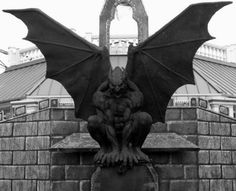 Now it’s time to talk about gargoyles, something Tyrion is associated with all throughout the series, as many of you may recall. The second half of this episode will primarily deal with the connection between Tyrion and gargoyles and its implications for the story, but interwoven throughout will be talk of Winterfell, Bran, and the Last Hero. It turns out to be impossible to talk about Tyrion the gargoyle without bringing up Winterfell, Bran, and the Last Hero, so that’s what we will do. For example, the first place where we see Tyrion described as a gargoyle is Winterfell, and Winterfell is in turn famously decorated with gargoyles. Gargoyles feature prominently in Bran’s early story arc in A Game of Thrones, particularly his fall from the tower, and in turn Tyrion the Gargoyle is connected to Bran by the saddle he designed for him after his accident, and by Catelyn’s fateful decision to accuse Tyrion of attempting to murder Bran which basically shapes the entire story of A Game of Thrones.
And as you guys know, I can never resist a little Last Hero talk when it’s there to be had.
The first mention of gargoyles in A Song of Ice and Fire comes at Winterfell, but refers not to the actual gargoyles on the walls of the keep, but to Tyrion Lannister on the walls of the keep:
The sounds of music and song spilled through the open windows behind him. They were the last things Jon wanted to hear. He wiped away his tears on the sleeve of his shirt, furious that he had let them fall, and turned to go.
“Boy,” a voice called out to him. Jon turned. Tyrion Lannister was sitting on the ledge above the door to the Great Hall, looking for all the world like a gargoyle. The dwarf grinned down at him.
Twenty three pages later, we start hearing about gargoyles on the tops of buildings at Winterfell, and by this time, we’ve most likely forgotten about Tyrion being called a gargoyle as her perched atop a building at Winterfell. But I would suggest that there’s a deliberate connection being drawn. Tyrion is called a gargoyle many, many times in the series, and I believe the reason is this: gargoyles are flying stone beasts associated with hell and dragons, both in the real world and in A Song of Ice and Fire.
The term gargoyle generally refers to any grotesque stone creature which adorns the roof of a buildings, and they come in all different forms. In fact, the same thing is said of gargoyles that is said of snowflakes: no two are alike. There are several variations on the story of how the first gargoyle came to be, but they all involve a fellow named St. Romanus capturing and burning a dragon. The head and neck of the dragon, having been hardened by years of breathing fire, would not burn, and so St. Romanus mounted the head and neck of the dragon on the walls of the newly built church to scare off evil spirits.

French educational card
Gargoyles come in many forms, but they are first and foremost stone dragons. Most legends of gargoyles involve them waking in the night and flying around, so you’ve got the ‘dragons waking from stone’ idea present in the mythos of the gargoyle as well. Calling Tyrion a gargoyle is very close to naming him a dragon, and at the very least, it’s naming him a hell-beast which wakes from stone, just like the demon monkey king Sun Wukong. In other words, both of Tyrion’s nicknames point towards hellish demons waking from stone, and dragons. Both of them point to … Tyrion Targaryen.
A nice touch on Tyrion’s gargoyle association is the fact that gargoyle statues often have chains about their neck, which reminds us of Tyrion’s famous chain which saved King’s Landing.
As for the gargoyles of Winterfell, they are so worn that you cannot make out their shape, but the truth about them is revealed when they are seen in dream form by Bran. This is from A Game of Thrones:
In his dream he was climbing again, pulling himself up an ancient windowless tower, his fingers forcing themselves between blackened stones, his feet scrabbling for purchase. Higher and higher he climbed, through the clouds and into the night sky, and still the tower rose before him. When he paused to look down, his head swam dizzily and he felt his fingers slipping. Bran cried out and clung for dear life. The earth was a thousand miles beneath him and he could not fly. He could not fly. He waited until his heart had stopped pounding, until he could breathe, and he began to climb again. There was no way to go but up. Far above him, outlined against a vast pale moon, he thought he could see the shapes of gargoyles. His arms were sore and aching, but he dared not rest. He forced himself to climb faster. The gargoyles watched him ascend. Their eyes glowed red as hot coals in a brazier. Perhaps once they had been lions, but now they were twisted and grotesque. Bran could hear them whispering to each other in soft stone voices terrible to hear. He must not listen, he told himself, he must not hear, so long as he did not hear them he was safe. But when the gargoyles pulled themselves loose from the stone and padded down the side of the tower to where Bran clung, he knew he was not safe after all. “I didn’t hear,” he wept as they came closer and closer, “I didn’t, I didn’t.”
He woke gasping, lost in darkness, and saw a vast shadow looming over him. “I didn’t hear,” he whispered, trembling in fear, but then the shadow said “Hodor,” and lit the candle by the bedside, and Bran sighed with relief.
This dream occurs immediately after Tyrion returns to Winterfell on his way back from the Wall and offers up the design for a saddle that will enable the crippled Bran to ride horses – this is done to put is mind of Tyrion right before the dream about fiery-eyed gargoyles, perhaps. In any case, let’s discuss the fiery associations of the gargoyles. They watch Bran with red eyes like hot coals, a match for descriptions of the eyes of Melisandre, Bloodraven, Ghost, and most importantly one the dragons, Viserion. They “might have been lions once,” suggesting a correlation between the gargoyles and the Lannisters, and this of course follows up on the labeling of Tyrion as a gargoyle earlier in the book. It’s also quite suggestive of the gargoyles as an Azor Ahai reborn / moon meteor symbol. Azor Ahai and his meteors “used to be lions” in that they represent a transformed sun – a sun which has transformed into something more monstrous. Those monstrous moon meteors drank the fire of the sun, but they also came from the moon, and indeed, when Bran sees the gargoyles, they appear superimposed over the moon, right at the top of the tower, where heavenly bodies belong. Then the gargoyles “pulled themselves loose from the stone,” implying a detachment from the stone moon, and descend the black tower with red eyes like hot coals. This is all just as it should be if the gargoyle are intended to represent Azor Ahai reborn and his flying dragon meteors.
There can be little doubt this scene is a case of mythical astronomy, with Bran climbing up a black tower through the clouds and into the night sky and the earth a thousand miles below him – that’s about as clear as it gets. The moon appears at the top of the black tower , showing us the idea that the tops of towers are equivalent to the celestial bodies, and then a fiery gargoyle comes down from the moon – that’s also pretty easy to understand. This falling gargoyle idea is an echo of that first scene with Tyrion as a gargoyle when he jumps down from the roof:
“Can you climb down, or shall I bring a ladder?”
“Oh, bleed that,” the little man said. He pushed himself off the ledge into empty air. Jon gasped, then watched with awe as Tyrion Lannister spun around in a tight ball, landed lightly on his hands, then vaulted backward onto his legs.
George has said that he actually regrets depicting Tyrion as being so nimble, because for most of the rest of the series George gives him a limp and a waddling gait. Regardless, Tyrion the gargoyle jumps down from the sky spinning like a ball, giving us the image of a falling moon meteor, just as the gargoyle coming down from the moon in Bran’s dream did. Gargoyles come from the moon because they represent one aspect of the moon meteors. George puts the words “bleed that” into his mouth as he falls, which is the only time anyone uses that expression in the novels, and I think the purpose is to create the image of a bleeding star or a bloody stone falling from the sky. Jon watches with awe.
Since Bran is the one who falls from the tower, it’s pretty clear Bran is also representing the moon’s fall from the heavens. He’s specifically pushed out of the top of a tower by a sun figure, so there’s really not much wiggle room here. His head swims, which creates the image of a moon face going swimming in the ocean, the familiar moon-drowning symbol. Bran weeps with fear, and of course the moon crying meteor tears is a symbol you guys are well familiar with. Then he wakes lost in darkness, just as Azor Ahai reborn wakes lost in the darkness of the Long Night.
As always, the various incarnations of the moon meteors all tell us different things about Azor Ahai reborn and Lightbringer. It may seem weird that Bran and the gargoyles are representing the same thing, but we can learn different lessons from each. We’ll start with Tyrion.
Generally speaking, the fiery gargoyles show us monsters coming from the moon, which is easy to understand, but I should also point out that gargoyles are pretty consistently associated with protection and warding against evil spirits. We’ve seen Azor Ahai reborn sometimes depicted in this role, such as with Sandor protecting and avenging moon maiden Sansa Stark, and with the idea of Oathkeeper being used to avenge and protect Ned’s children. Tyrion himself also protects Sansa from Joffrey’s abuse, and later plays a protective role for Penny, the dwarf girl, with a gargoyle reference specifically hung on Tyrion in one of those scenes – we’ll check that out in a moment, actually. Tyrion also successfully saves King’s Landing from Stannis – that’s quite the act of protection, and there’s again a great gargoyle quote right in the middle of the battle. Stannis is seen by those in King’s Landing as “the Stranger comes to judge us” who serves a “demon god,” so in this sense Tyrion’s definitely warding King’s Landing against evil.
I also wouldn’t be surprised to see him play a similar protective role to Daenerys. In fact, there’s a clue about Tyrion helping Dany in The World of Ice and Fire. One story from Yi Ti is that “a woman with a monkey’s tail” somehow helped to end the Long Night. A tail is also the name for the attendants of a monarch, and a monkey for a tail might be Tyrion as an advisor to a woman who might help end the new Long Night – Daenerys.
In any case, the protection aspect of the gargoyle, illustrated by Tyrion, has some potentially serious implications. We’ve seen the protection theme as one aspect of Azor Ahai reborn a few times now, and I think this almost certainly applies to the idea of Azor Ahai protecting all warm-blooded life from the Others with Lightbringer, whether that deed was performed by Azor Ahai’s son, the Last Hero, who would have been righting the wrongs of his father, or else by a reformed Azor Ahai doing something similar, atoning for his own actions. At this point, I think it’s an inescapable conclusion – although Azor Ahai broke the moon when he forged Lightbringer, which seems to have been the cause of the Long Night, Lightbringer and some version of Azor Ahai reborn seem to have later fought off the Long Night and returned the sun to the sky. This makes sense, when you think about it. Azor Ahai is a solar character, and his fall from grace depicts the darkening of the sun. If the sun eventually came back out to shine, as we know it did, it follows that Azor Ahai gained some level of redemption, either through penitence and on his own part or that of his descendent. Thus, the gargoyle actually shows us two things about Azor Ahai reborn and Lightbringer – it’s a fiery monster descending from the sky, but there is some aspect of it which can protect or avenge.
What does Bran as a moon meteor symbol tell us? Well, I think the message has to do with Bran becoming a greenseer. Bloodraven is draped in a certain type of Azor Ahai symbolism, as we’ve discussed before, and he is of course THE greenseer of the north. We’ve also seen many instances of crossover between fire magic and old god / greenseer magic – Jon Snow, Beric Dondarrion, Bloodraven, the leaves of the weirwoods being like fiery and bloody hands, and many more. Azor Ahai broke the moon, and the greenseers supposedly called down the Hammer of the Waters – but I have laid out a strong case that the Hammer was a moon meteor. If Azor Ahai was a greenseer, or worked with greenseers or their magic somehow, then both stories contain an element of truth, which is usually how Martin does things. I actually have a ton to say about the intersection of greenseer magic and fire magic, which will be its own episode, so for now I’ll have to simply say that Bran as a reborn moon child almost certainly plays into that idea.
A bit more on Bran as an Azor Ahai reborn person: Bran skinchanges Hodor, and Hodor too gets the Azor Ahai symbols on occasion – a sword and a torch, one eye wound, etc – and he specifically gets those symbols in scenes where Bran is skinchanging him. There are some great Lightbringer forging metaphors in those scenes, particularly at Queenscrown with all the lightning and it’s broken tower top and the scene at the Nightfort. Another time… another time. This could indicate that Azor Ahai might have done a bit of body snatching, which is exactly the kind of thing we should expect from him if indeed he was a greenseer, as I am coming to suspect he was. His rebirth might have been… well… you know. A body-snatching.
Some people have guessed that Bran will actually skinchange a dragon, and wouldn’t that be just badass! I’ve always liked the idea… and it would totally fit with the symbolism of Bran’s fall from the tower as a parallel to the hatching of the moon dragons. If Azor Ahai was a dragon riding greenseer, then it kind of makes sense for a greenseer like bran to become a kind of dragon rider. So now, read this quote from A Game of Thrones, remembering what the gargoyles represent:
Bran pulled himself up, climbed over the gargoyle, crawled out onto the roof. This was the easy way. He moved across the roof to the next gargoyle, right above the window of the room where they were talking.
“All this talk is getting very tiresome, sister,” the man said. “Come here and be quiet.”
Bran sat astride the gargoyle, tightened his legs around it, and swung himself around, upside down. He hung by his legs and slowly stretched his head down toward the window. The world looked strange upside down. A courtyard swam dizzily below him, its stones still wet with melted snow. Bran looked in the window.
Bran sat astride the gargoyle. <dun dun dun>
I’m not sure if we can interpret this as a foreshadowing of Bran riding a dragon in the future or not, because he’s sitting astride the gargoyle right before the sun figure pushes him out of the tower, which is more like Bran riding a moon dragon down to a fateful impact with the earth. However, we can note that Bran is learning to “fly,” as is said many times, and he’s being taught to do so by a Targaryen greenseer. Who knows – we’ll just have to see what happens. As a side-note, the idea of Bran hanging upside-down from a dragon’s belly like an expertly skilled horsemen is pretty entertaining.
I’ve talked about the theme of the Bloodstone Emperor Azor Ahai being one of stealing from heaven, of trying to climb too high, just like the Morningstar is perceived to be trying to rise before the sun and steal it’s glory as if itself were the sun, the high god, only to fail and fall back down to earth. The Bloodstone Emperor Azor Ahai tries to gain the starry wisdom, the heavenly fire of the gods. There’s an echo of this theme in Bran’s scene, as he’s literally climbing a tower into the heavens, only to be pushed out of the tower because of something he knows. Forbidden knowledge that almost cost him his life. He tries to unhear what he has heard, screaming “I didn’t hear!” but of course he did hear, and he does know, and this knowledge cost him a fall from the tower. Ultimately, this event resulted in a transformation. Bran dreams while in his coma, and actually seems to begin to tap into his greenseer abilities before waking, when he finally learns to fly and astrally projects himself all over Westeros and sees events that are actually occurring, albeit in somewhat symbolic fashion. This is the Azor Ahai reborn story, a man who reached for the stars and got burned, and was transformed. The big question now is, “how did his story end?”
Perhaps the most obvious and important implication of the idea of Bran as an Azor Ahai reborn figure is that Bran seems to be closely mimicking the arc of the Last Hero, and here we will deviate for the aforementioned Last Hero talk. The Last Hero journeyed into the frozen, dead lands seeking out the children of the forest and ended up working against the Others and the Long Night – pretty much Bran’s storyline so far. The Last Hero had a sword, which broke, and twelve companions, who died, as well as a dog and a horse who also died. Bran himself may be the broken sword, if you want to take it that far, with a wolf for a dog and an elk for a horse. My buddy from the Westeros.org forums known as the Last Melnibonean has an interesting theory that Bran has met twelve people on his journey that have either died or will die as a correlation to the Last Hero’s twelve dead companions. Regardless of the smaller details, he’s definitely retracing the important footsteps of the Last Hero (ironic metaphor alert… Bran… footsteps…). Bran as both a falling moon meteor figure and a Last Hero figure is another corroboration that the Last Hero story is somehow connected to the idea of Azor Ahai reborn.
Now, Bran being a Last Hero figure also clues us in to the idea that the Starks are probably connected to the Last Hero as well – an idea we already had, of course – and thus to Azor Ahai reborn. The mystery of how the Starks, the Last Hero, and the Last Hero’s blade of dragonsteel are connected with the myth of Azor Ahai and Lightbringer is one of the biggest mysteries in the books, in my opinion. It’s the whole reason that Jon being half Targyen and half Stark is significant, for one thing, and I believe it will figure into the ultimate endgame of the series.
I mean ask yourself – why all this to-do about Azor Ahai and Lightbringer, a fantastical myth from the other side of the world, in a story which is squarely centered on Westeros and the Starks? There must be some connection, right? I’m claiming Azor Ahai, also called the Bloodstone Emperor, caused the Long Night, but the most famous effect of the Long Night besides the general darkness was the invasion of the Others, in Westeros. In order for all this Azor Ahai stuff to be relevant, there needs to be connection to the main events in Westeros. Everyone can see that the dragons and the Others are on some sort of collision course – people can sense there’s a connection, a date with destiny. Many think the solution to the ice demons might involve heroes who are dragon-blooded people riding dragons, the “three heads of the dragon.” I mean you could look at it the other way round – pun intended – and say that the elegant ice elves are the solution to the fire monsters, but the point is – what’s the connection? Because all things come round again in A Song of Ice and Fire, the same must have happened in the past – this would be the place where Azor Ahai and Lightbringer connect to the Last Hero, dragonsteel, and the Starks.
Similarly, everyone can see the parallels between Jon and Dany, that they both are the clearest manifestations of Azor Ahai reborn – but one is associated with fire, and the other with ice, pun intended again. Now let me tell you – I think the debate about which one is “really” Azor Ahai reborn is quite silly. They’re both Azor Ahai reborn, but one is Azor Ahai reborn in any icy sheath. The interaction between Jon and Dany stands to figure prominently in the conclusion of the story, however you envision that meeting going down. The question is, what happens? What is the interaction between ice and fire, between Other and dragon? I have some ideas about that actually… it’s one of the big conclusions which all of my essays are building up to.
Here’s a bit of a clue about that, and it brings us back to gargoyles again – the real ones carved from stone this time, not people symbolized by gargoyles. I’ve actually been waiting to bring up this topic for a long time… so check this out. There are actually only two castles in all of Westeros – nay, in all of A Song of Ice and Fire – which are warded with gargoyles. And those two castles are: the First Keep of Winterfell, the oldest part which was built by Brandon the Builder, and Dragonstone, the ancestral home of House Targaryen which was built by the Valyrians. That’s quite a fascinating parallel, don’t you think? Putting gargoyles on castle walls is nothing special – that’s where you’d expect to see them, after all – and if George had randomly sprinkled them on various castles throughout the land, we wouldn’t think much of it. But instead, we find them exclusively at these two extremely significant castles. This tells us much and more, I believe.
The gargoyles of Dragonstone are all hell beasts of various kinds, with dragons being chief among them. The two on Cressen’s balcony are a hellhound and wyvern, for example, and of course the dragons are everywhere. The stone gargoyles and dragons are specifically used as meteor symbols in scenes on Dragonstone such as the Cressen prologue of Clash and the burning of the Seven scene, also from Clash, where Stannis and Mel do their little Lightbringer re-enactment ceremony. The gargoyles of Dragonstone themselves are made of fused black stone – stone burnt black and super-hardened by dragonfire, which makes for a very clear and vivid parallel to our burning black moon meteor dragons.
In that scene where they burn the Seven and draw forth fake Lightbringer, the gargoyles and dragons look as though they are about come to life in, just as Winterfell’s gargoyles come to life with fire in their eyes in Bran’s dream:
Heat rose shimmering through the chill air; behind, the gargoyles and stone dragons on the castle walls seemed blurred, as if Davos were seeing them through a veil of tears. Or as if the beasts were trembling, stirring…
This entire scene is laced with talk of waking dragons, and we can see here in the second paragraph of the chapter that the idea of waking gargoyles is akin to waking dragons – they’re lumped in together as stone hell beasts that might be stirring. The veil of tears is an expression which refers to the barrier between life and death, so the resurrection symbolism is really pretty think here. Not only are the dragons and gargoyles coming to life, they are coming back from the dead, through the veil of tears, but in the wrong direction. In the prologue of Clash, Cressen actually talks to his gargoyles and thinks about them talking back, only to scold himself for being crazy. He’s not crazy, but again we see the idea of the gargoyles coming to life. I think it’s all pretty clear – gargoyles in A Song of Ice and Fire are fiery hell beasts woken from stone, and they make up one aspect of Azor Ahai reborn, the flying moon meteor.
And there they are, sitting atop the oldest part of Winterfell.
What does this mean? Well, the fact that the Winterfell gargoyles are so worn that you cannot tell what specific creatures they are is quite suspicious, to me. If George had put dragons on the walls of Winterfell, after all, we’d all look at it quite differently, wouldn’t we? I suggested last time that Winterfell and Ned himself are symbols of the destroyed second moon that gave birth to dragons – this would be the fire moon in my hypothesized ice moon / fire moon scenario. But wait, isn’t Winterfell and House Stark a symbol of the North, the cold and frozen lands? Well, actually, what Winterfell is is a bulwark against the cold. It’s situated on top of a geothermal hot spot, as evidenced by its hot pools which are pumped through it s walls like veins of warm blood:
Of all the rooms in Winterfell’s Great Keep, Catelyn’s bedchambers were the hottest. She seldom had to light a fire. The castle had been built over natural hot springs, and the scalding waters rushed through its walls and chambers like blood through a man’s body, driving the chill from the stone halls, filling the glass gardens with a moist warmth, keeping the earth from freezing. Open pools smoked day and night in a dozen small courtyards. That was a little thing, in summer; in winter, it was the difference between life and death.
Winterfell is warm and smoking. It’s a beating heart which may be the difference between life and death. Here’s Jon Snow making the same analogy between hot blood and the hot water at Winterfell in A Game of Thrones:
So cold, he thought, remembering the warm halls of Winterfell, where the hot waters ran through the walls like blood through a man’s body. There was scant warmth to be found in Castle Black; the walls were cold here, and the people colder.
It’s often said that Winterfell is the heart of the north, and we can see that it is a warm heart which pumps hot water through its stone walls like blood. At the heart of Winterfell, of course, we have the heart tree, with its bloody hands and mouth and eyes weeping tears of blood. That’s a lot of warmth!
Many have suggested that the name Winterfell might imply that it was the place where winter fell, and that’s fell as in defeated. The King of Winter rules over winter like a defeated subject, in other words. This idea is reinforced by the description of the crown of the King of Winter, which we receive in A Clash of Kings:
Lord Hoster’s smith had done his work well, and Robb’s crown looked much as the other was said to have looked in the tales told of the Stark kings of old; an open circlet of hammered bronze incised with the runes of the First Men, surmounted by nine black iron spikes wrought in the shape of longswords. Of gold and silver and gemstones, it had none; bronze and iron were the metals of winter, dark and strong to fight against the cold.
To fight against the cold. The King of Winter fights against the cold, and his castle is a warm beating heart and a bulwark against the cold… and its covered in hellish gargoyles of one sort or another. The King of Winter has a beast at his side, too – the direwolf. We’ve seen that all the Stark direwolves have eyes explicitly described to be fiery, and we’ve seen that the direwolves seem to be playing into the archetype of the fiery hellhound, guardians of the underworld. Who is this King of Winter anyway, with his dark metals and fiery hellhounds, and his loathing of the forces of the cold?
Gargoyles ward against evil spirits, and the evilest spirits around are of course the Others, demons made of ice. It makes sense to see fiery gargoyles and hellhounds warding against icy demons, right?
This seems like the right time to mention that Winterfell, as a proper second moon symbol, is burnt and cracked open. Theon reflects in A Dance with Dragons:
The great stronghold of House Stark was a scorched desolation.
And later in the same book, Theon again:
Only a shell remained, one side open to the elements and filling up with snow. Rubble was strewn all about it: great chunks of shattered masonry, burned beams, broken gargoyles. The falling snow had covered almost all of it, but part of one gargoyle still poked above the drift, its grotesque face snarling sightless at the sky. This is where they found Bran when he fell.
That’s a nice tie between falling Brans and falling gargoyles. One gargoyle lies broken, staring sightlessly, just as Bran lay broken in that very spot. This also the spot where the dead body of Little Walder was found – the line was “under that ruined keep, my lord, the one with the old gargoyles.” You’ll recall that Little Walder appears to Theon in the haze of the snow and mist of the godswood as a red bull, and sacrificed bulls are a recognizable sacrificed moon symbol. Fallen moon children, fallen gargoyles, and fallen red bulls – all the same idea. These are dragons which hatch from the moon in a burst of blood and fire and fall to earth, landing with great trauma. The thing I really want to draw your attention to in this passage is the use of the word “shell” to describe Winterfell, something which occurs several times. This is Jon, also in Dance:
“The castle is a shell,” he said, “not Winterfell, but the ghost of Winterfell.”
When Bran surveys the devastation of Ramsay’s burning, he observes:
The First Keep had not been used for many hundreds of years, but now it was more of a shell than ever. The floors had burned inside it, and all the beams. Where the wall had fallen away, they could see right into the rooms, even into the privy.
It’s a burnt out shell,once again. And of course we know what hatched from that shell:
The smoke and ash clouded his eyes, and in the sky he saw a great winged snake whose roar was a river of flame. He bared his teeth, but then the snake was gone. Behind the cliffs tall fires were eating up the stars.
That was Bran’s vision through Summer’s eyes of what sounds an awful lot like a dragon, taken from A Clash of Kings. I will address whether or not I think that was a real dragon on some other occasion – tease tease – but for now it serves to make the point that when Winterfell was burned and cracked open like a shell, a dragon hatching is depicted. A bit later in the chapter, right after that quote about the First Keep being more of a shell than ever before, Osha declares that they “made enough noise to wake a dragon.”
Right before that, we get this paragraph:
The sky was a pale grey, and smoke eddied all around them. They stood in the shadow of the First Keep, or what remained of it. One whole side of the building had torn loose and fallen away. Stone and shattered gargoyles lay strewn across the yard. They fell just where I did, Bran thought when he saw them. Some of the gargoyles had broken into so many pieces it made him wonder how he was alive at all. Nearby some crows were pecking at a body crushed beneath the tumbled stone, but he lay facedown and Bran could not say who he was.
Here we can another equation between Bran and the gargoyles, both of which fell from the tower and landed in the same spot – it’s an identical comparison to the one Theon made in book 5, here in a Bran chapter of book 2. Bran’s fall was depicting the moon disaster, just as the fire which gutted Winterfell was, the body which tumbled facedown in this scene is more of the same – the moon fell face down, that’s the idea. All of the fallen objects are broken or dead or crushed, indicating the dead / undead nature of Azor Ahai reborn and the association of death which Lightbringer bears.
It’s worth noting that the gargoyles of Dragonstone also fell from the walls when Daenerys was born:
Daenerys Stormborn, she was called, for she had come howling into the world on distant Dragonstone as the greatest storm in the memory of Westeros howled outside, a storm so fierce that it ripped gargoyles from the castle walls and smashed her father’s fleet to kindling.
We’ve talked about the idea of incredible storms accompanying the birth of Azor Ahai reborn – the storm of sword meteors, to be specific – and how this is manifest in this story of Dany being born during a legendary storm which flung gargoyles from the walls of “dragon-stone.” Dragonstone is one of the first symbols of the second moon and its meteor children that we discovered, and like Winterfell, we have gargoyles falling to the ground or coming to life when symbolic Lightbringer forgings occur. These repeated parallels between the two fortresses further solidify the interpretation of Winterfell as a symbol of the moon which was destroyed by fire and gave birth to dragon meteors.
Returning to Bran surveying the ruins of Winterfell, we have this:
It took the rest of the morning to make a slow circuit of the castle. The great granite walls remained, blackened here and there by fire but otherwise untouched. But within, all was death and destruction.
Walls blackened by fire may be another parallel to Dragonstone, whose walls were all burnt black by dragon fire. More importantly, this quote reinforces the shell idea – the blackened walls are the shell, and inside the egg is fire and death and destruction. Dragons, in other words. Or, if you prefer, the fiery heart of a star, one which becomes a flying dragon.
I’m tempted to wonder if Martin is making a super nerdy joke about Lightbringer and electricity – they make a circuit of the broken shell, get it?
So, to sum up, Winterfell is a symbol of the destroyed second moon, the potential “fire moon,” which gave birth to dragons. The King of Winter has hellhounds and dark metals to fight the cold. He lives in an oasis of warmth, the warm heart of the north. And his castle is festooned with gargoyles, just like a dragonlord fortress. What’s going on here?
Well, if there’s a connection between Azor Ahai, who is definitely from the east and affiliated with dragons and fire magic, and the Last Hero, who is from Westeros and strongly affiliated with the Starks, then somehow, the Starks should have some ancient connection with dragons and fire magic… and indeed, they seem to be. I think George has hidden this fact in plain sight. Consider: the first time we saw Winterfell, we saw Ned Stark cleaning the blood off of his smoke-dark, dragon-forged sword in the black waters of the godswood pond. This is clearly one of the most important early scenes in the book, and in it, we find Lord Stark, our stand-in the for the King of Winter, honing and admiring his black dragonsword with the dark glow. The very first scene with Eddard was the execution of the runaway Night’s Watchbrother, and again his black Ice sword features prominently. Think about it: the first thing we ever see Ned do is cover his dragon sword in human blood. Yes, that’s deserving of another dun-dun-dun.
I have come to the opinion that here, right at the beginning of the first book, we are being shown the King of Winter archetype. Dark metals to fight the cold – honestly, that sounds like the idea of Lightbringer the black sword fighting the forces of winter, a.k.a. the Others. That’s just what Jon dreams of – fighting the cold forces from the lands of always winter with a black Valyrian steel sword which burns red, with black ice armor to remind us of Ned’s black sword called Ice. And speaking of Jon and heroes, we have this from A Dance with Dragons:
When Jon had been a boy at Winterfell, his hero had been the Young Dragon, the boy king who had conquered Dorne at the age of fourteen. Despite his bastard birth, or perhaps because of it, Jon Snow had dreamed of leading men to glory just as King Daeron had, of growing up to be a conqueror.
From young dragon to Lord Snow – meaning “King of Winter” – is this the path of Azor Ahai the conqueror, or perhaps his son? It’s definitely a nice clue about Jon being a dragon person… AeJon the Conqueror, if you will. Kidding aside, let me be clear: I think the clues indicate that the King of Winter, who may or may not have been Brandon the Builder or the Last hero of the Night’s King or any combination of the three, may have at least some dragon lineage. In particular, I am thinking of Azor Ahai or his son marrying a Westerosi woman of First Men heritage to found the line of House Stark, the Kings of Winter who fight the cold with dark metals and hot castles and fiery hellhounds and gargoyles.
Whew, that was exciting. Dragons in Winterfell and the King of Winter unmasked as a fiery dude who actually is not so fond of the cold! You better believe I am going to come back to all of that. As I mentioned last time, the Last Hero clues just kind of seem to come in drips and drabs as we study other things. This essay is mainly about Tyrion, but the clues about the gargoyles led to that mini-episode about Winterfell and the King of Winter and the Last Hero, and far be it from me to edit cool stuff like that out of my podcast. I hope you enjoyed it, and if you did, I’m glad I included it.
Now, let’s bring things back to Tyrion by examining a couple of the passages in which he is called a gargoyle, and we’ll just sort of see what we find. We already covered the first occurrence of Tyrion the gargoyle at Winterfell, and the next one is to be found in A Clash of Kings… it’s a hum-dinger, and it opens the chapter:
Motionless as a gargoyle, Tyrion Lannister hunched on one knee atop a merlon. Beyond the Mud Gate and the desolation that had once been the fishmarket and wharves, the river itself seemed to have taken fire. Half of Stannis’s fleet was ablaze, along with most of Joffrey’s. The kiss of wildfire turned proud ships into funeral pyres and men into living torches. The air was full of smoke and arrows and screams.
Right off the bat, we take note of the fact that King’s Landing was built by dragon people, and thus it’s entirely fitting to place a gargoyle like Tyrion atop its walls. That gargoyle is a dragon, after all, according to theory. We see a burned hellscape of desolation, and the deadly kiss of fire which consumes everything it touches, just like the sun kissed the moon and cracked it open. Notice what the fiery kiss does – it turns men into living torches. Think of Beric, animated by fire magic, who was brought back by the fiery kiss, and thus we see once again the idea that undead fire beings were a result of the forging of Lightbringer. Human torches, if you will. The kiss also turns wooden ships into funeral pyres, evoking the funeral pyre of Khal Drogo and the smoke which rises from the meteor impacts to blot out the stars.
As I mentioned before, Tyrion is the protector of King’s Landing, and here he is, literally perching on its walls like a gargoyle, overseeing his efforts to ward the city. This is actually the chapter where Tyrion rides out into battle in defense of the city, making his protection role a direct and visceral one. Besides his own person, the main weapon which he employed to save King’s Landing was his wildfire – the jade demon, as it is called during the battle. The next paragraph:
Downstream, commoners and highborn captains alike could see the hot green death swirling toward their rafts and carracks and ferries, borne on the current of the Blackwater.
Black water and green fire – a match for Tyrion’s green and black eyes, perhaps? Color symbolism is always quite subjective, so who knows, but I thought I would point it out. The chapter continues with an appearance of the Last Hero math: a group of twelve great fires led by one even more terrible fire, which is Tyrion’s demon:
A dozen great fires raged under the city walls, where casks of burning pitch had exploded, but the wildfire reduced them to no more than candles in a burning house, their orange and scarlet pennons fluttering insignificantly against the jade holocaust. The low clouds caught the color of the burning river and roofed the sky in shades of shifting green, eerily beautiful. A terrible beauty. Like dragonfire. Tyrion wondered if Aegon the Conqueror had felt like this as he flew above his Field of Fire.
Well, that was fairly on the nose, wasn’t it? Oh that’s right, I guess shouldn’t make nose jokes about Tyrion. It kind of goes without saying, but in this scene, we see Tyrion’s jade demon compared to dragonfire, and Tyrion might feel kinda like Aegon the Conqueror. Because he’s a secret Targaryen.
There’s also not one, but two monkey-demon references connected to Tyrion’s protection of King’s Landing, which I saved for just this moment. As one of the chapters before the Battle of the Blackwater closes with Tyrion musing about how the people of the city don’t have one of their shining heroic knights to save them, but only the one they hate, “the dwarf, the evil counselor, the twisted little monkey demon.” In another scene before the battle, Tyrion commands Bronn to gather a hundred men and “burn everything you see here between the waters edge and the city walls” in order to deny Stannis wood for scaling ladders. Bronn suggests that the lowly peasants won’t take kindly to that, to which Tyrion quips that “they’ll have something else to curse the evil monkey demon for.” Tyrion the monkey demon is employing fire as a weapon to protect the city on multiple occasions , and sometimes the fire itself is a demon, and sometimes it looks like dragon fire. This all plays in to the themes of using dark weapons and dark powers related to fire to potentially save the day which we’ve seen many times now.
Well, that was a pretty good one. Let’s go to out next Tyrion as gargoyle quote, from a Sansa chapter of A Storm of Swords:
Queen Cersei studied her critically. “A few gems, I think. The moonstones Joffrey gave her.”
“At once, Your Grace,” her maid replied.
When the moonstones hung from Sansa’s ears and about her neck, the queen nodded. “Yes. The gods have been kind to you, Sansa. You are a lovely girl. It seems almost obscene to squander such sweet innocence on that gargoyle.”
“What gargoyle?” Sansa did not understand.
Besides the moon stones draped over Sansa’s kissed by fire head of auburn hair, Cersei also fastens a white maiden’s cloak about Sansa which is “heavy with pearls.” Moonstones and pearls – white ones, at least – are both symbols of pure, shining moon – one that has not been penetrated by burning dragon seed or burning dragon swords. It’s such a shame, wasting such an excellent moon maiden on a gargoyle like Tyrion.
Tyrion represents the gargoyle version of Azor Ahai reborn, which is a child of sun and moon. His lion nature reflects his “dad’s genes,” if you will – the fact that the sun is Azor Ahai reborn’s father. Azor Ahai transforms into Azor Ahai reborn when Lightbringer is forged and the moon cracks, when the Long Night falls and the sun turns dark, and so we can see that giving an innocent moon maiden to the likes of an Azor Ahai reborn character is indeed an obscene act. The thing is, Tyrion is not like his father the sun, who’s all about Tyrion forcing himself on Sansa. Tyrion refuses to do this, and instead he protects Sansa’s chastity and autonomy, like a true gargoyle, leaving the choice of consummation up to her. He also protected Sansa from the beatings of the Kingsguard which came at the behest of another ravenous sun king, Joffrey.
Again, this protection role is a match for Sandor, a hellhound version of Azor Ahai reborn, who also protects Sansa from rape at the hands of the mob during the riot, and from Joffrey when Sansa speaks up for Dontos at Joffrey’s nameday tournament. You remember that whole thing about what a man sows on his name day, he reaps throughout the year, right? In other words, the takeaway here is that moon maiden Sansa is protected by hellhounds and gargoyles. Once again, if Tyrion were to end up protecting Daenerys, it would match the symbolism perfectly. Sansa and Daenerys are moon maidens with very similar imagery, as we have seen.
Consider also that Tyrion’s great shame is that he did not protect his first love Tysha – instead he did nothing while a hundred of his father’s guardsman raped her. This is a deep violation of Tyrion’s calling to protect moon maidens, and accordingly, it haunts him throughout his storyline. Similarly, he choked Shae until her face turned black – and this too haunts his memories. Of course Shae’s face turning black is a vivid depiction of the moon turning black when it was killed. The opening of the fiery hand of the king in the sky was the death of the moon, and Shae dies with golden hands embedded in her flesh.
Moving right along, there’s another occasion of Tyrion being called a gargoyle in Storm, when Sandor curses out Tyrion to Arya as he sets out to take her to the Twins for “your uncle’s bloody wedding,” a.k.a. the Red Wedding. That passage is mostly about Sandor, so I have chosen not to quote it, but it involves Sandor declaring that he is through with the Lannisters and leaving King’s Landing, which is a depiction of the hellhounds flying from the sun, landing, and then turning against the sun as they throw up the smoke which blots out the sun’s face. This may also be another clue about the Last Hero turning against his evil father Azor Ahai, or perhaps his sword being taken from him and used to undo his evil deeds.
In A Feast for Crows, we get a Tyrion gargoyle reference when Cersei receives a severed dwarf’s head which is not Tyrion’s, and says..
There are gargoyles on Dragonstone that look more like the Imp than this creature.
That’s a pretty sweet tie-in to Dragonstone. Tyrion has now been associated with gargoyles on all three of the castles we’ve discussed: Winterfell, King’s Landing, and now Dragonstone. The plot didn’t provide a convenient way for Tyrion to perch on Dragonstone’s walls like a gargoyle, as he did at Winterfell and King’s Landing, but this comparison by Cersei does the trick nicely. Once again, the fact that King’s Landing and Dragonstone were both built by dragon people kind of raises the possibility that the First Keep of Winterfell was built by dragon people too.
There’s a few lines worth looking at leading up to Cersei’s line about Tyrion, as the would-be informers present Cersei with their head:
He laid his hand upon his chest. “I bring you justice. I bring you the head of your valonqar.”
The old Valyrian word sent a chill through her, though it also gave her a tingle of hope. “The Imp is no longer my brother, if he ever was,” she declared. “Nor will I say his name. It was a proud name once, before he dishonored it.”
“In Tyrosh we name him Redhands, for the blood running from his fingers. A king’s blood, and a father’s. Some say he slew his mother too, ripping his way from her womb with savage claws.”
What nonsense, Cersei thought. “ ’Tis true,” she said. “If the Imp’s head is in that chest, I shall raise you to lordship and grant you rich lands and keeps.”
That’s a fabulous description of Azor Ahai reborn, the dragon, ripping its way out of its moon-mother shell. Red hands is a nice one, tying into the well-established bleeding and burning hands symbolic motif. Well-established, anyway, if you’ve been listening to these podcasts in order, which I highly recommend. Tyrion killed his father too, as everyone well remembers, and this is simply another depiction of the moon meteors, children of sun and moon, turning against their sun father by darkening the sky with ash and smoke.
I have to say, I think it’s becoming increasingly likely that the original Azor Ahai had a son who turned against him. Remember that Azor Ahai “reborn” can refer to either a child of Azor Ahai or to a resurrected Azor Ahai, and my best guess is that we had both the first time around. An undead dad and a son who went against his father. Perhaps the son slew the father, who was then resurrected. That’s taking the whole odeipus thing to a whole new level, right? Son slays father, father rises from the dead, sacrifices son in bloodmagic ritual on alter made of ice? Something like that, surely.
We saw this idea of two Azor Ahai reborn figures clashing a moment ago in the idea that Sandor, the hellhound version of Azor Ahai reborn, wishes death on Tyrion, the gargoyle version of reborn Azor Ahai. We also see it in the Battle of Blackwater Bay itself, when the army led by Tyrion clashes against that of Stannis, a distinct Azor Ahai reborn figure in his own right. I think we have to ask the question: Is this a conflict between Azor Ahai reborn the resurrected dad and Azor Ahai reborn the child? Or were there more than one child? It seems possible, since we have all this in the current story about three heads of the dragon, and the original three heads of the dragon – Aegon, Visenya, and Rhaenys – were all siblings. That’s a hole we’ll have to fall down another time. It’s safe to say there is a lot of familial conflict of every sort in A Song of Ice and Fire, and it’s likely a lot of this is echoing familial conflicts from the Dawn Age.
Our final Tyrion as gargoyle reference comes from A Dance with Dragons, and it’s actually from the same chapter where Moqorro sees Tyrion snarling amidst all the dragons in a fire vision. This is from the page before that vision, as Tyrion feels empathy for Penny, the dwarf girl:
And the sight of me can only be salt in her wound. They hacked off her brother’s head in the hope that it was mine, yet here I sit like some bloody gargoyle, offering empty consolations. If I were her, I’d want nothing more than to shove me into the sea.
Tyrion does indeed play the protective gargoyle for Penny all through their time together, so we can see that this is an apt evocation of the gargoyle aspect of Tyrion’s character. Tyrion is a bloody gargoyle, even better, and perhaps he should be shoved into the sea like some sort of falling sea dragon. We’ve seen many references to moon or moon meteor drowning throughout these essays, and this is yet another. The equivalency drawn between Tyrion and Penny’s dead brother is another suggestion of Azor Ahai reborn as being a dead person.
The quote continues:
He felt nothing but pity for the girl. She did not deserve the horror visited on her in Volantis, any more than her brother had. The last time he had seen her, just before they left port, her eyes had been raw from crying, two ghastly red holes in a wan, pale face. By the time they raised sail she had locked herself in her cabin with her dog and her pig, but at night they could hear her weeping. Only yesterday he had heard one of the mates say that they ought to throw her overboard before her tears could swamp the ship. Tyrion was not entirely sure he had been japing.
Penny is playing a pure moon maiden role here – she’s a weeping maiden with two ghastly red holes for eyes, and she has a wan, pale face. That’s the wan light of a moon pale face and the torn out eyes of the moon which became the bleeding stars. The side-by-side appearance of tears and torn-out eyes is impossible to miss at this point, and unmistakable as well. I don’t have to summarize the whole moon tears / eyeless skulls thing again do I? We’ve talked about it enough, I trust. Penny’s tears might even swamp the ship – that’s a flood tide of tears, in other words, enough to drown things.
Finally, we see a parallel to the idea of throwing Tyrion into the sea, as moon maiden Penny is also associated with being thrown into the sea. Elsewhere in the same chapter, there’s also a mention Penny becoming suicidal and jumping into the sea. Sea dragon moon meteors drown in the ocean, and then then drown whole islands, get it? Also recall that pennies are called copper stars in Westeros, so the weeping, eyeless, moon-faced Penny who is drowned in the sea also shows us a star having its eyes torn out, weeping a flood tide, and drowning in the sea. Once again, I am left to marvel at the density of Martin’s mythical astronomy – he touched on all these ideas in multiple ways in the space of just two paragraphs.
And then, just a moment later, Moquorro sees Tyrion snarling and casting long shadows in the midst of dragons. There’s another line about Penny here, as Tyrion suggests that perhaps it was Penny he saw in his dream – this makes sense because Penny is a moon maiden, and dragons come from the moon.
Well, that does it for the gargoyle – I think it’s a fabulous use of real-world myth, and we can see that Tyrion has a well-established track record of protecting moon maidens. Again, I think it’s pretty likely Tyrion will be doing the same for the penultimate moon maiden, Daenerys Targaryen. What better way to protect a moon maiden like Daenerys than by riding on the back of a dragon?
And so, I will close this essay by leaving you with a possible foreshadowing of Tyrion’s future dragon-riding, and this is the very mild spoiler from one of Tyrion’s Winds of Winter sample chapters which I spoke of at the beginning. I left it to the end so that you can tune out if you don’t want Winds of Winter spoilers, for whatever reason. This scene takes place in the command tent of the Second Sons, where a Yunkishman comes in to give more incredibly foolish battle commands to the Brown Ben Plumm, the captain of the Second Sons. You’ll recall that the Second Sons betrayed Daenerys by turning their cloaks and going over to the Yunkish forces – in this scene, Tyrion has been trying to convince Brown Ben to go back over to Daenerys, who seems like the wining side. The Yunkish man arrives with his crappy orders:
Out went Kem. When he returned, he held the tent flap open for a Yunkish nobleman in a cloak of yellow silk and matching pantaloons. The man’s oily black hair had been tortured, twisted, and lacquered to make it seem as if a hundred tiny roses were sprouting from his head. On his breastplate was a scene of such delightful depravity that Tyrion sensed a kindred spirit.
Oily black roses which have been tortured and and twisted – you guys caught that one right? That’s the moon flower of oily black stone, unfolding like an iron rose such as we saw with Tywin’s army at the battle of the Green Fork. The Yunkishman is called kindred and wears yellow to draw an analogy to Tywin, the solar character, who wields the iron rose. In fact, Tyrion recalls that battle scene in this Winds chapter, just a couple of pages previous, and uses the same symbolic language that we saw all the way back in the first book:
“I was just recalling my first battle. The Green Fork. We fought between a river and a road. When I saw my father’s host deploy, I remember thinking how beautiful it was. Like a flower opening its petals to the sun. A crimson rose with iron thorns. And my father, ah, he had never looked so resplendent. He wore crimson armor, with this huge greatcloak made of cloth-of-gold. A pair of golden lions on his shoulders, another on his helm. His stallion was magnificent. His lordship watched the whole battle from atop that horse and never got within a hundred yards of any foe. He never moved, never smiled, never broke a sweat, whilst thousands died below him. Picture me perched on a camp stool, gazing down upon a cyvasse board. We could almost be twins… if I had a horse, some crimson armor, and a greatcloak sewn from cloth-of-gold. He was taller too. I have more hair.”
Penny kissed him.
The moon wandered too close to the sun and kissed it, chuckle chuckle.
The choice to use the same symbolic language about the iron rose six books and twenty years apart shows specific intention on the part of the author, I would suggest, and the black rose theme is reinforced by the oily black hair of the Yunkishman that is tortured to look like roses. Previously on Mythical Astronomy of Ice and Fire, we have examined a long series of solar characters who have some sort of black moon weapon symbol, beginning with Tywin’s unfolding iron rose and also including Jon Snow’s rivers of black ice and black ice armor, Drogo’s oily black hair which is like a river of darkness, Jamie and Joffrey’s “waves of blood and night” swords , and Oberyn’s oily black sun-spear. I forgot to mention last time that Oberyn’s eyes are described as being “as black and shiny as coal oil.” As you can see, the oily black rose hair of the yellow-cloaked Yunkishman fits very tightly into this established pattern, and presented in close proximity the repetition of the iron rose army of Tywin Lannister idea… well let’s just say it’s not a coincidence. The thing to remember is that this a depiction of the sun using the moon as a black weapon – so while all these characters are solar figures, their symbolism also includes the moon, and that is where there black and bloody tides and the black sword meteors come from.
In Tyrion’s memory of the battle scene, Tywin watches from atop his horse like a sun in the sky, and this is compared to Tyrion watching the cyvasse table from atop his stool. They could almost be twins! Tywin’s iron rose army is drawn as an equivalent to Tyrion’s chess pieces, and this is where the dragon-riding clue comes in. After our oily-rose head Yunkishman gives his commands, Jorah has a second opinion:
Mormont’s longsword was in his hand. As the rider turned, Ser Jorah thrust it through his throat. The point came out the back of the Yunkishman’s neck, red and wet. Blood bubbled from his lips and down his chin. The man took two wobbly steps and fell across the cyvasse board, scattering the wooden armies everywhere. He twitched a few more times, grasping the blade of Mormont’s sword with one hand as the other clawed feebly at the overturned table. Only then did the Yunkishman seem to realize he was dead. He lay facedown on the carpet in a welter of red blood and oily black roses. Ser Jorah wrenched his sword free of the dead man’s neck. Blood ran down its fullers.
A bloody sword, a face-down sun figure, a pool of blood and oily black roses. That’s a nice summary of episodes 2 and 3 of the podcast, complete with references to blood tides, black roses, oily black stone. Just as Tyrion the twisted monkey demon killed his solar father figure, this oily Yunkish solar figure has been killed by Jorah, who wears the demon mask. Once again, we see the idea that sun is killed by a demon-spawn, which would Azor Ahai reborn, the sun’s own son. And then comes the dragon reference:
The white cyvasse dragon ended up at Tyrion’s feet. He scooped it off the carpet and wiped it on his sleeve, but some of the Yunkish blood had collected in the fine grooves of the carving, so the pale wood seemed veined with red. “All hail our beloved queen, Daenerys.” Be she alive or be she dead. He tossed the bloody dragon in the air, caught it, grinned. “We have always been the queen’s men,” announced Brown Ben Plumm. “Rejoining the Yunkai’i was just a ploy.”
“And what a clever ploy it was.” Tyrion gave the dead man a shove with his boot. “If that breastplate fits, I want it.”
Viserion, the white dragon, has just been flying above the battle scene and eating corpses as they are flung into the air by the catapults – so I think there can be little doubt that this bloody white dragon which Tyrion claims is a reference to Viserion, if it’s a reference to anything. There’s also a link drawn to weirwood, pale wood veined with red – and of course, this makes be think of Bloodraven, who’s sigil is a white dragon, and who is transforming into a weirwood. There’s a whole mysterious connection between white dragons and weirwood – you’ll notice this coloring matches Ghost’s as well – and that we will have to save for another day.
But the chess analogy here is quite clear: Tyrion deploys the chess pieces just as Tywin deploys his army. Tywin’s army is a black iron rose, and Tyrion’s is a bloody white dragon. This connection was reinforced with a line earlier, which was Tyrion saying “This is just a cyvasse game to the Wise Masters. We’re the pieces. They have that in common with my lord father, these slavers.” We are the pieces, he says, and the pieces are a bloody white dragon. Tyrion is a bloody white dragon, in other words, and perhaps he will ride one too, deploying it like a chess piece to protect his dragon queen. Tyrion tosses the dragon into the air – that’s where you ride them, after all – and says ‘all hail queen Daenerys.’
Last but not least, Tyrion wants the armor of the dead sun figure, the one with all those depraved scenes, despite the fact that it might have blood and black oil on it. Tyrion has always wanted that magic armor from Valyria, right? As a monkey demon following in the tradition of Sun Wukong, he needs a suit of magic armor. Earlier, Tyrion remarks that he’d be like Tywin, if only he had that splendid armor. Well, he’s getting the armor of the sun, but it’s the armor of a dead sun – the dead solar king we know as the black dragon, Azor Ahai reborn.
Attentive listeners will remember that we quoted a scene earlier where Tyrion plays cyvasse with Young Griff, a.k.a. probably fAegon Blackfyre, and Tyrion was noted to move the black dragon around the board instead of the white in this scene. Like chess, cyvasse has a black and a white “wooden army,” as they are called, and it’s interesting to compare Tyrion’s role as dragon advisor in the two scenes. When he had the black dragon, the yin side if you will, he was deceiving Young Griff, both on the game board and his strategic advice and manipulation. In this scene here with the white dragon, it certainly appears that Tyrion genuinely is on team Daenerys. This recalls Sun Wukong’s nature as a trickster god who can push the balance in either direction.
I’ll close by mentioning that there’s actually a white dragon in the story of Sun Wukong told in “Journey to the West.” Later in life, after escaping from the mountain under which the Buddha had imprisoned him, Sun Wukong works to atone for his evil deeds by playing the role of protector to the main character in the second half of the story, Tang Sanzang. That’s a nice overlap to the protection aspect of gargoyles. Tangs horse is eaten by this a dragon prince who takes the form of a white dragon. Sun Wukong fights and drives off the white dragon, who retreats underwater. Sun Wukong tracks him down, after which the white dragon transforms into a kind of dragon-horse and serves as Tang’s new steed for the rest of the journey. Sun Wukong himself doesn’t ride the whet dragon, but he subdues it and gains it’s loyalty, and then Sun Wuong serves the rider of the dragon. As we have seen, George never writes his stories and characters as exact, one-to-one correlations to their mythological forefathers, so I think the important takeaway here is simply that Sunk Wukong has a white dragon on his team, and it is my prediction that Tyrion will soon have the same.
Thanks for listening everyone, and I need to give a bit of credit where credit is due. There were a few essays by others that proved handy as I was writing this, which I will have links to on the wordpress version of this essay. My buddy from the Westeros.org forums known as Mithras has two essays worthy of note: one is called “A Theory on The Evil Twisted Litlle Monkey-Demon,” which has analysis on the monkey demon quotes, and another one which is simply recommended reading, called “Dany’s Dragonriders” which talks about the idea of Tyrion riding Viserion. My Pobeb from the ASOIAF sunreddit has written a nice piece called “Tyrion, Gargoyles, and the Implications.” I’m pretty sure that’s a clever imp word pun (imp-lications, get it?) and I recommend that as a supplement to this essay. Pobeb made the astute observation that the gargoyles statues on top of medieval buildings served not only to ward off evil spirits, but to divert rainwater off the roof – and this is manifest in the fact that Tyrion was given the job of making sure all the drains and cisterns in Casterly Rock flowed smoothly, which he achieved with brilliant success. Very clever gargoyle reference there, nice catch Pobeb.
As a final note on Sun Wukong, there’s actually a major-studio Chinese 3D action movie in the works based on Journey to the West., set for release some time in 2016. The white dragon horse is on the cover, and Sun Wukong will feature prominently. I’m definitely looking forward to that one. With any luck, the movie will be released right around the time of episode 9 of the HBO show when Tyrion rides a dragon.

The cast of Journey to the West, with the actor playing Sun Wukong, Liuxiaolingtong, imitating the classic monkey king pose.
The Mountain vs. the Viper and the Hammer of the Waters
We’ve spent most of the last two Bloodstone Compendium episodes using the mythical associations of bloodstone as a way of explaining the various elements of the Long Night disaster and the various characteristics of Lightbringer. Now that we know what’s up with the black bloodstones, let’s take this knowledge and apply it to a highly metaphorical scene where we will see most of these bloodstone associations come in to play. The trial by combat to decide Tyrion’s fate between prince Oberyn Martell, the Red Viper of Dorne, and Ser Gregor Clegane, the Mountain that Rides, is a terrific scene which is made even better by decoding its mythical astronomy.
I’m going to deal with this scene much as I did with Dany’s alchemical wedding scene at the end of the first essay. This means that we will go through the important parts of the scene chunk by chunk, and as we go, I will bring in other scenes from throughout the series which have correlating symbolism. When we went through Dany’s alchemical wedding where she undergoes fire transformation and wakes the dragons, we referenced other scenes that involved burning blood and fire transformation to show how they work in parallel to tell the same story, and we will do so again here.
This essay is basically going to be a chapter review, but in a totally twisted kind of way that bears little resemblance to what you might think of as a “chapter review.” It will also bear little resemblance to our usual format of following a specific idea like the cause of the Long Night or Azor Ahai and is character, so instead we’ll be going through the chapter picking out the mythical astronomy and identifying the symbolism of the characters and their deeds. It’s going to be a little bit like reading the chapter on 30,000 year old cave man mushrooms, but not so much so that it’s going to get weird or anything, so you’ve nothing to fear. Well… maybe.
Basically, here’s the deal: there are some chapters which are essentially metaphorical from beginning to end, and now that I have introduced most of the Lightbringer / Long Night symbols, we can go through these chapters and really harvest all the gold nuggets. There’s a certain art to the way Martin runs a metaphorical idea through an entire chapter, and sometimes I find it’s really worthwhile to keep the focus on a single chapter and follow his train of thought. In addition, we’re going to occasionally depart from the trial by combat to explore few related sub topics, such as the Last Hero, the sword Widow’s Wail, the Purple Wedding and Sansa’s poisonous black amethyst hairnet, and Aegon II Blackfyre a.k.a. “John the Fiddler” from the third Dunk and Egg novella, The Mystery Knight. Most of all, we’ll have a major section right in the middle about the Hammer of the Waters and the Storm God’s thunderbolt of the Grey King legend.
Although we are always talking about the Long Night in general, certain chapters seem to really hone in on specific aspects of the disaster. The chapter we’ll be looking at today contains some great Hammer of the Waters clues, and let me tell you – Hammer of the Waters clues are the best sort of clues. It’s a fascinating subject, and the metaphors are equally impressive. What’s even more impressive is how Martin manages to take a mysterious event from the ancient past and not only feed us the clues we need to solve the puzzle, but to actually provide us multiple avenues of corroboration. It’s like this huge, four-dimensional jumble of clever with all the metaphors and word puns and… well, you’ll see. By the time we are done today, I feel confident that you will feel confident you know the basics of what’s up with the Hammer of the Waters.
I’ll be doing a lot more of these chapter reviews in the future – I’ve got a lot of notes on a bunch of my favorites, and I’ll break them out as it seems appropriate or as people holler out requests from the back of the room. Sorry, I don’t know Freebird… although I can play the History of Westeros theme on my bass. Now when I first wrote this intro, I wrote a sentence here about how “these types of chapter-centric episodes will tend to be a bit shorter and more contained than my regular ones” but now that I’ve finished the whole thing… I should probably just stick to “it’ll be really interesting and fun and the moon meteors will probably come up again, and did I mention the Amethyst Koala has a lovely reading voice?”
King Bran
✧ Greenseer Kings of Ancient Westeros
✧ Return of the Summer King
✧ The God-on-Earth
End of Ice and Fire
✧ Burn Them All
✧ The Sword in the Tree
✧ The Cold God’s Eye
✧ The Battle of Winterfell
Bloodstone Compendium
✧ Astronomy Explains the Legends of I&F
✧ The Bloodstone Emperor Azor Ahai
✧ Waves of Night & Moon Blood
✧ The Mountain vs. the Viper & the Hammer of the Waters
✧ Tyrion Targaryen
✧ Lucifer means Lightbringer
Sacred Order of Green Zombies A
✧ The Last Hero & the King of Corn
✧ King of Winter, Lord of Death
✧ The Long Night’s Watch
Great Empire of the Dawn
✧ History and Lore of House Dayne
✧ Asshai-by-the-Shadow
✧ The Great Empire of the Dawn
✧ Flight of the Bones
Moons of Ice and Fire
✧ Shadow Heart Mother
✧ Dawn of the Others
✧ Visenya Draconis
✧ The Long Night Was His to Rule
✧ R+L=J, A Recipe for Ice Dragons
The Blood of the Other
✧ Prelude to a Chill
✧ A Baelful Bard & a Promised Prince
✧ The Stark that Brings the Dawn
✧ Eldric Shadowchaser
✧ Prose Eddard
✧ Ice Moon Apocalypse
Weirwood Compendium A
✧ The Grey King & the Sea Dragon
✧ A Burning Brandon
✧ Garth of the Gallows
✧ In a Grove of Ash
Weirwood Goddess
✧ Venus of the Woods
✧ It’s an Arya Thing
✧ The Cat Woman Nissa Nissa
Weirwood Compendium B
✧ To Ride the Green Dragon
✧ The Devil and the Deep Green Sea
✧ Daenerys the Sea Dreamer
✧ A Silver Seahorse
Signs and Portals
✧ Veil of Frozen Tears
✧ Sansa Locked in Ice
Sacred Order of Green Zombies B
✧ The Zodiac Children of Garth the Green
✧ The Great Old Ones
✧ The Horned Lords
✧ Cold Gods and Old Bones
We Should Start Back
✧ AGOT Prologue
Click to open in iTunes
Now, before we begin, I want to very briefly bring up two scenes which we’ve already analyzed the bejesus out of, because they set the stage for the symbolism we are about to see in this fight. The first is Melisandre’s vision of the eyeless skulls with sockets weeping blood and the black and bloody tide from A Dance with Dragons, as well as its corresponding scene where Jon and Mel find the decapitated heads of three Night’s Watch brothers mounted on spears just north of the Wall. To sum up:
- The black and bloody tide and the blood coming from the eyeless sockets of the skulls represents the moon blood motif, and the moon blood refers to both the flood of bleeding stars in the sky and the resulting floods of seawater which came from one or more meteors landing in the ocean and triggering tsunamis.
- All of this blood is black because it refers to the general concept of fire transformation, such as the second moon experienced at the time of the Long Night. Melisandre bleeds black blood when she sees this very vision in the flames, and has “the fire inside her, searing her and transforming her.”
- The skull motif in general represents the idea of a decapitated moon face, falling from the sky, and the multiple skulls in particular represent the moon meteors of the Long Night. They weep blood because the meteors are bleeding stars which appear to trail blood, and they trigger a bloody tide rising from the depth because the real floods of the Long Night were triggered by moon meteors. For what it’s worth, the rock inside a comet or meteor is commonly referred to as the ‘head’ of the comet.
- The blindness / eyes torn out motif refers to the moon weeping blood or being blinded or both. Think of Lyanna weeping blood, or of the tears of the weeping Wall that appeared to Jon Snow as streaks of red fire and rivers of black ice, or think about the moon as an eye which is put out.
- The heads of the Nightswatch brothers found later that chapter, which were mounted on spears of ash wood with black and bloody holes for eye sockets, combines all of these symbols. Spears by themselves can represent meteors or comets, and the addition of a severed head on the tip simply adds to the imagery. The spears of ash wood create the idea of a burning meteor trailing ash behind it as it falls to earth, weeping blood and flame.
There’s one other scene which is important to remember for this fight, and it’s the one I like to call “Benerro pantomimes the Mythical Astronomy theory.” This one I will quote because it would take longer to summarize it:
The knight nodded. “The red temple buys them as children and makes them priests or temple prostitutes or warriors. Look there.” He pointed at the steps, where a line of men in ornate armor and orange cloaks stood before the temple’s doors, clasping spears with points like writhing flames. “The Fiery Hand. The Lord of Light’s sacred soldiers, defenders of the temple.”
Fire knights. “And how many fingers does this hand have, pray?”
“One thousand. Never more, and never less. A new flame is kindled for every one that gutters out.”
Benerro jabbed a finger at the moon, made a fist, spread his hands wide. When his voice rose in a crescendo, flames leapt from his fingerswith a sudden whoosh and made the crowd gasp. The priest could trace fiery letters in the air as well. Valyrian glyphs. Tyrion recognized perhaps two in ten; one was Doom, the other Darkness.
The things I want to draw your attention to here are the fact that Benerro’s fist represents the moon, and when it opens in a burst of fire, the fingers represent the meteors. In turn, the soldiers of the “Fiery Hand” are called fingers here, and they hold fiery spears. Thus Benerro’s fiery fingers and the fiery spears are both meteor symbols. In the Mountain vs. the Viper trial by combat, we will see spears, fingers, and fists aplenty, all of which will build on the symbolism laid out here in the Benerro scene.
You’ll notice that Benerro’s fist only becomes the fiery hand when it opens and shoots out the fiery fingers. That’s because the closed fist represents the moon before it kisses the sun; once it’s impregnated with the sun’s fiery dragon seed, it explodes in a burst of flame and becomes the fiery hand. This correlates to the Qarthine “lunar origin of dragon” folktale, where the moon kisses the sun and cracks from the heat, and the emerging moon dragons “drink the fire of the sun.” Of course, these sun-fertilized moon meteors represent the children of the sun and moon, which is Lightbringer. Similarly, the ‘fiery hand’ is neither sun nor moon, but both. It’s when the sun animates the moon with fire and the fiery fingers pour forth like spears and dragons. Pretty much all of the severed, burned, or bloody hands in A Song of Ice and Fire play into this running symbolic motif.
Alright, now that we’ve brushed up on all that, let’s dig into the chapter.
The Viper and the Mountain
A Storm of Swords, Tyrion
First, let’s identify our two combatants, starting with Oberyn Martell.
The Sun Snake
Prince Oberyn Martell is from Sunspear, the capital of Dorne. The sigil of Dorne is a red sun transfixed by a golden spear, so the obvious thing to connect Oberyn with is the sun. Indeed, Oberyn is essentially a manifestation of this sigil. He wears a “high golden helm with a copper disk mounted on the brow, the sun of Dorne,” wears red leather gloves, and wields a deadly spear. Oberyn’s armor is more of the same: its made up of bright copper disks and referred to as “scales of gleaming armor.” A snake would have armor made of scales, naturally.
Oberyn is called the “Red Viper,” which immediately puts us in mind of the red comet and the red sword remembered as Lightbringer. Dragons, snakes, and wyrms are from the same mythological family tree, both in the real world and in A Song of Ice and Fire – Damon Targaryen named his red dragon “Bloodwyrm,” for example, and some believe that dragons were engineered from firewyrm stock, as Maester Yandel tells us in The World of Ice and Fire. We’ve also seen quite a lot of serpentine vocabulary used to describe the dragons. Oberyn the Red Viper is sometimes called “a snake” or “the snake,” in this chapter in particular. Tyrion muses as follows:
The snake is eager, he thought. Let us hope he is venomous as well..
..and then:
I hope to seven hells that you know what you are doing, snake.
He’s a venomous hell-snake, our Red Viper. Towards the end of the fight, we get this line:
“If you die before you say her name, ser, I will hunt you through all seven hells,” he promised.
The Dornish desert is pretty much the next best thing to hell, and there is this nasty place called the Hellholt, which used to be ruled by a Lord Lucifer Dryland who was sent to the Wall in golden fetters by Nymeria… but I have to think the hellish references ultimately go back to the Bloodstone Emperor Azor Ahai and his luciferian influences. This motif also pops up with the dragons and their brimstone stink and a few others quotes about other Azor Ahai reborn characters like Stannis, such as when Davos reflects on the horrific death toll of the Battle of Blackwater Bay:
Drowned or burned, with my sons and a thousand others, gone to make a king in hell.
Adding to the devilish imagery is Oberyn’s squire, who is named Daemon, and then this bit, from the very beginning of the fight:
When the two men were ten yards apart, the Red Viper stopped and called out, “Have they told you who I am?”
Ser Gregor grunted through his breaths. “Some dead man.”
Azor Ahai, the walking dead, once again. We cracked open that topic last time, so we don’t need to dwell on it here, but Azor Ahai was indeed a dead man at some point, or a resurrected man, something along those lines. The dark solar king is a night sun, a dead or undead sun, in other words.
I think it’s safe to say Oberyn is playing into the Azor Ahai / dark solar king archetype, armed with a venomous sun-spear. He reminds me of the Aztec and other related Mesoamerican solar deities who are depicted with bloodthirsty, outstretched tongues – and in fact there’s a line where Oberyn describes his younger self as “a monstrous young fellow,” and says that “someone should have sliced out my vile tongue.” Of course we’ve seen tongues of flame used to describe the meteor shower, so the idea here is of fiery projectiles coming from the sun. Spears, tongues, fiery fingers and hands and swords, poison darts, dragon flame, dragon’s teeth which are like swords or knives – they all create a similar picture.
Put it all together and you have the kind of dastardly solar king who would destroy the moon – a monstrous, vile fellow indeed. The “red viper” aspect of Oberyn seems like a great symbol of the red comet wielded by the sun in the Azor Ahai myth. This also nails the poisoning idea related to bloodstone and the notion of the moon having been poisoned and sickened, since vipers are among the most poisonous snakes in the world. Oberyn’s offspring are even called sand snakes, which seems a good parallel to Azor Ahai being the father of the moon dragons.

This is called a dragon snake.
Young Oberyn was also described as being “quick as a water snake” by Doran who reflects on how Oberyn would always win the contests played amongst the children at the Water Gardens. That’s a pretty great “sea dragon” reference, and you know I always get excited to see the sea dragon pop up. Remember that this is the sea dragon that drowns whole islands, which seems like a fairly on-the-nose description for a dragon meteor landing in the sea and causing floods that drown the land. We’re going to talk about the Hammer of the Waters in a little bit, which certainly involved drowning a lot of land, and I think both of these events are simply different descriptions of moon meteor impacts.
In that same chapter with Doran, Obara also says that “the Red Viper of Dorne went where he would,” which evokes a bit of the red wanderer idea, perhaps.
Oberyn’s shield adds to the bloodstone ideas:
His round steel shield was brightly polished, and showed the sun-and-spear in red gold, yellow gold, white gold, and copper.
The other name for bloodstone is heliotrope, which means “sun,” “to turn,” or “to turn the sun” or “to turn towards the sun.” There’s also a device called a heliotrope which uses mirrors to refract focused sunlight. Oberyn will actually use his brightly polished shield to reflect the sun at a crucial moment in the fight, just like the heliotrope device. It’s a mirror-shield, in other words.
Now recall all the copper shield / sun imagery we saw with Drogon and the eyes of the dragons. If the pointy weapons like spears and swords make for good meteor symbols, the round, shiny shields make for good sun and full moon symbols, and we will see George use shields in just this way in the fight here.
Speaking of spears and meteors, we’ve seen the meteors symbolized as spears on many occasions, including the two passages I highlighted at the beginning – Mel’s chapter with the Night’s Watch brothers’ decapitated heads on ash wood spears, and the scene at the red temple with the fire knights of R’hllor who hold spears that look like writhing flames. As you can see, the idea of a solar character like Oberyn wielding a big ass spear also shows us the sun wielding the giant red comet, the moon-killer. If the red comet is a spear, then it would surely be a sun-spear, as would the fiery dragon meteors children of the sun and the moon. There’s a line about the two weapons of the Dornish being the sun and the spear, with the sun being the more deadly of the two. Now imagine the sun actually throwing fiery meteorite spears at you… yeah. Real bad news.
The Sun Spear
Saving the best for last, let’s have a look at that poisonous sun spear, shall we?
“We are fond of spears in Dorne. Besides, it is the only way to counter his reach. Have a look, Lord Imp, but see you do not touch.” The spear was turned ash eight feet long, the shaft smooth, thick, and heavy. The last two feet of that was steel: a slender leaf-shaped spearhead narrowing to a wicked spike. The edges looked sharp enough to shave with. When Oberyn spun the haft between the palms of his hand, they glistened black. Oil? Or poison?
The spear is tipped in black poison, which looks like black oil. This is a great connection, tying the magically toxic oily black stones to the idea of a poisonous sun-spear. I have proposed that the oily black stones are moon meteors, black bloodstones, and here we see that the steel blade of the sun-spear is coated in black poison that looks like oil. That’s pretty sweet symbolism, right? I’ll say it again: the sun’s spear is an oily black blade. And I say to you: are you not entertained?
One of the bloodstone ideas we explored last time was its association with drawing out snake venom, and we saw that George seems to have inverted this, making his bloodstone toxic and poisonous itself. Think of Asshai and Yeen, where no plants will grow anywhere near the greasy black stone found in those locations. My idea about this oily black stone is that it is either moon meteorite ore, or stone burnt black by moon meteor impacts. Comets and meteors which enter the Earth’s atmosphere push a wave of super-heated air in front of it hot enough to melt stone, and there’s really too much oily black stone to all be meteorite ore, so I’m guessing a lot of it was created by these moon meteor firestorms. Additionally, if a meteor or comet strikes a rocky part of the earth, the meteor itself will melt or vaporize and fuse with the bedrock. I’m not sure exactly how this shakes out, but I do know that we are seeing these repeated clues tying the oily black stone to the moon meteors, so I think we can feel confident there is a very close connection.
The toxicity of the oily black stone does seem likely to be magical in nature, particularly in Asshai, and this correlates nicely with Qyburn’s assessment that the snake venom on Oberyn’s spear was thickened by magic.
There’s another link between Oberyn and the oily black stone, which is his “water snake” description. The only place water snakes are mentioned in the books that I can find is at Moat Cailin, and as we saw last time, the objects in the bog of Moat Cailin symbolize different aspects of the moon meteors – the poison kisses flowers, the lizard lions, venemous water snakes, and most of all, the oily-looking black stones that lay strewn about the bog “like some god’s abandoned toys.”
Most importantly, the Red Viper’s oily black snake-poisoned sun-spear ultimately turns Gregor’s blood black, just as the the Lightbringer comet turned the moon’s blood black when it plunged into its heart. I mentioned before that I think the oil or grease on the black stone is George’s depiction of blackened moon blood. Don’t get too literal here, but that’s the picture being drawn – the greasy or oily black stones are somehow covered in black moon blood, which is poisonous. This also fits with the notion of the red comet being a bleeding star, Dany’s dream of her black dragon child being covered in her blood, Nissa Nissa’s blood coating Lightbringer, the eyeless skulls weeping blood, and all the other times dying moon maidens have bled upon stone to create bloodstone that we discussed in the past two episodes. Gregor is no maiden, but his blood is turned black by a Lightbringer symbol, and that symbol is Oberyn’s spear which is covered in black, oily poison.
And now we’ll break from all the esoteric symbolism with a word from NASA’s website about the nature of comets. This is taken from an article titled “What’s in the heart of a comet?” Their list of factoids includes:
- The surface is very black.The very black material on the surface is carbon-based material similar to the greasy black goo that burns onto your barbecue grill. Comets originally form from ices (mostly water ice), silicate dust (like powdered beach sand), and this type of black space gunk.
That’s quite the interesting cocktail: greasy black space gunk, dirty ice, and the basic elements of glass. Don’t forget stone and iron, of course, which is mentioned elsewhere in the article. We can see all the elements here George is working with to make his magical weapons which symbolize comets. A comet is made of ice and has a blue and white or silver tail, which can suggest Dawn or perhaps a white sword made of ice, or even an icy sword which burns with pale flame. The idea of dragonglass is present as well, and as I’ve mentioned before, one of the side effects of a comet impact can be falling pieces of obsidian know as tektites. Most of all, the idea that comets are coated in greasy black space gunk gives us a pretty clear indicator of what George was thinking about with his comet and moon meteors being tied to greasy black stone, weapons with black oil to symbolize Lightbringer and the moon meteors, and so on. The red comet, in other words, shows is us greasy black stone and black ice burning red, and that is exactly how I see Lightbringer, with the extra detail that it may have been black fire shot through with red to match that of the black dragons, Drogon and Balerion, and the name of the ancestral sword of House Targaryen, which is called Blackfyre.
To finish up with Oberyn’s sun-spear, consider the shaft, which is called “turned ash.” This is referring to ash wood, but the image created is of a turning spearhead trailing ash behind it like a falling meteor. The “trail of ash” motif may also refer to the description of Azor Ahai’s sword as “white hot and smoking” before he thrust it into Nissa Nissa’s heart.
The turning phrase applied to the spear is another bloodstone match: a turned ash sun-spear evokes the “sun-turning” meaning of heliotrope. We are going to see a whole damn lot of turning in this scene, primarily Gregor turning to face the sun, just as the heliotrope plant does. You remember Klytie, the goddess who pined away after the sun every day for nine days, and eventually took root and turned into the heliotropium flower? I wouldn’t call Ser Gregor a flower to his face, but regardless, that’s what’s going on, as you’ll soon see.
Oberyn’s ash wood spear is a direct parallel to the ash wood spears on which the heads of the eyeless Night’s Watch brothers were found, and this parallel again points to the oily black stone being some kind of black bloodstone which is associated with moon meteors. I’ve shown that both of these ash wood spears represent meteors, as much as anything does, and severed heads and black blades in general make fantastic moon meteor symbols, so let’s compare the objects on the tips of the spears, because they are both describing the same thing in different ways. Oberyn’s spear is topped with an oily black steel blade, the ones north of the Wall with the heads of the Night’s Watch brothers. Night’s Watch brothers are said to have “black blood” as a manner of speaking; here, the severed heads actually have black and bloody holes where their eyes used to be; and in Mels’ dream, they weep the black and bloody tide. Compare that to the poisonous black oil on Oberyn’s spear, and you can see that the black blood of these heads and the black oil of Oberyn’s blade are parallel symbols. If the oil on the infamous oily black stones is to be understood as “moon blood,” then the black blood and black oil should be placed in parallel, and indeed they are in this scene, both appearing atop significant spears of ash wood.
We saw the same blood and oil parallel in the Sansa moon blood scene from the Waves of Night and Moon Blood episode, where Sansa balled up the sheets that were literally coated in her moon blood and then doused them in oil before burning them and filling the room with smoke.
One of the main hypothesis I have made in these podcasts is that Azor Ahai and the Bloodstone Emperor were the same person, and I’ve pointed out people like Jon and Daenerys who seem to combine the symbols and actions of both as evidence that they were the same person. Consider Oberyn, a distinctly solar character whose red viper symbolism and undead symbolism tie him to Azor Ahai, not to mention his slaughter of a moon character. As we just saw, he has multiple bloodstone symbols about him as well, with the heliotropic mirror shield, oily black sun-spear, and the tangential water snake connection to the oily black stone. Consider Oberyn to be another example of characters who seem to combine Azor Ahai and Bloodstone Emperor symbols.
That’s it for Oberyn, the vengeful and bloodthirsty sun character who wields an oily black sun spear and gives birth to snakes. But before we move on to the Mountain that Rides, I want to briefly point out a third ash wood weapon which I believe parallels the two we just discussed. This would be Areo Hotah’s longaxe, his “ash-and-iron wife.” Oberyn’s ashen spear has a blade atop it and the ones north of the Wall have severed heads, but Areo’s has both:
When she appeared beneath the triple arch, Areo Hotah swung his longaxe sideways to block the way. The head was on a shaft of mountain ash six feet long, so she could not go around.
Did you catch that? The blade of the axe is the head. This is the same longaxe which decapitates Ser Arys Oakheart, he with the white silk cloak which is “as pale as moonlight.” Killing moon characters is what sun-spears do, and it seems Areo’s longaxe is in the same class. It’s interesting that it is called “mountain” ash, since Oberyn’s ash wood spear end up planted firmly in the Mountain’s chest, and Gregor is also decapitated, like Ser Arys. We’ll come back to this idea in a moment.
Lightbringer drank Nissa Nissa’s blood and soul, the Lightbringer meteors are made of moon, and according to my theory, Lightbringer the actual sword was made from a black moon meteor. These meteors represent Nissa Nissa and the moon maiden who was the wife of the sun. Areo’s longaxe plays into this idea – it’s called his “ash and iron wife,” and Areo thinks about it as a woman in a slightly creepy and ominous kind of way:
Hotah strode forward, one hand wrapped about his longaxe. The ash felt as smooth as a woman’s skin against his palm.
He even sleeps beside it – like I said, it’s a little weird. We’ll talk a little more about Arys and weapons of ash as we go, and now we’re ready to move on to Ser Gregor of House Clegane, the “Mountain that Rides.”
The Stone Giant
Martin always depicts people in symbolic terms inside of dreams or visions, and since we are primarily concerned with symbolism here, we will take a look at how Gregor appears in vision form. Think of the Ghost of High Heart, who perceives people in terms of their sigils or personal symbolism, or Dany’s visions in the House of the Undying of the blue rose (Jon Snow) or the cloth dragon swaying on poles (Young Griff a.k.a. fAegon). It’s the same with the sigils themselves – Martin uses them to build up the set of symbols which apply to a certain character or house. A third technique for building up a character’s personal symbolism is the type of language used to describe them in the main action of the text. For example, Melisandre’s adjectives are always fiery, some characters are often called “giant,” sometimes people have a “moon face” – things like that. We’ll take a look at Gregor’s symbolism from all of these angles, starting with his appearance in a famous vision. This is Bran’s coma-dream vision of the three shadows from A Game of Thrones:
There were shadows all around them. One shadow was dark as ash, with the terrible face of a hound. Another was armored like the sun, golden and beautiful. Over them both loomed a giant in armor made of stone, but when he opened his visor, there was nothing inside but darkness and thick black blood.
Knowing what we know now, it’s pretty easy to decode the celestial symbolism here. We have Jaime Lannister as the sun, but appearing as a shadow – there’s our dark solar king, our darkened sun. He’s golden and beautiful, but it’s a terrible beauty, especially to Bran who also seems Jamie’s golden face in his reoccurring nightmares of falling from the tower.
The second shadow is the Hound’s. It’s as dark as ash to show us the black meteors in their hellhound form, trailing ash as they fall and of course kicking up a ton more ash when they land. It’s a parallel to the ash wood of Oberyn’s spear and the spears which hold the bloody and eyeless skulls of the Night’s Watch brothers, both of which represent burning moon meteors trailing ash behind them. You’ll recall from the last chapter where we examined Sandor and Sansa at King’s Landing that the hellhound figure seems to be another facet of Azor Ahai reborn, and of course Azor Ahai reborn can refer to the surviving red comet or the black moon meteors. The hellhound in particular seems to refer to the meteors as opposed to the comet – more on hellhounds in a minute.
Finally, we have Gregor the stone giant, the third shadow in Bran’s vision. As you are about to see, the symbolism of Gregor as a stone giant is 100% consistent with Gregor’s symbolism in the fight against Oberyn and elsewhere. The most important part here is the empty visor spewing “darkness and thick black blood.” That really clinches this interpretation of the stone giant in Bran’s dream being Gregor, because Gregor is eventually decapitated (leaving his helmet empty and dark) and his blood turns black. Here’s the passage, from A Storm of Swords, and this is Pycelle talking to the small council:
The veins in his arm are turning black. When I leeched him, all the leeches died.
Of course we mythical astronomers recognize this symbolism very well: “darkness and thick black blood” is just another way of saying “waves of blood and night” or “black and bloody tide.” The darkness and blood comes from the moon when it is decapitated, and this gives us the tip off as to what role Gregor plays: he is the moon.
We’ve seen that decapitating a moon figure is a good way to show the moon falling from the sky, such as with the eyeless skulls with sockets weeping blood in Mel’s vision of the black and bloody tide, and it works even better if the moon figure is a giant made of stone. The head of the stone giant represents the moon in the sky, and when it’s decapitated, darkness and black blood flow from the black hole it leaves. The severed stone head becomes a storm of stony moon meteors or hellhounds, burning through the atmosphere and trailing ash. The sun turns into a shadow sun as ash and smoke darken the sky and the Long Night falls.
When Gregor’s skull is presented to the Martells by Arys Oakheart’s replacement, the white knight Ser Balon Swan, the skull is noted to shine in the candle light as white as Ser Balon’s cloak. Balon’s cloak is the same pure white as Arys Oakheart’s white cloak which was called “as pale as moonlight,” so we are right back to the idea of a moon-pale skull. I can’t help but notice that Gregor’s skull is presented in a box of black felt, making it look all the more like a moon in the sky, and is then placed on a pillar of black marble, perhaps to invoke the shadow tower / black tower idea we looked at last time, or perhaps just to keep it looking like it is suspended in space. Remember that if the moon or the sun in the sky is the head of a “giant,” then we are talking about giants with invisible bodies, and the Mountain’s head on a black pillar accomplishes something similar.
The third shadow in Bran’s vision is called “a giant in armor made of stone,” and Gregor’s ‘stone giant’ symbolism is essentially ubiquitous. We know that he is often called a giant and his nickname is “The Mountain that Rides, ” or just “the Mountain.” Mountains are giants made of stone, of course – Martin periodically uses the word giant to describe a mountain in the books – but just to make sure we get the picture, he often describes Gregor in stony terminology. This is a good one, taken from A Game of Thrones, where one of the surviving victims of Ser Gregor’s rampage through the Riverlands tells the tale :
“..the one who led them, he was armored like the rest, but there was no mistaking him all the same. It was the size of him, m’lord. Those as say the giants are all dead never saw this one, I swear. Big as an ox he was, and a voice like stone breaking.”
Giants and stone, once again. Mountains are made of stone, and a mountain that rides – that moves – creates the image of a flying stone, or perhaps a falling mountain. That’s an apt fit for a falling chunk of moon, of course. If you decapitate a stone giant, you get a falling mountain. Think again of Areo Hotah’s longaxe, with its head mounted on a shaft of mountain ash, but think about it as the decapitated head of the moon mountain, falling through the sky like a blade and trailing ash. Mountain ash.
When we recall that the Dothraki see the stars as fiery stallions and Daenerys perceives the red comet as Drogo’s fiery stallion, we can see that the idea of the falling meteors as mountains that “ride” makes a lot of sense. One even thinks of the stallion who mounts the world – perhaps that is a reference to the mountain that rides. Most people see the Stallion prophecy pointing towards Dany, Drogon, or both, and of course Dany is a symbol of the moon transforming into the red comet while Drogon represents the moon transforming into black dragon meteors… both are mountains that ride, in this sense. I have some more ideas about the Stallion that Mounts the world, but you know… another time.
Gregor was called “as big as an ox” by the surviving villager here, and we’ve seen a lot of slain bulls symbolize the moon, echoing the myth of Mithras and the white bull. We’ll see more bull language applied to Gregor in the fight, so I don’t think it’s coincidence. The idea of his voice being like “stone breaking” kind of implies the moon breaking, which is how you get a falling chunk of moon. Keep that in mind and listen to one of the first quotes about Gregor from the trial by combat chapter, where Tyrion sees Gregor ‘step into the ring:
Cersei seemed half a child herself beside Ser Gregor. In his armor, the Mountain looked bigger than any man had any right to be. Beneath a long yellow surcoat bearing the three black dogs of Clegane, he wore heavy plate over chainmail, dull grey steel dinted and scarred in battle. Beneath that would be boiled leather and a layer of quilting. A flat-topped greathelm was bolted to his gorget, with breaths around the mouth and nose and a narrow slit for vision. The crest atop it was a stone fist.
If Ser Gregor was suffering from wounds, Tyrion could see no sign of it from across the yard. He looks as though he was chiseled out of rock, standing there. His greatsword was planted in the ground before him, six feet of scarred metal. Ser Gregor’s huge hands, clad in gauntlets of lobstered steel, clasped the crosshilt to either side of the grip. Even Prince Oberyn’s paramour paled at the sight of him. “You are going to fight that?” Ellaria Sand said in a hushed voice.
“I am going to kill that,” her lover replied carelessly.
Gregor is chiseled out of rock, perhaps out of moon rock? It seems like a match to his voice sounding like stone breaking – one way to say it would be that Gregor represents chiseling and breaking stone. His steel is dinted and scarred, his sword is scarred too, which could imply the craters of the moon and the general idea of a battered moon. Together with the stone fist, it all implies the moon exploding and turning into falling mountains that punch down through the atmosphere and land with a thud. Notice the language around Gregor’s huge sword: it is “planted in the ground.”
Earlier in the chapter, Tyrion breaks it down to Oberyn, telling him just how ridiculous Gregor is:
“He is almost eight feet tall and must weigh thirty stone, all of it muscle. He fights with a two-handed greatsword, but needs only one hand to wield it. He has been known to cut men in half with a single blow. His armor is so heavy that no lesser man could bear the weight, let alone move in it.”
Of course a stone is a British unit of measurement, but it’s one George doesn’t use very often, so taken with the other references to Gregor being made of stone, I don’t think it’s coincidence. Oberyn speaks of getting the Mountain off of his feet, and that’s exactly what happens to the moon.
Ser Gregor, the giant stone mountain that rides, is playing the role of the moon, but I think we can get more specific than that – he represents the moon breaking and turning into things. Gregor is a giant, stony moon warrior that transforms into a black-blooded mountain that falls like a stone fist. His decapitation leads to darkness and waves of thick black blood.
Now we’ve seen both solar characters and lunar characters transform into an “Azor Ahai reborn” figure, because Azor Ahai reborn is the child of the sun and the moon. To call them all “Azor Ahai reborn” characters is true in a sense, but it’s also an oversimplification. Each Azor Ahai reborn character shows us different aspects of the transition from either sun or moon into moon meteor. Don’t think about them as all being exactly the same – the differences between the various characters show us important things about the moon disaster and Azor Ahai reborn. Dany’s transformation shows how the moon gives birth to dragon meteors and a transformed red comet, while Gregor’s transformation tells a story about a variety of disasters which come from the fractured moon, such as the darkness, black blood, stone fists, and falling mountains. Gregor’s status as a giant also implies giants waking in the earth – meaning earthquakes – which we’ll discuss a bit later.
As terrifying as all of that is, some people still don’t take it seriously enough:
Prince Oberyn was unimpressed. “I have killed large men before. The trick is to get them off their feet. Once they go down, they’re dead.”
That’s quite true – we’ve seen that Lightbringer and the moon meteors are heavily associated with death when they come down from the sky, and that Azor Ahai reborn seems to have been a dead or undead person. We’ve talked a lot about those skulls with eyeless sockets representing moon meteors in Mel’s vision of the bloody tide, and of course a skull is an obvious death symbol. But that vision also seemed to foreshadow the resurrection of Jon Snow, an Azor Ahai reborn character, when Mel sees him as a man, then a wolf, then a man again. This is the dream where Mel famously asks to see Azor Ahai and sees “only (capital ‘S’) Snow,” and so once again we get the Azor Ahai figure associated with resurrection.
We’ve seen dead babies represent Lightbringer too, from dead lizard baby Rhaego to Melisandre’s shadow-baby assassin, and even Ashara’s Dayne’s miscarriage fits the bill, since Ashara plays the role of moon maiden when she “dies of a broken heart” and leaps into the sea. I suppose now might be a good time to point out that “moon tea” in ASOIAF is an abortifacient. I’ve been meaning too bring that up – I think it plays into the moon meteors and black moon blood as being poisonous and Azor Ahai reborn being a dead person in some way. Of course right at the outset of this fight, Gregor names the Red Viper as “some dead man.”, and Gregor himself becomes the undead Ser Robert Strong after Qyburn does his Dr. Frankenstein thing.
I’ve mentioned this before, but A Song of Ice and Fire is really all about zombies. It only masquerades as historical-fiction flavored dark fantasy… it’s really a much, much better version of the walking dead. Perhaps that’s why HBO picked it up! Martin was like “don’t worry, it only seems like Tolkien-esque fantasy fiction, but it ends up as your standard zombie thing. You guys will love it.”
Returning to the idea of Gregor being a stone giant that becomes a riding mountain also known as Azor Ahai reborn the falling moon meteor, it’s worth noting that Mithras, one of the main inspirations of the Azor Ahai fable, is born from a rock. That’s the depiction of him commonly referred to as “rock-born Mithras,” where he emerges from stone holding the sword and torch. George has translated this idea into Azor Ahai reborn being a meteor which emerged from the moon, and this is why Gregor is made from stone and chiseled from rock, etc. Gregor is showing us the transformation of a moon into a flying rock, one which we know as Azor Ahai reborn and Lightbringer.
Check out this quote about Ser Gregor being “born from a rock,” from A Game of Thrones.
Ser Gregor Clegane’s face might have been hewn from rock. The fire in the hearth gave a somber orange cast to his skin and put deep shadows in the hollows of his eyes.
Notice what George has done with the firelight: his skin is lit up by the fire, just as the moon drank the fire of the sun and was burned by its heat, but his eyes are hollows, deep in shadow, which sounds a lot like Melisandre’s eyeless skulls and the heads with empty eye sockets. This of course plays into all the bloody tears and blinding motifs associated with the moon. Then, just to reinforce the idea, Gregor hears the report from the sentry and commands that the outrider who didn’t do his job should have his eyes torn out, and the man after him and so on until the the job is done correctly.
After shadow-eyed Gregor gives the command to have people’s eyes torn out, we get a little sun-turning action:
Lord Tywin Lannister turned his face to study Ser Gregor. Tyrion saw a glimmer of gold as the light shone off his father’s pupils, but he could not have said whether the look was one of approval or disgust.
I included this bit just to show the consistency of using eyes as symbols in this scene, as Tywin’s golden eyes shine, in marked contrast to Gregor’s shadowed, hollow eyes. It just goes to show that George can manipulate things however he wants to create the desired symbolism: two men stand in a room with a fire, but one man’s eyes appear to shine with light while the other’s eyes are lost in shadow. Why? Because the symbolism demands it, and so it is.
The Tower of the Hand
A moving or riding mountain is a good description of a large meteor, just by itself, but the clincher is the stone fist atop his helm. You’ll recall Benerro using his fist to symbolize the moon, which then opens in a burst of fire to become the fiery hand of god, flinging black meteors like flaming spears and spreading doom and darkness. Thus, Gregor’s stone fist is entirely consistent with his status as a riding Mountain and a moon warrior. Later in the fight we will see Gregor’s actual hands used in interesting ways which add to the moon meteor / fist imagery. And by ‘interesting,’ I mean ‘horrifically violent yet symbolically significant.’
Oberyn, our solar character has a matching symbol: his red gloves which suggest bloody hands. Why do both solar and lunar characters share in this fiery and bloody hand symbolism? The easiest way to picture it is like this: imagine the moon as a sock puppet shaped like a hand, and when the sun stands behind the moon and sticks it’s fiery hand up the puppet’s… ah, “puppet hole” I guess we’ll call it, the puppet is animated with fire and becomes the ‘fiery hand.’ If the sun is the king, the exploding moon can be seen as the hand of the king, the one which holds Lightbringer, or which IS Lightbringer. Naturally, this should be a bloody and / or flaming hand, like Oberyn’s red gloves, Jon’s burned hand or occasionally bloody hands, Jamie’s severed hand, Davos’s severed fingers, Benerro’s fiery hand, Timmet son of Timmet, who is the Red Hand of the Burned Men in the Mountains of the Moon, the five pointed red leaves of the weirwood tree which are said to resemble bloody hands or a blaze of flame – you guys get the picture. The moon becomes the weapon of the solar king’s wrath, which can be his hand or his sword or his black iron rose, and so on and so forth.
Gregor shows us the moon turning into falling objects like riding mountains and stone fists, which is what the opening of the fiery hand is about. All Gregor the stone fist is missing is a little drinking of the sun’s fire, a little impregnation via sun-spear, if you will, and that is of course exactly what Gregor has coming to him.
We are well familiar with the idea that the tops of the towers and mountains and people can symbolize heavenly bodies, so think about the fact that the “Hand of the King” sits at the top of the Tower of the Hand, just as Gregor’s stone fist is at the top of his head. Down in Sunspear, the ruling Prince of Dorne sits atop the “Tower of the Sun,” and Oberyn has a sun atop his visor. It’s almost like they’re wearing name cards above their heads, like those stupid little “Hello, my name is _____” stickers. “Hello, my name is snaky sun man.” “Hello, my name is stone moon-fist giant.” The stone fist, which is the fiery hand of the king, comes from the heavens, which can be depicted as the top of a tower, the top of a mountain, or the top of a person. In this case, it’s the top of a person called “the Mountain” whose flat-topped helm looks like a tower.
George even places the Tower of the Hand between the two combatants like a kind of symbolic reminder:
A platform had been erected beside the Tower of the Hand, halfway between the two champions. That was where Lord Tywin sat with his brother Ser Kevan.
The Tower of the Hand is the moon symbol, and so fittingly, right beside it we have the solar tower, with Tywin the Lion sitting atop it. That’s kind of creating an eclipse alignment, with the solar tower next to the moon tower (depending on where you are standing, I suppose). We should be seeing signs of the eclipse here, because this battle is a fight between sun and moon. We’ll actually see several of them as we go along, and I think this is the first. There’s also a mention of the sun being hid behind the clouds and of the day being grey.
Just to follow up on this, the Tower of the Hand, symbol of moon and moon fist, is eventually burned and collapsed in grandiose fashion. Think of our other collapsed moon towers such as Mel’s towers by the sea, the Children’s Tower at Moat Cailin, or the Tower of Joy. The burning of the Tower of the Hand scene is loaded with symbolism, so we’ll certainly come back to that another time – it’s a prime candidate for a chapter review. For now, I’m content to point out the tight correlation between the Tower of the Hand and Gregor’s helm with its stone fist, and to briefly introduce the concept of the Hand of the King playing the moon role to the king’s sun role.
As I mentioned a moment ago, the ‘fiery hand’ symbol comes about when the sun animates the moon fist with fire. In other words, the fiery hand is the child of sun and moon, just like Lightbringer. And just as both solar and lunar characters can show us the fiery or bloody hand symbolism, both sun and moon people can transform into an Azor Ahai reborn character, as we’ve seen.
Additionally, and for the same reasons, both solar and lunar warriors can wield Lightbringer weapons. The important thing to realize is this: Lightbringer is a child of both sun and moon, and therefore can be depicted in the hands of either. Accordingly, both our solar warrior and our lunar warrior will wield a version of Lightbringer, as we are about to see. Oberyn has his sun-spear, while Gregor’s huge longsword is described as “flashing” twice during the fight.
On a basic human level, what we are talking about with mythical astronomy in general is people looking up at the sky at a celestial events and thinking of creative allegorical ways to describe what they see. Since the moon explosion was preceded by an eclipse alignment, with the moon positioned in front of the sun, you can choose who you want to see as holding the comet sword, in other words. You can choose to see the whole thing as a battle between sun and moon, or as the copulation of two lovers. The comet might look like a sword or a spear or a dragon’s tail, depending on your culture. It might even look like a sperm fertilizing a moon egg. That’s the fun part about all of these myths we are talking about – how many different ways can George take this one event and spin it into little mini-fables? The answer is, a whole damn lot.
Now some scenes give us very straightforward symbolism: Drogo is a sun, Dany is a moon, and when the moon wanders too close to the sun’s fire, the dragons hatch. Nice and clean. But other times, such as with this duel between Oberyn and Gregor, it’s not so neat. Here’s the thing you need to understand: George does not look at the various pieces – the sun, the comet, the moon, and the moon meteor children – and divvy them up between Oberyn and Gregor, like a draft. “You get the sun and the comet, and he gets the moon and the moon meteors” – no, it’s not like that. Each character can use all of the objects. Each characters is approached independently, which is why Oberyn and Gregor can both hold a weapon that symbolizes Lightbringer, and both can show us the fiery or bloody hand symbol. And even though Gregor himself represents the second moon, Oberyn’s shield – the sun-mirror – can also represent the second moon. If you think about it, it kind of has to be this way – if both weapons in this duel symbolize the Lightbringer comet, then both shields need to represent the moon, because Lightbringer strikes the moon. Oberyn’s shield shows us the heliotropic, sun-drinking aspect of the second moon, and Gregor’s shield shows us something completely different, which we are about to discuss.
To say it another way: when George designs Oberyn’s symbolism, he’s free to use all the celestial bits. The second moon – the sun mirror – sits in front of the sun to create the eclipse, and you can easily perceive this as the sun holding a moon shield in front of him, with the comet as his spear. Seeing the moon as the sun’s shield is the same as seeing the moon as the sun’s fiery hand, or as the sun’s weapon.
As for this fiery hand of the king, in order to become a falling fist or a rain of steel fingers, that hand needs to get chopped off. You’re thinking of jaime’s hand – yes, absolutely, but check out this quote from Jaime about Aerys and the Hands of the King who served him:
But the Mad King was always chopping off his Hands. He had chopped Lord Jon after the Battle of the Bells, stripping him of honors, lands, and wealth, and packing him off across the sea to die in exile, where he soon drank himself to death.
That’s Jon Connigton, the “griffin reborn,” who is “not quite dead” after all. As a reborn red griffin with flaming red hair, he makes a fine fiery hand to be chopped off. The King is always chopping off his hands, ya know?
And now, a little comet-related potty humor. You know how they say the King eats, and the hand takes the shit? Well, more than one ancient culture regarded comets and shooting stars as the feces of stars. In other words… if the moon is the hand of the king, the cause of the Long Night could be said to be the hand taking a giant, kingly star-shit all over the place. Yes, you’re welcome for that. One thinks of Tywin, the fiery Hand of the King, whose shitty odor was remarked upon many times.
The Hounds of Hell
Returning to Gregor’s symbols, we have his sigil to consider: three black dogs on a golden field. This means that it’s time to talk about Cerberus, the three-headed hell hound of Greek myth, and how it relates to the idea of a three headed dragon. George’s three-headed dragon idea which is both the sigil of House Targaryen and some sort of cryptic prophecy about dragon riders seems to be a kind of bastard offspring of Cerberus and the Hydra, a seven headed sea dragon of Greek myth. Cerberus is the ultimate hellhound – he’s called “the Hound of Hades” because he guards the entrance to the underworld and prevents the dead from leaving. As we’ve discussed, one ramification of the “three heads has the dragon” motif would be three large moon meteors which struck Planetos, with one of those perhaps exploding in the sky to create the thousand dragon meteor shower. This would of course parallel the three dragons which Daenerys hatched at the alchemical wedding.
Therefore, I interpret the three black dogs to represent the three dragon meteors that come from the moon – this is just another way of saying that the hell hound idea applies to Azor Ahai reborn the flying meteor. The golden field that forms the background of the Clegane sigil probably represents the sun, which was positioned behind the exploding moon. Again, the eclipse alignment. It’s very like the Blackfyre sigil, the three-headed black dragon on red. Red and gold both work for the sun, and both are typically found with our solar characters. Azor Ahai reborn is associated with the color red and the idea of a red sun, and of course during an eclipse the ring of the sun and the sky usually appears red.
This interpretation is enhanced by the fact that Gregor has also painted over his three-black-dogs-on-yellow sigil on his shield with a seven pointed star. As the fight progresses, the paint is scratched off and “a dog’s head peeped out from under the star,” creating the image of a star which breaks apart to unleash three black apex predators (dogs instead of dragons). Gregor’s shield tells the story of the Long Night – a moon star has it’s face scratched by a sun-spear, and then we get the three hellhounds, black dogs with fiery eyes. Pretty clever stuff, and again, if you’re listening to this podcast, it’s for moments like this. One of the reasons I write and make this podcast is because this stuff George has done with symbolism and mythology is just too clever not to be able to share and talk about with you guys and gals.
When Gregor’s brother, “the Hound” Sandor Clegane, fights a duel with Azor Ahai stand-in Beric Dondarrion, the three black dogs on his shield are set on fire and cut from the shield by Beric’s flaming sword, which I believe is the same symbolism. There’s even a point in that fight where Arya yells “you go to hell, Hound!” It’s clever wordplay, and a direct reference to Cerberus, the fiery three headed hellhound. This also creates a parallel between Oberyn’s spear which uncovers the dogs on Gregor’s shield and Beric’s flaming sword which cut the dogs free from Sandor’s, and this makes perfect sense if Oberyn’s oily black spear is meant to be a Lightbringer symbol as I suggest. In myth speak, we’d simply say that the sun’s flaming sword is really an oily black spear. We’ll break down that scene in full sometime, as there’s a lot going on there, including a flaming sword which is split in half, black blood, and one of the many Beric resurrections. This is another prime candidate for a mythical astronomy chapter review.
Last time, we saw the Hound take on the form of a hellhound in Sansa’s moon blood scene in King’s Landing, and in that scene, hellhound-Sandor is playing the role of Azor Ahai reborn: he’s burned, covered in blood, “transformed,” and has the fiery glowing eyes of a dog. This corroborates the conclusion we just came too: the hellhound is one aspect of Azor Ahai reborn and refers to the black moon meteors. We see an interesting hellhound scene when Theon briefly occupies Winterfell in A Clash of Kings. He has a well-deserved nightmare of Bran and Rickon’s direwolves having human heads and dripping burning black blood, chasing him through an antagonistic wood…
Mercy, he sobbed. From behind came a shuddering howl that curdled his blood. Mercy, mercy. When he glanced back over his shoulder he saw them coming, great wolves the size of horses with the heads of small children. Oh, mercy, mercy. Blood dripped from their mouths black as pitch, burning holes in the snow where it fell. Every stride brought them closer. Theon tried to run faster, but his legs would not obey. The trees all had faces, and they were laughing at him, laughing, and the howl came again. He could smell the hot breath of the beasts behind him, a stink of brimstone and corruption. They’re dead, dead, I saw them killed, he tried to shout, I saw their heads dipped in tar,
We know what black blood signifies – the fire transformation of the moon into the black bloodstone meteors which represent Azor Ahai reborn. The direwolf hell-hounds in that scene are as big as horses, another prime meteor symbol, and sound very like dragons, with the burning black blood leaving smoking holes where it drips, just as Drogon’s burning black blood does in Daznak’s pit. They even smell of brimstone, just as the dragons do. All the scenes seem to agree – hellhounds in general and the wild dogs of House Clegane in particular are associated with fire and can be used to symbolize the black moon meteors and Azor Ahai reborn. Therefore it makes a great deal of sense when the star on Gregor’s shield gives way to the three black dogs – it’s pretty detailed mythical astronomy.
To bring things back to Gregor, consider that he’s known as one of “Tywin’s dogs,” along with Amory Lorch and Vargo Hoat, because of the raiding, burning, and pillaging they do on behalf of Lord Tywin. That’s entirely in keeping with Tywin as the sun and Gregor as a moon-turned-hellhound meteor weapon. I like the fact that Tywin has three dogs – like the three dogs of the Clegane sigil and three-headed cerberus, it correlates to the idea of three moon meteor impacts and the three heads of the dragon motif. It also places the solar king in the position of Hades, king of hell, and that’s a great match to how we have come to see Azor Ahai, the king of hell on earth and the night lands, avatar of the Lion of Night. It’s also quite interesting because Hades famously stole a moon maiden, Persephone. A king of the underworld who steals moon maidens and commands hellhounds seems like the kind of thing Martin can work with, and we can see that he’s building on these ideas by having his lord of night, Azor Ahai reborn, steal a moon maiden, and by assigning the hellhound as an aspect of Azor Ahai reborn a.k.a.the moon meteors. We’ll talk some more about Persephone when we return to the subject of moon maidens whose abduction prevents spring from coming – it’s a common theme in world mythology and it’s one Martin has seamlessly integrated into his Long Night mythos. The Long Night is a story of a reborn king of the afterlife and a stolen moon that causes a winter without end.
To be accurate, I should note that the Greek underworld is not “hell” as Christians might think of it, but more of an afterlife, which is typical of polytheistic religions. Also, my friend and fellow blogger sweetsunray has a terrific series of essays about Hades and Persephone and their correlation to Eddard and Lyanna Stark and the crypts of Winterfell as a chthonic (underworld) realm on her amazing blog, Mythological Weave of Ice and Fire. Those are some of my very favorite A Song of Ice and Fire essays, so I highly recommend them for more fantastic analysis on this subject.
The Fight
All right, so we’ve set the stage rather exhaustively. Oberyn is a spear-wielding sun and Gregor is a moon-star that turns into a stone fist, we’re all clear. You’re probably wondering if we are actually going to talk about the fight. So let’s get ready to rumble!
The Dornishman slid sideways. “I am Oberyn Martell, a prince of Dorne,” he said, as the Mountain turned to keep him in sight. “Princess Elia was my sister.”
“Who?” asked Gregor Clegane. Oberyn’s long spear jabbed, but Ser Gregor took the point on his shield, shoved it aside, and bulled back at the prince, his great sword flashing.
Here begins Gregor’s sun-turning, which will go throughout the fight. We see a bull reference hung on Gregor, and we will see another a bit later in the fight. Gregor’s sword flashes here, making it a sword of light, or perhaps even lightning, as in the Storm God’s thunderbolt from the Grey King myth.
The long spear lanced in above his sword. Like a serpent’s tongue it flickered in and out, feinting low and landing high, jabbing at groin, shield, eyes. The Mountain makes for a big target, at the least, Tyrion thought. Prince Oberyn could scarcely miss, though none of his blows were penetrating Ser Gregor’s heavy plate. The Dornishman kept circling, jabbing, then darting back again, forcing the bigger man to turn and turn again. Clegane is losing sight of him. The Mountain’s helm had a narrow eyeslit, severely limiting his vision. Oberyn was making good use of that, and the length of his spear, and his quickness.
It went on that way for what seemed a long time. Back and forth they moved across the yard, and round and round in spirals, Ser Gregor slashing at the air while Oberyn’s spear struck at arm, and leg, twice at his temple. Gregor’s big wooden shield took its share of hits as well, until a dog’s head peeped out from under the star, and elsewhere the raw oak showed through.
Oberyn and Gregor are acting like orbiting planetary bodies here, moving round and round in spirals. Oberyn circles, like the sun appears to do in the sky, while Gregor turns and turns again, creating the image of a moon turning on its axis. Of course, it’s turning to follow the sun – a sun-turning heliotrope, like the goddess Klytie and the heliotropium flower. We see the dog’s head peeping out from the star as it is scratched by Oberyn’s spear that I referred to earlier as telling the story of a three headed monster emerging from the destroyed moon. The blindness motif appears again with Gregor losing sight of Oberyn, and Gregor’s vision being “severely” limited.
We also see a direct comparison between the spear and a serpent’s tongue, confirming our association of these two symbols. I am reminded of the death of Biter in A Feast for Crows, where Gendry shoves a sword through the back of BIter’s throat, and Brienne sees his snake-like tongue turn into the bloody sword:
Biter threw back his head and opened his mouth again, howling, and stuck his tongue out at her. It was sharply pointed, dripping blood, longer than any tongue should be. Sliding from his mouth, out and out and out, red and wet and glistening, it made a hideous sight, obscene. His tongue is a foot long, Brienne thought, just before the darkness took her. Why, it looks almost like a sword.
Brienne is a character with rich symbolism that we’ll dissect another time (although perhaps ‘dissect’ is the wrong word given that Biter was just eating her face in this scene), but she is, at the very least a maiden taken by darkness right at the moment she sees the “hideous, obscene” bloody sword. That’s why Jamie and others are constantly calling her a cow – that’s a reference to cows and bulls as sacrificed moon symbols. And once again, we see the familiar signs that Lightbringer, the bloody sword, was obscene, an affront to the gods even. It was longer than any tongue had a right to be, just as the Mountain was “taller than any man had a right to be.” The Bloodstone Emperor Azor Ahai, the maker of Lightbringer, challenged the gods and stole from heaven. He broke the moon, caused the Long Night, practiced dark arts, torture, and necromancy, yadda yadda yadda you guys know the rap sheet. Every time we see these kind of associations with Lightbringer or Azor Ahai, it only strengthens the conclusion that he was an evil dude with an evil sword who challenged the gods.
Interestingly, this bloody sword tongue turns out not to have been a sword at all, as we hear from Thoros later in A Feast for Crows:
He’s dead. Gendry shoved a spearpoint through the back of his neck.
As we can see, bloody swords and bloody spears and bloody tongues are more or less interchangeable.
Picking up the Mountain and Viper duel again, we see Gregor yelling at Oberyn to “shut his bloody mouth,” continuing this line of symbolism. As Gregor loses his temper, Tyrion notices that “He doesn’t use words, he just roars like an animal,” which of course puts us in mind of a roaring dragon. It also implies Gregor being unable to speak, which will become a reality when he is resurrected as Ser Robert Strong. Suns and moons, losing their tongues and spitting things, being choked and silenced and having their throats slit, I believe that’s the idea. It’s definitely a running motif, and needs further investigation to see what George might be saying with all this silence. I get the idea of the sun spitting fiery meteors and of the throat-slitting of ritual sacrifice, but I feel like there is something more here as well. A lot of characters have their throats cut or speech taken from them in some way. Returning to the fight, we have a blow to the throat which emits a loud screech:
“You raped her,” he called, feinting. “You murdered her,” he said, dodging a looping cut from Gregor’s greatsword. “You killed her children,” he shouted, slamming the spearpoint into the giant’s throat, only to have it glance off the thick steel gorget with a screech.
“Oberyn is toying with him,” said Ellaria Sand.
That is fool’s play, thought Tyrion. “The Mountain is too bloody big to be any man’s toy.”
The mountain’s sword does a “looping cut,” which I think again might imply the (approximately) circular orbit of moons and comets. The references to toys here are worth pointing out… check this out. The Hound was burnt by his older brother Gregor for playing with his toy, which was a toy knight. Here, Tyrion says the Mountain is too “bloody” big to be any man’s toy – for a mortal, yes, but not for a god. We’ve seen the black blocks of Moat Cailin – which, like Gregor, are also meteor symbols – referred to as “some god’s abandoned toys,” and so we can see that Gregor, the stone fist and the mountain that rides, is indeed a toy knight – a god’s toy. A bloody toy, at that. That’s another clever one by George, and another link between oily black stone and moon meteors.
The fight continues with more bull symbolism:
Gregor tried to bull rush, but Oberyn skipped aside and circled round his back. “You raped her. You murdered her. You killed her children.”
“Be quiet.” Ser Gregor seemed to be moving a little slower, and his greatsword no longer rose quite so high as it had when the contest began. “Shut your bloody mouth.”
Gregor’s flashing sword represents Lightbringer, which, you know, no longer rises as high as it once did. It’s come down to earth a bit, you know? This may also be a direct reference to Venus, the Morningstar, which gradually rises less and less high above the horizon throughout it’s cycle until it finally switches over to the Evenstar position, becoming the lord of night. As for roses, we’ve seen them used as moon symbols, and we’ve seen sentences like “Drogon rose, dark against the sun” and “a red sun rose and set and rose again.” In the fight scene here, the word rose is being used in a similar fashion, referring to Lightbringer and the moon flower which holds it. Did I just call Gregor a flower again? I really got to watch out for that, guy has a temper.
“SHUT UP!” Gregor charged headlong, right at the point of the spear, which slammed into his right breast then slid aside with a hideous steel shriek. Suddenly the Mountain was close enough to strike, his huge sword flashing in a steel blur. The crowd was screaming as well. Oberyn slipped the first blow and let go of the spear, useless now that Ser Gregor was inside it.
Did you catch that? Gregor got inside the spear. That’s the moon, inside the oily black sun-spear. Get it? The moon is inside the sun-spear, because the sun-spears are made of moon. Heh heh heh. This is George’s sense of humor folks, so I think it’s worth taking a minute to enjoy it. He’s certainly fond of puns and basically any kind of wordplay you can think of. Once the moon is inside the spear, our solar king Oberyn drops it, suggesting the idea of sun-spears falling out of the sky. And don’t forget, that’s an oily black spear, so that’s a moon getting inside a oily black spear and the sun dropping an oily black blade – yet another tie between oily black stone and moon meteors.
Right before this, the sun-spear strikes the moon’s breast, suggesting Nissa Nissa’s bared breast which was pierced by Lightbringer, and it’s accompanied by another hideous steel shriek, a match for Nissa Nissa’s cry of anguish and ecstasy which cracked the moon. Gregor’s sword flashes again, this time in a blur, which sounds like a suggestion of a glowing sword that looks blurry. Oberyn dodges the first blow, then the second blow falls:
The second cut the Dornishman caught on his shield. Metal met metal with an ear-splitting clang, sending the Red Viper reeling.
This is a repeat of Nissa Nissa’s cry leaving a crack across the face of the moon: this time Oberyn’s mirror shield plays the moon role, and the Mountain’s sword the Lightbringer comet role. When the sword strikes the shield, there’s a sound which is ear-splitting. Think of ear splitting as head splitting, and of the moon as a face, and once again we have a sound which splits the moon’s face open, just like Nissa Nissa’s cry which broke the moon. This ear-splitting clang sends the Red Viper reeling, which is a depiction of the sun being injured from the moon explosion. The language of the shield “catching” the flashing sword evokes the light-drinking heliotrope ideas – the sun mirror shield is catching the light of the flashing sword which represents Lightbringer, just as the moon drank the sun’s fire by ingesting the Lightbringer comet.
By the way, there might be a three attempts to forge Lightbringer pattern here. I’m not entirely sure, but I thought I’d mention it. The three attempts to temper Lightbringer are made in water, a lion’s heart, and then Nissa Nissa’s heart. In the fight scene, once the Mountain gets inside the spear, the first and second blows are counted out: it says “Oberyn slipped the first blow” and then “the second cut the Dornishman caught on his shield.” Well, the word “slipped” kind of implies water, and Oberyn’s dropped weapon might imply a failed attempt to forge Lightbringer. The second cut makes the ear-splitting sound, which might be a match for the second attempt in the lion’s heart where the sword shattered and split. I’ve interpreted that to refer to the splitting of the comet, so the word split in that line has always stood out as important – and here it is with the second cut from Ser Gregor. The third cut definitely finds a sacrificial victim, though it doesn’t seem like Nissa Nissa:
The stable was behind him. Spectators screamed and shoved at each other to get out of the way. One stumbled into Oberyn’s back. Ser Gregor hacked down with all his savage strength. The Red Viper threw himself sideways, rolling. The luckless stableboy behind him was not so quick. As his arm rose to protect his face, Gregor’s sword took it off between elbow and shoulder. “Shut UP!” the Mountain howled at the stableboy’s scream, and this time he swung the blade sideways, sending the top half of the lad’s head across the yard in a spray of blood and brains.
The stableboy is no moon maiden, and he doesn’t have any obvious symbolism, but the face wound / decapitation and spray of blood is a match for the idea of moon decapitation or there being a crack across the face of the moon. Like I said, I’m not sure if George is meaning to imply the three forgings or not, but I thought I’d show it to you so you can judge for yourselves.
Regardless, all of the sounds and blows in this sequence give us great symbolism – ear-splitting and shrieking sounds when a blow to the breast or mirror shield occurs, a rain of blood, a decapitation, a falling spear, the moon figure getting “inside” the spear” – it’s all pretty good stuff. Even better, I am about to suggest that an arm wound inflicted by a Lightbringer symbol like Gregor’s sword can symbolize the moon meteor which I believe struck the Arm of Dorne and was remembered as the Hammer of the Waters. But hold that thought for just a couple of paragraphs longer.
The Mountain whirled. Helm, shield, sword, surcoat; he was spattered with gore from head to heels. “You talk too much,” he grumbled. “You make my head hurt.”
The mountain is whirling like a planet again, and now he is covered in gore. Gregor has become a true bloodstone moon, a stone covered in sacrificial blood. And I can’t but wonder if there isn’t a word pun in Gregor’s name. He armor is always noted to be grey, and he gets covered in gore – grey gore? It wouldn’t be the first word pun in someone’s name from George. In any case, Oberyn is making Gregor’s head hurt, which makes sense because it is Gregor’s head with it’s stone fist which symbolizes the second moon. It contains darkness and thick black blood, and will soon be separated from his body.
The Mountain snorted contemptuously, and came on … and in that moment, the sun broke through the low clouds that had hidden the sky since dawn.
The sun of Dorne, Tyrion told himself, but it was Gregor Clegane who moved first to put the sun at his back. This is a dim and brutal man, but he has a warrior’s instincts.
If Gregor is the moon, then George has just created a solar eclipse, with the moon positioned in front of the sun. Let’s see if anything exciting happens!
The Red Viper crouched, squinting, and sent his spear darting forward again. Ser Gregor hacked at it, but the thrust had only been a feint. Off balance, he stumbled forward a step.
Prince Oberyn tilted his dinted metal shield. A shaft of sunlight blazed blindingly off polished gold and copper, into the narrow slit of his foe’s helm. Clegane lifted his own shield against the glare. Prince Oberyn’s spear flashed like lightning and found the gap in the heavy plate, the joint under the arm. The point punched through mail and boiled leather. Gregor gave a choked grunt as the Dornishman twisted his spear and yanked it free. “Elia. Say it! Elia of Dorne!” He was circling, spear poised for another thrust. “Say it!”
So, as soon as the moon warrior is positioned in front of the sun, he’s hit by a poisonous sun-spear. Who would have guessed?!? We would have, of course. Now we see the mirror shield trick, evoking the Serwyn story and the concept of heliotrope as a sun-mirror. Notice the parallels between the story of Perseus and the Medusa: the Medusa is a goddess with a head full of snakes, which correlates to our second moon that gives birth to dragons, and that’s the role Gregor plays in this fight. Perseus turns the Medusa to stone with the mirror shield trick, while Gregor, blinded by the sun’s reflection in the mirror, already is a stone giant. It’s not a perfect one to one correlation with the Perseus myth, but all the elements are there, just reshuffled a bit. We’ll talk more about Medusa a bit later when I revisit the idea of Sansa’s black amethyst hairnet being symbolized as a head full of snakes.
Oberyn’s shield plays the role of sun-mirror, and we know that heliotrope / bloodstone is a sun-mirror. In the Qarthine legend, we are told that dragons can breathe flame because they drank the fire of the sun, just as bloodstone is seen as being imbued with the sun’s energy and power because it as a heliotrope, a sun-stone. Oberyn’s heliotrope mirror shield does the same thing here, drinking in the sun and then shining with the sun’s fire and reflecting the sun’s light like a spear shaft (note the use of the word “shaft” to describe the light). Like Oberyn’s shield, Gregor symbolizes the moon, and he too is bathed in the sun’s reflected fire. This occurs right at the moment he’s stabbed with the sun-spear – the spear and shaft of light are parallel symbols, just as they are on the sigil of Dorne, and just as the sun and the spear are said to be the two weapons of the Dornish.
It may be that George is showing us a light and dark split – the bright shaft of sunlight and the oily black spear. It’s kind of like when the shadow baby assassin, which takes the form of Stannis, wields a shadowsword, and it’s called “the shadow of a sword which isn’t there.” It’s Lightbringer’s shadow. Just as the Lion of Night is the shadow aspect of the sun and the Maiden-Made-of-Light the bright aspect, it seems possible that Lightbringer itself might have such a dichotomy… and if this is the case, it seems to me that Dawn and Azor Ahai’s black sword might well be that light / dark pair.
In any case, Gregor being bathed in sun fire at the time of his mortal wounding parallels the moon dragon meteors of the Qarthine myth drinking the sun’s fire, and more generally to the moon maiden being stabbed by Lightbringer the flaming sword of the sun. It’s also a parallel to the alchemical wedding, where Daenerys the moon maiden is quire literally bathed in the sun’s fire as the dragon’s eggs crack open.
In addition to Gregor himself creating an eclipse, he also does it with his shield. We’ve seen Gregor’s shield acting like the moon as well, a star which gives way to three black things. Gregor tries to block the reflected shaft of sunlight with his shield, evoking the moon eclipsing the sun and blocking its light. That’s two eclipses for the price of one!
At this important moment, the spear “punches” through the gap in Gregor’s plate, echoing the stone fist imagery on Gregor’s helm. The fist motif is emphasized later in A Storm of Swords, and this is Qyburn talking to Cersei:
His squire tells me that he is plagued by blinding headaches and oft quaffs the milk of the poppy as lesser men quaff ale. Be that as it may, his veins have turned black from head to heel, his water is clouded with pus, and the venom has eaten a hole in his side as large as my fist.
Here we see the familiar blindness and black blood ideas associated with Gregor, and the venomous sun-spear is again associated with a fist. Like Gregor’s stone fist, the punching sun-spear is playing into the larger symbolic theme of the fiery hand of god which flings the black meteors. This reinforces what I was saying about both the solar and lunar warriors having weapons that symbolize different aspects of lightbringer. Both Oberyn and Gregor have hand and fist symbolism, and they both have Lightbringer weapons, but they show us different things about Lightbringer. Gregor’s fist emphasizes the stone and falling mountain ideas, and Oberyn’s punching spear poisons, blackens blood, and leaves a hole. Gregor’s fist shows us that the stone fists comes from the moon, and Oberyns’ punching spear shows us the sun is the one which blackened and poisoned the moon rock. Oberyn’s red gloves pretty much parallel Gregor’s fist at the end of the scene, which is noted to be covered in blood at the high point of the scene, right before he smashes Oberyn’s face in. As for their weapons, it may be that light / dark dichotomy again, as we have a huge flashing sword and an ash wood spear with a black oily blade.
Lightning and the Thunderer
So now, the lightning. Prince Oberyn’s oily black spear flashed like lightning when it stabbed Gregor in the arm during the Gregor eclipse, and of course Oberyn’s spear is a prime moon meteor symbol. This seems important, as I’ve been suggesting that both the Hammer of the Waters and the Storm God’s thunderbolt from the Grey King story also refer to moon meteor impacts. It’s kind of an intuitive thing, since the Hammer of the Waters and the thunderbolt both just kind of sound like falling meteors. Meteors were often called “thunder stones” by ancient people, and it’s not hard to understand why.
If there really was a moon disaster, we should see many myths about the falling moon meteors, so as I began looking for stories which might be about falling meteors, those two just seemed to fit. The Grey King thunderbolt myth, as well as the sea dragon legend, involve stealing the fire of the gods, and we’ve seen that that is a central part of the Lightbringer myth. But it goes much deeper than that of course.
For a start, we know Martin draws from Norse mythology quite a lot, and the Norse Storm God is none other than Thor, “the Thunderer,” who has a famous, ass-kicking hammer called Mjolnir which causes lightning and thunder when it strikes. That’s a pretty big clue to associate hammers and lighting and storm gods right there, especially because in the Grey King legend, it is the Storm God who hurls the thunderbolt, just as Thor was a storm god. Thor’s hammer and his thunderbolts are basically the same weapon, so if the Hammer of the Waters and the Storm God’s thunderbolt are both the same thing – moon meteors – it would really just make a damn lot of sense. And indeed, this seems to be the case.

Thor’s Battle Against the Jötnar (1872) by Mårten Eskil Winge. Note the black goat of Qohor in the foreground.
The Hammer of the Waters broke the arm of Dorne, and the Dornish city next to the broken arm is called Sunspear. A “sun-spear” is a pretty recognizable description of our flaming meteors, so I’ve taken the naming of Sunspear next to the broken arm as a clue that the Hammer of the Waters was a sun-spear, a moon meteor. Oberyn’s spear having a steel point covered in black poison which looks like oil clues us in to the idea that sun-spears and moon meteors have something to do with the oily black stone we find here and there. And then here in this battle, the first hit scored by the oily sun-spear, the one which occurs during the Gregor eclipse and therefore symbolizes the forging of Lightbringer, is described as flashing like lightning, and strikes the joint under Gregor’s arm. As I mentioned, I think that these conspicuous arm wounds that occur during Lightbringer reenactments are a clue about the Hammer of the Waters, which broke the Arm of Dorne, being a moon meteor.
That’s an awful lot of specific detail here to be coincidence, in my opinion, and it gets better – in addition to breaking the Arm of Dorne, the Hammer of the Waters was also supposed to have flooded the Neck, where the Crannogmen live, and here Gregor gives a “choked grunt” as his arm is hit – perhaps that’s a reference to choking of the Neck of Westeros. Earlier in the fight, the stableboy received the same wounds – a severed arm and a severed head. Gregor even strikes the second blow which severs his head specifically to silence him – he screams “SHUT UP!” as he kills him – and this may again be implying throat cutting or strangulation to go along with decapitation.
This is kind of a big deal, so we are going to pause the fight and talk about the Hammer of the Waters for bit. Having introduced the idea of a person’s arm and neck wounds symbolizing the damage that the Hammer of the Waters did to Westeros, I want to follow up on it a bit so you guys know that I didn’t just jump into a tinfoil canoe and start paddling off in the wrong direction. If I’m going to claim to have solved the mystery, I have to offer up some corroborations. As usual, George hides his patterns everywhere, so there’s no shortage of examples to cite; I won’t quote them all by any means, but I will offer up a few of my favorites. These will all be examples of people taking the arm and neck wounds in the middle of a Lightbringer forging scene; I will refer to these as “the Hammer of the Waters injuries.” We’re also going to talk about Moat Cailin, the lore around the Hammer of the Waters itself, and giants waking in the earth.
Ok, so remember the quote with Biter and Brienne and the bloody sword that was like a long tongue? Brienne has her arm broken near the end of that fight, and Biter tries to choke her and tear her head off – arm and neck wounds, and specifically a “broken arm.” There’s a ton of lightning all through that scene, including some cool wordplay which ties the hammer to the lightning:
Brienne sucked in her breath and drew Oathkeeper. Too many, she thought, with a start of fear, they are too many. “Gendry,” she said in a low voice, “you’ll want a sword, and armor. These are not your friends. They’re no one’s friends.”
“What are you talking about?” The boy came and stood beside her, his hammer in his hand.
Lightning cracked to the south as the riders swung down off their horses.
Did you catch that? One sentence ends with “his hammer in hand,” and the next one starts with “lightning cracked..” There’s a lot going on in this scene – it’s another chapter review candidate, for sure – but I had to mention it here because it ties hammer and lightning to broken arms and choked necks, all amidst Lightbringer symbols like the bloody spear-tongue and Oathkeeper. Later, when Brienne wakes up and recalls the fight and her broken arm, we get another lightning reference:
Even in the depths of dream the pain was there. Her face throbbed. Her shoulder bled. Breathing hurt. The pain crackled up her arm like lightning. She cried out for a maester.
Next we have Ser Arys Oakheart of the moon-pale white cloak, who receives the same set of wounds from Areo Hotah’s ash-and-iron wife – a severed arm and a severed head. It too comes amidst heavy, heavy Lightbringer forging symbolism. Right before Areo dismembers and decapitates Ser Arys, we get one of my favorite lines in the whole series, which I’ve been saving for just this moment. Arianne Martell and Darkstar (a walking metaphor, that one) are traipsing around in the Dornish desert, and there’s a line which says:
“The sun was beating down like a fiery hammer, but it did not matter with their journey at its end.”
This is very clever wording, because the end of the journey symbolizes the landing of the fiery sun hammer. They are parallel journeys. Their journey ends with Arys Oakheart taking the Hammer of the Waters injuries (head and neck ) as well as Myrcella, another moon maiden, being slashed across the face by Darkstar. I’ve mentioned that Darkstar is a Bloodstone Emperor symbol, which makes his face-slashing of Myrcella a Lightbringer forging scene to go along with Arys Oakheart’s Hammer of the Waters injuries. All of this occurs immediately after the sun beats down like a fiery hammer. Ser Arys’ head lands “among the reeds,” which I think suggests a meteor impact which strangles the Neck of Westeros, where House Reed reigns supreme.
Now you better believe that the first time I read this quote about the fiery hammer, it pretty much jumped off the page and hit me like a hammer. And remember, this scene is in Dorne, next to where the Hammer fell. The sun beat down like a fiery hammer and a sun-spear, y’all… that’s the deal.
If you’re still not convinced – I know you skeptics are out there, god bless you – one of the islands in the Stepstones is actually named “Bloodstone.” It’s like a signature on a bathroom wall – “bloodstone was here.” “For a good time, call Azor Ahai,” etc. We have places called Bloodstone and Sunspear, right by the broken Arm, like giant “we did it” signs. Watch out for fiery hammers and falling bloodstones, those are dangerous.
So, the Hammer of the Waters was a moon meteor with the name bloodstone attached to it, and according to legend, Azor Ahai broke the moon when he stabbed Nissa Nissa. This is more confirmation that the Bloodstone Emperor and Azor Ahai are in fact the same person – the person who broke the moon and dropped the Hammer of the Waters.
Said another way, the Hammer of the Waters was the cause of the Long Night. Check out this major clue about the Hammer being the cause of the Long Night that George gave us way back in A Clash of Kings:
Theon was about to tell him what he ought to do with his wet nurse’s fable when Maester Luwin spoke up. “The histories say the crannogmen grew close to the children of the forest in the days when the greenseers tried to bring the hammer of the waters down upon the Neck. It may be that they have secret knowledge.” Suddenly the wood seemed a deal darker than it had a moment before, as if a cloud had passed before the sun. It was one thing to have some fool boy spouting folly, but maesters were supposed to be wise.
That’s a pretty clear one – the Hammer is discussed, and then everything darkens as if something was clouding the sun. I should mention that I don’t think the children of the forest dropped the Hammer, not exactly, and certainly not to stop the First Men, though we’ll have to discuss that more another time. But consider the logical inconsistency in this quote – if the children grew close to the people who lived in the Neck, the Crannogmen, why would they they try to destroy their home? Personally I don’t see the children doing anything to destroy the earth. I believe they would kill people if it was in the best interest of the earth – call them very aggressive environmentalists, perhaps – but causing massive earthquakes and having anything to do with causing the Long Night really doesn’t seem like something they would do in my opinion.
There are two different locations which are said to be ‘the place where the greenseers called down the hammer’: the Isle of Faces and the Children’s Tower of Moat Cailin. The latter really doesn’t make any sense, because the Hammer damaged the Neck, where Moat Cailin is. That’s like dropping a Hammer on yourself. And since when do children of the forest hang out in black castles and cast spells from the tops of towers? That sounds more like someone else we know all too well, right? Performing cataclysmic blood magic from the top of a tower made of black stone which may or nay not be oily black stone?
The Children’s tower itself has a few clues for us. I mentioned before that the tower has a “broken crown,” and that it’s “slender as a spear.” We talked about this applying to the slender-as-a-spear maidens such as we see on occasion, but given what we’ve seen with Oberyn’s spear, this stands out as a pretty awesome oily black spear reference, and directly associated with the Hammer of the Waters. As icing on the cake, I will also tell you that when Robb’s party originally came down the causeway and stopped at Moat Cailin for a night, there were three standards noted to have been raised over the three towers that are left standing. Robb unfurls the direwolf of Stark above one tower, the Karstarks put their sunburst sigil above another… and above the children’s tower, the Umbers place… their giant in shattered chains.
And the old gods stirred, and giants awoke in the earth, and all of Westeros shook and trembled. Great cracks appeared in the earth, and hills and mountains collapsed and were swallowed up. And then the seas came rushing in, and the Arm of Dorne was broken and shattered by the force of the water, until only a few bare rocky islands remained above the waves. . . . Or so the legends say.
That last bit was taken from the section about the Hammer of the Waters in The World of Ice and Fire. The only edit I would make here is that instead of saying that “the seas came rushing in,” I would say is that it was the sea dragon that came rushing in and broke the Arm of Dorne. Otherwise Yandel pretty much nails it here. And remember… one of those bare, rocky islands that remain is called Bloodstone. If you think I’m going to mention that again, you’re right. I wrote two giant essays about bloodstone and its correlation to A Song of Ice and Fire, so you have to understand how excited I was when I saw “Bloodstone” on the map in the middle of the broken arm. Then I saw Oberyn stick his oily black blade into Gregor’s arm… well this is the stuff dreams and podcasts are made of, my friends. It was actually only after I put all that together that I recalled that Thor’s hammer shoots lighting and thunder.
Speaking of giants waking in the earth as a metaphor for an earthquake, Gregor the stone giant gives us this symbolism early on in the fight:
There were fifty yards between them. Prince Oberyn advanced quickly, Ser Gregor more ominously. The ground does not shake when he walks, Tyrion told himself. That is only my heart fluttering.
Gregor represents various disasters that come from the moon – the black blood, darkness, stone fists, and riding mountains, and I think we can add earthquakes to the mix. Comet and meteor impacts can in fact cause earthquakes, particularly if they land near a fault line, and even ones that explode in the atmosphere (like the meteor which caused the Tunguska Event) measure on the Richter scale like an earthquake.
I’ve noticed that all of the characters who take the Hammer of the Waters arm and neck wounds are giants in some sense. Gregor is a stone giant, that much is clear. Ser Arys Oakheart descends from John the Oak, who was sired by Garth the Green on a giantess, according to legend. Brienne is freakish tall and may even be a descendent of Ser Duncan the tall (a.k.a. Dunk of Dunk and Egg), who is also called a giant. Dunk’s horse is named Thunder, for what it’s worth, and he both takes and gives out significant arm wounds in his battle with Ser Lucas Longinch at the climax of The Sword Sword. The poor stableboy who loses his arm and then his head to Gregor’s sword isn’t a giant, but another stableboy we know all too well certainly is, and that’s Hodor, who has interesting symbolism in his own right which we will get to in due course. Tyrion has one of these arm and neck wound incidents too, and he is called a giant many times.
All of these giants take wounds that represent the earth, and giants wake from the earth. A moon meteor can surely cause an earthquake, and the Hammer of the Waters woke giants in the earth and certainly caused a great earthquake. All of this makes makes me think that these characters are representing the earth itself – the giants that wake in the earth – or perhaps the union of meteor and earth. Gregor’s stone fist shows us a meteor pounding the earth, so it seems this is the key – the characters are showing us transformations from one state into the next. The transformation from moon meteor into a part of the earth is what wakes the giants in the earth, and so we see moon meteor characters who are giants taking the Hammer of the Waters injuries.
At the end of that last passage where Gregor makes the earth tremble, there’s bit about Tyrion having a fluttering heart, or perhaps a heart with wings that can fly. The meteors can be described as the heart of a fallen star, or as a fiery heart such as we see on Stannis’s banners. Tyrion, meanwhile, is a son of the sun and in all likelihood a dragon-spawn, so the idea of him having a fluttering heart creates the image a flying and burning meteor heart, the one we know as Azor Ahai reborn.
We kind of ignored Tyrion during this chapter because I eventually want to deal with Tyrion on his own, but the idea of him being a child of the lion and the dragon fits in with him being an Azor Ahai reborn type, and more specifically, one of the “three heads of the dragon.” At the very end of the chapter, he’s dragged down the serpentine steps to the black cells, and calls himself a dead man. That’s reinforcing the idea of Azor Ahai reborn as a dead man very nicely.
What’s that you say? You like Tyrion, why I am teasing you like that and not giving you more Tyrion? Well ok, just a little more Tyrion. As I mentioned, Tyrion is many times described as a giant – my giant of Lannister, for example, and also when Maester Aemon says that Tyrion “is a giant come among us, here at the end of the world” – that’s a pretty nice one, a giant which comes among us at the end of the world. Sounds catastrophic. The point is, Tyrion the giant undergoes the Hammer of the Waters injuries at the Battle of the Green Fork in A Game of Thrones. As you listen to this, imagine Tyrion as the moon being knocked from the sky, and recall that not only does the Latin word “lucifer”mean “light-bringer,” but also “morningstar.”
The knight came thundering down on him, swinging the spiked ball of a morningstar around his head. Their warhorses slammed together before Tyrion could so much as open his mouth to shout for Bronn. His right elbow exploded with pain as the spikes punched through the thin metal around the joint. His axe was gone, as fast as that. He clawed for his sword, but the morningstar was circling again, coming at his face. A sickening crunch, and he was falling. He did not recall hitting the ground, but when he looked up there was only sky above him. He rolled onto his side and tried to find his feet, but pain shuddered through him and the world throbbed. The knight who had felled him drew up above him. “Tyrion the Imp,” he boomed down. “You are mine. Do you yield, Lannister?”
Yes, Tyrion thought, but the word caught in his throat. He made a croaking sound and fought his way to his knees, fumbling for a weapon. His sword, his dirk, anything …
“Do you yield?” The knight loomed overhead on his armored warhorse. Man and horse both seemed immense. The spiked ball swung in a lazy circle. Tyrion’s hands were numb, his vision blurred, his scabbard empty. “Yield or die,” the knight declared, his flail whirling faster and faster.
That’s a pretty spectacular one – a thundering morningstar knocking our giant moon character out of the sky and punching and exploding his arm. Not so sweet for Tyrion, but it’s terrific mythical astronomy. Tyrion “claws” for his sword, implying dragon claws like a true moon dragon. He had an axe in hand until he was hit with the morningstar, whereupon he lost it, just as Gregor’s sword flies from his hand when he is hit with the lightning-like sun-spear. Tyrion seems to have lost his sword on the way down as well, which is more of the same idea. We also see the neck wound implied as Tyrion’s words catch in his throat and he croaks like a frog, and the implication of frogs in turn implies the Neck, where the “frog-eaters” live.
Notice the line about “the world throbbed” – that’s our giants waking in the earth, surely, and right as Tyrion falls from the sky and lands on the earth. The northmen who felled him, meanwhile, looms immense overhead with his orbiting morningstar, his voice booming. Of course, Tyrion is able to turn the tide when he stands up and accidentally kills the horse of his foe, causing the horse to fall atop his enemy and… break his arm.
It’s particularly notable that this battle took place at the Green Fork, the same place where Robert’s mighty warhammer felled a dragon in night black armor. Not only is this significant because it features a very famous hammer and a black dragon falling into the water, but it also takes place at a crossing of a body of water which lies between two landmasses, which is now called the Ruby Ford. The same goes for the fight between Areo and Arys, where Arys takes the arm and neck wounds – Arys is chopped up as he and his horse leap over the river onto the boat. Ser Duncan and Lucas Longinch also had their fight in a stream between the lands of two rivals. The reason for all of this is apparent – the Arm of Dorne is a crossing. Creating Hammer of the Waters metaphors at a crossing of a body of water simply adds detail to the picture, and it’s pretty consistent. Also, keep an eye out for broken bridges and bridges in general – it’s the same idea. The Arm of Dorne was a land bridge.
So now, here is the recounting of Robert and Rhaegar from an Eddard chapter of A Game of Thrones:
They had come together at the ford of the Trident while the battle crashed around them, Robert with his warhammer and his great antlered helm, the Targaryen prince armored all in black. On his breastplate was the three-headed dragon of his House, wrought all in rubies that flashed like fire in the sunlight. The waters of the Trident ran red around the hooves of their destriers as they circled and clashed, again and again, until at last a crushing blow from Robert’s hammer stove in the dragon and the chest beneath it. When Ned had finally come on the scene, Rhaegar lay dead in the stream, while men of both armies scrabbled in the swirling waters for rubies knocked free of his armor.
I’ve always liked that line about Robert’s hammer having “stove in” the dragon, because the dragon here represents the second moon, and the second moon is some thing of a stove, if you will. Now what we have here is a hammer crushing a dragon who falls into the water, instead of a hammer dragon crashing into the water, but for symbolism’s sake, the pattern is there. Rhaegar is a dead and bloody black dragon with a “black heart” lying in the water where the ford is, just as the island Bloodstone sits in the crossing of the Narrow Sea among the Stepstones. Rhaegar’s blood and his fiery rubies both fall into the Green Fork, giving us the image of fiery bloodstones falling from the sky and landing in the water at the place where the hammer fell. Here we see the original bloodstone coloring – splashes of red blood and rubies on green (the green fork). This exact image in the Areo Hotah scene as Ser Arys’s bloody head lands in the river called the Greenblood, and the line is “..the Greenblood swallowed the red with a soft splash.” Rhaegar is also depicting the idea of bloodstone being submersed in water to create the image of blood in the water, a trick we see often with the sea dragon.
In The Princess and the Queen, George’s short story about the infamous Targaryen civil war known as “the dance of the dragons,” we learn that Daemon Targaryen, who rides the red dragon Bloodwyrm, sets himself up as King of the Narrow Sea and takes Bloodstone for his seat – pretty cool. Daemon is somewhat of a usurper here, fittingly, and he’s even usurping his sibling, just as the Bloodstone Emperor usurped his sister, the Amethyst Empress. Wyrms and serpents and dragons are all virtually interchangeable, and so the red dragon known as the Bloodwyrm is a symbolic match to the “Red Viper,” Oberyn Martell, and of course to the idea of a flaming red sword. Daemon’s sword was Dark Sister, which I have long suspected is a reference to the second moon, a dark sister to the remaining one.
Daemon uses Dark Sister to blind his nephew Aemond “One Eye” Targaryen in a dragon on dragon battle above the God’s Eye lake, which plays into the running motif of the moon and occasionally the sun having it’s eyes torn out, and of the falling meteors being like fiery eyes. There’s another element to this family of symbolism, which is the concept of the God’s Eye, but we have to save that for another essay. That one is mostly written and will be coming up soon, so look out for that.
Most notable about Daemon’s dragon dance with Aemon One Eye are the dragons falling like thunderbolts and landing in the water. This is particularly satisfying because it combines the thunderbolt and the sea dragon in one image:
The attack came sudden as a thunderbolt. Caraxes dove down upon Vhagar with a piercing shriek that was heard a dozen miles away, cloaked by the glare of the setting sun on Prince Aemond’s blind side. The Blood Wyrm slammed into the older dragon with terrible force. Their roars echoed across the Gods Eye as the two grappled and tore at one another, dark against a blood red sky. So bright did their flames burn that fisherfolk below feared the clouds themselves had caught fire.
Caraxes the bloodwyrm attacks while hidden in the glare of the sun – that means he’s between Aemon One-Eye and the sun, creating a dragon eclipse as the sun sets. They are dark against the blood red sky, reminding us of Drogon turning dark against the sun and Darkstar standing outlined by a dying sun, and also of Lyanna’s blue roses blowing across a blood-streaked sky. This scene gives the whole picture – dragon eclipse, sun setting, blood in the sky, the clouds catching fire, dragons falling like a thunderbolt, and then finally the sea dragon, as both dragons lock together and fall into the lake. Pretty sweet.
Saving the best for last, one of the very finest clues about the breaking of the Arm of Dorne occurring when Lightbringer was forged comes in Dany’s Alchemical Wedding. I’ve mentioned this before, but it bears repeating, and here it is. This is the second dragon’s egg cracking in the pyre:
And there came a second crack, loud and sharp as thunder..
And then the third egg:
With a belch of flame and smoke that reached thirty feet into the sky, the pyre collapsed and came down around her. Unafraid, Dany stepped forward into the firestorm, calling to her children.
The third crack was as loud and sharp as the breaking of the world.
So there you have it – the cracking of these dragon’s eggs represents the cracking of the moon, and here we see one that is like thunder and one which is like the breaking of the world. The breaking of the world is a pretty good match to the Hammer of the Waters, which literally broke a single landmass in two. This came about as a result of the moon giving birth to dragons. The thunderbolt too, it seems, can be traced to the waking of moon dragons. All of this happened when the comet came by, when there was a firestorm and smoke rose high into the sky, when the sun and moon burned together in holy wedlock.
With that, I rest my case – the Hammer of the Waters was a moon meteor, it fell during the time of the Long Night, and indeed, it brought on the Long Night. If I am correct that Azor Ahai was in some way responsible for cracking the moon, that means that either the story of the children of the forest calling down the Hammer is wrong, or there must be some sort of overlap or collaboration between Azor Ahai and the children of the forest.
Gosh, that seems like a subject someone should make a podcast about. Who knows, maybe someone will!
Finish Him… Fatality
We aren’t done with Oberyn and Gregor, so let’s finish up the trial by combat. We paused the action right after Oberyn finally gave the Mountain a tickle with his poison spear, and that’s where we will pick it up.
Prince Oberyn had circled behind him. “ELIA OF DORNE!” he shouted. Ser Gregor started to turn, but too slow and too late. The spearhead went through the back of the knee this time, through the layers of chain and leather between the plates on thigh and calf. The Mountain reeled, swayed, then collapsed face first on the ground. His huge sword went flying from his hand. Slowly, ponderously, he rolled onto his back.
Gregor is still turning like a heliotrope, but too slowly. He’s struck from behind. What does this mean, I wonder? Was the moon struck from behind? Is this a dark side of the moon joke? Gregor’s arm and neck wounds match the wounds of the planet, but Westeros doesn’t have an area named after a leg or knee.
Whatever the case, after being struck by the spear again, Ser Gregor collapses face-first on the ground, creating the perfect image of a moon-face falling to earth. I have noticed that the Hammer of the Waters injuries usually occur when some is falling to the ground or is about to fall, I suppose because when they lay flat on the ground it makes them more like a map. Makes sense, right? Since Gregor fell face-first, the stone fist on Gregor’s helm struck the earth along with his face, reinforcing the fist aspect of the moon meteor family of symbolism.
Most importantly, his huge sword goes flying from his hand. That’s perfect – the moon is knocked off its feet and out of the sky, and that’s exactly when huge flying Lightbringer swords should appear. And it’s a bloody huge sword, have no doubt. Brandon would have liked the sight of it, we can be sure.
We’ve got a lot of flying weapons here, actually, and a flying snake as well:
The Dornishman flung away his ruined shield, grasped the spear in both hands, and sauntered away. Behind him the Mountain let out a groan, and pushed himself onto an elbow. Oberyn whirled cat-quick, and ran at his fallen foe.
“EEEEELLLLLLIIIIIAAAAA!” he screamed, as he drove the spear down with the whole weight of his body behind it. The crack of the ashwood shaft snapping was almost as sweet a sound as Cersei’s wail of fury, and for an instant Prince Oberyn had wings. The snake has vaulted over the Mountain. Four feet of broken spear jutted from Clegane’s belly as Prince Oberyn rolled, rose, and dusted himself off. He tossed aside the splintered spear and claimed his foe’s greatsword.
Oberyn flings away his ruined sun-mirror shield, which perfectly depicts the sun destroying the moon, which was a sun-mirror, and knocking it out of the sky. It’s a match for Gregor’s shield, the star that gives way to the three black dogs. The flying snake is a clear reference to a dragon, and the “cat-quick” line is likely meant to imply the Lion of Night and solar lions in general. The snake “vaulting over the mountain” sounds like a celestial snake flying through the vault of the sky, thrusting it’s sun-spear in the moon’s chest, just as Lightbringer was thrust into Nissa Nissa’s heart.
There’s an image of the comet splitting here, too: flying snake Oberyn and his serpentine sun-spear are one until colliding with the moon mountain, but are split as Oberyn leaves the spear in Gregor’s chest and flies over him. That’s exactly the image of the comet splitting, with one half striking the moon and the other half flying through and past the explosion. I think it’s a really nice, detailed parallel here. The spear itself also breaks, giving us another version of the split comet motif.
The loud crack of the spear shaft as our moon figure is impaled calls to mind the loud cracks we saw in Dany’s Alchemical Wedding scene, which were “as loud as the breaking of the world” and “as loud as thunder.” You’ll notice the crack of the shaft is noted to be as sweet as Cersei’s wail. Cersei is a widow, so her wail is in fact a “widow’s wail” of anguish (no ecstasy this time, sorry Cersei). Actually, the ecstasy is implied because the same sound that enrages Cersei is noted to bring sweet joy to Tyrion.
Post-impact Oberyn the sun warrior “rose” like the sun, but he was all dusty, and brushes the dust off of himself. That sounds like a sun which is obscured by the dust and debris of the moon collision, and the brushing off of the dust implies dust and debris filling the air, falling from the sun-moon conjunction.
Finally, Oberyn the sun warrior claims the sword which came flying from the moon. That’s the Bloodstone Emperor Azor Ahai, making his sword from a piece of the moon. This is a really important detail, so I’ll say it again: after the moon crashes to earth, the Red Viper walks over and picks up the sword that came from the moon.
And now to the grisly end of the fight.
Ser Gregor tried to rise. The broken spear had gone through him, and was pinning him to the ground. He wrapped both hands about the shaft, grunting, but could not pull it out. Beneath him was a spreading pool of red.
The moon is down, and cannot rise. It’s no longer in the sky – it disappeared, and it’s stuck on the earth. Beneath Gregor is a “spreading pool of red,” depicting the moon blood and the moon flood, which we discussed extensively in episode three. But just when our Bloodstone Emperor character is about to finish things off, Lightbringer in hand… the moon has its revenge.
Clegane’s hand shot up and grabbed the Dornishman behind the knee. The Red Viper brought down the greatsword in a wild slash, but he was off-balance, and the edge did no more than put another dent in the Mountain’s vambrace. Then the sword was forgotten as Gregor’s hand tightened and twisted, yanking the Dornishman down on top of him.
“And then the sword was forgotten” – I guess that means we’ll never actually find Azor Ahai’s black sword. Either that, or it’s hiding in plain sight and everyone has forgotten what it really is.
Now, in the original Long Night disaster, moon meteors crash to earth, but fill the air with smoke and debris and blot out the sun. This is the mutual annihilation I’ve been referring to. First the sun kills the moon, but the moon reaches out from the grave and strikes back, just as mortally wounded Gregor reaches up with his fist and pulls Oberyn down. At least, that’s one way of seeing it, and that’s how it’s being depicted here.
Keep in mind, however, that the sun is not just killed, but transformed into a night sun, black sun, a black hole, dark star, etc. – or perhaps you might even say a dead sun. Besides the smoke and debris of the meteor impacts on the planet, a cloud of smoke and ash would also gradually spread outward from the broken moon itself, like waves of night which hide the sun’s face and transform it into the dark sun of the Long Night. This spreading darkness is the same as Lord Tywin’s army unfolding like an iron rose. It’s one facet of Lightbringer; the “shadowsword” aspect you might call it. This implies that forging lightbringer not only transformed Nissa Nissa, but also Azor Ahai. Blood magic doesn’t come without cost, of course, and it seems Azor Ahai was transformed through his dark deeds. Recall that the steel shriek of the spear hitting the moon character’s chest sent Oberyn reeling – it’s the same idea.
There’s a couple of things here to corroborate this notion of the moon’s revenge taking the form of the clouds of smoke and ash. Consider the broken spear that is planted in the Mountain’s chest: it’s four feet of ash. That’s very like a column of ash, rising from the fallen moon rock. And there’s one more, a second later, right before the killing blow:
As he drew back his huge fist, the blood on his gauntlet seemed to smoke in the cold dawn air.
Gregor’s fist represents the stone fist motif, and it’s covered in blood, and smoking – it’s a bloody, smoking bloodstone, just as the ash wood depicts a column of smoke rising from Gregor himself. His bloody, smoking fist is the thing which pulled down the sun and which smashed the sun’s face in. I’ll spare you that particular quote, we all know how it goes. Point is, I believe this lunar vengeance rising up to kill the sun is the smoke which rose from the moon meteor impacts. You’ll notice that at the alchemical wedding scene, the smoke rising high into the air from the pyre of the sun king is remarked upon, and it’s far from the only example. It’s all over the place, actually. We saw it at the end of that dragon rider vs. dragon rider battle between Daemon Targaryen and Aemond One-Eye, albeit in watery form:
Half a heartbeat later, the dragons struck the lake, sending up a gout of water so high that it was said to have been as tall as Kingspyre Tower.
By comparing the gout of water to a tower named “king’s pyre,” he’s created the image of a pyre of smoke towering into the air. Those falling dragons represent Azor Ahai reborn the dark solar king in meteor form, and so we can see that when the king makes his landing, it throw’s up a king’s pyre. Think again of the greasy smoke rising from solar king Khal Drogo’s funeral pyre – you can see that this is a running motif. As a bonus, my friend from the Westeros.org forums known as “Mithras” has predicted that the wildfire caches under King’s Landing will be set off before the end of the story and King’s Landing will burn and be destroyed. I have to say, it makes a lot of sense and it fits the symbolism. We’ve already seen King Stannis “land” at King’s Landing and fill the air with smoke during the battle of the Blackwater, when Sansa has her moon blood scene up in one of the towers of the Red Keep.
Another great example of the column of smoke coming from a moon dragon meteor landing is found in the third Dunk and Egg novella, the Mystery Knight, and so here will take a detour for some Dunk and Egg action.
I love the Blackfyre Rebellion’s first album, but everything after that…
Ok, now just leave Oberyn and Gregor right where they are for a minute, frozen in time like the Matrix. We’re more or less done with the fight – there’s just a couple other things to wrap up. But let’s roll with this idea about the column of smoke rising from moon meteor dragon landings for a bit and talk some Dunk and Egg, because this in an important idea, and everyone likes Dunk and Egg. When I say it’s an important idea, consider that this is essentially the mechanism which causes the Long Night. It’s the smoke and ash thrown up by the landing of the meteors which blots out the sun, so if Martin wants us to figure it out, then he’s got to show us this smoke, and in fact it does appear in many many scenes. This is at the conclusion of the Mystery Knight, when Lord Bloodraven has come to Whitewalls to put down the more or less impotent second Blackfyre rebellion:
In the end, the second Daemon Blackfyre rode forth alone, reined up before the royal host, and challenged Lord Bloodraven to single combat. “I will fight you, or the coward Aerys, or any champion you care to name.” Instead Lord Bloodraven’s men surrounded him, pulled him off his horse, and clasped him into golden fetters. The banner he had carried was planted in the muddy ground and set afire. It burned for a long time, sending up a twisted plume of smoke that could be seen for leagues around.
That’s a black dragon banner burning there and sending up the twisted plume of smoke. Think of black dragon meteors burning as they fall to the ground, landing, and sending up twisted plumes of smoke – that’s the idea. In the Ironborn legend of the Grey King stealing the fire of the Storm God, the Grey King accomplishes his fiery theft by tricking the Storm God into setting a tree ablaze with his mighty thunderbolt. Thus, burning trees are directly linked to the thunderbolt, and here the burning black dragon standard is “planted” in the ground like a tree, and it was the same with Gregor’s longsword at the beginning of the fight. Weirwoods, the screaming trees with leaves like bits of flame, may tie into this burning tree motif as well.
Only a page before Daemon II Blackfyre a.k.a. John the Fiddler rode out to be captured and had his banner burned, there is a parallel event. Daemon was unhorsed in a joust by Glyndon Ball a.k.a. “Fireball.” Fireball’s sigil is the most comet-like of any sigil in A Song of Ice and Fire, I’m sure you’ll agree: it’s literally a streaking ball of fire on a night black field. This duel between streaking fireball and black dragon creates the image of a fiery comet slamming into the second moon, the moon which becomes the black dragons. Check out the quote here:
Somewhere in the east, lightning cracked across a pale pink sky. Daemon raked his stallion’s side with golden spurs and leapt forward like a thunderclap, lowering his war lance with its deadly iron point.
Daemon’s black stallion emerges, riderless, as Daemon himself lies facedown in the mud and the crowd jeers about the “brown dragon.” Daemon the black dragon is planted in the mud just like his black dragon banner is planted in the mud before it burns and sends up the plume of smoke. The language here very nicely ties the lightning to the black dragon, as Daemon’s charge is worded as the answering thunderclap to the lightning in the sky. I don’t mean to beat a dead horse here (chuckle chuckle), but I think this is another clue about the thunderbolt of the Storm God in the Grey King myth being a black moon meteor, a blackfyre dragon.
The idea of this entire scene showing us black meteors landing is reinforced as Dunk later goes out to Bloodraven’s tent and sees the severed heads of two of the Blackfyre conspirators mounted on spears – Lord Gormon Peake of Starkpike and Black Tom Heddle of Whitewalls. Severed heads on spears ? We know what that’s about.
First of all, consider the word “Starpike.” We could be talking about a star which is a pike, as in the spear-like weapon known as a pike, in which case we have a “star-spear.” If we are talking about the fish called a pike, then we have a star which falls into the sea and becomes a fish – a sea dragon, in other words. Starpike’s sigil, which Dunk sees on the shield planted in the ground before the severed head, is of three black castles on a field of orange, so again we have the implication of the three-headed dragon and three black dragon meteors. The castle aspect of it makes us think of fortresses built of oily black stone, such as Moat Cailin, Yeen, and the entire city of Asshai, and also of the black castles of other Azor Ahai figures like Dragonstone (Aegon, Rhaegar, Stannis), Castle Black (Jon Snow), and Blackhaven (Beric Dondarrion). Black Tom Heddle has no sigil but wears a demon helm when going into battle, so his severed head also gives us a pretty strong resemblance to the black dragon meteors.
Finally, Lord Peake’s eyes are noted to be flinty, and of course flint is a stone which can produce fire. There is talk of the crows eating Lord Peake’s eyes soon, a nice tie in to the eyeless skulls in Mel’s vision and the severed Night’s Watch brothers’ heads on spears who are also eyeless. Not sure if I’ve mentioned this, but those heads were left there by a wildling who is known as “The Weeper” because he cuts out the eyes of his victims. This connects the bloody tears of the moon idea to the spear-like and sword-like meteors, just as Jon’s scene with the Wall weeping to produce streaks of red fire and black ice does.
There’s a scene where Obara, one of the Sand Snakes, tells of the day her father Oberyn came to claim her. Oberyn gave young Obara a choice between his spear and his mother’s tears, referring to it as a choice of weapons. The joke is that the mother’s tears are spears. Obara adds that her mother died weeping… indeed.
One final note on this passage is that according to Bloodraven, the main event which takes place at this tourney turns out to be the fulfillment of John the Fiddler’s dream of a dragon’s egg hatching at Whitewalls – but that dragon turns out to be Egg coming into his own as a Dragon of House Targaryen. There is also a literal dragon’s egg at the tourney, but Bloodraven has the dwarf mummers climb up the privy shaft and steal it in the night. In other words, everything about this tourney represents the waking of dragon’s from the lunar egg, with the white castle of Whitewalls playing the part of eggshell. Thus all the symbols I’ve highlighted here can safely be interpreted as applying to the forging of Lightbringer and all the rest.
Dunk and Egg stories are densely packed with mythical astronomy, and this tournament at Whitewalls in particular is pretty great, so we’ll have to come back to that some other time. I thought that it fit in well here because it has the black dragon meteors landing and throwing up a high column of smoke, the thunder and lightning references which tie into the Storm God’s thunderbolt, and the by-now-familiar severed heads on spears make a conspicuous appearance. I’ve been looking for an excuse to talk a little Dunk and Egg, so there you go.
Kissing, Wailing, and the Last Hero
There is just a couple more items to wrap up from the Oberyn and Gregor fight, so let’s go back to that frozen moment where Gregor has just pulled Oberyn down on top of him, seconds before Oberyn could chop his head off. The first topic is the sexual procreation aspect of the Lightbringer myth. Just because this is a super manly fight between two fearsome warriors doesn’t mean George can’t slip in a little sexy talk! I’m betting you don’t even remember these lines are in here (you might have been too busy throwing up into the trashcan or weeping violently), so here it is:
Tyrion saw with horror that the Mountain had wrapped one huge arm around the prince, drawing him tight against his chest, like a lover. “Elia of Dorne,” they all heard Ser Gregor say, when they were close enough to kiss. His deep voice boomed within the helm.
So that’s two references to procreation, kissing and being lovers. Slipped it right in there, like a smooth operator! And this occurs when the sun and moon are pressed close together, creating yet another eclipse alignment at the moment a lightbringer forging is symbolized. Gregor’s voice “boomed” within his helm to tell us what is happening here – this is a moon explosion, blowing up right in the sun’s face. The second moon kissed the sun, and then blew up in his face. Boom.
Next we have the symbolic wounds that take place at the end. Tyrion thinks that he would never know whether Oberyn intended to “hack off Gregor’s head or shove the point through his eyeslit,” while Gregor pushes “steel fingers” into Oberyn’s eyes before smashing his head in. Head wounds and blinding, familiar symbolic wounds which the sun and moon undergo. The steel fingers re-emphasize the symbolism of Gregor’s stone fist, which was bloody and smoking – fingers in particular represent meteors in the Benerro scene at the Red Temple, where the spear wielding soldiers are the fingers of the “Fiery hand.” Steel fingers give us the idea of meteors that can make steel swords, which makes a lot of sense, and these fingers blind the sun, destroying its face. Again I think this reinforces the idea that it was the smoke of the moon meteors which blotted out the sun. Note that the black dragon swords known as Valyrian steel are “smoke-dark,” and I think there’s a distinct possibility that all Valyrian steel contains black moon meteorite stone. That’s even more of a link between the idea of smoke and these meteors, or the swords that symbolize the meteors.
There’s one more notable injury, which is the Mountain making splinters of Oberyn’s teeth. I’ve mentioned a few times that dragon’s teeth are described as black swords or knives as well as black diamond, and the Viper’s fangs or teeth serve the same purpose. Thus, the splintered teeth imply a shower of black meteors, the infamous storm of swords. Oberyn’s oily sunspear was also described as “splintered” when Oberyn tossed it aside after stabbing the Mountain, so once again the symbolism correlates very tightly, showing us that Oberyn’s splintered teeth and the splintered spear are the same thing.
There was a sickening crunch. Ellaria Sand wailed in terror, and Tyrion’s breakfast came boiling back up. He found himself on his knees retching bacon and sausage and applecakes, and that double helping of fried eggs cooked up with onions and fiery Dornish peppers.
Fried and boiled eggs – the moon was an egg which was scalded, as we’ve seen, so that’s not too hard to understand. And look, a double helping – because there were two moons, I take it. Fiery Dornish peppers – why not. I won’t comment on the sausages. The mention of sickness fits with all the poison imagery, and refers back to the moon being poisoned and sick. More importantly, Ellaria, who is a newly-made widow, gives us the widow’s wail of terror (I suppose the other wailing widow, Cersei, has now found joy again).
So that’s it for the fight itself! Whew! Get up and stretch your legs a bit if you need to, unless you’re driving a car, in which case it’s probably not a good idea. “Everybody Hurts” by REM is a great music video but it’s pretty lousy for the people stuck behind you. Ninenteen-nineties pop cultural references aside, we are finished with the fight and the chapter proper, but I want to keep going with the widow’s wail idea for a minute because we’ve just received a healthy dose of wailing widows and ear-splitting metallic screeches and shrieks, and the sword Widow’s Wail is just such a damn cool piece of symbolism which relates back to many of the ideas we have covered today.
It seems like all of the wailing widows which pop up in these lightbringer scenes refer to Nissa Nissa’s cry of anguish and ecstasy which broke the moon, and to the idea of the moon meteors being seen as the moon’s tears. The sword Widow’s Wail has those waves of blood and night which show us a vivid depiction of the things that came from the moon when it was destroyed, making it a kind of moon meteor sword already. Widow’s Wail and Oathkeeper, made from Ned’s nearly black sword called Ice, represent black ice covered in blood, another reference to the bloodstone moon meteors we know and love. Those are the moon’s tears, and thus we can see that Widow’s Wail is basically a symbol of the moon’s tears which is named after the moon’s death cry.
Consider the course of Widow’s Wail’s life: it starts off as black ice, then becomes soiled in blood sacrifice of a sort. When it is split and reforged, it still appears as though it is covered in blood – but now it also has the cross guard which flames gold and the golden lion’s head. This sequence is showing us the life cycle of the red comet. It starts as a comet with no tail – basically a ball of black ice and iron – and then it’s covered in moon blood to become a bleeding star, and finally it lights up with red fire, making it a burning star as well. You’ll notice this is more or less the sequence for the forging of Lightbringer according to the myth – from smoking sword to bloody sword to burning sword. Pretty cool, right? Ned’s sword is covered in blood, and then reappears as two swords with flaming hilts, just as Lightbringer was covered with sacrificial blood in order to be lit on fire. The lion head pommels of Oathkeeper and Widow’s Wail in particular shows us that it has been fertilized by the sun, that it has drank the fire of the sun – and indeed, as we have seen a few times now, those swords are specifically said to drink the sun in the scene where we first see them. Essentially, blood and fire are added to black ice, and the result is Lightbringer the red sword or red comet.
The splitting of the comet is emphasized not only be the splitting of Ice into two red and black swords, but also by the scene where Lady Stoneheart sees Oathkeeper after capturing Brienne: the ruby eyes of the lion’s head in the pommel appear as two red stars. Two red stars for two halves of the red comet – I’m not really sure what else they could be referring two. Since they seem to work in parallel with the split sword itself, I think it’s a safe conclusion.
I mentioned Oberyn’s broken spear as a reference to the split comet, and I want to add that all of these comet splittings may ultimately be referring to the broken sword of the Last Hero – I think that’s what is important here. Beric’s flaming sword broke in half, Oberyn’s spear broke in half, the Titan of Bravos has a broken sword, Ned’s sword was split in half… and the Last Hero’s sword was said to have snapped from the cold. There’s a nice tie in to broken Lightbringer weapons and possibly the Last Hero in the scene at the purple wedding where Joffrey names Widow’s Wail:
Lord Tywin waited until last to present the king with his own gift: a longsword. Its scabbard was made of cherrywood, gold, and oiled red leather, studded with golden lions’ heads. The lions had ruby eyes, she saw. The ballroom fell silent as Joffrey unsheathed the blade and thrust the sword above his head. Red and black ripples in the steel shimmered in the morning light.
The sword of the morning? It’s certainly not a white sword, and Joffrey is no white knight. Does this mean that the Last Hero’s sword was a black sword, and not the white one we know as the Sword of the Morning? I go back and forth on that all the time – it really seems like it could have been either. Gregor’s bloody fist smoked in the “cold morning air,” so there may be something to this. It could simply imply the War for the Dawn – that’s kind of what it seemed like at the Battle of the Green Fork, where Tywin’s army unfolded in the dawn light like an iron rose, throne gleaming. The northmen in that scene were largely Karstarks, who are called “white star wolves” because of their white winter sun sigil, and that’s also the battle where one of those northmen hit Tyrion with the morningstar. The point is, we might be seeing the white swords and morningstar symbols on one side, and the black iron / dark solar king forces on the other – the War for the Dawn. So I don’t think that every weapon that shines in the morning light is necessarily a sword of the morning symbol, although it’s something we always have to consider.
In any case, it’s nice to see some oil incorporated into Widow’s Wail, and that’s the oiled red leather scabbard. The scabbard is also made of “cherrywood,” which might be meant to imply burning wood, since an ember in a fire can be called a cherry, and cherrywood is presumably red. As always, Widow’s Wail’s red and black ripples are made note of. The scene continues:
“Magnificent,” declared Mathis Rowan.
“A sword to sing of, sire,” said Lord Redwyne.
“A king’s sword,” said Ser Kevan Lannister.
A king’s sword, a sun sword, a sword associated with song. We’ve talked about the theme of singing as it relates to dragons and the moon, but of course we have the Moonsingers of the Jogos Nhai, the devotees of Starry Wisdom church who sing to the stars, the direwolves singing to the stars, and the last line of A Game of Thrones is “..for the first time in hundreds of years, the night came alive with the music of dragons.” I think the dragonbinder horn and the “cry of anguish and ecstasy” / Widow’s Wail motifs play into this idea as well. We’ll do a whole thing about sound at some point, but let’s continue with the scene:
King Joffrey looked as if he wanted to kill someone right then and there, he was so excited. He slashed at the air and laughed. “A great sword must have a great name, my lords! What shall I call it?”
Sansa remembered Lion’s Tooth, the sword Arya had flung into the Trident, and Hearteater, the one he’d made her kiss before the battle. She wondered if he’d want Margaery to kiss this one.
Making moon maidens kiss sun swords is what the sun is all about – that’s a pretty nice one. Throwing swords that are like teeth into the river… sea dragon, ahoy!
The guests were shouting out names for the new blade. Joff dismissed a dozen before he heard one he liked. “Widow’s Wail!” he cried. “Yes! It shall make many a widow, too!” He slashed again. “And when I face my uncle Stannis it will break his magic sword clean in two.” Joff tried a downcut, forcing Ser Balon Swann to take a hasty step backward. Laughter rang through the hall at the look on Ser Balon’s face.
I suggested before that Balon Swann is probably a moon character, and he’s almost struck by the sun’s black sword – the look on his “face” is particularly amusing, it seems. As for that broken Lightbringer idea, it’s represented here twice. Ned’s sword represents Lightbringer and was split in half, and then Joffrey suggests splitting Stannis’s sword in half as well.
This is another clue that the Last Hero and probably his later sword made of dragonsteel are closely connected to Azor Ahai and his fiery sword. You’ll notice that Joffrey dismissed a dozen names before choosing one, and anytime I see that 12 + 1 pattern, I tend to think of the Last Hero, whose twelve companions died before the end of his quest. Here we have broken Lightbringer swords and the ‘Last Hero math’ together, so I’m inclined to think that is what this is all about.
As a matter of fact, Joffrey features in more Last Hero math in Jamie’s weirwood stump dream. That’s the one where Jamie finds himself in the bowels of Casterly Rock, and he and Brienne both wield identical flaming swords. That’s kind of like a split sword, particularly because we see one sword first, and then a few moments later, there are two. Think of how Oathkeeper and Widow’s Wail are two matching swords made from one original. Oathkeeper’s waves of blood red and night black contrast nicely with the pale, silvery-blue flame of Jamie’s and Brienne’s swords, for what it’s worth. Anyway, the line is:
Joffrey was there as well, the son they’d made together, and behind them a dozen more dark shapes with golden hair.
My best guess for the identity of the Last Hero so far has been that he’s a son of Azor Ahai – Azor Ahai reborn as a child carrying on the legacy of his father – or perhaps, going against the legacy of his father. Whichever it may be, it’s tempting to see Jamie as the Azor Ahai figure here, since he wields the flaming sword and carries the significant hand and eye wounds (like Jon Snow, for example), and to see his son Joffrey as the Last Hero, leading twelve dark shapes that resemble him in some way. The Last Hero’s companions died, which might be the meaning of these twelve shapes behind Joffrey being shadows.
Joffrey is the son of the sun, if you will, just like Quentyn Martell is called the “son’s sun” because he is a son of Dorne in general and a son of the ruler of Dorne specifically. I believe that this “son’s sun” idea is the same thing as the “second son” motif we see here and there as well. Comets and meteors, the children of the sun in our story, can indeed light up the sky to such a degree that they can be said to be like a second sun in the sky, as with the Ojibwa myth of the “long tailed heavenly climbing star” that we examined in the last chapter. George does something similar when he describes the fires of the Hardhome disaster from 600 years ago, calling it “..a conflagration that burned so hot that watchers on the Wall far to the south had thought the sun was rising in the north.” We’ll explore the second sun idea further some other time, but I will just point out that the banner of the sellsword company known as the “Second Sons” is.. (wait for it) ..a broken sword.
Dun dun dun.
Now I know what you’re saying, Joffrey isn’t very heroic – no, certainly not. He’s a sadist and a budding psychopath. However, a couple of things stand out about Joffrey which may apply to the Last Hero. He died when he was thirteen, and in fact the red comet appeared bright in the sky the morning of his thirteenth name day, and was called Joffrey’s comet by the royal lackeys of the Red Keep. Some people think that the Last Hero may the be same person as the Night’s King, who was the 13th Lord Commander and who ruled for thirteen years before being cast down, seeing a correlation between these 13’s and the Last Hero leading a group of thirteen (twelve plus himself). Perhaps Joffrey’s psychotic nature is a clue about the Last Hero becoming the Night’s King and committing dark deeds.
In any case, besides being identified with the red comet, Joffrey of course wields Widow’s Wail, the perfect sword for an Azor Ahai reborn character to bear. The two swords which he owned before Widow’s Wail tell an interesting story as well. First he had’s Lion’s Tooth, which was thrown into the river – this was a hilarious scene, yes, but it shows us a meteor-as-tooth symbol being thrown into the water like a sea dragon. His second sword was Hearteater, which seems like a good symbol for the comet that stabbed the moon’s heart, and perhaps a distant call-out to the Daenerys eating the horse heart which represented the comet.
Now I can’t help but notice that going through a progression of three swords which ends with the sword of night, blood, and fire seems like a dead ringer for the Azor Ahai story of forging three swords. The three attempts to temper Lightbringer were made in water, a lion’s heart, and then Nissa Nissa, and Joffrey’s swords parallel this. The first sword was thrown in the river, so that’s water. The second one, Hearteater, has a lion’s head on the pommel, but then, all three swords have lion symbolism, so that’s not very helpful. However, Hearteater’s pommel is a lion with a red ruby heart between its jaws – so the lion’s heart is specifically referred to with the second sword after all. Then comes the third sword, Widow’s Wail, with its two red stars for eyes and all the blood and night and wailing symbolism we’ve already examined. A dozen names for this kingly sword are inadequate, but the thirteenth one hits the mark.
Red star eyes are the same as red sun eyes, and you might recall that Ghost’s red eyes are described as “two red suns” in a scene from A Storm of Swords. Ghost and Jon Snow both have Last Hero symbolism, so it’s interesting to find the second sun motif here. Jon would be Rhaegar’s second son if R+L=J is true, and Tyrion would be Aery’s second son if Aerys was indeed his father, for what it’s worth. Oathkeeper is a black sword with two red star eyes, while Ghost is a white wolf with two red sun eyes, and so once again, I am left wondering whether the “sword of the morning” was a black or a white sword. Consider: Jon himself dreams of his father’s sword, ‘Black Ice,’ wields the black sword Longclaw, and dreams of wielding a red sword while armored in black ice, so he should wield a black sword, right? On the other handJon is very strongly associated with the Sword of the Morning, as my friend Sly Wren demonstrated in her terrific essay on Westeros.org called “From Death til Dawn: Jon Will Rise as the Sword of the Morning.” Even his black sword has a “pale stone” wolf’s head for a pommel, which makes us think of the pale stone from which Dawn was supposedly made. He’s also set to merge in some fashion with his white wolf, so… he should wield a white sword!
Like I said, I can see evidence for both, so I really am not sure. We can’t rule out some sort of weird mixing of two broken swords, either, as it would kind of jibe with the general Daoist / yin and yang / balance of opposites philosophy which permeates the series.
And that does it for our little detour into Last Hero talk. The Last Hero is a subject which we kind of touch on here and there throughout all the essays, because it’s one of the more cryptic puzzles of ancient Westeros. Eventually I am sure we can find the truth of the Last Hero, although we certainly need to take a look at him from the Stark side of things as well. For now, we can see that the broken Lightbringer weapon motif seems to consistently appear with the Last Hero 12+1 pattern, and with an Azor Ahai reborn figure. The Last Hero was said to have a broken sword, so this all seems to add up… to thirteen.
A Wedding and a Funeral… and Vengeance
Now, this is where a reasonable person would end this podcast. And if you want, you can pretend I am a reasonable person and turn off the podcast right now! However, I’ve always been a fan of long books ( I can think of five you’re a fan of too), long songs and albums – a one song album like Jethro Tull’s Passion Play hits the spot nicely, as do fifteen-minute plus offerings from the Mars Volta, King Crimson, Tool, Pink Floyd, and the like; long podcasts like Dan Carlin’s sensational Hardcore History; and long sentences, like the one I’m drawing to a close at this very moment. And so, as I am still ‘feeling it,’ I’ve got a little more mythical astronomy for you. I could have chopped it off and saved it for a future essay – the voice of reason was crying out for this – but the thing is, all of it relates back to the fight and the symbols we have just explored, and now that you have all this stuff fresh in your mind, you have all the context needed to really get what is going on here with Sansa’s hairnet and the Purple Wedding. If you want, you can pause the podcast and turn it back on again later and pretend it’s a new episode. Presto! You’re the editor I never had.
So, having stomped my conscience into submission, let’s talk about the purple wedding and Sansa Stark, the moon maiden Medusa. We’ve discussed the purple wedding a bit, as the events of the purple wedding figure prominently in the Oberyn / Gregor duel – after all, the trial by combat is a direct fallout from the purple wedding. There’s an interesting line in the fight which leads us right back to the purple wedding again, and specifically to Sansa’s hairnet. Back at the beginning of the fight, as the combat between Gregor and Oberyn is about to start, Tyrion observes the scene thusly:
Some had dragged out chairs to watch more comfortably, while others perched on barrels. We should have done this in the Dragonpit, Tyrion thought sourly. We could have charged a penny a head and paid for Joffrey’s wedding and funeral both.
Copper pennies are also called stars in A Song of Ice and Fire, so again we see the idea of heads being symbols of stars and celestial bodies. The dragon pit is an excellent symbol for the destroyed moon – it’s a home of dragons which was destroyed in a great fire and collapse. Just as the sun had two moon goddess wives, Aegon has Rhaenys and Visenya, and of course the Dragonpit is on the hill of Rhaenys, who died early, killed when she fell from dragon back at the Hellholt. A dragon princess tumbling from the sky along with a dragon – there’s our falling moon maiden symbolism. Her dragon Meraxes was shot in one eye, recalling the Serwyn tale of spearing the dragon Urrax through one eye. I will have an essay coming on these two moons, as I mentioned earlier, but the point of bringing it up it here is that Rhaenys was Aegon’s “fire moon” bride, and all of her symbols align with the destroyed second moon. The dragon pit being on the hill of Rhaenys is a prime example; thus talk of holding this fight in the dragonpit is simply another indication of what this fight is actually depicting – the destruction of the second moon. Additionally, the Mountain was said to have killed princess Rhaenys, Elia and Rhaegar’s daughter who was named after the original Rhaenys, another link between those characters and the second moon.
Also notable in the previous quote was the idea of Joffrey, another solar king, having a wedding and funeral which are connected parallels the purple wedding. Joff died at his wedding, just as the sun died when it coupled with the second moon, and just as Oberyn and Gregor kill each other in this fight. When Joffrey was poisoned, his solar face turned dark, and the poison came from another moon maiden – Sansa. This is a depiction of the waves of night (cloud of moon debris) which blotted out the face of the sun, the vengeance of the moon that we discussed. When Dontos gives Sansa the hairnet containing the poison and instructs her to wear it to Joffrey’s wedding, he tells her that “It’s vengeance that you hold.”
Joffrey’s poison-darkened face is mirrored by Tywin’s reaction at the beginning of this Oberyn and Gregor chapter when Tyrion declares that he wants a trial by combat:
Lord Tywin’s face was so dark that for half a heartbeat Tyrion wondered if he’d drunk some poisoned wine as well. He slammed his fist down on the table, too angry to speak.
I like the touch of Tywin slamming his fist down on the table, a match for Gregor’s fist depicting a Lightbringer meteor landing when the sun turns dark. Areo Hotah, too, thumps the butt of his longaxe on the ground frequently in lieu of communicating with actual words, including the signal which began the killing attack on moon character Arys Oakheart. In addition to looking poisoned, Tywin cannot speak, evoking the choking, throat slitting, and severing of the Neck of Westeros ideas we saw in the Mountain and Viper fight to the death. The poison used against Joffrey is called the Strangler, adding to this line of symbolism.
But enough about Tywin, let’s talk about Sansa and Joffrey and the wedding which was basically a funeral. Technically, Sansa the moon maiden doesn’t die with the sun king at the “purple wedding,” but she does pull an epic disappearing act, and some of the rumors that spread about her escape match the moon maiden archetype: it’s said that Sansa “changed into a wolf with big leather wings like a bat, and flew out a tower window.” The transformation and leather wings are reminiscent of Dany’s wake the dragon dream transformation, and of course the leaping from a tower window is a key part of the moon maiden package.
The Ghost of High Heart sees Sansa in a dream vision as a Medusa – a girl with snakes in her hair. This is also from A Storm of Swords:
I dreamt of a maid at a feast with purple serpents in her hair, venom dripping from their fangs.
Those poisonous snakes in the dream are representative of the black amethyst crystals from Asshai in Sansa’s hairnet which contain “the Strangler.” Just as poisonous snakes can come from the sun, as with Oberyn’s poison spear, they can also come from the moon, because the poisonous black Lightbringer meteors are the (say it with me) child of the sun and the moon. They are released along with the death of the sun, and bring darkness to Joffrey’s solar face (so sad).
The amethysts invoke the Amethyst Empress – killed by the Bloodstone Emperor, here brother – and she is a second moon symbol, as well as the purple eyes of Targaryens (Dany’s eyes are referred to as amethyst by Euron and Victarion a couple of times). Targaryens are dragon people and Dany is of course a symbol of the second moon as well, so we can see that the symbolism here runs many layers deep, and that the various symbols work to corroborate each other. But wait, it goes deeper still.
Just as Gregor’s shield turning from one star to three black dogs tells a transformation story, Sansa’s hairnets do the same. The first one is made of moonstones, which are bluish-white and milky looking (and alive with light in a certain sense), and the fateful one has the black amethysts, symbolizing what the bright moon became after its transformation. Gregor himself shows us the same thing – when alive, he constantly has the milk of the poppy flowing through his veins, but after he’s poisoned by the sun spear he has the black blood.
It was a hair net of fine-spun silver, the strands so thin and delicate the net seemed to weigh no more than a breath of air when Sansa took it in her fingers. Small gems were set wherever two strands crossed, so dark they drank the moonlight. “What stones are these?”
“Black amethysts from Asshai. The rarest kind, a deep true purple by daylight.
The black amethysts being said to be “so dark they drank the moonlight” is a clear indicator that these poison black amethysts which are like purple snakes represent the light-drinking bloodstone meteors (hat-tip to Evolett of Blue Winter Roses blog for that find). The greasy black stone at Asshai drinks the light too, of course, as does Ned’s sword when it is reforged. The description of the amethysts as looking black at night and dark purple in the sun is a perfect match for the eyes of Darkstar, Ser Gerold Dayne, and he too represents the sun and bright moon breeding dark stars which are poisonous.
Silver, by the way, is the color most strongly associated with the moon, along with white. The light of the existing moon tends to paint things silver, and I believe that the destroyed second moon was associated with silver before it’s transformation as well – think of Dany riding her silver horse and being called the “silver lady” several times before she ever transforms in the funeral pyre and wakes the dragons. Dany’s hair is also described as molten silver when it is wet, so this is yet another connection between Sansa and Daenerys. Sansa’s hair is kissed by fire and covered in silver, which compares nicely to molten silver and gold hair and the idea of Dany being fire made flesh, like her dragons.
Comparing Dany as a moon mother of dragons and Sansa as birthing poisonous snakes from her head, we see that the black amethysts from Asshai are placed in parallel to the dragons, because both come from the moon. In our recent collaboration with History of Westeros covering all things Asshai, we determined that it seems quite possible or perhaps even probable that dragons came from Asshai, like the black amethysts. Since dragons and black amethysts alike both represent Lightbringer, this might be another clue that Lightbringer and Azor Ahai did in fact come from Asshai. If the purple eyed Valyrians descend from the seemingly purple-eyed Amethyst Empress, then they may come from Asshai as well, because I believe Asshai was part of the Great Empire of the Dawn.
Maester Cressen tells us about the Strangler in the prologue of A Clash of Kings:
Cressen no longer recalled the name the Asshai’i gave the leaf, or the Lysene poisoners the crystal. In the Citadel, it was simply called the strangler. Dissolved in wine, it would make the muscles of a man’s throat clench tighter than any fist, shutting off his wind pipe. They said a man’s face turned as purple as the little crystal seed from which his death was grown, but so too did a man choking on a morsel of food.
In other words, these light-drinking black gems are all about turning things dark, and the parallels between dark purple faces and eyes and the dark purple amethysts is intentional. There’s another parallel to Oberyn’s leaf-shaped blade, too – the poison disguised as a black amethyst comes from a leaf. Calling it a seed is interesting too, since comets are sometimes known as star-seed. Lightbringer can be seen as the sun’s fiery dragonseed as well. There’s some pretty nice synergy going on here.
There’s actually a really terrific eclipse reference in that Cressen prologue too, as Cressen hides the crystals in the pocket of his robes. He thinks that it’s really a shame he doesn’t have one of those “hollow rings” the Lysene poisoners favor – but a hollow ring is exactly what an eclipse looks like, and in fact eclipses are called a “diamond ring” eclipse when they produce a certain optical effect that makes it look as though there is a shining gem in one spot of the solar ring as you can see in this picture:

Photo: Greg Wood/AFP/Getty Images
A slightly different solar ellipse optical effect is called the “ring of fire,” which you can see here, and note the red sky as well:
It’s a hollow ring everyone, and that’s where the black amethyst poison comes from.
Just as the moon can be a black hole in the sky when it becomes a dark star, the hairnet seems to do the same, and this is from A Storm of Swords:
When she pulled it free, her long auburn hair cascaded down her back and across her shoulders. The web of spun silver hung from her fingers, the fine metal glimmering softly, the stones black in the moonlight. Black amethysts from Asshai. One of them was missing. Sansa lifted the net for a closer look. There was a dark smudge in the silver socket where the stone had fallen out.
A dark smudge in the silver socket – that’s our black hole moon. When Sansa pulls the silver covering off of her “kissed-by-fire” auburn hair, it “cascades down her back and across her shoulders” like a river of fire. As I just mentioned, it seems the dragon moon which was destroyed was also associated with silver before it was burned and torn from the sky. Now, check out the very next paragraph:
A sudden terror filled her. Her heart hammered against her ribs, and for an instant she held her breath. Why am I so scared, it’s only an amethyst, a black amethyst from Asshai, no more than that. It must have been loose in the setting, that’s all. It was loose and it fell out, and now it’s lying somewhere in the throne room, or in the yard, unless…
Uh oh, Sansa’s heart is in trouble. A moment earlier, she ponders the reality of Joffrey finally being dead, and wonders
Why was she crying, when she wanted to dance? Were they tears of joy?
Agony and ecstasy, like Nissa Nissa, and Sansa’s heart is hammering. Of course meteors are referred to as hearts of fallen stars in our story, and a falling moon meteor is exactly what the Hammer of the Waters was, according to our theory, so Sansa’s hammering heart is simply another confirmation that the Hammer was indeed the heart of a fallen moon star.
Her heart is hammering as she realizes the black amethyst, symbol of the black moon meteors, has fallen out, and it might have fallen out in the throne room of King’s Landing, where the dragon king sits on the iron throne. As I mentioned before, the name King’s Landing refers to the landing of Azor Ahai reborn the black meteor, and this idea is also manifest in the landing of Azor Ahai figures Aegon the Conqueror and Stannis Baratheon at the site of King’s Landing.
At the heart of King’s Landing lies the red keep, and inside the red keep we find nothing but dragon meteor symbols, so the black amethyst crystal would fit right in. First we have the iron throne, a “hulking black beast” of twisted swords burnt black by Balerion’s black fire. A black dragon sword throne surrounded by red stone makes me think of a black dragon meteor surrounded by red flame, as with the sigil of House Blackfyre (a black dragon on red), House Peake (three black castles on orange), House Clegane (three black dogs on yellow), and the personal sigil of Bittersteel (a red stallion with black dragon wings on an golden field), as well as Jon Snow’s motifs of black ice and red fire. The throne room of King’s Landing also used to have the black dragon skulls, another dragon meteor symbol, and finally the dragon king himself, who generally seems to wear black armor, and whose kingly sword was named Blackfyre.
In other words, this last paragraph with Sansa and Dontos is a fabulous Hammer of the Waters clue – a moon maiden’s heart is hammering with agony and ecstasy when a black amethyst crystal falls to the ground at the Red Keep, where the black dragon king also landed. And speaking of those dragon skulls and their teeth of black diamond, there’s actually a reference to missing teeth in the next paragraph of the Sansa scene:
Ser Dontos had said the hair net was magic, that it would take her home. He told her she must wear it tonight at Joffrey’s wedding feast. The silver wire stretched tight across her knuckles. Her thumb rubbed back and forth against the hole where the stone had been. She tried to stop, but her fingers were not her own. Her thumb was drawn to the hole as the tongue is drawn to a missing tooth. What kind of magic? The king was dead, the cruel king who had been her gallant prince a thousand years ago.
Azor Ahai was a gallant prince a thousand years ago – perhaps ten thousand – but now he’s a dead king, got it? Like Oberyn’s oily black sun spear whose poison was thickened with magic, we see the suggestion that the black amethysts are both poisonous and magical. As for the black amethysts leaving a hole like that of a missing tooth, we’ve seen that dragon’s teeth make excellent dragon meteor symbols, and the fact that dragon’s teeth are described as black diamond makes a nice opposite to the idea of regular diamonds being equated with stars, as they often are. The Sword of the Morning constellation, for example, has a bright white star in its hilt which “blazes like a diamond in the dawn,” but dragon’s teeth represent dark stars and therefore are black diamond, just as the black amethysts represent dark stars and black holes.
The line about Sansa’s fingers not being her own works with another line which appears a paragraph earlier:
She felt so numb and dreamy. My skin has turned to porcelain, to ivory, to steel. Her hands moved stiffly, awkwardly, as if they had never let down her hair before.
Sansa’s hands turning to porcelain and ivory makes us think of shiny white things, like milkglass and the white moon, while steel fingers hearken back to Gregor’s steel fingers and moon meteors as fingers or steel swords. Letting her fiery hair down evokes the fire from the moon again, which is when we should see steel fingers. Note the process here – she removes the silver hairnet, and let’s down her river of fire. Sansa’s dress also has pearls in this scene, and pearls are a distinctly lunar symbol, but these pearls are covered up by Sandor’s soiled cloak, which Sansa has dyed a dark green. Covering up the moon pearls is pretty clear symbolism, and a soiled cloak that used to be white and is now dark tells the same story. In order to be sure we are dealing with a metaphorical passage, we are always looking for multiple symbols that say the same thing and make sense appearing together, and that’s just what we have here with Sansa’s symbolism.
The last thing we need to examine regarding the hairnet is the fact that Dontos tells Sansa that the hairnet is “vengeance for your father,” and here’s the quote:
“It’s very lovely,” Sansa said, thinking It is a ship I need, not a net for my hair.
“Lovelier than you know, sweet child, It’s magic, you see. it’s justice you hold. It’s vengeance for your father.” Dontos leaned in close and kissed her again. “It’s home.”
Earlier, I presented the idea that the lunar vengeance is the smoke and ash from the explosion of the moon and the rising column of smoke and ash created by the impacts of the moon meteors. The black amethysts represent the black meteors which throw up the ash and smoke – they kill the sun, in other words, just as Gregor’s upthrust smoking fist kills Oberyn.
You know what else has been labelled as vengeance for Ned? The red comet, of course. This is from A Clash of Kings:
Catelyn raised her eyes, to where the faint red line of the comet traced a path across the deep blue sky like a long scratch across the face of god. “The Greatjon told Robb that the old gods have unfurled a red flag of vengeance for Ned.
The red comet shares all the black ice / red fire symbolism of the moon meteors. Like the moon meteors, the red comet is also a child of the sun and moon – you’ll remember that we kind of settled on the idea that Azor Ahai reborn is the red comet, and the moon meteors his dragons woken from stone, but that that they were really two parts of a greater whole with the same nature, just like Dany and Drogon or Jon and Ghost. Both moon meteors and red comet show us the “waves of blood and night” symbolism, and these waves of blood and night are the lunar vengeance. The black amethysts suggest the black meteors, Azor Ahai’s dragons, and the red comet suggests Azor Ahai reborn, so they make a nice pair. Both of these can be regarded as the cause of the Long Night, and therefore the vengeance of the moon against the sun.
The waves of blood and night are found in the folds of Oathkeeper and Widow’s Wail, which used to be Ned’s smoke-dark Valyrian steel sword called Ice. The red comet is compared to vengeance for Ned by the Greatjon, but Arya compares it to Ned’s Ice, covered in Ned’s owns blood. This brings Oathkeeper and Widow’s Wail into the “lunar vengeance” category, and indeed, Jamie gives Brienne Oathkeeper and says “you’ll be defending Ned Stark’s daughter with Ned Stark’s own steel.” Oathkeeper and Widow’s Wail also drink the sun and darken color, as we’ve said many times, so we can see that the idea of darkening the sun is already baked into the swords made from Ned’s Ice. Therefore it makes a particularly potent symbol of lunar vengeance against the sun.
Ned himself is a moon symbol, in case you haven’t guessed. His own sword, “Black Ice” and which is a prime Lightbringer symbol itself, drinks his blood, just as Lightbringer, the sword made from the moon’s corpse, drank Nissa Nissa’s blood. Ned was beheaded just like Ser Gregor, and just as Gregor has a sun character take his sword, Ned had his sword taken by Tywin. Ned’s sword was turned against him, just as Oberyn turned Gregor’s sword against him (although not as successfully, of course). Ned is also sick and fevered at the time of his beheading, like the moon maiden.
Ned was the Hand of the King as well, and he was indeed chopped off. He lived in a grey stone castle before that, one which has warm water pumping through it’s stone walls like blood. And you remember that time Winterfell burned, right? That time when Summer and Bran saw something which might be a dragon hatching? The walls crack open and Winterfell is called a shell, and the warm water spills out and pools up, showing us the moon blood flood. The grey stone matches Gregor’s description as a grey stone giant, and in fact early on in A Game of Thrones, Ned appears as a giant to Bran:
He looked up. Wrapped in his furs and leathers, mounted on his great warhorse, his lord father loomed over him like a giant.
I’ve never seen anyone try to make anything of this quote, so it’s worth mentioning. Basically, Ned and Winterfell are both moon symbols, and so therefore the two incarnations of Ned’s lunar vengeance, the red comet and the black amethysts, make a ton of sense. The amethysts are light-drinking, venomous moon-snakes that are a part of his child, while the red comet symbolizes his sword. The moon meteors, of course, can represent the moon’s sword or the moon’s children, and so we can see that the moon’s vengeance comes form it’s sword and it’s children. You’ll remember from episode three that we saw Sandor Clegane playing the role of Azor Ahai reborn as a hellhound, and he was both protecting and avenging Sansa the moon maiden.
In a general sense, all of this basically says the same thing – the sun kills the moon, but then the moon has its vengeance by blotting out the sun. I think it might also imply the idea of Azor Ahai having his own sword turned against him, perhaps by his son, who may be the Last Hero.
Mountains in the Wind
Ok! We are almost out of here! There’s just one last bit of Lightbringer symbolism woven into this trial by combat between Oberyn and Gregor. Remember when we talked about Drogon as the Black Dread reborn, and Mirri’s seemingly impossible prophecy about Drogo would return to her only when she bears a living child and a bunch of other unbelievable things happen?
“When the sun rises in the west and sets in the east,” said Mirri Maz Duur. “When the seas go dry and mountains blow in the wind like leaves. When your womb quickens again, and you bear a living child. Then he will return, and not before.”
The idea was that either Drogo being reborn or Dany bearing a living child would both represent Azor Ahai the flying moon meteor. This will happen when mountains blow in the wind like leaves. We’ve just established that Gregor ‘The Mountain that Rides’ is showing us Azor Ahai as a flying moon meteor, but do the meteors blow in the wind like leaves? Recall that Oberyn’s oily black sun-spear, which can also symbolize a moon meteor, has a “leaf-shaped” blade. The blade Mirri uses to sacrifice Drogo’s red stallion and bathe Drogo in blood is similar, and it’s described thusly:
It looked old; hammered red bronze, leaf-shaped, its blade covered with ancient glyphs. The maegi drew it across the stallion’s throat, under the noble head, and the horse screamed and shuddered as the blood poured out of him in a red rush.
Red bronze like a red sun, hammered like the Hammer of the Waters, and leaf shaped like mountains blowing in the wind. Remember that the sun and moon both die when Lightbringer is forged, when the sun wanders too close to the moon and cracks it. The tide of black blood that pours from Gregor’s visor in Bran’s vision was transformed by Oberyn’s leaf-shaped sun spear, and the red tide of blood from Drogo’s stallion is triggered by Mirri’s leaf shaped blade. Drogo’s red stallion in turn represents the red comet, the bleeding star, and this is of course what triggers the tide of burning moon blood, just as Drogo’s horse gives us the blood tide. In other words, leaves blow in the wind, leaf-shaped blades can represent Lightbringer, and Lightbringer can also be seen as a falling mountain. But I wouldn’t base a conclusion like that on just one flimsy quote, heavens no…
This one involves Ser Balon Swann and the riot in King’s Landing with Sansa, the Hound, Tyrion, Joffrey, and the rest.
Tyrion saw Aron Santagar pulled from the saddle, the gold-and-black Baratheon stag torn from his grasp. Ser Balon Swann dropped the Lannister lion to draw his longsword. He slashed left and right as the fallen banner was ripped apart, the thousand ragged pieces swirling away like crimson leaves in a storm wind. In an instant, they were gone. Someone staggered in front of Joffrey’s horse and shrieked as the king rode him down. Whether it had been man, woman or child Tyrion could not have said.
Pieces of the sun blowing like red leaves in a storm wind – you don’t say. Remember that the falling moon meteor mountains are children of moon and sun, so either a fallen sun or a fallen moon can give us meteor-like things. In an instant, the sun is gone, and right at this moment, someone staggers in front of Joffrey. That’s someone standing in front of the sun, creating an eclipse, right when the sun banner births a fiery leaf storm. And what does our solar king do to his would-be eclipser? Why, he rides them down, of course. The victim’s shriek would be a parallel to Nissa Nissa’s cry of agony and ecstasy.
Notice also that when Ser Balon drops the solar banner, he draws his sword, which makes sense because those thousand fiery leaves are of course the fiery moon meteors which are like swords and were perhaps made into swords. Swords, leaf-shaped blades, you get the idea.
Azor Ahai reborn, the burning leaf everyone.
And lastly, we cannot talk about burning leaves and red leaves without mentioning the red leaves of the weirwood tree. They are well-known for being said to look like bloody hands, but they are also described as bits of flame, such as in this Theon chapter in A Clash of Kings:
The red leaves of the weirwood were a blaze of flame among the green.
As we know, objects in the branches of mythological world trees like Yggdrasil, from which the weirwood ‘descends,’ in a manner of speaking, represent the celestial or heavenly realm. Therefore, the weirwood having red leaves which resemble bloody hands or bits of flame creates the familiar image of blood-and-fire-associated things to represent meteors falling from the sky. It makes for a nice parallel to the torn lion banner in the previous scene which became a storm of red leaves, and the idea of the meteors as bloody hands leads us right back to the stone fist and fiery hand symbols.
You see how all these ideas work together to corroborate each other? This is the tangled knot of symbolism which I am always ‘ooh’ing and ‘ah’ing over. Oberyn’s black oil covered, leaf-shaped spear mounted on a shaft of ash wood ties to several different ideas: oily black stone, leaves as meteors and thus weirwoods, and the ash wood spears with the heads of Night’s Watch brothers and thus the black and bloody tide. The red leaves of the weirwood which are like flaming bloody hands tie in to the leaf shaped blades which unleash the blood tide, the fiery hand and fist ideas, and fire and blood in the heavens. Mountains blowing in the wind like leaves ties several of these ideas together, while Gregor the Mountain has stone fists and waves of black blood and night, and so on and so forth. Most of my time is spent trying to figure out how to explain this stuff in some sort of coherent order – it can be quite a challenge. But now that we have journeyed this far together, we have all these ideas floating around in our noggins and we can see how the central ideas are corroborated from many angles, and that George’s use of symbolism seems highly intentional and consistent. If it were not, we could never form any of the sort of hypothesis and tentative conclusions that we do here on this podcast.
As a special bonus on the weirwood leaves, I’ll give you this little nugget from an Arya chapter of A Clash of Kings, where she has just descended from the branches of the weirwood tree at Harrenhall:
The light of the moon painted the limbs of the weirwood silvery white as she made her way toward it, but the five-pointed red leaves turned black by night.
During the Long Night, the moon meteors were black. Bits of flame, yes, but after they landed and caused the darkness, they were black.
I mentioned last time that there’s quite a lot of interesting crossover between greenseer / skinchanger / old gods ideas and Azor Ahai and fire magic, and the idea of burning leaves representing moon meteors seems to be of that. We have Beric and Bloodraven both sitting in a type of throne of weirwood roots; Jon Snow the soon-to-be-resurrected skinchanger who is also an Azor Ahai reborn figure, like Beric; and that perplexing scene in A Dance with Dragons where Mel calls Ghost to her, seemingly overriding Jon’s skinchanger bond. Mel even encourages Jon to develop his skinchanger abilities, which is perplexing since she is otherwise fond of burning weirwoods.
To top it all off, and to preview an upcoming episode which will develop these connections further, I will mention that the Storm God’s thunderbolt, which we now know to be a moon meteor, is famous for SETTING A TREE ON FIRE. And what is a weirwood, but a screaming tree with burning hands?
 lucifermeanslightbringer
